Sunday, 4 September 2016

Early Bird (A Conversation Piece)


Conversation Pieces was a five-part series of claymation shorts commissioned in the early 80s by Jeremy Isaacs of the newly-birthed Channel 4 and directed and animated by Peter Lord and David Sproxton of Aardman Animations (still the only staff members of Aardman at the time).  These were ordered upon the strength of two very similar shorts which Lord and Sproxton had created for BBC Bristol in 1978, Confessions of a Foyer Girl and Down and Out, which used audio recordings of real-life conversations as the basis for experimental animation, and enabled Lord and Sproxton to further develop and expand upon the craft which would later become one of Aardman's most familiar trademarks (once Nick Park, who joined Aardman in the mid-80s, figured out that there was a wealth of humour to be mined if you matched recorded interview dialogue with claymation animals in vox populi fashion).  Like so many of the non-Morph films from Aardman's early years, this series tends not to receive the attention it deserves in most contemporary Aardman retrospectives, so I've opted to make it the subject of my next pet project and to review each of the shorts individually.  With my look at Sweet Disaster all dusted and complete, I need a new series of underrated animations to champion.

In order to collect conversations for the series, Lord and Sproxton hid microphones around a number of everyday locations, although sourcing usable material proved to be a challenge.  In the book Creating Creature Comforts, written by Andy Lane and published by Boxtree in 2003 (p.52), Lord recounts how attempts to record a conversation at a barber shop went awry when a customer caught sight of the microphone and took exception to their underhanded tactics.  An ironmonger's shop was tried as another potential location, but nothing of any real interest happened.

On the whole Conversation Pieces, which aired on Channel 4 in 1983, took a very naturalistic approach to the material, with three of the five films, On Probation, Sales Pitch and Late Edition, recreating their respective conversations in contexts and environments that were presumably very similar to how they played out in real life.  Much of the charm arose from how richly the animation could capture the reality of each situation, and how the various quirks and mannerisms of the claymation models could convey human emotion and vulnerability in ways that subtly enhanced the poignancy and drama.  It's when we get onto the remaining films, Early Bird and Palmy Days, that we see Aardman dipping into slightly wackier territory, with the audio serving more as a springboard for Lord and Sproxton to flex their creative muscles in significantly reinterpreting what they were hearing and creating something altogether stranger.  The naturalistic character details remained an integral part of the charm, but these shorts were less about faithfully reconstructing a real-life situation than in reveling in the dissonance that comes from matching the mind-boggling with the mundane (as such, traces of Creature Comforts DNA can be glimpsed therein).

Early Bird, which follows the morning routine of a breakfast DJ at a regional radio station where the various items of broadcasting equipment appear to all have minds of their own, is something of an oddity in the series, as it contains no two-way conversation, merely the intermingling of light radio patter with promos, jingles and news/traffic reports.  The disc jockey is the only human figure to appear throughout, and the film crackles along by focusing extensively upon how many weird, witty and wonderful sight gags can be packed into the setting, giving us a humourous imagining of what goes on behind the scenes of an early morning breakfast show.  We see the disc jockey incorporating his presentation into a more conventional wake-up routine, his mannerisms conveying a blatant weariness that contrasts brilliantly with the perkiness of his on-air persona.  The featured disc jockey is none other than pirate radio veteran Roger Day, who at the time was presenting at Radio West (sitting in, we are told, for John Hayes on this particular morning), the first commercial radio station of Aardman's home town Bristol.  Also featured is the late Trevor Fry, who sadly passed away in 2014, and who shows up here in an entirely unexpected guise that takes the wackiness of the short to a whole extra level and provides it with the perfect closing punchline (one which neatly foreshadowed the central gimmick of Creature Comforts).

In the absence of any other human characters, the short revolves broadly around the DJ's interactions with his technical environs, which by turns seem barren and secluded, animated and expressive, and at times downright surreal (one of the stranger, less explicable sight gags involves Day's frog sidekick leaping onto the mounted head of a cat, which immediately glares at it).  The grey, ostensibly lifeless walls of Radio West seem far removed from the bucket-and-spade seaside getaway that Day repeatedly references, and yet they glimmer with energy in unexpected places, with Day's incorporation of the studio environs into his breakfast routine flickering between the witty (such as using the microphone grill as a tea strainer) and the totally absurd (cooking breakfast upon the turntable, buttering an audio cassette in place of toast).  The breakfast show dialogue is not, in itself, particularly interesting - from the trite observation made by Day on the long list of female names in Peter's 18th birthday dedication to the wishy washy horoscope reading, this is predominantly lightweight listening, with hints of a darker, more tumultuous world occasionally rising to the surface (the news report on coal pit closures) - but Lord and Sproxton enliven it considerably by representing it in a slightly more twisted light.  Some wry humour upon the undemanding nature of the dialogue also works its way in - check out the brand of breakfast cereal Day has stashed away in his record library (in another neat touch, the brand name "Aard's" has also here replaced "Kellogg's").

The animation has the rough, unpolished but lovingly crafted look which was characteristic of the early Aardman shorts, with the attention to detail being absolutely splendid all round.  The only slight chink occurs when Day pours the aforementioned cereal box and we blatantly switch into live action footage of cornflakes filling up a bowl, which seems discordant with the overall flow of the stop-motion animation - and yet it also fits in perfectly with the sense of half-asleep, pre-caffeine delirium which Early Bird captures so enchantingly.

Availability: Early Bird was selected to represent the Conversation Pieces series, and Lord and Sproxton's work as a whole, on the 1991 Connoisseur Video VHS release Animation on 4: Volume 1.  It also appears on the Momentum VHS A Taste of Aardman.  The complete Conversation Pieces can be found on the 2000 DVD release Aardman Classics.

Friday, 2 September 2016

Farthing Wood Deaths Revisited (Horrific Injuries Bonus Round): Reservoir Vixens


Remember that infamous ear-slicing scene from Reservoir Dogs and how much hand-wringing it generated back in the day?  Right from the start, Quentin Tarantino drew criticism as a film-maker who reveled in graphic depictions of onscreen violence, but he himself was always at pains to point out that the camera actually pans away during the exact moment in which the ear is severed from the body, meaning that no such incident is ever depicted onscreen, and that the viewer is essentially manipulated into thinking that they saw something which in reality they didn't.

I bring this up because it should be noted that in 1994, two years after Reservoir Dogs premiered at the Sundance Film Festival in 1992, The Animals of Farthing Wood ventured into territory that even Tarantino was much too restrained to tackle at the time - which is to say, they featured a scene in which an animal's ear is bitten off onscreen.  Naturally, the aftermath features considerably less blood than that of Tarantino's film, but the brutality is downright startling, and all the more so for being inflicted by a character who up until now has been noted largely for her compassion and benevolence.

The long-awaited showdown between Fox and Scarface is preceded by a briefer, more impromptu confrontation between their respective right-hand vixens.  What the battle lacks in duration, it makes up for in the sheer degree of viciousness with which the two vixens go at one another.  Each vixen gets only one hit in this battle, but they certainly know how make it count.

Vixen is patrolling Farthing Land when she happens across Lady Blue and demands to know what she is doing there.  Lady Blue is deliberately evasive in her response, and it isn't long before the two vixens lose all patience with one another and decide to settle things with their teeth.  As the two of them sidle up to one another, we hear both of them getting up to some seriously disconcerting growling.  This level of violent aggression is something that we've never seen from Vixen before and she certainly doesn't pull any punches - for her first move, she lunges straight at Lady Blue, latches onto her right ear and bites a huge chunk of it off.  Lady Blue retaliates by biting Vixen in the chest in a very painful-looking manner, which causes Vixen to retreat immediately, suggesting that she has all the spunk and killer instinct for battle but not much stamina, I guess.  In the end, Lady Blue wins this round, despite having been on the receiving end of the visually nastier injury.

All in all, this may just rate as the single most cringe-inducing sequence in the entire series.  Even today, the brutality of it leaves me speechless.

Thursday, 1 September 2016

Farthing Wood Deaths Revisited (Horrific Injuries Bonus Round): Tails You Lose


As I stated back in May, I wasn't yet done with my retrospective upon the many gruesome and disturbing deaths from the first two series of The Animals of Farthing Wood.  Revisiting the series, it struck me that a couple of the most shocking instances of onscreen violence from Series 2 resulted merely in non-fatal injuries, and I thought it a shame that, owing to the nature of the retrospective, I wouldn't also be able to cover those.  So in the end I decided to stick them on as a special bonus round.  I will not be rating these, but I thought each of them worthy of their own miniature review.

The first of these occurs after the Farthing animals' bungled assassination attempt on Scarface, which  instead resulted in the death of Bounder and left Scarface eager to hit back against the culprit before they have another chance to strike.  Ranger has tipped Scarface off as to Adder's whereabouts, falsely believing that Adder had acted independently of the Farthing Fox and hoping to divert his father's attentions away from their ongoing feud.  Scarface isn't quite so naïve, but recognises that it is imperative that he get Adder out of the way while her venom levels are still replenishing.  Finding Adder basking in the sun by the pond, Scarface carefully sneaks up on her, but Adder spies him in time and makes a sharp bolt to a small hole in the bank of the pond.  Unfortunately, she isn't quite quick enough, with Scarface managing to grab the end of her tail and clamping down hard on it with his jaws.  Adder is able to latch on to a large root from inside the hole and the two of them engage in a vicious game tug of war for a while, before finally something has to give - this being the end of Adder's tail, which is literally torn in half onscreen.

I can still recall the initial shock I felt when I first saw this sequence back in 1994; the moment of severance happens in a blink of an eye, but it manages to be stark and unsettling, in no small part due to the small streaks of red which momentarily burst from Adder's broken body.  This is otherwise an entirely bloodless affair, but no less gruesome for it; we see from the subsequent shots that Scarface has bitten off quite a sizeable chunk of Adder's tail, which makes the sight of him standing beside the discarded remains (along with the images of Adder's mutilated body from inside the hole) utterly skin-crawling.

Saturday, 27 August 2016

The Big Snit (1985)


When it comes to animation depicting the horrors of nuclear war from the perspective of a married couple who are seemingly unaware of the depth and the direness of their situation, Richard Condie's tragi-comic short The Big Snit is probably the second most famous of its kind, surpassed only by Jimmy T. Murakami's 1986 feature adaptation of Raymond Briggs' graphic novel When The Wind Blows.  Both films are intensely heart-breaking, although Condie's short approaches the subject with a decidedly playful, off-the-wall lunacy which contrasts with the sombre realism of Murakami's haunting masterpiece. 

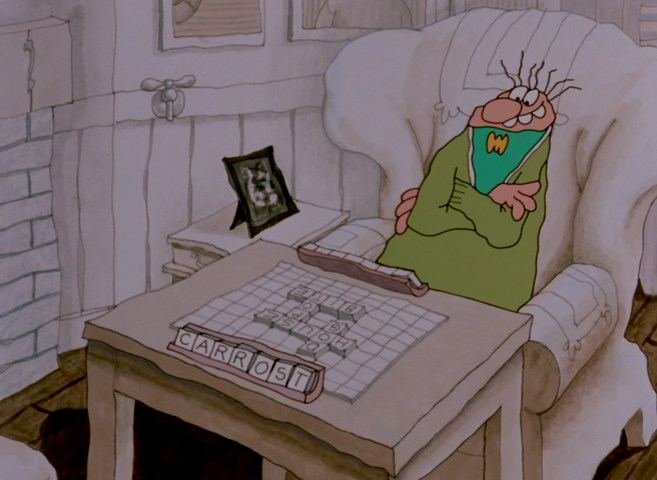
Produced by the National Film Board of Canada in 1985, The Big Snit is also a strong contender for the most celebrated animated short of all-time upon the subject of nuclear devastation, rivaled only the 1956 film A Short Vision by husband and wife team Peter and Joan Foldes.  Acclaimed upon release, it went on to win a multitude of awards, including the Hiroshima Prize at the Hiroshima International Film Festival in 1985, and was nominated for Best Animated Short Film at the 58th Academy Awards in 1986 but lost out to Børge Ring's Anna and Bella.  In addition, Matt Groening has cited the film as the inspiration for the opening scene to The Simpsons episode "Bart The Genius"; in both cases, various character quirks and relationship dynamics are established through a particularly agonising game of scrabble.

The Big Snit sees the impending threat of nuclear war played against the petty squabbles of an anonymous suburban couple who have had their momentary fill of one another's company (cleverly, the title does not make it clear to which "snit" it is referring, although as the short progresses there can be no question as to which of the two conflicts best commands our attention and emotional investment).  The wife's habit of detaching her eyeballs from her body and shaking them in order to align her pupils is irritating the snot out of her husband, who in turn has a tendency to saw compulsively at household furniture.  He's also not above a bit of foul play in his tactics on the scrabble board.  The initial tension between the couple is established entirely through understated means - awkward silences, rattling eyeballs, the futile rearranging of scrabble tiles - to the extent that we're over a minute and a half into the short before any actual dialogue is heard.  Having reached an impasse with their game of scrabble, the two decide to take a breather - the wife in order to hoover around the bathroom, and the husband to indulge in a guilty pleasure by watching his favourite show, Sawing For Teens.  By the time they return to their game, tensions have merely escalated (not helped by the husband's attempt to take a stealthy peak at his wife's scrabble tiles), with the husband finally reducing his wife to tears by making one angry accusation about her eyeball rattling habit too many.

Due to their absorption in their personal woes, and to their mishap-prone cat gnawing through the television power cord, they miss an emergency broadcast warning that a nuclear missile is headed in their direction and remain largely oblivious to the intense state of panic that has gripped the world outside (the husband becomes aware of it at one point, but can only conclude that a parade is taking place).  The manner in which the film balances the (mostly) quiet, understated world inside the house with momentary glimpses of the apocalyptic insanity unfolding beyond it is perfect, underscoring the self-contained nature of the couple's conflict and creating a sense in which the fears and concerns of the outside seem ridiculous and insignificant compared to this latest strain on their relationship.  Condie's eye for quirky details is also a delight (among the figures attempting to flee nuclear apocalypse are Santa Claus, a chicken driving a "Palace of Poultry" van and Noah with an ark full of animals).  The banality of the couple's spat is flavoured with a wonderful dash of absurdity which perfectly encapsulates the capriciousness from which everyday conflicts originate and escalate.  And yet this conflict is also treated with a degree of tension and humanity which is totally lacking in the mindless panic outside.  Our assumptions that the couple might be able to put their problems into perspective if they understood the bigger picture are completely subverted - in the build-up to the nuclear blast, the outside world is treated as little more than an intrusive distraction which the couple are fortunately able to keep at bay.  The panic from the impending catastrophe is played almost entirely for laughs - even the initial announcement has a distinctly humourous edge, what with the newscaster taking the form of a decaying skeleton, the ludicrous advice (eg: to take cover beneath a refrigerator) and the language of the warning finally merging with that of an airline announcement; gags which nevertheless underscore the overwhelming futility of the situation.

The Big Snit takes an immensely touching turn in its climax, with the husband looking to make amends with his tearful wife by playing to her on an accordion, a symbol from the early days of their relationship which serves as a wordless reaffirmation of their enduring bond.  During the accordion performance and the couple's subsequent reconciliation the commotion outside is completely tuned out, as if anything beyond it ceases to matter.  Only when the cat, apparently having had enough of being on the receiving end of so many accidents, motions to be let outside and the husband dutifully reaches for the door knob, does the chaos of the outside world finally permeate the internal world of the household, a few rumbles and an ominous white glow seen through the keyhole indicating that the nuclear missile has landed.

The ending of the short, in which the couple find a newfound enthusiasm for life (ironically after dying) and decide to return to their game of scrabble, apparently oblivious to the fact that the world has just ended, is a real tearjerker, on a par with Jim and Hilda's final fate in When The Wind Blows, although once again there couldn't be more of a contrast in terms of how the two films handle what are essentially very similar conclusions.  By the end of When The Wind Blows, Jim and Hilda are no longer blind to the reality of their situation, although neither wants to admit this to the other (particularly Jim, who struggles to maintain his façade of optimism to the finish), and as both of them retreat feebly into their paper sacks, they now seem quite resigned to the inevitable.  The nameless couple of The Big Snit, meanwhile, are ultimately impervious to any significant changes in the outside world, to the extent that they can step out into an ethereal Heaven and care only about getting back to their shared experience over a game of scrabble.  Much as the impending global catastrophe has provided little more than the backdrop to the much more pressing issue as to whether or not this couple are able to overcome a frivolous butting of heads, so too their renewed bond and devotion to one another proves so overpowering that it transcends the horror of the situation.  In that sense, it is a triumphant story about basic humanity rising above the forces of chaos and indifference that threaten to destroy it.

Like When The Wind Blows, The Big Snit focuses extensively upon a single couple in order to emphasise the individual lives affected by global affairs, and in the process reflects much upon what it is to be human, from the individual quirks and habits which can sporadically cause us to lose patience with those closest to us, to the various smaller, everyday pleasures which ultimately make life endurable when so much else lies beyond our control.  It is over an entirely frivolous game of scrabble that the occurrences causing the disagreement between the couple are set into motion, and in the same entirely frivolous game of scrabble that the couple find the promise of a new day (albeit no longer in this world), having decided that whatever minor disputes or grievances they might have are simply not worth it in the end.


Availability: Watch The Big Snit on the National Film Board of Canada's website: http://www.nfb.ca/film/big_snit/

Tuesday, 16 August 2016

Confessions of a Family Dog Viewer: "Eye on the Sparrow"


 Original air date: 7th July 1993

If you've been keeping up with my Family Dog reviews to date, then you've no doubt figured out by now that my least favourite aspect of the series has to do with its representation of the two youngest Binfords, Billy and Buffy, both of whom are highly unpleasant characters and not at all fun to watch.  The last episode, "Enemy Dog", had them both at their utmost worst - Billy as a sadistic, hyperactive brat who gets his kicks from the suffering he routinely inflicts on the dog and Buffy as a babbling, inane little terror whose shrill preschool prattlings tend to be more teeth-gritting than endearing.  It's somewhat ironic, then, that "Eye on the Sparrow", by far the most Billy-centric episode of the series, should wind up being one of its better instalments - it has a dash more heart than your typical Family Dog outing, and it's also one of the very few to attempt to do anything with Billy other than portray him as a rambunctious, one-dimensional hellraiser.  The little rotter actually gets something resembling character development here, even if the odds of it sticking in subsequent episodes are frightfully glum.  The bad news is that "Eye on the Sparrow" does take a while to get going, and we have to sit through a number of early scenes of Billy being his typically unendearing self, all while showing an increasingly callous and disturbing attitude toward the dog, as Skip and Bev sit nonchalantly back and barely lift a finger to intervene.

(Oh, and on the flip side, this episode does such a wonderful job of sidelining the other Binford child that for the most part I'm able to forget that she even exists altogether.  Buffy only appears in a very tiny handful of scenes in this one, for which I am very appreciative.)

The opening sequence is fairly effective, in showing the dog prancing around the garden and taking curious sniffs at various smaller animals (including a red sparrow, whom the shot lingers upon for long enough for us to determine that it will be of great significance later on) while gradual changes in the natural scenery indicate a transition through the seasons, the dog becoming less active and more lethargic as we shift through late autumn into winter.  The one constant throughout this sequence is the overheard bickering in the backdrop, as Billy continually butts heads with his parents over his reluctance to get off the couch and engage in any kind of strenuous physical activity outside.

The second sequence is pure filler, and follows the dog as he attempts to find a warm and comfortable resting place after being driven into the house by heavy snowfall.  Bev isn't willing to give up her armchair while her soaps are on, the heater makes incessant buzzing noises, and sleeping too close to the fireplace results in his fur getting singed; it's all quite dull.  Still, one gains an appreciation for the dreary calmness of this sequence when Billy appears and starts screaming, upset because his parents now won't allow him to play outside as a heavy blizzard has been forecast.  When he gets as far as threatening to feast on human flesh (albeit his own leg) a la the Donner Party, Bev relents and gives him a water gun in order to shut him up, although Skip foresees the inevitable disaster and questions her decision.  Meanwhile, Billy delves deep into some raucous fantasy where he's cast himself as "Mercenary Boy", hell-bent upon eliminating evil enemies "El Lardo" and "Thunder Thighs", whereupon we get this exchange between Skip and Bev:

Skip: Arghh! Alright, he shot me!
Bev: It's only water, honey.
Skip: The boy shot his father!  Do you know what that means?  Do you read the literature?

This?  This is actually a pretty well-written gag.  All credit for that.

Billy's behaviour quickly attracts ire from the rest of the family, including the dog, who does not appreciate the disturbance, so they corner him in his bedroom and gather around to watch his water gun melt on the fireplace.  This merely prompts the little brat to seek out even nastier weapons, however, and before the dog can get a decent moment's rest he finds himself being repeatedly fired upon with a pea shooter.  The harassed mutt attempts to flee but, finding himself pursued by the little wart all over the house, finally decides to resort to sneaky, underhanded tactics and tricks Billy into firing a pea at his mother (again, we see the dog exhibit some fairly advanced cognitive reasoning in this scene - not to mention some seriously exaggerated facial expressions - which really push at the boundaries of his generally non-anthropomorphic portrayal).  Predictably, Bev is none too appreciative about being hit square in the buttocks with a dried pea, so she confiscates the toy and banishes Billy to his bedroom to read a book (an activity which is incomprehensible to Billy).

Just when you thought that Billy's cruelty couldn't get any more casual, he reappears in the following scene, now armed with a slingshot and a bag of marbles, and proceeds to exact his disproportionate vengeance upon the dog.  We're getting to the point where Billy could easily do some genuinely quite appalling damage if he's not careful, so it's downright galling when Skip and Bev become aware of the situation and jadedly shrug it off as something they'd sooner not acknowledge.  I appreciate that the whole purpose here is to show Billy's recklessness getting increasingly exaggerated and out of control, so as to make the upcoming dramatic turning point all the more impacting when it arrives, but the Binfords' all-round utter indifference toward the suffering of their pet still isn't making for enjoyable viewing.

The dog flees outside into the shelter of his kennel, but is flushed out by Billy, who proceeds to stalk him wherever he tries to hide around the garden.  As the dog seeks refuge atop the porch, the red sparrow from earlier suddenly reappears and perches upon the garden fence.  Unfortunate, because Billy's blood is up and he's prepared to settle for whatever moving target he can get.  He fires one marble at the sparrow and misses, but as the sparrow tries to escape he takes a second shot and knocks it clean out of the sky (we don't actually see the moment of impact, just an image of the lifeless bird flopping ominously down behind the back of the fence as the dog looks on in horror).  Billy leaps around triumphantly, delighted to have finally taken something out with his marble-shooting blood lust.  But when he peers over the garden fence and sees the tiny sparrow lying stiffly in the snow with its legs in the air, he suddenly has a change of heart, apparently shocked by the realisation that his actions might actually have killed the bird.

This sudden change in demeanor from Billy is abrupt, startling, and perhaps not entirely convincing.  After all, it's not as if Billy had shown any prior indication, in either this episode or anywhere else in the series, that he's capable of feeling compassion toward other forms of life.  Heck, in the previous episode he was positively thrilled by the implication that his own dog might have been devoured by the Mahoneys' dog.  It's also not as if Billy hit that sparrow by accident - he knew exactly what he was doing when he fired the marble, so what did he think would happen if he hit it?  I suppose the best interpretation is that Billy has finally woken up to the fact that life is not a game and that terrible actions will often reap terrible consequences - being confronted by such a consequence may finally have knocked some sense into him.  I could buy it, although I do wish that there had been a bit more foreshadowing, even if it had been something as slight as one of his parents warning him that if he didn't take care he might end up doing something which couldn't be reversed.


As Billy runs off crying for help from Skip and Bev, the dog burrows under the fence and goes to the body of the sparrow, which he discovers is still alive, merely stunned.  As he carries the injured sparrow back to his kennel, Billy reappears with Skip and begins to panic, believing that the bird has been buried beneath the snow.  Skip tries to get him to return to the house, telling him that, if nothing else,  he might take this as an opportunity to learn a valuable lesson, namely that, "once something's gone, it's gone."  Very perceptive, Skip, although perhaps you should have attempted to impart that same lesson earlier on instead of turning a blind eye and then lecturing him after the fact.  Billy sees the sparrow in the dog's kennel, whereupon Skip makes a grim remark which merely underscores the level of negligence quite typical to the dog's daily routine - "Don't look, I don't think we fed the dog today."

Billy brings the wounded sparrow a mug of hot cocoa - which, honestly, doesn't strike me as the most sensible substance to be feeding a bird under any circumstances, but I suppose I should at least appreciate the sudden display of tenderness on Billy's part.  Billy's jerkass streak hasn't totally subsided, however; certainly not toward the dog, who is sharply commanded to get back when he begins sniffing at the cocoa.  Regardless, the cocoa appears to do the trick, because the sparrow suddenly recovers the strength to stand upright.  Billy then attempts to release the sparrow in the garden, but it still has difficulty flying, and fails to reach its nest in a nearby tree before collapsing again.  Bev and Skip call to Billy to return to the house as the blizzard is on the way, but Billy refuses to give up on the bird and leaves the garden along with the dog in order to retrieve it.  Upon finding the sparrow, Billy resolves to take it back to the house, but the dog suddenly realises that the sparrow has babies in her nest whom she was trying to get back to, and barks to get Billy to stop.  Billy's contempt for the dog is still so strong that initially he brushes it off, but finally becomes aware of the baby birds and decides to climb up the tree and get them.  This alarms the dog, who immediately starts barking.  Meanwhile, the blizzard arrives in full force and, realising that Billy still hasn't made it back to the house, Skip and Bev go outside looking for him.  They fail to notice that Buffy has also escaped from the house and, in a particularly grim (albeit clearly deliberate) display of their parental negligence, Bev steps on her daughter's snow-covered body twice without realising that anything's up.


In the meantime, Billy's tree-climbing heroics don't go so well; he merely slips down the trunk and lies in a screaming, crumpled heap as the dog tries to climb the tree and retrieve the nest in his stead.  Bev and Skip successfully locate Billy (having been pulled in his direction by the dog's barking) and debate about whether or not his leg is really broken, whereupon Billy seizes the opportunity to ask if he can stay home from school tomorrow and is angrily ordered back to the house.  Amid all this, I couldn't help but feel that the drama with the sparrow family had been completely forgotten.  Certainly, I did not see Billy pick up the red sparrow again, nor does he refer to her or her babies as his parents lead him away.  As for the dog, Skip questions his whereabouts once, but as the family head back to the house, absolutely nothing else is said about him.  Once again, it seems that the Binfords are quite happy to abandon their dog to his unhappy fate.  At least they're confronted with a brutal reminder of their negligence when they return to the house and discover a Buffy-popsicle on their doorstep.  Oh, and it turns out that Billy does have the red sparrow on him after all - he places it beside the fire and speaks tenderly to it once again, although he says nothing of the babies she's been forced to leave behind.

Thankfully, the dog manages to successfully retrieve the nest and transport the baby birds back to the house, where they're reunited with their mother beside the fireplace.  At this point, the mother sparrow suddenly regains her ability to fly as the baby sparrows discover theirs, and the entire Binford family gathers around to watch this wonderful outcome.


The red sparrow then proceeds to lead her babies in making a hasty exit from the house (yep, I certainly wouldn't want to be stuck with the Binfords for a moment longer than I had to), but Bev notices that they are heading for the sliding screen door and begins to panic.  Skip is totally clueless on what to do, so it falls upon Billy's devious ingenuity to save the day (for once) - he pulls out his slingshot and fires another marble, thus smashing a hole through the glass and enabling the birds to safely fly through.  A happy ending for the sparrows, then, although Skip and Bev are none too appreciative about the damage caused to their door and force Billy to surrender his slingshot to the fireplace.  The final moments involve the dog curling up contently beside the fireplace, using the freshly-abandoned birds' nest as a pillow.

I actually really like the ending of this episode, as it shows Billy using his destructive tendencies for a benevolent purpose and ties in pretty neatly with the earlier narrative thread about his reckless impulse for firing upon everything in sight. All in all, "Eye on the Sparrow" builds into quite a solid outing after a fairly shaky first act, although that's not to say that those latter stages are without their share of problems.  There are some weak aspects to the script - I'm not a fan of how Billy seems to completely forget about the baby sparrows after falling from the tree, or of how the Binfords as a whole show little concern for their dog when he's apparently lost out in the storm.  Make no mistake, nestled beneath this ostensible display of warmth and concern over the fate of a family of wild animals is the usual underlying story thread about the Binfords basically not giving a toss about what becomes of their own family pet. While it's nice that Billy comes to regret his casual cruelty toward the sparrow, it's not clear whether or not he's made the connection between same reckless behaviour and what he might potentially have done to the dog if he'd actually hit him with one of those marbles.  The dog also receives no thanks or credit for any of his heroic actions, be it preventing the wounded sparrow from freezing to death, helping Skip and Bev to locate Billy (Skip does talk about wanting to personally pin a medal upon the dog if he leads him to Billy, only to later abandon him in the blizzard) and actually rescuing the baby sparrows in the end when the humans have all but given up.  Still, any effort to add more than one dimension to Billy is so rare and precious that it should be cherished, and the episode does do a good job of making me genuinely care about the bird (then again, it would take a very special effort to make one not care about a tiny, wounded and innocuous animal who's only trying to make it back to her babies).

Oh yes, and while it certainly isn't my intention to keep on comparing this series to The Simpsons in every review (some comparisons are inevitable, but I'm sure that you all get the picture by now), "Eye on the Sparrow" does have a very obvious Simpsons counterpart in the Season 10 episode "Bart the Mother" (which came along a number of years after Family Dog), in which Bart kills a mother bird and decides to atone for his unpleasant actions by caring for her nest.  As these comparisons go, I'd say that the two episodes are about neck and neck - Bart's remorse and desire to take responsibility are a lot more convincing than Billy's, but that episode ultimately doesn't hold together well and disappears down a weird and rather unsettling rabbit hole in its final act.  In fact, I might even be inclined to give Family Dog the edge on this particular occasion.  Its heart's in the right place, even if it's as frustratingly blind as ever to just how bitter and twisted its basic underlying scenario truly is.

Sunday, 7 August 2016

Levi's Flat Eric (1999) - Wanted


The "I.D." ad of Levi's 1999 Sta-Prest campaign, in which Eric and Angel are able to convince a traffic cop that there's nothing unsavoury lurking beneath their wrinkle-resistant exterior, may be the best-remembered of Flat Eric's advertising career, and understandably so (in my recent coverage of the ad, I couldn't dredge up a single negative thing to say about it).  For me, however, this particular instalment, which came from the encore run of ads the characters received later that summer, will always be one which perfectly encapsulated the sleek, stylish and irresistibly bonkers spirit of the campaign.  There's not a single missed beat or wasted moment, and everything about it is so brilliantly done that I have no qualms in declaring it one of the finest ads of the 1990s.  It's blisteringly cool in ways that even one of Mr Oizo's "dirty house" tunes couldn't top.

No electro house beats feature here, just the peaceful ambience of a largely deserted-looking stop in California, as Eric and Angel survey their own wanted posters at the back of a mini mart, whereupon they whip out a couple of black markers, chew off the tops and proceed to deface one another's images.  Naturally, the folds in Angel's perfectly-pressed Sta-Prest attire have to go too - they're much too integral a component of his suave, imperturbable identity - so Eric carefully blots them out with correction fluid.  At this point, the unlikely partners in crime make a speedy getaway in their dented blue vehicle, escaping the notice of a cop who's sipping nonchalantly at the same variety of fizzy drink enjoyed by Eric in the earlier "Fly" instalment of the campaign, the sleeves of his uniform bearing the ungainly creases which mark him out as an unworthy adversary to the renegade man and puppet.

In the absence of music or dialogue, it falls upon the various little audio effects to convey a huge portion of the charm and character here, and the subtle succession of sounds made by the markers scribbling against the paper, the fluid being shaken and, of course, the spitting noises as Eric and Angel casually discard their marker tops, is entirely delightful, while the background ambience carries a muted "middle of nowhere" feeling that contrasts with the ostentatiousness of the earlier, beat-driven ads in the Flat Eric campaign.  The unspoken alliance between Eric and Angel, coupled with the slickness of their physical mannerisms, creates the perfect blend of deft style and bizarre kitsch that befits any campaign where one of the key characters is a fluffy yellow monkey-weasel on the run from the law.  In the end, it's simply a charming, laid-back story about resourcefulness, friendship and survival in the secluded cracks of society, executed with maximum flair and, of course, plenty of trust in the seductive appeal of that weird little puppet.

Saturday, 6 August 2016

Levi's Flat Eric I.D. (1999) - Escape the Crease Police

LEVI'S / FLAT ERIC I.D. from Mr OIZO / Q.DUPIEUX on Vimeo.

Following 1998's "expect the unexpected" campaign, an intensely motley collection of ads that threw up a a handful of interesting ideas but was sorely lacking in focus and ultimately dominated by the bum notes struck by the Kevin the Hamster instalment, Levi's finally figured out how to tap into the hip and youthful mindset they were desperately seeking in early 1999, with help from an unlikely plush creation with a stylish penchant for head-banging and soda-slurping.  A fuzzy yellow puppet with a physique comparable to that of Kermit The Frog, but species-wise resembling a puzzling cross between a weasel and a spider monkey, Flat Eric (so-called because an early, unused pitch for the campaign had called for his head to be flattened by a car) became one of the 20th century's last great advertising super-stars, appearing in several ads for Levi's Sta-Prest range throughout the year, as well as a hit music video.  Predictably, there was also an official Flat Eric plush, which remains a highly sought-after collector's item to this day.

Flat Eric had a precursor, a quirky-looking glove puppet named Stéphane who had been rescued from a flea market by Parisian house artist Quentin Dupieux (also known as Mr Oizo).  The two formed an alliance, with Stéphane starring in a music video directed by Dupieux to his own track, "M Seq", in 1998.  The video, along with Stéphane's characteristic charms, caught the eye of advertising agency Bartle Bogle Hegarty, who hired Dupieux to direct an initial triplet of ads for Levi's Sta-Prest campaign.  To avoid potential copyright infringements, Janet Knechtel of the Jim Henson's Creature Shop was called upon to create a new puppet for the campaign, very much in Stéphane's likeness but with minor tweaks made in order to differentiate them.  Thus, Flat Eric was born, with Bartle Borgle Hegarty favouring the name "Eric" for its international appeal.

Another essential element of the campaign, if greatly more unsung, was Eric's human co-star Angel, played by Dupieux's chum Phillipe Petit, who sported the wrinkle-resistant attire and had the task of playing the ultra-suave foil to Eric's silent eccentricities.  Indisputably though, the puppet was where all the real hipness was.  The first ad of the campaign featured Eric and Angel driving along the streets of Los Angeles, the former finger-tapping and head-banging to Mr Oizo's electro house track "Flat Beat".  Not a lot to it, but viewers went absolutely wild for the quirky puppet and dirty house beats.  Things took an even more offbeat turn in the second instalment (above), in which the two are pulled over by a police officer, forcing them to conceal their outlaw spirit behind ostensible symbols of decency and blandness (Mr Oizo is swapped for a Don Gibson tune, a picture of a female cop displaying her thighs flipped to reveal a reverse image of an innocuous pony).  The cop inspects the trunk of their car and finds a stash of immaculately pressed jeans and shirts, whereupon he allows them to go their merrily head-banging way.  The ad ends with the cop suddenly becoming incredibly self-conscious about the creases in his own clothing, which he attempts to straighten out.  Dupieux's simple but engaging approach hit all the notes that "expect the unexpected" had been previously courting - it was original, eye-catching, unsettling in the best possible ways and, of course, cool as hell.  That puppet was an outlaw in a way that made that rebellious kid from Levi's 1998 "Square Peg" ad look like a total square.

Indeed, part of Flat Eric's charm as a character was in how he combined adorable Muppet antics with a demeanor which seemed just the tinniest bit unnerving.  He was cute, sure, but there was also a distinctive oddness to him, which took a slightly sinister tone when coupled with his evident need to evade police detection.  Still, without knowing what he did, we all went nuts for the little puppet criminal.  Unlike Kevin the Deceased Hamster, he actually succeeded in making the declining denim market seem "cool" all over again, with Sta-Prest sales in the UK increasing 21 times over a four month tracking period in the wake of the campaign.  "Flat Beat" was released as a single in March 1999 and became a massive hit, with Eric fronting the music video (its success being somewhat vexing to Dupieux, who admitted that, while it worked in the context of the advert, he'd never considered it his best work).  The third and final ad in the initial series was more laid-back, lacking a music track and instead focusing upon Eric's love of soft drinks and his skills as a fly-swatter, while Angel continued to exemplify the chill, uncreasable qualities of the Sta-Prest brand.

The campaign so exceeded Levi's expectations that they brought Eric and Angel back for a further series of ads that summer, charting their continued attempts to evade the police with a brief trip to the barber shop in between.  Still, despite his immense popularity, Flat Eric's advertising career was surprisingly short-lived, with Levi's retiring him after that second burst of adverts, perhaps reluctant to run the character into the ground.  Dupieux, however, has retained the rights to the character and, having gone through a period of resenting his eternal association with the yellow weasel-monkey, has learned to embrace him all over again.  Over the past few years, we've seen Flat Eric pop up in a number of projects, most recently the video for Mr. Oizo's "Hand In The Fire".  This odd little puppet enabled the 20th century to ride out in style, and now he truly looks to have become a cult figure for the ages.

Wednesday, 3 August 2016

Levi's Square Peg (1998) - I Fought The Law


The problem with covering the "Square Peg" instalment of Levi's messy and confusing "expect the unexpected" campaign from 1998 is that it does rather obligate me to also look at the fourth and final advert in the series, "Mall", if only in the interests of having a complete set. At a later date, maybe.

"Square Peg", directed by Gore Verbinski, is probably the best executed of the quartet, in that it conveys the pro-originality message central to the campaign in a manner that manages to be fresh, witty and all kinds of cool.  Indeed, had it not been totally overshadowed by the controversy surrounding the Kevin the Hamster ad, then Levi's might have had a one-off classic with this particular instalment, in which a small child successfully defies the limitations imposed by a wooden shape sorter to the strains of Dead Kennedys' version of "I Fought The Law".  The ad takes place in an odd green room that appears to be located some kind of psychological research facility, where our plucky young hero is being closely observed by a woman struggling to maintain the illusion that she's deeply engrossed in a book instead.  From the looks of things, the kid is much too smart to fall for her act and determined not to be outwitted, either by the dumb wooden toy in front of him or the powers that be pulling the strings around him.  It's a highly novel scenario by which to illustrate the virtues of ingenuity and defiance, just alien enough to be unsettling, and likeably offbeat enough to be hip and vibrant.  There's the usual issue in that, like the majority of the ads from this campaign, it avoids directly linking its content to the product in question, but in this particular case I think that the symbolism is communicated so efficiently that it ceases to be a problem.  The ad gets by simply on being a self-contained joy.

The only thing I can't claim to be particularly fond of is that self-satisfied bit of fourth wall-breaking from the child at the end, as he celebrates his victory by leering directly at the camera.  Like the polygamist ad, the overall effect is somewhat marred by the decision to strike one particularly self-conscious note too many, and make it absolutely clear to the viewer, if they hadn't picked it up already, that this kid's rebellious spirit has served him well.  Still, it manages to bow out with a genuine sense of exhilarating triumph, and not the state of stunned disquietude which inevitably follows that hopelessly misjudged Kevin ad.