Showing posts with label crudely drawn filler material. Show all posts

Saturday, 15 May 2021

The Simpsons 138th Episode Spectacular (aka As The Weeks Went On, So Did The Cartoons)

It's been a while since I last talked about a Simpsons clip show on here. Long overdue is my coverage of the clip show that many fans (although not I) would rate as the strongest of a questionable bunch - "The Simpsons 138th Episode Spectacular" (3F31), which first aired December 3rd 1995 as part of the show's seventh season.

"138th Episode Spectacular" is a more challenging episode to analyse than "So It's Come To This: A Simpsons Clip Show" or "Another Simpsons Clip Show", thanks to the total lack of anything resembling a traditional Simpsons plot. Whatever our feelings on the artistic merit or integrity of being served up a casserole of reheated clips in place of a completely fresh narrative, its predecessors do at least offer the family the opportunity for a little personal growth and reflection amid the forced reminiscing; the recycled material is structured, however vaguely, so as to be building toward something of meaning for the Simpsons in the present. "Spectacular" eschews a framing narrative in favour of linking segments with everyone's favourite C-list fish fetishist, Troy McClure, who in a bit of reality-blurring is presenting the celebration from the Springfield Civic Auditorium. Troy, who prior to this episode had never interacted with the Simpsons in person and should logically have no idea who these people even are (although that would all change soon enough), has temporarily detached himself from the show's internal universe in order to provide to provide an external commentary. As such, this boasts the distinction of being the series' first non-canonical episode outside of the Treehouse of Horrors. It's an obvious precursor to the criminally undervalued Season 8 offering "The Simpsons Spin-Off Showcase", which uses Troy in a very similar fashion. Both episodes are characterised by a veneer of showbiz phoniness purposely designed to signal creative bankruptcy, and Troy, with his feigned enthusiasm and fixed plastic smile, provides the perfect human face for that veneer. I suspect that the unusually protracted emphasis on Troy is a huge factor in why this episode enjoys a somewhat sunnier reputation than others of its ilk. Both of Phil Hartman's recurring characters are obviously firm fan favourites and, compared to Lionel Hutz, Troy rarely got the opportunity to be involved directly in episode plots, "Spectacular" being one of only three appearances in which he was used as more than just a one-scene side character. That in itself makes it quite a rare and precious thing.

"The Simpsons 138th Episode Spectacular" was written by Jon Vitti, who was no stranger to the clip show arena, having previously penned "Another Simpsons Clip Show". In both cases, Vitti was so uneasy about having his name attached to something so discreditable that he hid behind the moniker of a certain child-eating, shape-shifting clown (this time, director David Silverman followed suit and assumed the pseudonym Pound Foolish). Vitti admits on the DVD commentary that he felt more comfortable with how this one turned out, chiefly for the fact that it advertises its magpie nature upfront, whereas "Another" opens more deceptively, like any regular Simpsons episode. Vitti also feels that "Another" hampered itself by approaching the series with a degree of reverence that "Spectacular" utterly spurns. The killer clown doth sell "Another Simpsons Clip Show" too short, methinks, although there's no denying that "Spectacular" gave the show an opportunity to be inordinately uncharitable toward itself, one of its most infamous gags being a particularly brutal one at the expense of the late Bleeding Gums Murphy, whose passing was viewed as a more serious matter in the episode in which it occurred (although in that regard he still fared better than poor Dr Marvin Monroe, who wasn't even considered important enough to receive his own exit arc). Gruellingly honest "Spectacular" may be, but it's also one of the series' fluffier pieces, and probably the fluffiest of the entire classic era. For all of its self-deprecating charms, the lack of even a perfunctory narrative does mean that "Spectacular" inevitably comes off as a shallow affair, one that's fun but offers little substance beneath the novelties (say what you will about the two previous clip shows, there were stakes in both their cases). I would suggest, however, that there is, once again, an implicit narrative being conveyed amid the collaging - it's one that I think "Spin-Off Showcase" would tackle a whole lot better later on, but "Spectacular" still makes for a perfectly respectable test run.

All three classic era clip shows, regardless of how straight the face with which they play themselves, contain a particularly pivotal line of dialogue that accentuates the unmistakably sour intentions behind the reminiscing. In "So It's Come To This: A Simpsons Clip Show", it was about attempting (perhaps in vain) to relive long lost summers. In "Another Simpsons Clip Show" it was about opening up old wounds - discovering that certain summers are perhaps better off lost. In "Spectacular", I think the ethos of the episode is best summed up in Troy's comment, "As the weeks went on, so did the cartoons" - a seemingly banal statement on the development of the Ullman shorts that encapsulates, in the tidiest of nutshells, the entire history of The Simpsons and a few of the contemporary anxieties about where it might be headed. In its predecessors, the most grudging attacks on the entire clip show exercise were reserved for the episode titles, and "Spectacular" is really no exception, the 138th episode being a conspiciously arbitrary milestone. There's nothing particularly special about that number, aside from the fact that it was, at the time, considered a big one for a show of this nature. "Hasn't this cartoon been running for an extraordinarily long amount of time?" seems to be the underlying point at the heart of "Spectacular", a question that speaks to the impressive strength and endurance of the series, but also to the eternal drudgery in having to keep the damned thing going. It was a tension that dominated much of Oakley and Weinstein's tenure as showrunners, the implicit problem one that Troy McClure would raise explicitly at the end of "Spin-Off Showcase" - how do you keep The Simpsons fresh and funny after so many years? "Spectacular" is not so much a celebration of the show's longevity as a public unmasking that openly invites us to see the cracks within the series, something perfectly encapsulated in the visual metaphor of the auditorium set, which has been done up to resemble the family's living room, and which, from certain angles, betrays intermittent glimpses of the dark, empty stage space beyond.

When I covered "So It's Come To This", I noted that the prolificness of the clip show in US television (at least back in the day) can be attributed to their conforming to the basic principles in George Ritzer's theory of McDonaldization, mainly efficiency (clip shows mean a higher episode count at lower costs) and predictability. The assumption behind clip shows is that audiences don't mind being offered the same material all over again because humans are naturally drawn to what is familiar and and will enjoy getting to relive all of their favourite gags in quick succession. In that regard, "Spectacular" is something of a boat rocker; it offers a very different clip show experience to its predecessors, in pooling from a more adventurous range of material. Only around the middle portion of the episode, when Troy answers a sampling of faux fan mail, does it settle for simply regurgitating the familiar, yielding a couple of demo reels for Homer's devolving intelligence and Smithers' closet sexuality. Elsewhere, the episode concerns itself with quite unchartered territory, extending way back beyond the usual boundaries to the series' roots and to the dark corners that had previously been concealed from public eyes. For viewers familiar only with the show in its current, stand-alone form, it was a rare (and potentially startling) opportunity to get acquainted with its origins as a series of crudely animated supporting skits on The Tracey Ullman Show - a step further back than the show, in its contemporary form, was perhaps comfortable with its memories being cast. Elsewhere, discarded footage from favourite episodes saw the light of day for the very first time (Troy's term, "Cut-out Classics", being an obvious oxymoron) and, most shockingly of all, we learned of the existence of an alternate solution to the previous summer's "Who Shot Mr Burns?" two-parter, in which Burns named a different suspect as his shooter. Unlike a more conventional clip show, its purpose is not to immerse you in the cozy glow of nostalgia, but instead to upset everything you thought you knew about The Simpsons. It is, in many respects, an anti-clip show, a clip show for people who don't like clip shows, not altogether dissimilar to the South Park episode "City on The Edge of Forever", in that it presents us with a version of The Simpsons were everything is fundamentally wrong at every turning - not least, the fictitious representation of series creator Matt Groening as a gun-toting crackpot who, unbeknownst to us, was feeding us subliminal right-wing messages in the opening sequence every week.

For me, the best of the clip shows will always be "Another Simpsons Clip Show" - I know that's not a popular opinion, but it's a hill I will nevertheless die on. It's the one that I think does the best job in illustrating the futility of retreating down memory lane and taking comfort in past adventures - adventures which, on closer inspection, have distinctly negative implications that might reverberate within the present. It is, however, of little surprise to me that "Spectacular" is the one most commonly favoured among fans. After all, it has a ton of footage that, at one time or another, you couldn't see anywhere else, almost to the point that I feel that the presence of so much novel material gives it an unfair advantage over the other clip shows. The question is, how does it hold up now, when the march of time and media have brutally chiselled away at a chunk of that novelty? 

Clip shows in general are today regarded as something of an outdated television convention - The Simpsons hasn't made one since "Gump Roast" of Season 13 - making more sense in an era when viewers would not have known if or when they would get to see their old favourites again. The increased availability of complete show inventories through DVD box sets and, more recently, streaming has somewhat robbed them of their function. In a post-DVD world, "Spectacular" is left with little advantage over its brethren - deleted scenes, alternate endings and all sorts of miscellaneous goodies that, in Troy's words, "You were never meant to see" can be easily accessed at the touch of two or three buttons. As Erik Adams notes in his review on the AV Club, the episode now has the air of a "glorified DVD extra...were it not for the extra work that went into the Troy McClure sequences, it’d be indistinguishable from a retrospective featurette whipped up for the Complete Seventh Season box set". A distinction "Spectacular" does retain is that it's still one of the very few venues in which you can legally see a selection of the Ullman shorts, although only two of these, "Good Night" and "Bathtime", are shown in their entirety. The Ullman shorts have remained a surprising obscurity across the years, although if you're really interested then uploads of those can be easily accessed online, albeit seldom in outstanding quality.

Ultimately, "Spectacular" is at its strongest when it does appear to be making some statement on the current status of the series, even if very little from the show's regular inventory is actually shown. Of all the Simpsons clip shows, this one feels the most consciously structured to comment pointedly on not only the development of the show and how far it had come, but also its imminent, possibly concurrent decline. Professor Lawrence Prince's hilariously concise observation that "Homer gets stupider every year", represented a common charge from fans on Homer's continued debasement over the years (the people expressing this concern back in 1995 did so not unreasonably, although I think that Bachman Turner Overdrive might have had apt words for them nevertheless). The selection of clips used to assess this point is somewhat lackadaisical - for Season 6, they used a clip from the "Treehouse of Horror V" segment "The Shinning", in which Homer's over the top behaviour is NOT a sign of excessive stupidity, but a well-observed parody of Jack Nicholson's scenery chewing in the role of Jack Torrance - but we nevertheless get a decent taste of how increasingly outlandish the series had gotten as it went along, starting in the relatively grounded world of "Blood Feud" and "Flaming Moe" and (discounting the Halloween clip) ending up with the plausibility stretchings of "Deep Space Homer" (put a pin in that, because it comes up elsewhere in the episode).

The episode as a whole takes us from the visual grotesqueness of "Good Night", and the show's messy birthings, to more-or-less the present day and the conceptual grotesqueness of "Who Shot Mr Burns?", an intriguing mystery that ended with the deliberately far-fetched revelation that a baby had pulled the trigger. It's important to note that the alternate scenario shown in "Spectacular"  - where Burns was wounded by his best friend Smithers - was a dummy ending created purely to keep the animators from leaking the answer, and never considered seriously as a possible solution to the mystery (I emphasise that, in part, because I find the mere suggestion of Smithers as the gunman to be profoundly upsetting). Nevertheless, we might ponder if its existence undermines the validity of the ending we were given, in illustrating just how arbitrarily things could be tweaked in another direction, or if it ends up vindicating the actual solution as the only one that makes any kind of narrative or intuitive sense. The thinly-veiled cultural reference in Troy's remark about ignoring Simpson DNA evidence aside, that actually isn't the issue with the Smithers solution - Burns still has his lollipop tussle with Maggie, so he could presumably have acquired her eyelash in much the same manner. The real issue has to do with how the gun used to shoot Burns ended up inside the Simpsons' car, which isn't accounted for in this version of events (and Smithers obviously kept the gun on him, if he still went on to shoot Jasper). But the DNA thread does, at best, get turned into rather a weak red herring, while Smithers' established alibi is casually fudged. Ultimately, though, the major selling point behind Maggie being the shooter is underlined in the flagrant ridiculousness of Burns and Smithers' relationship resuming normalcy outside of a 5% pay cut for the latter - she was one of the few characters who could do the deed and reasonably face no repercussions. There is the status quo to maintain (Marvin Monroe Memorial Hospital notwithstanding).

Of all the truly salacious tidbits on offer, I'd say that the "Cut-out Classics" hold up the least well. It's a fairly arbitrary selection of deleted scenes (if you've trawled through the extras for each season's DVD release, you'll know that they had a lot of options to choose from), with only two clips that really benefit from being recontextualised here. It is, in all cases, easy enough to deduce why they might have been cut - presumably, the writers had enough confidence in their comedic merit for them to have made it into full animation, but the majority of them are weird tangents that don't contribute anything to the overarching narrative. The deleted scene from "Krusty Gets Kancelled" is the only one that would have furthered the plot in any way, in that it contains the pivotal development promised by the title, but even then the final edit had more impact for omitting it. The excised scene from "Treehouse of Horror IV" gives Lionel Hutz more closure than he received in the version that aired, but I think the implication there - that he scarpered and had no intention of coming back - is far funnier than him returning to present Marge with an empty pizza box. Sometimes less is more.

Some of them may have been excised for slightly more complex reasons than needing to speed up the narrative flow. As per the DVD commentary, the clip from "Homer and Apu" was cut because Bollywood was deemed too esoteric a target for The Simpsons to be ribbing. The clip from "Burns' Heir" was cut because Richard Simmons was deemed too obvious a target for The Simpsons to be ribbing. And, let's face it, as delightfully unnerving as that robotic Simmons is, it would be an inanely out of character item for someone as zeitgeist-challenged as Burns to own. Whereas most of these cut-out classics I can readily swallow as once having conceivably been part of their respective episodes, there's something about that robotic Richard Simmons encounter that strikes me as intrinsically inauthentic - it's so over the top, left of field and at odds with the friction of the scene in question that it's difficult to contemplate it fitting in without the benefit of Troy's quotation marks. I am not questioning the legitimacy of the clip, but it does feel like it was always conceived to go along with a show of this nature than with its supposed mother episode. It comes across more as a parody of a deleted scene than an actual one, an alternate resolution to the stand-off between Homer and Burns that's deliberately jarring in how much sillier it is than anything leading up to it (I think there's a good reason why they saved this clip for last - it may be one of the most out-there Simpsons cut scenes, period). That the clip receives a callback at the end of the episode, when we're treated to a montage of naked Simpsons arranged to the same KC & The Sunshine Band track emitted by robot Simmons, merely reinforces the idea that the clip's natural environment was always right here amid the show at its loosest and most pointedly self-aware. And yet, it seems that one of the greatest legacies of "Spectacular" has been to permanently rewire many a viewer's perception of "Burns' Heir" - I've encountered a number of fans who report that, upon hearing Homer's challenge of "Do your worst!", they reflexively connect the dots to Burns' response in "Spectacular", and it feels jarring when Simmons doesn't appear (I won't lie, I do it myself). Something in their heads tells them that this is how the scene should play out. Which raises an interesting question - if a scene is excised, but we see it anyway, is it still a legitimate part of the episode? Does it potentially undermine the authenticity of the cut we were given? At the very least, it gives us a glimpse into what could have been (and, in the case of robotic Richard Simmons, was anyway, thanks to "Spectacular"), making the final product seem less like the definitive version, but just one of several possibilities.

The other deleted scene that I feel works a lot better here than it would have done in its original form, or even as a stand-alone DVD extra (albeit for very different reasons), is that of "Mother Simpson", an episode that would at the time still have been pretty fresh in viewers' minds, having aired only a couple of weeks prior to "Spectacular". It's also the most restrained cut-out of the bunch - no dancing robots or pornography-peddling clowns, just Homer and Mona sitting at the breakfast table, continuing their game of catch up after decades apart. Ostensibly, the punchline of the scene is in Homer assuring Mona that, despite working at a nuclear power plant, he does not, in practice, support the nuclear power industry on the grounds that he's such a lousy worker. But a far subtler gag occurs just before, when Homer references the events of "Deep Space Homer" of Season 5 and asks Mona if she was aware that, two years prior, he was blasted into space as part of a publicity-baiting mission by NASA. The pivotal beat is in Mona's casual response - "I read all about it...after all, it was national news" - which is, when all is said and done, a more passive-aggressive variation on Frank Grimes' overtly disgusted reaction on being related the exact same story a season later. In both cases, it's an acknowledgement on the show's part of how debased its own adherence to basic plausibility had become in recent seasons, with Homer the astronaut being their mutual watermark for the series at the very peak of its absurdity (although a baby gunning down an old man has got to come close). In its early years, the kinds of adventures the family were involved in were of the low-key variety that typically wouldn't extend far beyond the local papers, if they even made that. Since then, Homer has enjoyed exposure of such magnitude that even someone as supposedly out of the loop as Mona has a decent idea of what he's been doing. Such humor was a defining characteristic of the Oakley/Weinstein era, when the series was evidently building toward an existential crisis regarding its own longevity, a malaise that came to dominate a significant chunk of the atmosphere in Season 8 (see below). You can catch traces of it in Season 7, but it tended to be a bit more stealthily disguised - take Marge's pep talk to Bart and Lisa toward the end of "The Day The Violence Died", for example, the actual purpose of which was touched on a little in this entry - with Mona's line being one of the earliest, if not the earliest examples. It's probably for the best that it didn't make the final cut of "Mother Simpson" - such snarky self-deprecation would have felt out of place in one of the most sincere and heartfelt episodes of the entire series - but it's great that "Spectacular" managed to preserve that status nonetheless.

Mona's words have additional resonance in this episode, for their logical conclusion is something that Troy makes all-too explicit in his closing reflection: "Who knows what adventures they'll have between now and the time the show becomes unprofitable?" Judging by a few of the adventures the family had in Season 8, this was a question that was evidently causing the production crew a few sleepless nights (not that they were sleeping much anyway, on their work schedule). A quarter-century later, and Troy's grim prophesy has still not come to pass, but throughout Oakley and Weinstein's reign the series seemed increasing resigned to likelihood that it was nearing the end of its natural lifespan, with multiple episodes underlining the basic practicality as to what more there possibly was to do with these characters after so many years on the air. Troy's words are ostensibly optimistic, pointing to the many exciting possibilities that lie ahead, but are undercut by a stark and deliberately unsentimental reminder that everything, even a cartoon institution as formidable as The Simpsons, is ultimately mortal, and that profit has the final word on everything. But there is another implicit threat in that statement, and one that did prove far more prescient - the suggestion that the show would keep on going specifically until it became unprofitable, as opposed to bowing out because the best of its years were now behind it. With hindsight, Troy's statement wasn't a warning that the end was in sight, but that the insanity was only just beginning. You thought Homer going into space was stretching the limits? Do Bachman Turner Overdrive have words for you!

Tuesday, 29 January 2019

Crudely Drawn Filler Material: The Simpsons in "Babysitting Maggie" (May 31, 1987)


Here's something to ponder - if The Simpsons had started life as a full-fledged TV series from the beginning, rather than as a collection of shorter supporting segments on a comedy sketch show, then would Maggie still have been a part of it? That may seem like an odd question - after all, Maggie is every bit as iconic as any other member of the family, and would your typical Simpsons milieu really be the same without the sounds of her obsessive pacifier-sucking emitting from somewhere in the backdrop? But consider this - Maggie seldom gets to be more than just an orally-fixated runt supplying background noises. Episodes in which she plays a significant part in narrative progression are undeniably thin on the ground, which I suspect has to do with her being such a challenging character to build extended stories around. Maggie is a perpetual infant - that is her charm, but also her great limitation. Her non-stop pacifier cravings may supply her with her characteristic means of expression, but her need to keep the artificial teat clasped between her gums at all times also signifies an attachment to the status quo; an aversion to growth and development. All of the family are bound by some degree by the show's fundamental need to preserve the status quo, but Maggie is the one who offers by far the least scope for expansion, in that she (almost) never speaks, and she's severely limited in her ability to interact with other characters. I seem to recall that David Silverman actually said something along these lines when discussing the then-upcoming theatrical short The Longest Daycare, which gave Maggie a rare turn in the spotlight, only the quote in question now eludes me. If I remember correctly, he stated that they chose to focus on Maggie because her brand of pantomime humour is better suited to a four minute short than to a twenty-two minute episode. She's a character built for very short adventures, not longer-form narratives.

Episodes from earlier on in the series' run did make more of an effort to accommodate Maggie and her unique character traits. "Call of The Simpsons", for example, has that adorable, if rather baffling subplot which sees her getting lost in the wilderness and adopted by a family of grizzly bears. "Itchy & Scratchy & Marge" has her instigating a huge part of the narrative action with her repeated attempts to brutally injure Homer, while "A Streetcar Named Marge" gives her her own miniature arc in which she spearheads a mission to liberate a collection of confiscated pacifiers at a ridiculously authoritarian daycare. As the series went on, however, it seemed that the writers slowly started to lose interest in Maggie's place within the main family dynamic, relegating her increasingly to the same level as family pets Santa's Little Helper and Snowball II, in that she was often more of a prop than a character per se. Maggie still had her uses (most notoriously, she got to be the one to pull the trigger on Mr Burns in the series' much-publicised two-part mystery) but Season 5 onward saw her fade increasingly into the backdrop. There's a Season 11 episode, "Hello Gutter, Hello Fadder", where Homer explicitly refers to Maggie as "the forgotten Simpson", which was less a reflection of Homer's negligent parenting than an admission from the writing staff that they hadn't known what to do with her for yonks.

To ruminate on the question I posed earlier, I certainly wouldn't want any version of The Simpsons that didn't have room for Maggie. She's an ostensibly minor but very vital part of the family dynamic, with her non-verbal mannerisms providing a welcome contrast to wordiness of the rest of the clan. I love the fact that she's such a wild card and you can't often tell what she's thinking - depending on the circumstances, she can be either an oblivious innocent, a precocious whizz-kid, or even unnervingly dangerous. Maggie's the kind of character you underestimate at your own peril, as both Homer and Mr Burns can attest, and if the writing staff aren't interested in probing that amazing infant brain of hers, then that's their loss entirely.

"Babysitting Maggie" is the first Simpsons short to put Maggie at the centre, painting her as a happy-go-lucky tot who seems perpetually oblivious to the horrors of the world she inhabits - not least the cold indifference of her negligent older siblings, who have been tasked with watching her while their parents are out but, predictably, cannot pry their eyeballs away from the seduction of the chattering cyclops. At the mercy of such mean and inattentive souls, Maggie has no chance of survival, or at least she wouldn't if not for the cartoon physics holding her together. As Ullman shorts go, this is is actually one of the darker and more mean-spirited in tone, since it revolves around Maggie wandering around the house unattended and stumbling across deathtrap after deathtrap in her guileless pursuit of a butterfly. Miraculously, Maggie always survives, unshaken and unscathed, but not without enduring a ton of physical abuse that in a more realistic scenario would result in a dead baby or at the very least one with life-changing injuries. Bart and Lisa do not come across terribly well in this one, particularly Bart, who seems to have assumed the mentality of a domestic abuser, as evidenced in this exchange, where Bart produces a retort that seems more befitting of his tormentor Nelson Muntz:

Lisa: I think I heard a thud...

Bart: You'll hear another one if you don't shut your trap. 

Sure, Bart and Lisa had a much more hands-on sibling rivalry back in the day, but there's something about seeing Bart subjugate his younger sister with the threat of physical violence that just rubs me the wrong way. But then "Babysittting Maggie" is an uncomfortable short all-round. It toys with our emotions, knowing all-too well how the sight of an infant in peril arouses our protective urges, every thud Maggie makes as she tumbles down the staircase being engineered to make us wince. Maggie never seems at all hurt or fazed by her non-stop misadventures, leading up to the final punchline, where Maggie's butterfly friend flies away, prompting her to erupt in tears and Bart to dismiss her as "such a baby". An appropriately callous conclusion to a pretty cold-hearted short, I suppose (honestly, the lack of comeuppance for Bart and Lisa is really annoying). I'd note that this kind of calamity without consequence was something that The Simpsons would move increasingly away from as it developed as a concept. (Remember how big a deal it was in the Season 2 episode "Bart The Daredevil" when Homer falls down a canyon and endures some seriously gruesome looking injuries?) There's also a tendency, one maintained all throughout the Ullman shorts, for Maggie to break the fourth wall at the end of skits. She certainly does stare directly into the camera and smile at the viewer a lot, which is her way of signalling that everything is a-okay (and hinting that, despite appearances, Maggie is actually the most canny and self-aware of the Simpsons brood). This was another gag that ultimately got axed as the show settled upon a less overtly cartoony approach.

"Babysitting Maggie" was effectively remade at the end of the Ullman shorts' run as a two-part story, "Maggie In Peril", which again involved Maggie wandering into all kinds of life-threatening danger while under the care of Bart and Lisa, who fail to realise that she's even slipped her playpen. By this stage, The Simpsons had sharped both in confidence and animation quality, so the peril could be staged a lot more dramatically, and Maggie herself doesn't undergo a fraction as much of a physical beating this time around.

Finally, "Babysitting Maggie" establishes that Maggie has something of an affinity for butterflies, so might we view it as a sort of precursor to The Longest Daycare, which involves Maggie befriending a butterfly within the walls of a highly impersonal daycare centre, and protecting it from obliteration at the hands of Baby Gerald? I see it almost as coming full cycle; both shorts entail the challenges of surviving, against the odds, in a world that blatantly doesn't care less, only whereas in "Babysitting Maggie", Maggie is the one who's been left helpless and alone, by The Longest Daycare she's grown savvy enough to comprehend the bleakness of her situation, and is using the skills at her disposal to defend a being even more defenceless than she. It seems as if Maggie is moving up in the world, and figuring out what she can do to make it a marginally more bearable place.

Sunday, 20 January 2019

Crudely Drawn Filler Material: The Simpsons in "Bathtime" (March 19, 1989)


One of the earliest underlying gags of the Ullman shorts (and one which inevitably lost its bite as the animation gradually became tidier and the inherent grotesqueness of Groening's character designs, with their bulging eyeballs and gaping overbites, became softer, even familiar) was that the Simpson family were such a feral, vulgar and primordial-looking bunch that any attempt at civilised behaviour on their part came across as basically gestural, a thin veneer of respectability that was always threatening to crack at any moment. Even their perfunctory efforts at personal grooming play like exercises in futility, feeble attempts to scrub off the messiness of day-to-day living so deeply ingrained in their curtains and carpet fibres that they become thoroughly encrusted the instant they emerge from their bathroom (this is a gag played to very on-the-nose degrees in the Season 1 episode "Some Enchanted Evening", in which Homer shaves his five o'clock shadow only for it grow back almost instantly). To that end, it should come as no real shock to us to learn that Bart would sooner not make the effort at all.

Even if you haven't plundered the full catalogue of Ullman shorts in extensive depth, odds are that you know "Bathtime", which is the only Ullman short other than "Good Night" to be featured in its entirety in the Season 7 episode "The Simpsons 138th Episode Spectacular", and is most notable for Bart's affectionate impersonation of marine documentarist Jacques-Yves Cousteau. This nod to Cousteau feels, on the one hand, like an expression of nostalgia for the documentaries of yore, playfully contrasting Bart's bathtime experience with the eerie undersea voyages through unchartered realms that seem more like ghostly, half-remembered dreams when stacked up against the banalities of modern domestic living. On another level, it taps into that strange sensation one gets, when watching early Simpsons, that we are observing our own lifestyle and behaviours superficially represented as the behaviours of another species altogether. At their heart, the Ullman shorts are a celebration of the human animal, and how that animal has continued to thrive as we have ventured ever further down the path of domesticity. The early shorts in particular give such a loving focus to the cruder aspects of the human condition that they almost play like a collection of miniature mockumentaries upon the survival of the human animal in its new natural habitat; the perpetual caveman who managed to adapt to the modern world by putting on a shirt and pants and wiring up a TV.

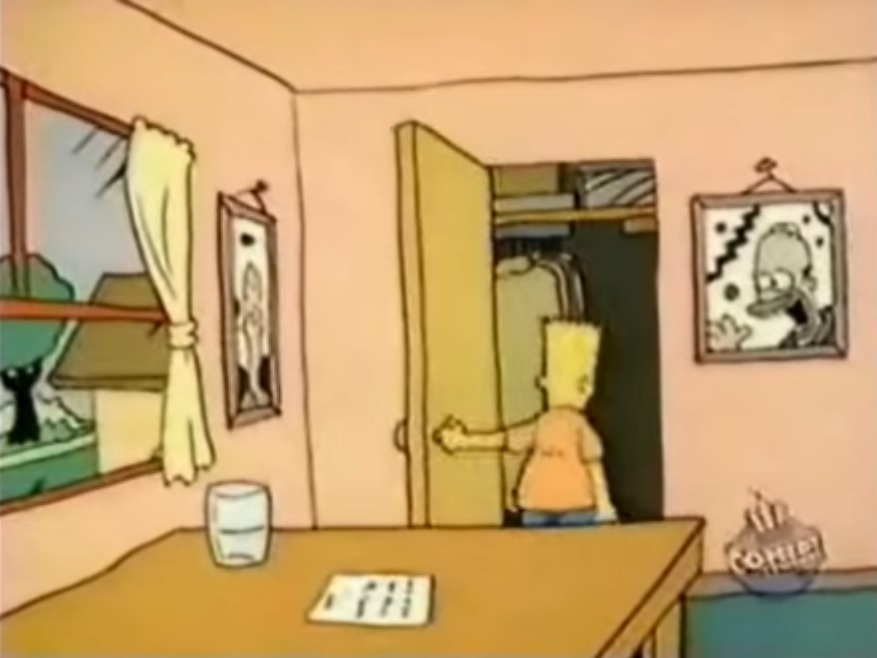
"Bathtime" opens with the now-familiar scenario of Bart trying to hide himself away from parental authority - this time, the looming threat comes in the form of his Sunday night bath, which Bart is determined to avoid. Having apparently not learned anything from his experience in "Closeted" (or, being so averse to the prospect of bathing that he's prepared to take the risk of being made to repeat the ordeal), Bart conceals himself in his bedroom closet in the hopes that Homer won't flush him out. On this occasion his own uncouth body fails him, for an ill-timed belch alerts Homer to his whereabouts, and he ends up being unceremoniously hauled down the corridor in the buff and tossed into the bath. There's a pretty nice perspective shot in which we see Homer searching for, and finally closing in on Bart through the closet keyhole, although some eye-poppingly weird animation also worms its way in, as usual, with Homer making some odd St. Vitus Dance hand gestures right after dumping Bart in the bath. Bart's objections to being subjected to this weekly cleansing ritual appear to stem at least partly from Homer's tendency to run the water ridiculously cold, but Bart copes with the situation by running the hot tap and escaping into fantasy, in which he envisions himself as the deep sea adventurer in his own version of The Undersea World of Jacques Cousteau, wittily (and haphazardly) transforming the domestic sphere into an undersea wilderness (which of course becomes all-too real when he neglects to turn the tap off).

Bart's daddy issues rear their head yet again when his search for the wily and elusive washcloth is interrupted by the appearance of an octopus-shaped bath toy that bears more than a passing resemblance to Homer, and he is compelled to tussle with it. The Homer-opus makes for a charming sight gag, one that's reinforced when Homer opens the bathroom door and is knocked down by the bathwater deluge, and he and the toy are shown side-by-side in the aftermath. This linking of Homer and deep sea beast also foreshadows the punchline of the short, in which the line separating refinement from barbarity is shown to be far thinner in Homer's case than that of his belching, bath-avoiding son. Bart comes out of the ordeal "clean as a whistle", a fact he is happy to flaunt before Homer, but Homer's final response is to cast aside all aspirations of civility and embrace savagery, as he chases after Bart in one of his overpowering gorilla-like rages. Bart won't stay clean for long.

Strange Picture Watch: We see portraits of Marge and an unidentified sea captain, which ties in with the nautical theme. Also, for some reason the Simpsons appear to have a framed picture depicting a boot with a bare hairy leg sticking out of it. If there's any deeper subliminal symbolism to be mined there, then don't ask me to decode it.

Sunday, 30 December 2018

Crudely Drawn Filler Material: The Simpsons in "Closeted" (February 21, 1988)


"Closeted" is yet another Ullman short examining Bart's inbuilt aversion toward adult authority. This one, however, has the added twist that neither Simpsons parent appears directly in the short, but their presence is felt extensively, and uncomfortably, throughout thanks to the array of background art adorning the household walls. Bart hears Homer calling him and, assuming that he's being summoned for some spirit-crushing chores, runs off to find a convenient foxhole in which to lie low until the coast is clear. Except there's a running gag that, no matter where Bart runs, he is perpetually confronted by Homer and Marge's disapproving gaze, perfectly encapsulated in the series of static framed images positioned at every turning of the Simpsons' house. It's actually hilarious just how consistently, aggressively stern Homer and Marge appear in these pictures, to the point where you're compelled to question why anyone would want to plaster images of themselves scowling all up and down their corridors. Obviously, one way to read it is that they're manifestations of Bart's guilty conscience. But they also hark back to the slightly more surreal tone of the earlier Ullman shorts, which incorporated a number of bizarre background gags to reward the eagle-eyed - not least, the artwork in the Simpsons' house would exhibit an uncanny life all of their own and tell some surprisingly macabre tales.

The Simpsons lived in a stranger universe in those days, but this extensive collection of furious Homer and Marge imagery also ties in with the uneasy underlying feeling that pervades "Closeted", in which Bart is effectively treated as a pariah by his family. "Closeted" is an oddly disturbing Ullman short, not so much for the sense it conveys of an omnipresent parental disapproval, but rather its overwhelming sense of cosmic mockery; the feeling that if we step out of line or play loose with the rules, the universe and our loved ones alike will take only too much pleasure in turning on us. When Bart becomes trapped in the closet, his family do not help him in his hour of need, possibly as a deliberate means of punishing him for attempting to shirk his domestic responsibilities (although it would be a mite unfair to pick on Bart when Lisa pulls the exact same stunt). Only Maggie responds to Bart's pleas for help from inside the closet, and her ultimate reaction is to turn Bart's self-serving indolence back on him, when Bart naively implores Maggie to do what he would do if he was in her situation, whereupon she retreats to the living room and gives the television her undivided attention.


Bart pays a heavy price for his lack of responsibility. Not only does he have to endure the discomfort of being trapped in a dark closet, but by the time he gets the door loose again, having realised that the sensible thing would just to be to knuckle down and do his chores, it transpires that those prospective menial tasks were all just a false alarm anyway. Bart discovers that Homer has left him a note, informing him that the family have gone out for Frosty Chocolate Milkshakes and that he's sorry he was unable to find Bart. Bart looks out the window just in time to catch sight of his family driving away for the promised treats, and for his gaze to make contact with Maggie's as she peers at him tauntingly from the back of the car. Despite Maggie's obvious awareness, there is nothing to indicate that the family's abandonment of Bart was done out of spite, or as a knowing reaction to his sneaky attempt to avoid doing chores. Perhaps it is merely a case of fate dealing Bart a bum hand on this occasion. And yet, the adjacent pictures once again add their own layers of meaning to the ending.

On the left-hand side of the above shot, there is a picture of an unidentified individual whom I initially assumed to be some Simpsons relative we've never met (possibly one of those great uncles Homer will occasionally bring up whenever he has an inheritance to claim). On closer inspection, I was struck by how much of a resemblance he bears to the excessively shaven Bart in the short "Bart's Haircut", which had aired earlier on in The Tracey Ullman Show's second season, and was later referenced in the hit single, "Deep, Deep Trouble". In this short, Bart has his trademark spikes lopped off by an incompetent barber and returns home to face no shortage of ridicule from his schadenfreude-indulgent family (between "Bart's Haircut" and "Closeted", you get the sense that the rest of the Simpsons clan really loves to show Bart up). Thus, Bart's desolation at the end of "Closeted" is accompanied by a snapshot of himself at his most brutally humiliated. In the final shot, we see that to Bart's right, overlooking both Bart himself and the shaven Bart image, there is a picture of a troublingly jubilant Homer that stands in startling contrast to the considerably meaner-looking Homer and Marge images that have dominated the mise-en-scene up until now. Ultimately, it is adult authority that has the last laugh, as Bart slinks dejectedly past the leering eyes of his silently derisive father and conceals himself back inside the closet, having decided that he prefers the dark embrace of confinement to the smirking callousness of the world beyond.

Sunday, 16 December 2018

Crudely Drawn Filler Material: The Simpsons in "Simpson Christmas" (December 18, 1988)


The Simpsons famously got their start as a standalone series with a Christmas episode, "Simpsons Roasting on an Open Fire" (which was actually the eighth episode production-wise, and moving it to the front of the queue created a few mild continuity issues - notably, Homer is already the power plant's safety inspector, a job he wasn't assigned until the third episode, "Homer's Odyssey"). Prior to that, however, the family had already had one festive venture, "Simpson Christmas", as part of their last season on The Tracey Ullman Show, which gave us a glimpse into a typical yuletide within the Simpsons household. The series proper has possibly conditioned you into supposing that a "typical" Simpsons yuletide involves Homer having to moonlight as a department store Santa, Bart burning down the Christmas tree or the town being invaded by ungodly Furby knock-offs, but compared to subsequent Xmas-themed Simpsons adventures, "Simpson Christmas" is a relatively uneventful affair. Here, the family don't do anything that most families probably don't do upon the big day. The kids get a little rebellious, the adults get their patience tried, it all ends with the lot of them zoned out in unison upon the couch before the soporific holiday scheduling (Itchy and Scratchy make an appearance but look to be in an unusually peaceful mood). This is the kind of nice, quiet, everyday Christmas that the family were permitted to have before they had a full twenty-two minutes to support.

The short consists of Bart reciting a heavily modified version of "The Night Before Christmas" by Clement Clarke Moore (maybe...authorship of this much-loved poem is disputed), as he describes how his attempt to get in a stealthy preview of his presents in the early hours of Christmas morn was thwarted by Homer's vigilance and aggressive temperament. Homer's hot-blooded parenting provides the most disturbing element of an otherwise fairly laid-back Simpsons outing - there is something appealingly off-kilter about the rhyming of Bart's declaration that his present is "rad, man" with his apt description of Homer's shadow looking like a madman, and Homer subsequently ordering his children back to bed before he kills them all. (Note: Homer actually gets his daughters mixed up, for he belts out the wrong names while pointing at each child individually. We also get a rare example of him calling Bart "Bartholomew" for the sake of a rhyme).

"Simpsons Christmas" is obviously a very materialistic celebration of the holiday, pivoting on the fact that those kids simply can't wait to get under the tree and making mincemeat of the wrapping paper concealing their presents, but such is the allure of the festive season when you're a child. Speaking as someone who grew up to have a very Ginny Grainger-esque view on Christmas, I find this short to be a very honest, even borderline poignant window into my faded youth, when Christmas meant being physically unable to remain still for the sheer excitement of what was to come. I could shed a tear through it, even as Homer dishes out the empty death threats.

Two minor notes - firstly, Binky and Bongo, the rabbits from Life in Hell, make a cameo in plush doll form. Secondly, I don't know why but I love the generic dance music playing during Lisa and Maggie's dancing candy bar vision. It sounds for all the world like they just threw in the first piece of library music they happened to pluck from their archives - not in the slightest bit festive-sounding, but damn, that is some sweet dreamin'.

Friday, 30 November 2018

Crudely Drawn Filler Material: The Simpsons in "Bart's Nightmare" (March 26, 1989)


(Not to be confused with the licensed video game Bart's Nightmare that was released for SNES and Sega Genesis in 1992.)

I get the impression, from watching these Ullman shorts, that Groening pilfered an awful lot of cookies in his youth and developed something of a guilt complex, for it's a theme to which they seem to keep returning time and time again. (In that piece he wrote on Dennis The Menace and the failure of the 1959 series to live up to his childhood expectations for an issue of the Simpsons comics - sorry, I forget which issue precisely - I seem to recall Groening specifically stating that he wanted a show about "a kid who stole cookies. A kid I could relate to.") "Bart's Nightmare" was the last in a trilogy of shorts examining Bart's compulsion to illicitly pocket and devour any cookies he came across, following on from "The Perfect Crime" and "Shell Game", both of which concluded with Bart's nefarious antics being foiled by super sleuth Maggie. "Bart's Nightmare" provides our epic finale, in which Bart's lust for sugar rebounds on him by dragging him into the deepest, darkest pits of despair and self-loathing. I do not recall cookie-stealing being a behaviour that Bart exhibited much in the series proper, so I can only assume that Bart (or, more accurately, Groening) had it all out of his system from here.

In "Bart's Nightmare" we join our intrepid anti-hero in the aftermath of a particularly bountiful cookie raid. Bart has already gorged himself into a bloated stupor, and his sugar-addled brain is about to take him on a twisted journey down a strangely familiar rabbit hole. This is one of the more interesting Ullman shorts, visually speaking - there's a sequence where Bart is transported through a Twilight Zone-esque vortex and chastised by each member of his family in turn (as with "The Money Jar", it is the withering, accusatory gaze of Maggie that proves the most damning rebuke of all), but more resonant still is the following sequence in which Bart finds himself shrunken down and dropped into his family's kitchen, gazing up at a cookie jar that's several times larger than him. The metaphor is obvious - Bart's cookie cravings have swollen to the extent that they now threaten to overwhelm and consume him. The scenario takes a particularly terrifying turn when Bart breaks the jar and Homer is summoned into view as a dark, hulking figure advancing slowly on Bart, who has no recourse but to cower and scream, "I didn't do it!" over and over in desperation ("I didn't do it" is, of course, a phrase that would gain added significance for Bart later in life). Those with a more comprehensive knowledge of Groening's cartooning career might recognise this The Simpsons' tip of the hat to his comic strip Life in Hell, more specifically the recurring "Shadow Rabbit" running gag, in which the silhouette of adult rabbit Binky looms threateningly over his one-eared son Bongo, who has been caught in the immediate aftermath of some kind of misdemeanor, incriminatory evidence fresh at hand, and makes a feeble attempt to bluff his way out of what is blatantly an inescapable situation.


The "Shadow Rabbit" comics are a riot, but they might also be the most authentically nightmarish concept ever to have sprung from any of Groening's creations (not being a Netflix subscriber I haven't seen Disenchantment, but absolutely no one I've heard discussing the series has been talking about how scary/disturbing it is). Ordinarily, Binky is not a particularly threatening character, but here he becomes an absolute leviathan, his blackened, imposing form encapsulating everything that young children instinctively fear about adult authority. Periodically, Groening would use the gag to lampoon the ineffectual attempts of contemporary politicians to cover their hides following some humiliating fumble (the most famous example being a panel in which Bongo is squeaking out, "Mistakes were made"), but at its most effective it functions as a painful window into the raw childhood terror of being caught out and having nowhere to run - the chilling split-second between exposure and the moment when the axe comes crashing down - the high walls in the backdrop emphasising Binky's magnitude but also Bongo's immense sense of entrapment and desperation. The "Shadow Rabbit" panels are so diabolically concocted as to make one feel physical discomfort just glancing at them, and that, of course, what makes them so weirdly alluring.

The real horror of "Bart's Nightmare", for Bart, lies in the discovery that he is effectively his own worst enemy; when he finds himself in the oversized kitchen and spies the giant cookie jar above him, his visceral reaction clearly goes against everything he understands to be smart and sensible. We saw in "The Money Jar" that Bart is bad at making moral decisions because his id and super ego operate on exactly the same page, but here he's already learned by bitter experience just what a detrimental effect his cravings are having upon him. It becomes a battle of common sense versus force of habit, with the result that Bart winds up screaming at his own body as it betrays him and makes a beeline for the sugar-laden treats. He finds himself entrapped twice over, not merely by Homer's monstrous shadow but by his own insatiable compulsions as they take a hold and pull the strings on his every movement. The short ends in full Wizard of Oz fashion, with Bart awakening to find his family gathered around him, alerted by his fuddled murmurs for clemency. "I didn't do it!", of course, becomes Bart's analogue for Dorothy's "No place like home", as the mantra that enables him to reject his troubled fantasy life and find his way back to reality. Unlike Dorothy, however, Bart finds no refuge in the staid embrace of reality. His family have apparently not twigged that Bart was responsible for their supply of cookies disappearing (this presents a mild continuity problem, as Bart fell asleep with cookie crumbs all around him), for Homer makes a sincere attempt to pacify Bart by offering him the last remaining cookie. Confronted with this symbol of his own gluttony, and his of subjugation to his own biological stirrings, Bart realises, to his wide-eyed distress, that the nightmare has not dissipated, but could potentially haunt him for many impulse-driven cookie jar raids and binges to come. And he's sworn off the damned things ever since (or at least, seems less prone to swiping them).

The Simpsons would pay homage to the "Shadow Rabbit" series once again in the music video to "Do The Bartman" in 1991, during the portion of the song where Bart speaks of putting mothballs in the beef stew (yeah, well, who does that? There's a whimsical jape and there's just plain stupidity, Bart). Here, both Homer and Marge get to play the role of Binky.


Oh, and one more random observation - at the start of the short, as we find Bart stretched out in his bedroom with a severely stuffed gut, we pan past a signed photo of Krusty The Clown (Krusty having made his debut earlier in this season of The Tracey Ullman Show), in which his name is actually misspelled as "Crusty". Oh well, we'd be finding out that he's illiterate shortly enough, I suppose. Then again, we all know that Krusty delegates menial tasks like signing autographs to some unfortunate personal assistant. What's their excuse, I wonder?

Sunday, 25 November 2018

Crudely Drawn Filler Material: The Simpsons in "The Money Jar" (March 20, 1988)


I touched on this last time, but whenever people talk about the Simpson family's characterisation during their initial run as supporting bumpers in The Tracey Ullman Show, it's often stated that all of the family were basically the same except for Lisa, who was initially nothing more than a female version of Bart. I would dispute that to a point (for one thing, Homer wasn't quite the same character in the Ullman shorts either), although it's certainly the case that Lisa received very little character development over the course of the 48 original shorts. Back then, Bart was very much the dominant Simpson, and Lisa didn't have much of a purpose outside of being her brother's foil. The two siblings were either mutually bratty rivals or partners in getting their parents' hackles up. Lisa was as prone to misbehaving as her brother, and would occasionally spout dialogue that seems egregiously out of character for her now (the most obvious example occurring in the twenty-fourth short, "The Aquarium", where the ardent animal lover apparently advocates seeing captive marine life pitted against one another in fights to the death).

Lisa was named after one of Groening's own family (as were all of the Simpsons, sans Bart), but it's clear that Groening had no real vision for Lisa at the start. Right off the bat, he knew what kind of character he wanted Bart to be. Groening has cited two key inspirations for Bart - firstly, Eddie Haskell, the trouble-making teen portrayed by Ken Osmond in 1950s sitcom Leave It To Beaver, whom Groening as a child had desperately wished could be the main character of the show, and secondly, Groening's childhood disenchantment with the 1959 series Dennis the Menace, which failed spectacularly to satisfy the young Matt's longing for a series centred upon the kind of rabble-rousing kid he could relate to. With The Simpsons, Groening finally had the chance to make the cartoon of his dreams, and dammit, Bart was going to be the rebellious protagonist he always wanted but was repeatedly denied throughout his own childhood. Groening was clearly less interested in Lisa, who had "Middle Child" as her sole defining character trait during the initial production stages; in her autobiography My Life as A Ten Year Old Boy, Nancy Cartwright recounts how she was originally invited to audition for Lisa but gravitated toward Bart when she realised that Lisa offered nothing for her to work with (Yeardley Smith, meanwhile, was originally invited to audition for Bart, but got the gig as Lisa when she couldn't make her voice sound masculine enough).

I'll profess to having a great fondness for Lisa, who is my personal favourite out of the Simpsons clan (although I do think that Marge is a really great and underrated character, and she certainly merits her own appreciation post some time in the future). At what point did she go from being an ill-defined middle child to one of television's most celebrated and admired young intellectuals? I've previously observed that the major turning point in defining Lisa's character and making her feel wholly distinct from Bart came when they placed a saxophone in her hands and had her wail out the Moaning Lisa blues. That woodwind instrument, and the startling boldness with which Lisa played it, suggested so much about her character that had previously gone untouched upon. She was passionate, soulful, melancholic and a little misunderstood. She had a wisdom and a gusto that were beyond her years. She became a torchbearer for introverted kids the world over who preferred to keep their noses in books and felt perpetually as if they didn't fit in. For me, one of the most heartbreakingly relatable things Lisa has ever said occurs in the Season 2 episode, "Dancin' Homer" (an episode I otherwise find quite nondescript by Season 2 standards), when the family are about to make their ill-fated move to Capital City and Lisa remarks to a group of her peers, "I can't help but feel if we had gotten to know each other better, my leaving would actually have meant something." I don't think there's been a statement that's encapsulated my own childhood social life so succinctly. Sideshow Bob may be the Simpsons character for whom I feel the greatest affinity, but Lisa is the one who most deftly holds a mirror up to my own innermost malaise.

The saxophone may have given Lisa her much-needed boost in terms of branching off and securing her own personality, but one could argue that the really critical turning point occurred in the Ullman short "The Money Jar", a short which went some way toward proving that, even in the Ullman days, Lisa was slightly more than just a carbon copy of her brother. Here, Lisa demonstrates that she has enough of a moral compass to resist the heinous crime of stealing from her parents' money jar when Marge has expressly told her not to, a test which Bart predictably fails. At the start of the short, Bart and Lisa request an increase in their allowance, which Marge staunchly refuses. She then goes out and warns her children not to get any ideas about raiding the money jar in the kitchen - somewhat bizarrely, as neither child had mentioned the jar up until now, meaning that Marge is effectively tipping her children off as to where they can fill up their pockets with ill-gotten change, but perhaps it all makes sense in light of the eventual punchline. Lisa is the first to get lured by the temptations of the money jar (there's a pretty inventive shot in which we approach the jar from Lisa's perspective) but before she can dip her hand in is seized by a sudden, revelatory moment of enlightenment. "I wonder if this is wrong?" she asks. And that was it. The real Lisa was born, and The Simpsons would never be quite the same again.

Lisa may have developed a sense of moral awareness in time to avoid betraying her mother, but not to evade the accusing eyes of her younger sister, who is watching her from the kitchen doorway. Lisa retreats in shame, at which point Maggie is gripped by a momentary avaricious craving of her own, and...you know what, I don't get why Maggie would be tempted to steal money from the jar in the first place. I get that they're looking to establish a clear pattern here, so that it'll be even funnier when Bart caves in to his basest desires, but still, she's only a baby and as such has about as much use for money as does Snowball the cat.

Maggie resists, but surely none but the most naive viewers were holding out any hope that Bart would follow suit. Bart reveals himself to be completely amoral, as demonstrated when his shoulder angel appears, not to appeal to his sense of decency but to give him that final push into degeneracy. Bart raises the lid and discovers that his parents' private stash consists of one measly dollar, prompting him to groan and deliver the short's ironic punchline, "You can't even trust your own mother." Indeed. Either Marge is very protective of that single dollar, or she just trolled her son, knowing full well that he wouldn't be able to resist the temptation to steal from the jar if the idea were planted in his head. Marge, you wily old trickster. I come away thinking that Lisa wasn't the only one to get a healthy dose of character development in this adventure.

Saturday, 24 November 2018

Crudely Drawn Filler Material: The Simpsons in "Family Therapy" (April 23, 1989)


Less than a year before they landed their own series and gave Dr Marvin Monroe an electrifying taste of his limits as a family counselor, the Simpsons had an encounter with another unfortunate therapist in one of their last ever outings on The Tracey Ullman Show, with much the same results. "Family Therapy" plays like a proto "There's No Disgrace Like Home", only here, in lieu of smiting his family by pawning the beloved television set, Homer has lured them to counselor's office with the false promise of Frosty Chocolate Milkshakes (remember when those were a staple of The Simpsons universe)? Tensions within the family have clearly reached a breaking point but, as with "No Disgrace", the Simpsons rediscover their sense of family unity through the joys of redirecting their internal anguishes at an unsuspecting stranger. Like "No Disgrace", there is also the suggestion that Homer's brutish discipline tactics are the root cause of the family's dysfunctionality.

"Family Therapy" is an unsettling Simpsons short for multiple reasons:

  • Homer's head disappears at multiple points throughout the short (see above). Pay close attention during any shot where Bart is raiding the mint bowl and you'll notice that Homer becomes momentarily decapitated. Freaky.
  • Bart eats too many piss-mints and regurgitates them back into the bowl. This, needless to say, makes for a thoroughly revolting visual gag, albeit not quite as vile as Homer's fishbait sarnie in "Gone Fishin".
  • Lisa kicks the therapist in the shins and gets called a "borderline psychotic" for her troubles. Yes, you read that correctly, and you'd do well to remember that Lisa was quite the angry young punk back in her earliest incarnation. Overwhelmingly, the Ullman shorts tended to focus on Bart and his relationship with Homer, and Lisa didn't really get a whole lot of character development in all of that - her primary function was either to butt heads with Bart or to back him up as another rowdy urchin out to undermine adult authority in all its guises. She did come off as the more intelligent of the two older siblings (albeit not in an intellectual sense) and there was the occasional hint that she was more morally-grounded than Bart, but it wasn't until Season 1 of the series proper that the writers actually took the time to establish who Lisa was. The decision to give Lisa a saxophone seems to be the major turning point in terms of defining her character - her passion for blues music paved the way her more artistic, melancholic personality, and the incongruous sight of an eight-year-old girl wailing tirelessly through such an unwieldy instrument revealed her as a powerhouse with hidden depths. In her pre-saxophone days, however, Lisa's only means of self-expression was to violently gnash her teeth and pound innocent strangers in the shins. I think there's a lesson here about the value of encouraging creativity in children.

This therapist, B.F. Sherwood, is less odious than Dr Marvin Monroe, so you do kind of feel sympathy for him in having to deal with the Simpsons' primordial antics (note: his name is an obvious nod to behavioral psychologist B.F. Skinner, who is famous for his operant conditioning studies on rats and pigeons and is sometimes erroneously thought to have raised his own daughter in a laboratory apparatus - the Simpsons crew clearly have a fascination with Skinner, for they also named series regular Principal Seymour Skinner after him). What's really noteworthy about the character is the vague resemblance he bears to Homer, which may or may not be intentional - he's got Homer's trademark five o'clock shadow, but then it's hard to distinguish between what's a meaningful nod and what's yet another of Matt Groening's generic early character designs. Still, it makes sense in context for him to be another of Homer's doppelgangers. One of the running gags emerging throughout the Ullman shorts, which never really took off in the series proper, was that the Simpsons lived in a universe that was populated by Homers. There are still remnants of this in the series itself. Krusty the Clown, one of the few non-family characters to be introduced in the Ullman shorts, was deliberately designed to look like Homer in clown makeup (a fact that was never exploited or even acknowledged in the series until "Homie The Clown" of Season 6). Similarly, Bart's favourite comic book hero, Radioactive Man, looked like a buffer Homer in superhero garb. The underlying gag was that Bart had a propensity for idolising people in his father's image, unbeknownst to himself. Sherwood could pass for a slimmer, more successful version of Homer (in other words, he's a precursor to Herb Powell). Ostensibly, he's the voice of calm and reason, but it only takes a bit of capering from the Simpsons children to blow that facade and reveal the simian rage lurking underneath. And yet, Sherwood's most withering comment comes when he calls Homer out for his own failings as a parent: "Now you gonna bully me like you bully your kids?" In reaching out into the outside world and finding it filled with like-minded souls, Homer discovers not solidarity, but self-loathing, his every indiscretion reflected back at him in the accusatory glare of his mirror image. Sherwood sees through Homer, because underneath he's a Homer himself. Still, he redresses the problem that the family came to him for, namely that they don't know how to laugh any more. The Simpsons may have grown weary of one another, but finding themselves mutually cast out by authority, they find reaffirmation in each other's company; more importantly, in their shared understanding that the greatest pleasures in life are to be found in exposing the dysfunctionality that underpins every corner of upright society. The wider world rejects them, not because it's above them, but because it's every bit as prone to the same eccentricities, and truly, that is something from which to hone validation.

Monday, 19 November 2018

Crudely Drawn Filler Material: The Simpsons in "Watching TV" (aka The Chattering Cyclops vs Wilson Bryan Key)


If the original Simpsons short that aired on April 19 1987 was all about establishing America's soon-to-be favourite family as a grotesque, if recognisably human subversion of traditional family values, then the second short, which aired on May 3 1987, cut directly to one of the concerns at the heart of their endearing dysfunctionality - namely, just how mutually besotted the family was with the blinkering light box at the forefront of their living room. "Watching TV" saw the genesis of a preoccupation that was to remain prevalent for a significant chunk of the series proper, and which would appear to bear out an argument presented by Wilson Bryan Key in his 1973 pop-psycho classic Subliminal Seduction - that the television set had become such a revered and omnipotent component of family life that it was practically a member of the family now. The TV, which Key identifies as "the one-eyed monster resident in every well-furnished living room", is clearly posited as the authority to which each individual Simpson will ultimately answer. Bart and Lisa time their petty squabbles in order to coincide with commercial breaks; Homer waxes poetic about the joys of family togetherness but obligingly submits when the box is talking. Throughout all of this, the TV screen throbs and pulsates with the sickening energy of a radioactive mutant. Just a typical night within the Simpsons' walls.

At its heart, The Simpsons has always been about the banality of television, and how slavishly our lives revolve around the chattering cyclops, right down to the show's opening sequence, in which the individual family members are depicted rushing home in order to amass before it on the couch (what are we to make of that, exactly? Is the implication that they are rushing home to watch themselves upon the box?). As viewers, our own relationship with the family's tube addiction is two-fold - we recognise the vapidity of their non-stop TV consumption while equally acknowledging the mirror they hold up to our own media-watching habits (after all, are we ourselves not participating in the same activity as these bug-eyed neon demons at this very point in time?). Writes Key: "Television is a major consideration as to when the family goes to bed (after the 11:00pm news), when the family goes to the toilet or engages in conversation (during commercials), when the family eats meals or snacks, what family activities will be on weekends (relative to games, program schedules, and sports seasons), when parents do or do not have sex (who wouldn't be tired after a night's hard work in front of the tube's window, pushing beer and potato chips down one's throat?)" (p.66)

Before we go any further, there is something I should probably clear up - yes, this is the same Wilson Bryan Key who wrote a series of books between 1973 and 1989 proposing that advertisers insert all manner of phallic and vaginal imagery into their campaigns in order to exploit our subconscious sexual desires and convert them into cravings for gin and designer jeans. Because deep down, you're a sexually frustrated dupe who can be aroused by strategically arranged images of ice cubes, and advertisers know exactly how to manipulate that Achilles heel to their own commercial ends. Nowadays, it's tough to encounter anyone who'll take Key's arguments particularly seriously, his body of work having been regulated largely to the slag heap of dubious 1970s pop psychology. Does this make Subliminal Seduction and its sequels any less obligatory reading? Of course not. Dubious or not, they're still entertaining as hell. If nothing else, Key taught me to look at the world a little more closely and to see the hidden smut in everything, and for that much I salute him.

Probably not.

The Simpsons' relationship with the TV, and its indispensability in maintaining the family's entire domestic equilibrium, had a major role in the conflict and resolution of the fourth episode of the series proper, "There's No Disgrace Like Home", which first aired on January 28 1990. This episode sees Homer pawning the sacred television set to fund a family counseling session, an act that seems egregiously out of character for him now but was entirely consistent with his characterisation in the Ullman shorts. Embarrassed by his family's unruly behaviour at a company picnic, Homer grows despondent over his perceived failure as patriarch, but his attempts to promote better conduct only cause his family to regress even further in social graces, to the extent that he transforms them into a legion of peeping toms whose voyeuristic behaviour petrifies the neighbourhood. "Why did you smite me with this family?" Homer laments to the omnivorous man upstairs, and is met with only silence. Instead, it is the all-powerful television that offers up salvation, in the form of a commercial for Dr Monroe's Family Therapy Center*, something Homer explicitly acknowledges when he reminds himself that, "the answers to life's problems aren't at the bottom of a glass; they're on TV!" He later assures Marge that Dr Monroe is reputable because "of all the commercials I saw, his was the best." The TV may have answered Homer's prayers, but paradoxically it also stands between him and his own credibility as family patriarch. Earlier in the episode, Homer had attempted to assert his authority by prying the family away from their TV dinner viewing (albeit an educational nature show, with narration mixing traditional notions of family values with the grotesqueness of nature: "The father of the family has worked all day to find this food for his children...unable to fend for themselves, the baby bald eaglets are dependent on their mother regurgitating food which she has found...") and ordering them to eat a traditional family dinner at the table instead. Homer effectively competes with the TV for his family's respect and attention, so it is hardly surprising, in this context, that he would be willing to sacrifice the TV to boost his own standing.

For the rest of the family, Homer's decision to pawn the TV constitutes a grave threat to their own sense of domestic stability; as such, during their counseling session with Dr Monroe, they are unanimous in identifying Homer as the source of their unhappiness (Marge even accuses him of driving a stake through the hearts of those who love him). By the end of the episode, Monroe has tired of the Simpsons and declared the family a hopeless case, but Homer holds him to his commercial's guarantee that they should expect either family bliss or double their money back. Ultimately, the two go hand in hand, for the final scene sees the family unified in their dsyfunctionality, proud that their eccentricities have proved financially beneficial - as Lisa so disarmingly puts it, "It's not the money as much as the feeling that we earned it." Marge is quick to suggest that they return to the pawn shop and restore that absent member of the family, the TV, to its rightful place, but Homer has other plans - he proposes they use the money to buy a new TV, one with a twenty-one inch screen, realistic flesh tones (ironic, no?) and "a little cart so that [they] can wheel it into the dining room on holidays". Far from wishing to keep the TV and family mealtimes in their respective territories, Homer now goes so far as to extend a place to the TV at the table. Thus, the episode closes with a truce between Homer and the TV, the two warring authorities having reached an arrangement that is mutually beneficial - the television is restored to its spot at the centre of the Simpson household, and Homer gets to claim a stake in his family's affections by facilitating that return in a new and improved guise (noteworthy is that the family's worship of television does not translate into a sentimental attachment toward the set itself, with the Simpsons' older model being left abandoned at the pawn shop). The ending reaffirms Homer as a breadwinner for the modern ages; he becomes the daddy bald eagle who works all day to provide for his family, only in place of nourishment he proves his patriarchal mettle by enriching their lives with the best possible televisual entertainment.

Five years on and another episode, "Homer Badman" of Season 6, would revisit the premise of the television having supplanted Homer as family patriarch, albeit from a much more madcap, sharper-toothed perspective that also satirises the media's tendency to create narratives to suit its own sensationalist ends. Here, Homer is wrongly accused of sexual harassment and undergoes a relentless crucifixion by the media, whom Lisa astutely identifies as being more interested in entertainment than truth. Nevertheless, seeing himself vilified on the tube, whose authority he is accustomed to trusting, proves deeply confusing to Homer. Bart admits to Homer that his own loyalties are divided - obviously, he would like to believe his father, but ultimately TV must have the final say, for it "spent so much more time raising us than you." Homer does not dispute this, agreeing dejectedly that, "TV's always right." In the end, salvation comes from an unlikely source - it's revealed that Groundskeeper Willie has a penchant for secretly videotaping couples in cars ("In this country it makes you look like a pervert, but every single Scottish person does it!") and can provide visual evidence of Homer's innocence. Homer is exonerated in the eyes of the TV-watching world, but he subsequently disappoints his family when he demonstrates that he has failed to grasp the obvious lesson from his experience about not believing everything he sees in the media.** "Homer Badman" ends, once again, with a moment of reconciliation between Homer and the TV, only here Homer goes so far as to physically embrace the set and fondly suggest that they never fight again. That the rest of the Simpsons clan are last seen slinking away in quiet dismay does not seem to matter, for the real hardship from this whole ordeal, for Homer, has come not from his friends and family's loss of faith in him but from his own inability to see eye-to-eye with what the TV is dictating. All Homer wants is return to a state of affairs where he can accept the Almighty Tube's interpretation of reality without question - for him to actually take the lesson suggested by Marge about not automatically taking the media's word for granted would be entirely counterproductive in this regard.


"Homer Badman" echos Key's warning that television, by its nature, does not foster individual thought or perspective; rather it thrives on the substitution of personal first-hand experience for a distilled recreation that has strategically filtered through someone else's lens for all-purpose consumption. He reflects that: "Everyone who watches the screen experiences precisely the same event...when you see a parade, a war, a concert, or whatever on television, you are not perceiving the event but a preprocessed and edited cameraman's, writer's, director's, sponsor's single-lensed version of the event communicated to viewers via only two sensory inputs - the eyes and ears." (p.66-7) Homer is at his most comfortable when allowing television to do his thinking for him; the recognition that the TV's presentation of events is a lie is disturbing enough, but what is really alienating about Homer's experience throughout "Homer Badman" is the knowledge that, in finding himself at odds with the media's image of him, he has been excluded from the overriding perspective that unifies TV viewership as a whole. As Key puts it, "The TV machine regulates time, channelizes or unifies perceptual experience and establishes (all subliminally) an entire range of desirable human expectations, value systems, identities, relationships, and perspectives toward the entire world." For Homer, to go along with the TV's take on events is to be part of a greater shared experience, to see and understand the world as everyone else does, to laugh at and disapprove of whatever the world at large is prompted to laugh at and disapprove of. Otherwise he is truly on his own, and this is frightening. Is it any wonder that he takes such giddy delight in rejecting the message that is explicitly extended to him at the end?

A common charge made against the rise of television, by both Key and within The Simpsons, is that it has led to the death of conversation. When Sideshow Bob launches his one-man crusade to have television obliterated from the face of the planet (or at least all of Springfield) in "Sideshow Bob's Last Gleaming" of Season 7, he explicitly declares his intentions to revive the lost art of conversation (and scrimshaw). Key would certainly agree with Bob, stating that, "With everyone perceiving precisely the same image on a TV screen, there are no unique perspectives for individuals. There is, therefore, really nothing to talk about. Try discussing a program you have seen on TV with someone who saw the same program. You can cover three hours of viewing in a handful of sentences." (Oh, if only that were so. Key passed away in 2008, so he never knew the pain and confusion of overhearing two work colleagues talk at length about the latest episode of Game of Thrones. Many of Key's statements seem charmingly quaint from a modern perspective.) There is a running gag throughout the series where, in order for the Simpsons to sit and reminisce about the old days, the TV must first be removed from the equation - a trip down memory lane cannot possibly hope to compete with the latest episode of Knightboat, after all. In "The Way We Was" of Season 2, Marge and Homer get to regale their offspring with the story of how they first became item, but only because the TV randomly blacked out as the family were watching "the bald guy argue with the fat tub of lard" (and Bart clings to the TV with all the desperation of a cocaine addict, insisting that if you stare closely enough you can still make out an image). In "And Maggie Makes Three" of Season 6, Marge purposely banishes the TV in favour of an hour of family reminiscing, but this has a slow start, for the Simpsons have now spent so many years huddled dutifully around the telly box that their memories are firmly entrenched in it - she opens the family album to find it filled with snapshots of the family watching Knightboat (a thinly-veiled pastiche of 80s action drama Knight Rider). Noteworthy is that the family are not unanimous in their enthusiasm for the show - Homer cheers it on with the excitement of a transfixed six-year-old, but Bart and Lisa are more indifferent and prone to pick holes in the internal logic of series; nevertheless, all three family members cluster around the TV every bit as obediently to watch a man chase starfish smugglers with the aid of a talking boat, as if there were really nothing better to do with their time.

The Simpsons repeatedly returns to the idea, expounded by Key, that the television stifles initiative and individuality, and yet television is an obvious emblem of stability in the Simpsons universe. It is the ultimate unifer (Key would say "pacifier"); take it away and everything crumbles. "There's No Disgrace Like Home" demonstrates just how integral the television is to maintaining relative peace and order within the walls of the family home; Homer's tactic of uprooting the TV in an effort to better his family has only detrimental consequences, and by the end of the episode Homer has seen the light and concluded that the answer to their problems is not to remove the TV but to make it bigger. By "Homer Badman", Homer's relationship with the TV has strengthened to the point that he has effectively placed it at the centre of the universe; his daily dosage of television viewing is more than just a means of whiling away a few hours but a matter of reaffirming the functionalities of the world and his own place in relation to this. By the time we get onto Sideshow Bob's attempt to eradicate television in Season 7, the gag has been expanded so that TV is no longer a family ritual or personal habit but the entire institution upon which modern civilisation is founded. "Would it really be worth living in a world without television?" queries Krusty the Clown, in contemplating the demands of his former sidekick. "I think the survivors would envy the dead!" Clearly, a perverse worship of the televised image pervades the entire culture of the series. Those who do not fall in line with this Springfieldian religion are posited as being deeply nefarious threats to society (like Bob) or doomed to a life of solitude and ostracisation (as was Homer during his brief rift with television in "Homer Badman"). And yet, The Simpsons is equally at pains to remind us that, by tuning into the show on a regular basis, we are participating in that very same culture. The Simpsons may be freakish little monsters, but so long as their adventures continue to occupy a place in our weekly schedules, they become objects of our own habitual TV worship.

To Key, part of what makes TV such a destructive tool is its practice of creating idealised models of human relationships, with which the viewer is expected to identify and emulate, often for the purposes of making product placement more persuasive. Key calls the television families of the early 1970s - My Three Sons, The Partridge Family, Doris Day and their ilk -  "superbly designed products of the merchandising imagination" (p.69), although he acknowledges that there are limits to just how much utopian fantasy an audience is prepared to swallow, noting that divorce and family discord were now so prevalent in American consciousness that the traditional two-parent family was already becoming a threatened species in the contemporary sitcom. Key proposes that "The real-life parent, passively stretched out before the tube before a nightly sunbath in stereotyped imagery, must appear to any child as the opposite polarity of all that is good, worthwhile and meaningful in the night's program schedule." It is a description that seems eerily befitting of the Simpson family's own would-be patriarch. Over its remarkably long lifespan, the animation in The Simpsons has become so clean and standardised (I would say plastic, were I in a less charitable mood) that it is easy to lose sight of just what grotesque little freaks the family were in their earlier incarnations. The characters were gross, ugly and flat-out unpleasant to look at, and yet there was something strangely engaging about their visual crudeness. In that regard, they were very much the subversion of what Key condemns as the impossibly idealised TV families masquerading as the real thing. The early Simpsons barely looked human and, being animated creations, are immediately recognisable as the products of fantasy, but a lot of the early acclaim they garnered was centred upon how much more authenticity they boasted over their flesh and blood sitcom counterparts. The series struck a chord in part because it was fixated on ugliness to the point where viewers were encouraged to feel an affinity with it. The characters are caricatures of the crudeness and vulgarity we fear are unshakeable facets of our own human conditions, and they are given a warmth and familiarity that makes us more at ease with the messiness of our own lives. Imperfection is much more fun when we have our favourite cartoon characters there to validate the perks of not being a demigod.

For all of the furore that originally arose over their so-called dysfunctionality, there is an extent to which the Simpsons embody a very traditional, old-fashioned model of the family unit, one that was already starting to look outdated by the early mid-90s. Indeed, there is little about the basic family structure that would appear to challenge more conservative notions of how a family should function. Homer may be an oafish slob who cannot possibly hope to compete with the television set for his kids' admirations (and by "Homer Badman" he had effectively regressed to being one of the kids himself) but he has held his position at the Springfield Nuclear Power Plant for long enough to remain the family's sole breadwinner. By contrast, Marge's main purpose within the family is to be its nurturing, emotional centre. Homer and Marge are still married after thirty-one years, despite numerous challenges to their relationship (and would anyone really have faulted Marge if she'd dumped Homer as far back as the series' ninth episode, "Life on The Fast Lane", instead of going all Officer and a Gentleman with him at the end?). Key proposes that we are genetically predisposed to respond to certain family archetypes, which he sees as being symbolically coded all over the media, writing that, "The human need to project into or identify with the symbolic family structure is used by writers, directors, and other media technicians as a subliminal device to hold an audience's interest and attention and to an effect identification between media content and audience." (p.63) The archetypal family, according to Key, consists of four members: the Father (the family's political leader), the Mother (the family's spiritual/moral leader) and their two children, the Craftsman (who supports the family in a technical and/or artistic sense) and the Clown (who provides comic relief). Key argues that such archetypes are not restricted to actual biological families, nor are they restricted to their associated genders, and goes so far as to identify the pre-Sgt. Pepper Beatles as an example of an iconic foursome that the public found it easy to embrace because they rang so true of the archetypal family, with John being the Father, Paul being the Mother, George the Craftsman and Ringo the Clown. It is easy to see how the Simpsons fall in line with this model - Homer and Marge's roles are self-explanatory, Lisa is the Craftsman and Bart the Clown (appropriately, he worships a TV clown) - although that does leave us with the problem of where to place Maggie in this equation.

As per Key's model, Maggie is a fifth wheel, and perhaps she is quite an easy character to ignore (as Homer does, for much of the time) because she gets no dialogue (in the conventional sense) and she is seldom the focus of a Simpsons adventure. What purpose does Maggie serve in the series (other than to provide the punchline to the heavily-publicised mystery of Who Shot Mr Burns)? I think back to Key's description of the TV as "the greatest pacifier of them all" - in his words "a total substitute for thumbsucking and toying with one's genitals" (p.67) - and I am inclined to consider this in relation to Maggie's oral fixation and her attachment to a literal pacifier. For the most part, Maggie sits on the sidelines of the Simpson family, passively sucking at her beloved mouthpiece while the rest of the family fixates on the TV. Maggie is an addict of a different nature, although the object of her addiction is a double-edged sword. The pacifier is Maggie's weapon, and she uses it in lieu of any actual communication. Maggie's non-stop sucking has become her characteristic means of expression - she suffers terribly when deprived of it at an authoritarian daycare centre in "A Streetcar Named Marge" - and yet her need to have that pacifier in her mouth at all times is stifling to her personal development, denying her the incentive or physical capability of developing any genuine language. In that sense, the pacifier keeps her permanently an infant. On occasion Maggie will attempt actual language, eg: the ending of "Lisa's First Word", where she can be heard gurgling "Daddy" (courtesy of Elizabeth Taylor), but she is clearly contented with the status quo (as is Homer, who advises Maggie to never say a word). It is not hard to read a parallel between Maggie's pacifier addiction and her older kin's preoccupation with the television set. On the one hand, TV is a peacekeeper and a unifier, but in keeping its viewers sedentary and constantly feeding out of its paw, it has them stranded in a limbo where nothing much ever changes. TV is status, but it is also status quo. Episodes consistently end by reaffirming the formidable dominance of television as an institution - for example, episodes focused on Itchy and Scratchy might test the cartoon cat and mouse's prevalence in the lives of young Springfieldians, but will inevitably end with the characters right back where they started, stretched out on the living room floor and laughing themselves silly at what are essentially variations on the same ultra-violent antics. Characters can either accept television's place at the top of modern life's food chain, or risk ending up like the show's perpetual rebel with a cause, Sideshow Bob, as he laments about how his latest crusade came to an end so formulaic it could have spewed from the power book of the laziest Hollywood hack.

The Simpsons has been on the air for just shy of three decades now, and within that time relatively little has changed about the content of the series, for better or for worse. But then the media landscape has changed considerably since Key and The Simpsons' respective heydays. What with the advent of catch-up TV and online streaming, "appointment television" of the nature depicted in the series' opening sequence is no longer such a prevalent facet of day-to-day life. Why on earth would the Simpsons be in such a rush to get home for their show when they could watch it a few hours later on demand, at their own leisure? We still turn to our favourite electronic toys for our endorphin fixes, but these days the tablet and the iPhone have replaced the television as the main objects of our affections. Key's Sideshow Bob-esque assertion that television is a threat "every bit as disastrous for the future of mankind and what we have come to call civilization as is pollution, overpopulation, or atomic and biological warfare," (p.68) might seem hopelessly naive to the reader living in the age of social media. As a love letter to the age of television, The Simpsons was slow to catch onto the rise of personal computers and the internet - the Johnny Cash-voiced space coyote was at pains to point out to Homer, in 1997, that he did not have a computer - and perhaps it's not a coincidence that the series' evergreen touch started to be called into question at around the point that interest started to shift away from the television screen and onto the PC Monitor. Nevertheless, in the era of Fake News, etc, some of The Simpsons' teachings about the media's role in dictating our world perspective (as in "Homer Badman") may remain as relevant as ever. Perhaps instead of fondly embracing our TV sets (or tablets and iPhones) it wouldn't hurt to call the little light boxes out on their nonsense sometimes. Or to go out and run a marathon or something. Life is short, kids.


* I used to think that the dysfunctional family depicted in Dr Monroe's commercial were hilarious, but now, no way, they just hit too close to home. That's not funny, that is my life.

** It is a little hypocritical for the family to get as hung up on it as they do, mind. Given that they themselves were at one point prepared to believe the TV over Homer.