Showing posts with label terwilliger tales. Show all posts

Thursday, 30 October 2025

The Most Wonderful Time of The Year (aka Look What Disney Did To Bob)

Watching the Simpsons shorts created for Disney+, it is somewhat mind-boggling to contemplate that there ever was a time when the series doing a self-proclaimed cheap cartoon crossover was treated as a matter of extreme contention, at least among the higher-ups. "A Star Is Burns" of Season 6 was conceived and created with the intention of convincing you to check out The Critic, a series by former Simpsons showrunners Al Jean and Mike Reiss, which had been picked up by Fox for its second season (following a troubled start on ABC) and would be premiering right after. Simpsons creator Matt Groening was so infamously opposed to the move that he insisted on having his name scrubbed from the credits, arguing that The Simpsons and The Critic didn't have anything to do with on another. He was basically right. Writer Ken Keeler had a valiant go at making the set-up as fun and credible as could possibly be expected, but there isn't much dancing around the fact that the episode rests on a massive contrivance - the idea that snobby New York film critic Jay Sherman and the uncultivated small-towners of Springfield would want to hang out together. There's a weird false harmony to their interactions, as if both parties know that ingratiation is their best recourse, even with Bart getting in the occasional aside about how intrinsically crummy the arrangement is. With hindsight, though, the possibility of Jay and the Simpsons sharing a common universe was barely a stretch at all, not when compared with the company the family would be toadying up to in three decades' time. Who would have guessed that in the 2020s we'd be seeing official content that had the Simpsons rubbing shoulders with fairy tale princesses, space tyrants and talking ducks who wear naval jackets (but not pants)? Welcome to the world of Disneyfied Simpsons, a world as baffling as it is brain-rotting.

The obvious rejoinder is that the Disney+ shorts (unlike "A Star Is Burns") are clearly not part of the Simpsons canon and that the crossovers therein represent no radical new world-building for the show's internal universe, but rather pieces of fun, bite-sized content to be readily consumed on the side. More accurately, they're thinly-veiled advertisements for the Disney+ library that hide behind a repurposed, declawed version of the Simpsons' irreverence. They're over before they've even started, they might give you the occasional dumb laugh (so help me, while watching May The 12th Be With You, I actually did chuckle when Mary Poppins - or was it Shary Bobbins? - said, "No fat-shaming on Disney Playground Planet, brat!") and have you go away wanting to binge the latest Marvel series, but they add nothing of value to the Simpsons brand. In my eyes, Plusaversary (2021) would be a strong contender for the nadir of the entire franchise. The part of it that had me absolutely throwing my hands up was at the end when Bart walked in dressed up as Mickey Mouse and Sideshow Mel leaned over and said something along the lines of "I can't believe you're getting away with this!" Excuse me Mel, but what the fuck is there to even be getting away with? Plusaversary is about as subversive as an episode of House of Mouse. Bart did a far more scathing Mickey Mouse impersonation in The Simpsons Movie, and even that was relatively mild compared to how savagely Disney were sent up in the episode "Itchy & Scratchy Land" (if they were able to sneak a gag like "Nazi Supermen Are Our Superiors" into one of these shorts then yeah, that might have impressed me). Before that head-scratching finale, we had Lisa singing a ditty about the virtues of Disney+, in a manner that seemed eerily reminiscent of her role in "The Simpsons Spin-off Showcase" segment "Chief Wiggum, P.I.", only without the winking irony. There were attempts to disguise the tackiness of the occasion with sprinklings of pseudo self-deprecation, including an ever so quaint gag about parents using their televisions as inexpensive babysitters. When Roald Dahl was making that observation in 1964 I'm sure it seemed biting and scandalous, but the conversation about children and screens has moved on significantly, what with the coming of tablets and social media, and I doubt that anyone in 2021 was terribly shocked by the admission that TV is a convenient fallback for keeping the kids pacified.

Defenders of the Disney+ shorts will point out that The Simpsons were never sticklers for artistic integrity, and that they were hawking candy bars before they even had a series proper, but at least those Butterfinger commercials had the decency to restrict themselves to actual advertising blocks and had zero pretensions about what they were. The Disney shorts are cynical slices of self-promotion dressed up as fun little nuggets of bonus content; superficially, they might be capable of acknowledging their own vapidness, but they are not designed to make us question our relationship with the media we consume, as might once have been expected of a creation as iconoclastic as The Simpsons. They have the air of a surrender more than a challenge. I think Frank Oz's comments about Disney's handling of The Muppets applies here: "They're cute...I love cute things like little bunny rabbits, but I don't like pejorative cute."

So yeah, the Disney+ shorts are not my bag and I've tended to avoid talking about them because these days I prefer to direct my efforts toward things that I like or that I at least think are interesting. Besides which, they're so aggressively lightweight that I'm not sure there is a whole lot to be said about them ("Chilli and Bingo were in the same narrative space as Marge and Maggie - isn't that nutty?"). And then last year they did the one thing guaranteed to grab my interest - they dragged Sideshow Bob into this dubious arena - and I thus feel obligated to comment. The Most Wonderful Time of The Year dropped on October 11th 2024, and revolves around Bob joining forces with the Disney villains to belt out an ode to the spooky season by way of a corrupted Christmas standard ("It's The Most Wonderful Time of The Year", originally recorded by Andy Williams in 1963). That they're singing about Halloween but the short has the trappings of a festive special is the big underlying joke. The definition of a Disney villain has been expanded to include the likes of Vader, Thanos and Agatha, but there is a curious dearth of Pixar villains in The Most Wonderful Time of The Year. Curious, because come on, one of them was actually voiced by Kelsey Grammer. Surely if you're going to have Bob interacting with bad guys from other Disney-owned properties, Stinky Pete is the first who should have come to mind? The mint condition prospector's failure to show must be this short's single biggest missed opportunity.

As it is, The Most Wonderful Time of The Year is basically harmless - which, honestly, is about as good as I could have hoped it to be. It's not as feeble and inexplicably self-congratulatory as Plusaversary, but it is every bit as vacuous. I'll start by focussing on what I liked about it, which is that Bob is still a treat to listen to. There's been so much discourse in recent years about the ageing voice cast and what it might mean for the future of series, but Grammer seriously doesn't sound too bad for a man entering his 70s (admittedly, I'm not sure if he's doing Bob's maniacal laugh any more - he apparently found that challenging enough in his 30s). There's a moment in the prelude where Bart (the only Simpson to have any dialogue in this short) indignantly requests that Bob kill him and not torture him with singing, and my immediate reaction was "How dare you? Bob is a wonderful singer!" And yeah, I stand by that. The performance was essentially fun. I also quite liked Bob's description of the Halloween season: "A time when we take a break from the hustle and bustle of daily life to think about what's really important: murder, mayhem, madness and, hey, a few laughs."

Worth noting is that The Most Wonderful Time of The Year is only our second villain-themed Disney+ short. The first was Welcome To The Club from 2022, which was about Lisa meeting the Disney villains, and which actually had the germ of a good idea. Lisa has been invited to become an official Disney Princess, only to discover that she has a greater affinity with the villains. And why not? Disney princesses are, generally speaking, upholders of traditional patriarchal systems and values, whereas villains are the rebels who challenge the status quo. I could see Lisa having some issue with Cruella De Vil, Gaston and the others who were animal killers or exploiters, but the ones who were queer-coded misfits would definitely have a case. It wasn't especially well-realised (Lisa's big hesitation about joining the villains is that they always die at the end, which historically has happened more rarely than people tend to assume), but the potential was definitely there for a short that integrated the characters in a meaningful way, and wasn't just a crossover for the sake of a crossover. Bob's reason for hanging out with the Disney rogues gallery is a lot more surface-level -  the gist of it is that he's a villain, they're villains, so let's all have a big song and dance where we celebrate being evil for the sake of evil. Needless to say, this is as surface-level as Bob's characterisation gets, in line with the flattening he underwent post-1990s. He is just here for the murder, mayhem and madness, and not because he too was once a queer-coded misfit who challenged the power structures of his own environs. The greatest contrivance of the set-up occurs at the opening, when he invites us to, "Pull up a chair, relax and let me extend you on behalf of Disney+ the most wonderful wishes of the season". You know, I don't for a second believe that Bob watches Disney+. He's a PBS guy and you know it. (Actually, as per "Sideshow Bob's Last Gleaming", he's not much of a chattering cyclops guy at all, but I'm sure he'd see Disney+ as particularly representative of dumbing down cultural standards.)

Unlike Welcome To The Club, there's not any real comprehensive narrative here. It's a straight-up music video, more or less. Bob is holding the Simpson family captive in their own living room in the opening sequence, but this doesn't go anywhere once the song itself gets underway (also, the house is on fire, a detail to which everybody inside seems strangely indifferent, and we later see Snowball II running from the blaze, but that's it). Bob doesn't have any overarching nefarious scheme going on, we don't see the Simpsons escaping from his clutches, and although Bart later shows up with Loki to oppose Bob, hitting him with a rake (ugh, fuck those things) is as far as it goes. Bart is also dressed up as Alex from A Clockwork Orange, a callback to the costume he'd donned in the wraparound narrative of "Treehouse of Horror III". It's an interesting choice, given that Disney doesn't own that film (no, that's Warner Bros' property to bastardise in their own stupid crossovers, as we saw with Space Jam: A New Legacy), but I think it's supposed to code him as being in something of a miscreant mode himself. And wouldn't you know it, by then end of the song he and Bob are on the very same page, singing side by side like they're the best of buds, conceding to the possibly that they are not so diametrically opposed after all, but rather different shades of the same deviant spirit. For Halloween is absolutely the time be unleashing your inner deviant, if not quite as literally as this song suggests. And yes, we could absolutely question the appropriateness of Bart dressing up as that character, which I think was supposed to be an implicit joke in "Treehouse of Horror III". Here, I don't know if Disney fully thought the implications through, seeing as how one of the stills during the closing credits shows Alex-Bart tormenting a gagged and bound Bob. Where exactly is our train of thought supposed to be going?

Futuristic rapists aside, The Most Wonderful Time of The Year is an overwhelmingly safe short, and that's absolutely to its detriment. It doesn't do anything really radical or unexpected with the concept of the Simpsons and Disney worlds colliding for a Halloween bash. There was precisely moment that genuinely caught me off guard, and that was when Amos Slade, the villain from The Fox and The Hound, was singing about the joys of shooting deer while directing his gun at Bambi and his mother, only for the Great Prince of the Forest to sneak up from behind and wallop him.

I'll admit that this sequence hit me, in part because my brain had a slightly hard time processing its very existence. We have Bambi, star of my favourite Disney movie, Bob, my favourite fictional character period, and Slade...well, I'm not really a massive stan of Slade per se (there are some who champion him as one Disney's most complicated villains; he certainly is one of the pettiest) but The Fox and The Hound was one of the quintessential movies of my childhood, and it blows my mind seeing them all onscreen together like this. When I was watching all three properties as a kid in the mid-90s, I would never in a million years have imagined that I'd be seeing them intersect in this way. It's precisely this kind of insidious buzz that these shorts are looking to coast on, and it has little to offer beyond cheap novelty. But it's also the one portion of the short that kinda sorta disturbed me on any level. Not because the action itself is especially edgy; it's not like Slade succeeds in even spooking the deer, after all (without Chief or Copper, I've a feeling he'd be a pretty incompetent hunter). No, what I find unsettling about it is the way Bob pops up wearing a bib with Bambi's face on and cries out, "Yummy!" Oh Bob. The death of Bambi's mother represents the ruptured innocence of umpteen generations of children; why are you cheering this on? Although let's face it, while Bob is absolutely not a Disney+ subscriber, and I'm also not convinced that he's as big a Halloween enthusiast as this short implies...he probably does eat venison. And it tears me up inside. 

Slade is, incidentally, the most "obscure" Disney villain to appear in the short, in that he isn't one you tend to see featured on merchandise (ie: not one of the sexy villains). For the Disney buffs, I don't think The Fox and The Hound could be considered an obscure title at all, but I suspect that your casual Disney+ viewer has no clue who he is and assumes that he's meant to be the actual hunter who killed Bambi's mother. The most obscure characters to appear overall would probably be Hansel and Gretel from the 1932 Silly Symphony short Babes In The Woods, who are brought out alongside Snow White, Aurora and Rapunzel for a joke about how a number of Disney's stars would be obliterated from existence (to the approval of Thanos) if the Brothers Grimm were somehow capable of getting their stories copyrighted. Meanwhile, a character who seems to be doing a more silent disappearing act is Dr Facillier from The Princess and The Frog. He's AWOL from Bob's celebration, despite being one of Disney's most popular 21st century villains, and the short unwittingly draws attention to his absence by incorporating a scene where the Sultan from Aladdin is transformed into a frog by Jafar, a bit that feels like it would be better suited for Facillier (sure, Jafar's got personal baggage with the Sultan, but turning humans into frogs is specifically Facillier's thing). 2024 really wasn't Facillier's year, since he was also conspicuously absent from the "Tiana's Bayou Adventure" attraction that opened in Disney's US parks upon the bones of Splash Mountain. There's been speculation that Disney is becoming increasingly hesitant to use him, for concerns that his voodoo associations could be deemed problematic, and I guess his absence here will be adding further fuel to that theory.

For the most part, the choices of characters are the predictable ones, and that's really too bad. If we must be downing these nutritionally-empty remember berry smoothies, then I say go whole hog with it. Slade was a good start, but there are far bigger swings to be taken still. For instance, why wasn't my man Frollo invited for the occasion? He's a gnarly old soul. Goob and Doris are also fun if you give them a chance. Disney has allowed the Who Framed Roger Rabbit property to stagnate for decades (despite it being the gold standard for cartoon crossovers, in that it was made with palpable love and skill), but Judge Doom and Toon Patrol are terrific villains who are absolutely crying out for more recognition. Be creative. Have Magnifico from Wish show up and all of the other villains be embarrassed to be seen with him, including Edgar from The Aristocats. Heck, why not get Harry and Marv involved, since Disney has Home Alone too? Those guys would absolutely sympathise with Bob, in knowing the sting of being repeatedly bested by a wily prepubescent. Or are there additional legal complications in using Pesci and Stern's likeness?

It also has to be said that the Simpsons visual style really doesn't become a lot of the Disney characters that are featured. In particular, I don't get why Scar, who has one of the most badass designs in all of Disney villaindom, always looks so unbelievably hideous in these shorts. I did wonder if it might be a nod to the show's tendency to draw cats in the most grotesque possible fashion (Groening has stated on multiple DVD commentaries that he thinks Snowball II might be the ugliest feline in animation history, of which he's very proud), only Shere Khan looks halfway decent by comparison, so that's probably not our answer. Elsewhere, the Tangled characters clearly didn't get the memo that The Simpsons is an iris-free zone, and egad does Mother Gothel look like she's on substances.

And what of The Simpsons' own antagonistic arsenal? Do they get much of a look-in with so many Disney foes running rampant? Besides Bob, Nelson is the only one to contribute anything to the song, but a lot of them do make appearances, notably during a crowd shot that packs in a fair number of knaves from across the series. The selection of characters is certainly interesting. Most of the expected faces are there - Mr Burns, Fat Tony, Snake, Herman, Russ Cargill, Hank Scorpio and the like. It's also heartening to see Ms Botz and Lyle Lanley, two one-off villains who presumably won't be back because their voice actors are sadly no longer with us, but that doesn't mean they can't be remembered and celebrated. Other choices are more questionable. Groundskeeper Willie? Er, in that one Halloween segment, sure. I'll concede that he also tried to bludgeon Bart in "Girly Edition". But outside of that, could you really call him a villain? Helen Lovejoy? I've always thought she had a ton of untapped potential as a rival to Marge, but I'm not sure if she ever went far enough with that energy to be lumped in with the rest of these ne'er do wells. Agnes Skinner? Look, much like Helen she's not a very nice person, but if that were the criteria, most of Springfield would be up here. Meanwhile, I was surprised by the absence of Kodos and Kang, given that this is a Halloween-themed short and all, but the space squids do feature later on, having some kind of strangling tussle with Ursula (or are they merely exchanging long protein strings?). The total lack of Cecil Terwilliger feels like the short's second biggest missed opportunity, but then I could imagine a man of his refinement, even one with faded dreams of being a TV clown's sidekick, turning up his nose at the idea of participating in anything so corny. ("Something like this was inevitable, Bob. It's the final step in your descent from legitimate maniac to dancing bear!")

The short ends in a predictable manner, with Bob getting hit by another rake and calling it a "tired gag". True, and pointing it out doesn't make it less so. Although the final still in the closing credits shows Bob riding off into the night on a rake a la a broomstick, implying that the hardest of feelings have truly been put aside in the spirit of the Halloween season. And that's just beautiful. God bless Us, Every One!

Friday, 15 December 2023

A Sideshow Bob Kinda Christmas: Bobby, It's Cold Outside (aka I''ll Just Lay Here And Chew)


"Gone Boy" came as such a pleasant surprise to me that I was obviously approaching Bob's subsequent showing, in "Bobby, It's Cold Outside" (ZAB0F01) of Season 31, with some caution. Its predecessor concluded with Bob realising, with the help of an unnamed psychiatrist, that his Bart-slaying obsessions were senseless and unhealthy, and moving on to a new ambition of opening a flower shop. An epilogue set many years in the future showed an older but wiser Bob living a secluded existence in a lighthouse, haunted by memories of his former life and aware that he had a valuable lesson to share with anyone who'd care to hear it (which the Squeaky Voiced Teen didn't). Character development that suggests a positive outcome for Bob comes only sparingly, and is absolutely not something that I take for granted. I was pretty certain that "Bobby, It's Cold Outside" was going to not only undo all of that, but not even bother to address it. I'd been there before, you know - "Day of The Jackanapes" had gotten around Bob's prior peacemaking with Bart in "Brother From Another Series" by ignoring it altogether. Was I right to be so suspicious of this one? Yes and no. Bob's interest in floristry presumably hasn't stuck as a serious ambition and, more dishearteningly, his thought processes are once again hijacked by his pathological revenge fantasies against everyone's favourite shamus in short pants (at the start of the episode, we find him making festive decorations in the shape of Bart being gored, strangled or devoured by sharks). Yet the events of "Gone Boy" are not completely forgotten, and "Bobby, It's Cold Outside" actually does serve as a weird kind of sequel to that episode. There's a direct callback to the ending of "Gone Boy", in that Bob is already living in his lighthouse and wearing what looks to be the same sweater he had on during the flash forward. It isn't exactly a direct continuation of the same storyline, but the reappearance of that lighthouse reinforces the idea that it holds some kind of symbolic significance for Bob - presumably, his compulsion to distance himself, both physically and emotionally, from the rest of society. With that in mind, I guess I can look on his ongoing Bart fixation as playing into that same metaphor, it being the thing that's pushed him so far down the path of desolation, stranding him in his deranged fantasy world and disbarring him from experiencing any kind of functional life's purpose or affinities. Although a twist is yielded on the latter front. Remember Teen's indication, at the end of "Gone Boy", that Bob wasn't the only societal outcast who'd sought out the seclusion of a lighthouse abode? That he still had fifteen others like himself to deliver to that day? Well, we potentially get to meet one of them here. Having exiled himself to the outermost regions of civilisation, Bob gets the unexpected opportunity to make a connection, with someone who's perhaps not exactly a kindred spirit (her darkest secret is that she puts extra butter in her muffins), but is capable of accepting and embracing him for who he is.

Of course, it still annoys me, on mere principle, that Bob is already back to wanting to disembowel Bart, but the good news is that "Bobby, It's Cold Outside" isn't another "Cape Feare" knock-off, and it finds something more for Bob to do than his usual homicidal scheming. In fact, he isn't even the villain of this episode. Oh, but you know what's really a breath of fresh air about this one? He doesn't take a rake to the face. I'm deadly serious. There's a joke in there involving a rake, but for once it doesn't entail Bob being injured by it. Bart knocks him out with a giant lollipop and Homer boots him about inside a box, but that's all the physical abuse he endures in this one. HALLELUJAH! This truly is a Christmas miracle! As to who the real villain is, let's just say that "Bobby" finally gave us a scenario that Simpsons viewers had been baying to see for decades. I'm not sure if this is how they'd envisioned it playing out, but it happened.

Airing on December 15th 2019, this was Bob's second Christmas episode (unlike "Gone Boy", this one actually takes place during the festive period) and, at the time of writing, his last canon appearance. And if Bob was going to take a hiatus for a few years then this was honestly a really nice place in which to leave him. "Bobby" gets automatic credit for closing on what feels like an unambiguously optimistic note for our friend. Holy shit, Bob actually gets laid at the end of this one. That in itself is a very good thing, and I will happily accept it as an explanation for how he's been able to stay out of trouble for so long. I have noticed a pattern wherein Bob seems to be a lot more chill in situations where his sexual needs are being met. It obviously wasn't the case in "Black Widower", but there Bob wasn't really attracted to Selma and visibly struggled with the whole love-making side of his ruse. By contrast, in "The Italian Bob", where Bob and Francesca had a very active and mutually gratifying sex life, Bob seemed genuinely happy for a while. Then we have "Wedding For Disaster", a rare episode that has Bob show up casually and present no threat to anybody, right after he and Krusty were reportedly sleeping together..."for warmth" in Krusty's words. Yeah, I'll bet. [1] I'm not saying that I believe sexual frustration to be the root cause of Bob's personality flaws - just that, every now and then, a truly satisfying fuck clearly does wonders in relieving his symptoms.

On the subject of Bob's love life, we can thank "Bobby, It's Could Outside" for finally clarifying the status of Bob's marriage to Francesca, who hasn't been seen or referenced since "Funeral For A Fiend" of Season 19. She doesn't get so much as a shout-out here, either - Cassandra Patterson, his new lady love, makes explicit note of the fact that Bob isn't wearing a wedding ring, so it seems safe to assume that he and Francesca have officially called it quits (maybe his time with Krusty in "Wedding For Disaster" had something to do with it, we can only speculate). In other words, Bob's family arc just fizzled, and Francesca and Gino may never be seen again, the thought of which does not leave me unsentimental. It's ironic, because when "The Italian Bob" first aired, I remember seriously not liking the idea of Bob having a wife and son. For years, I'll admit that I'd harbored the same misconception about his sexual orientation as Homer. In our defence, Bob is queer-coded AF, as many classic animated villains are, and their insistence on making him heterosexual still seems kind of suspect to me. (For the record, I have Bob headcanoned as bisexual, and he and Krusty as bitter ex-lovers from the start of the series. I'm 100% convinced that their boys' night in in "Wedding For Disaster" wasn't the first occasion on which they fucked.) And then eventually I came around to it, right about the time that The Simpsons decided they were done with that entire thread. More accurately, I came around to Gino. Francesca I could take or leave; as a character she was serviceable, but there was nothing in her chemistry with Bob that ever crackled and had me thinking, "Yes! Absolutely! This is the girl for Bob!" Gino didn't have masses of depth either - he is only a toddler, after all - but the idea of Bob being a parent was one that slowly grew on me. I figured that it could be a good next step in bringing out a whole different side to his character. Of course it never happened, and by this point in time I suspect the writers have forgotten that Gino even exists. It's something I contemplated very recently, after watching "Pin Gal". Obviously this was nowhere near my biggest concern regarding that episode, but it didn't escape my notice that the Bowlarama had a portrait of Bob in its gallery, apparently participating in some kind of kids' bowling league, and he was pictured with Gerald, the baby with the one eyebrow, and not his own son. The implication there, I guess, is that Bob was dating Gerald's mother, which might be somebody's fanfic fodder, but to me it's just a missed opportunity to work in a nod to the littlest Terwilliger, however marginal. Because I'd like to think that Bob has maintained some form of relationship with Gino, even if he and Francesca are now history. Bob's got his share of shortcomings - he's mean to his brother, and his first marriage ended because he attempted to blow up his bride on their honeymoon - but the one thing I'd never pegged him for was a deadbeat dad. C'mon Bob, you do have some standards.


Alas, I'm not sure if even Bob remembers that Gino exists. Cassandra asks him if he's ever thought about children, and Gino blatantly doesn't cross Bob's mind. We see Bob's train of thought, and it goes directly to Bart, and to the various little moribund representations of him currently dangling from his Christmas tree. You know Bob, there was a time, way back in Season 1, when you came across as being very compassionate toward children. Although maybe that side of him hasn't completely evaporated. This episode involves Bob getting a gig playing Santa Claus at a local Christmas-themed amusement park, and using that guise to be a force of benevolence around the town. Like I say, he's not the villain.

While it's a lot less explicit on this point than "Gone Boy", "Bobby" continues its predecessor's basic themes in exploring Bob's duelling desires and what he genuinely wants out of life, and in that regard it is quite a neat little character study for him. The title of the episode, while obviously modelled on a controversial festive standard that will come up later on, alludes to a lonely third party's efforts to get closer to him - the bookends with Cassandra underscore the tension between his urge to remain immured in his homicidal obsessions and his willingness to broaden his horizons by opening up to an intimate relationship. Cassandra occupies the lighthouse nearest to Bob's and is terribly unsubtle in her own yearnings to be better acquainted with her neighbour; Bob has evidently decided she poses no threat to him (when he goes to answer the door, he instinctively takes a machete, but puts it down when he sees that it's her), but remains guarded against her. He is, after all, in hiding after breaking out of prison, and is acting on the assumption that Cassandra doesn't know who he is. Spoiler - she knows exactly who he is, and when she asks Bob if he has any dark secrets of his own, this is her attempt to impart this to him, and not just an excuse for an exposition dump, although we get that too. The circumstances under which Bob managed to escape are revealed in a flashback that also incorporates elements of "Cape Feare" (yeah, predictable) and "The Bob Next Door" (the really gross stuff, so if you have a problem with body horror you should look away). Turns out he knocked out a priest, stole his clothes and bicycle and pedalled his way out without being challenged (I assumed at first that the priest was visiting the prison, but the guard at the gates tells him to stay out of trouble, so I guess the implication is that he was a fellow inmate being released? Hmm). Yeah, it's silly, but it's still less of a contrivance than Bob's (largely unexplained) escape in "Gone Boy", and it did have me giggling, so it will suffice.

"Bobby" also has shades of "Brother From Another Series", in that it explores Bob's capacity to do good whilst having to deal with the suspicions of a prying Bart. Bob is scouted out for the role of Santa on account of his mellifluous baritone, and his ego naturally overrides his inclination to keep himself hidden. Then when the Simpsons visit the park, and Bart unwittingly strolls directly into his clutches (why Bart is so anxious to see Santa is not revealed, but we've already observed that the show tends to vacillate on how much reverence he has for the Santa mythos), there is absolutely no fighting his urge to reveal to him his true identity. He makes an opportune attempt to off his nemesis by strangling him with Christmas lights, but this is really the script getting what it clearly sees as an obligatory plot point out of the way. Bob discovers, not for the first time, that his killer instinct is not forthcoming, which he here attributes to his commitment to staying in character: "I am a trained method actor. I inhabit my roles, like Daniel Day-Lewis in Phantom Thread, or Mike Myers in The Love Guru!" Phantom Thread is a movie I could totally envision Bob enjoying. I'm surprised he'd even want to acknowledge The Love Guru, though.

I said in my piece on "Gone Boy" that Bob's dynamic with Bart had by then come to resemble that of Wile E. Coyote and Roadrunner, but in this episode it's really more akin to that of Sam Sheepdog and Ralph Wolf. The characters are so accustomed to encountering one another that there's a certain degree of familiarity underpinning their interactions throughout. Bart attempts to expose Santa's identity but discovers that everyone else is entirely indifferent to the arrangement - if anything, Homer seems only too happy to have that common ground with Bob, pointing out that he also played Santa at the Springfield mall on a previous Yuletide. While Bart himself remains wary of Bob, even he doesn't attack his part as lone objector with quite the same level of frantic paranoia as he exhibited in "Brother From Another Series". I mean, he actually accepts a ride with Bob on this occasion, something I absolutely couldn't see him doing back then, whether or not he had a shotgun to brandish. And after all they've been through with Bob, it seems wild that the Simpsons would be so relaxed about having him inside their living room. But I also think of Sam and Ralph in terms of the idea that Bob sees himself as inhabiting a role. The episode operates on the conceit that he's in an unusually clement mood because he's so determined to be the embodiment of Santa - an explanation that's technically superfluous given how "Gone Boy" concluded, but my take is that Bob is less inhibited by the role of Santa than he is relishing the freedoms he's gained from stepping out of his designated role as town homicidal maniac. In doing so, he gets to be an asset to the community and experience a taste of what his psychiatrist previously alluded to when he asked Bob if he'd considered how his life might have gone had he devoted it to good. There is some unspoken sadness in the implication that this can only be temporary - Bob and the Simpsons demonstrate that they are entirely capable of getting along and functioning as a team, but it's tempered by the nagging knowledge that as soon as this narrative trajectory has run its course, they'll go back to being enemies again, for no deeper reason than that the Powers That Be demand it.

Meanwhile, there's this other story thread unfolding where Springfield is being ravaged by "The Ghost of Christmas Presents", a mysterious thief pillaging their online purchases from their doorsteps before they can access them. One of the victims is Lenny, who devises a plan to catch the thief by setting out a decoy package with an exploding dye marker inside. Unfortunately, the package ends up exploding in his hands, injuring him - quite badly; Carl finds him lying in a pool of his own blood in the aftermath - but he gets a glimpse of the looter and is able to identify them by writing the letters "SB" with his fluids. When word of this reaches Bart, he naturally assumes that "SB" refers to Sideshow Bob, and that his nemesis is out for revenge on the town by stealing Christmas (a scheme that frankly seems a bit banal for Bob's tastes). If this narrative misdirect is sounding familiar, it's because it was cheekily recycled from "Wedding For Disaster", where Homer was kidnapped and Bart and Lisa, on finding a keychain with the initials "S.B.", presumed Bob to be responsible (as it turned out, wrongly...Krusty was able to vouch for Bob's whereabouts when the kidnapping occurred). It could be that "Bobby" is making a deliberate callback to that episode, since there's a gag with Homer turning in Selma Bouvier, aka the real perpetrator of "Wedding For Disaster" (along with Patty), prompting the police to release their prior suspects Scott Bakula, Steve Ballmer and Sandra Bullock. In "Wedding For Disaster" there was an obvious flaw in Bart and Lisa's deduction, in that "S.B." aren't actually Bob's initials; Sideshow Bob isn't his real name, and I get the impression that Bob himself doesn't much care for the sobriquet, even if he is resigned to it. Here, Bart is working second-hand off of Lenny's identification, so I guess we can go easier on him. Bart returns to the Christmas park after dark and infiltrates Santa's workshop, hoping to find evidence of Bob's latest diabolical plan, but all he finds is a folder listing some rather dry life's goals. (I have a question - are these meant to be Bob's actual life goals, or just a character-building exercise for his performance as Santa? Because one of the listed actions is "Find birth father", and well...you're telling us that the man we met in "Funeral For A Fiend" wasn't Bob's biological father? Come on.) Bob shows up and vows to prove his innocence by assisting the Simpsons in pinpointing the real thief. He conceals himself inside a package (Bob is quite the contortionist, thanks to his background in clowning), which is subsequently stolen, and trailed by the Simpsons to a warehouse, where they discover that the culprits are...Smithers and Burns! Homer is quick to point out the blatant contrivance: "Since when does Smithers go first?" (No kidding; despite being our secondary antagonist, Smithers gets exactly one line this entire episode.)

That aforementioned scenario that Simpsons fans had been wanting to see for decades? Bob and Mr Burns finally meet. Viewers had always figured that if the show's two most prominent bad boys were ever to cross paths, we'd be in for a truly explosive match-up. I suspect most of them were anticipating that Bob and Burns would either team up in a nefarious alliance or to go head-to-head in an exhilarating face-off. So, what happens? Burns sits on Bob's knee and opens up about the emotional trauma his parents inflicted on him at Christmastime. Look, you've got to see the funny side. Burns recalls how, as a child, he was so starved for affection from his parents that he went to a Gimbels Department Store Santa and requested a hug from his mommy and a smile from his daddy. The store Santa, not seeing any reason why the young Monty wouldn't be getting these, told him that they'd surely be coming. Instead, Burns was packed off to boarding school on Christmas day, and both of his parents were dead by the time he returned. (Discontinuity alert! Burns' mater was alive during the events of "Homer The Smithers", remember?) Burns admits that he and Smithers were stealing the town's presents because he wanted everybody to experience the same Yuletide dejection that he did. "[My parents] never gave me anything except a hundred million dollars! Santa lied!" Bob has a diplomatic solution - using his skills as a dramatic thespian, he's able to convince the emotionally pliable Burns that he's the real Santa and that his mom and pop really did love him, their detached child-rearing style being the essential factor that made him so strong. Bob asks Burns to consider what's become of all the other billionaires of his day (Burns: "Broke, dead, a lot of #MeToo...") and points out that Burns himself has endured, thanks to his parents' love. It goes without saying that this whole sequence is swathed in a thick, thick layer of insincerity; it has it all, right down to a close-up shot of Burns shedding silent tears at Bob's blatant distortion of the truth and then experiencing an inevitable 180 degree change of heart. Manipulative sod that Bob is, what is clearly genuine is the relish with which he seizes the opportunity to act out the perfect Santa to ease Burns' pain, and that's goodwill enough. The seasonal spirit is transmitted from one misanthropic loner to another, and Burns resolves to return all of the stolen packages to everyone's doors, prompting the townspeople to sing his praises.

"Bobby, It's Cold Outside" is by no means a perfect episode, and I do have my share of nitpicks to dish out. There's a sequence with the Simpsons singing "Baby Shark" that's already looking kind of dated (are tots still into "Baby Shark"? My nieces outgrew that particular development stage long ago), and I could have lived without that sight gag where Bob kills a pelican, albeit by accident. And while I'm accustomed to criticising episodes made under Al Jean's watch for the abruptness of their endings, this one has basically the opposite problem, in that it seems to struggle in figuring out where to tie itself up. In part, this is to do with how the ending is structured, as there are three different story threads that are resolved separately in consecutive vignettes, giving the sense of an especially protracted conclusion. The Simpsons get a mundane wrap-up that involves Homer and Marge wanting to make out on the living room couch on Christmas morn but getting interrupted by their inconsiderate kids, who insist on creating bedlam with their presents. Then there's one where Burns meets Steve Ballmer at the airport, which is incredibly drawn-out and feels tacked on primarily to beef up Ballmer's guest role. Sandwiched in between is the ending that most matters, where Bob, the unsung hero of the season, receives his overdue share of the festive zest.

Now that Christmas Day has arrived and his obligations as the amusement park Santa have been fulfilled, Bob has little choice but to return to his lighthouse and resume his position as a societal exile. Yet, even with this being his seeming lot in life, he discovers that he doesn't have to be alone out here; there is someone who's prepared to receive him, not in the assumed guise of Santa, but as regular old Bob. He's resigned to spending his evening watching It's A Wonderful Life on the chattering cyclops (footage from the actual movie, not an animated parody, which is apparently a modern Simpsons thing; there was a small moment in "Gone Boy" where Bart watched real footage of a John F. Kennedy speech), and has gotten to the part where George Bailey blows up with his family. His sympathies are firmly with George ("That girl is pretty bad at the piano"). Just then, Cassandra comes knocking, wanting to give Bob a Christmas gift (a rake), and to reveal point blank that she knows all his dark secrets and is itching to kiss him. It becomes apparent at this point that Cassandra is a hybristophile, meaning that she finds Bob's criminal history a turn-on. Bob is still reluctant to let her in, and the ensuing interplay takes the form of a modified rendition of "Baby, It's Cold Outside", a call and response song written by Frank Loesser in 1944 that has since become a fixture of holiday albums. Traditionally performed as a duet between a male and female vocalist, who play a host and a guest respectively (known as "Wolf" and "Mouse" in the sheet music), it charts the former's efforts to dissuade the latter from ducking out of a romantic interlude prematurely by citing the inclement weather conditions. You'll be aware that there's been a ton of discourse surrounding this song in recent years, since the lyrics can be interpreted as alluding to a date rape scenario, with the line "Say, what's in this drink?" being a point of particular contention (that the participants are called "Wolf" and "Mouse" doesn't exactly dispel that sense of a predator-prey dynamic). The counterargument goes that the song was written as a subversive takedown of the social conventions of the 1940s (ie: the exchange is all foreplay, designed to bypass the expectation that a woman wouldn't spend the night with a man to whom she wasn't married), and while I find that credible, I can understand why it might still be uncomfortable listening for some. Here, Bob and Cassandra sing a gender-flipped version that's very attuned to contemporary concerns about the central scenario - Bob is, initially, the one trying to push Cassandra away and back into the cold, insisting that, "I'm being a gent...", but he comes around when Cassandra says the magic words: "I'm giving consent..." She's even willing to put that consent in writing, producing a contract that both parties sign (I've freeze-framed and tried to read what's on the contract, but alas, my eyes can't pick out much that's legible). Bob finally accepts her companionship, and while their tender moment is briefly interrupted by Captain McCallister, who's crashed his boat outside and needs them to turn the lights on, I've no doubt they resumed right after and were still on their hormonal high come Groundhog Day.

That's all very lovely, but if there's a festive song I'm going to predominantly associate with Bob, it's "Christmas Is Going To The Dogs" by Eels - you know, the one Max parties to in the Jim Carrey version of How The Grinch Stole Christmas. Granted, it was written to reflect a distinctly canine perspective, but the lyrics do seem to suit his morbid, gloomy outlook.


I said at the start of my "Gone Boy" review that Bob's wheels on the story and characterisation front had both been spinning for some time, and in spite of all the good work done with him in that episode and here, I have to stand by that statement, if only because I know that it will inevitably all be reset. What the 2020s will bring for Bob remains to be seen, but his recent Treehouse of Horror appearance was pivoted heavily on "Cape Feare" nostalgia, and I don't take that as a good sign. I would love for Cassandra to stick around and become Bob's long-term girlfriend, because I think she is good for him, but I fully expect her to go the way of Francesca and Gino and never be mentioned again. Still, whatever happens, the late 2010s were a surprisingly peachy time in Bob's life and I'm glad to have had them. I find it heartening that, after all my grievances in the 2000s, the show was able to go on to produce some further Bob installments that I've rather enjoyed, and the thought that he might have found happiness, however temporarily, is one I'm going to keep savouring for as long as I may. Soon after this aired, the world itself was completely changed - a pandemic was right around the corner, and before we knew it we'd all be as isolated as Bob and Cassandra. So in some respects this episode feels like the last dance of a more carefree age. I wouldn't praise "Bobby, It's Cold Outside" in the same breath as I would "Brother From Another Series" or "Sideshow Bob's Last Gleaming", but I am warmly disposed to it, and it has already become an annual holiday tradition in my household. And so, as Drederick Tatum (of all characters) observed, God bless Us, Every One!
 

[1] You're possibly going to tell me that Bob and Krusty didn't actually do the deed, they were were just sleeping in the same bed. But I don't know, I feel the writers were definitely taunting us to suppose otherwise, and that's good enough for me. Did I ever mention that I was an ardent Bob/Krusty shipper back in the day?

Saturday, 9 December 2023

A Sideshow Bob Kinda Christmas: Gone Boy (aka Bob Is Afraid)

Another Yuletide is upon us, and I can think of no better way of heralding the season than by circling back to a concern I touched on earlier this year in my coverage of "Pin Gal", but there didn't have scope to delve into - how IS Bob getting by in this cruel, crazy, beautiful world? I've brought you up to speed on the state of things for my other golden boy Jacques, and laid out in staggering detail how I feel about that, but what about Bob? He is, after all, the primary tie that still binds me to the series after all these years. My enthusiasm for modern Simpsons may not be up to much, but I remain so enraptured by Sideshow Bob as a character that whenever he's a new episode on the horizon, they have my undivided attention. It's not because I think there's a particularly riveting arc going on with his narrative or characterisation (to the contrary, both have been spinning their wheels for quite some time), but because he holds such immense significance to me personally. I feel like I've invested so much of myself in Bob, this peculiar-looking cartoon clown who's been around since my childhood, and for whom I've always felt this strange but unabating affinity. The fact that he's still here, and that I've been able to intermittently check in on him as I've grown up and aged over the years honestly seems pretty wild to me. Bob and I, we're on this journey to nowhere together, and I've no intention of deserting him now.

Bob made his most recent appearance only weeks ago, but in a Treehouse of Horror segment, meaning that it automatically had no bearing on his character's development or his current standing within the series' continuity (for whatever that continuity may be worth nowadays). In terms of canon appearances, Bob hasn't been seen since before the pandemic, and it just so happens that his last two episodes were both festive affairs. That in itself is a funny thing - The Simpsons went for about three decades without a seasonal Sideshow Bob installment, and then two came along, not quite at once, but in relatively close proximity. The first of these was "Gone Boy" (XABF02) of Season 29, which debuted on 10th December 2017 (just a few days ahead of Disney's announcement that they were officially buying Fox) and, of the two, boasts the more dubious Yuletide credentials. Personally, I wouldn't have classed "Gone Boy" as a Christmas episode - it's set during winter amid lots of snow-covered scenery, but other than an incidental remark from Abe about picking out a Christmas tree, there's nothing to specifically indicate that the season of good tidings is anywhere close at hand. And yet, they stuck an ostentatiously Christmas-themed variation on the opening sequence on the front, so here we are.

Thus far, I haven't spoken much about modern Bob episodes, or anything past the 1990s. Like many old-school viewers, I'm of the opinion that Season 8's "Brother From Another Series" was the last stop before a seriously rough ride - there was a significant gulf, both narratively and tonally, between his spat with Cecil and his next appearance, in Season 12's "Day of The Jackanapes", that set a negative precedent for how he'd be utilised going forward, and from which Bob as a character never truly recovered. Nevertheless, I think it's important to acknowledge that the Bob episodes that came after are not to be viewed as a monolith - within that time, there have been different eras applying their own approaches to the character, and the odd thing being done that's even quite interesting and experimental, at least in theory. Handily, these eras can be sectioned off more or less according to their decade, with the 2000s representing a particularly inauspicious time for our hero. It no doubt says something that my favourite Bob appearance from that era was in Season 20's "Wedding For Disaster", where Bob shows up for a single scene, the joke being that he is just randomly there and has nothing to do with the pivotal conflict. Of the "true" Bob episodes, "The Italian Bob" was the only halfway decent entry of the lot, with the aforementioned "Day of The Jackanapes" and "Funeral For A Fiend" each representing the absolute nadir of his career. I am willing to credit his 00s run with this much, however - with the exception of "Day of The Jackanapes", something that was maintained for most of the decade was the sense of an ongoing arc, with each new Bob appearance having some kind of meaningful impact on where he'd be situated for his next one. "The Great Louse Detective" did the unthinkable and allowed Bob to escape at the end; "The Italian Bob" went directly from there and revealed that Bob had fled to Italy, with the intention of starting a new life in a secluded village where nobody knew who he was. Then "Funeral For A Fiend" saw him return to Springfield with his newly-acquired Italian clan to cause fresh hell for the Simpsons, with the outcome that he was eventually recaptured and sent back to square one. The approach since then has been to treat that whole period as something of a lost weekend for Bob - none of its developments, including the fairly significant one of giving him a wife and child, have stuck. Continuity between Bob episodes has generally loosened, with writers sticking him wherever he's needed for the sake of convenience. So, "Wedding For Disaster" had him inexplicably out of jail and hanging out with Krusty, right before he was back behind bars for "The Bob Next Door". The 2010s also saw Bob sink to a new low in his homicidal obsessions, in that he started to do some really fucked up shit with his own body. Not so much in "The Man Who Grew Too Much", where it's more cartoonishly silly than it is gross or disturbing, but what he gets up to in "The Bob Next Door" would frankly make John Kramer vomit. I don't recommend that episode to viewers with a weak stomach. Unfortunately for them, it yielded one of the few developments that's actually impacted on subsequent Bob episodes - every now and then, we have this running gag where his facial skin will randomly peel off. Um, yay?

It might be a testament to how badly my expectations were whittled down across the preceding decade, but I was comparatively satisfied with Bob's run throughout the 2010s. Obviously we weren't scaling the same glorious heights of "Sideshow Bob's Last Gleaming" and "Brother From Another Series", but I've learned to take what I can get from these things. "The Bob Next Door" was the only one I honestly didn't dig on any level - once you get past the body horror angle (which is impressively gnarly for a non-Halloween episode), it's a very standard Bob-wants-to-kill-Bart story in the most worn and misshapen of "Cape Feare" molds (see below). The others, though, have at least something going for them. "The Man Who Grew Too Much", for as ridiculous as its narrative trajectory gets, has a genuinely lovely idea at its core - Bob and Lisa, two lonely intellectuals, finally realising that they have a lot of common ground. "Wanted: Dead Then Alive" from "Treehouse of Horror XXVI" is a pretty good Halloween segment that yielded one of my all-time favourite Bob quotes ("What is this Game of Thrones they're referencing?"). And then there's "Gone Boy", which finds Bob in a more introspective mood than usual. It doesn't do a whole lot more than state what's been bleedingly obvious about his character for some time, but the fact that it states it at all sets the tone for a somewhat different type of Bob encounter. This one is sympathetic toward Bob, and that much is definitely appreciated.

The title of the episode is an obvious nod to Gillian Flynn's 2012 novel Gone Girl (which became the basis of a David Fincher film in 2014), and like that story it deals with characters reacting to the disappearance and presumed death of a character who is actually very much alive, although that's as far as the plot similarities go. Homer manages to lose Bart out in the wilderness; unbeknownst to him, Bart has fallen down a manhole and become trapped inside a secret underground military bunker (which also happens to house a Titan II missile). The entirety of Springfield comes together in a frantic search for the missing boy but quickly writes him off for dead, much to the distress of his family...and to Sideshow Bob, who can't wrap his twisted head around the suggestion that something might have gotten to Bart before he did, and with his arch nemesis no longer out there he may just need to find a new hobby. That's the first thing we must address about modern Bob - his obsession with slaughtering Bart has basically eaten his brain, dominating his thought processes in a way that's often regressive to the rest of his characterisation. There comes a point where it ceases to be sinister and just becomes sad. So very, very sad. I said in my review of "Pin Gal" that Jacques' existence is looking kind of pitiful now, but he is still safely above Bob by numerous tiers in the debasement iceberg. Jacques at least has a passion and an occupation that gives him drive outside of stalking a Simpson.

My problem with most Bob episodes past the 1990s can be summed up in a nutshell - they are, broadly, way too indebted to "Cape Feare". "Cape Feare" is the episode they predominantly want to be, or at least to evoke. In some respects, that's understandable. For better or for worse, "Cape Feare" is the most beloved of Bob's appearances, and its cultural impact is undeniable. Its cheeky reappropriating of Bernard Herrmann's score for the 1962 thriller Cape Fear (also featured in the 1991 remake) managed to rewire popular perception of the theme, so that a significant chunk of people now recognise it foremost as Bob's leitmotif. But it's also the episode that bolstered perception that scheming to kill Bart is what Bob as a character is fundamentally all about - that he's a total monomaniac with no higher life's aspirations than to violently disembowel a 10-year-old child. For someone as talented and resourceful as Bob, that's a pretty dire fall from grace, yet it is the assumption that's clearly underpinning almost all of his later appearances. If you're not convinced that that wasn't all Bob cared about back in the day, then let's play a game. Of the six original Bob episodes, how many of them actually involved Bob attempting to murder Bart? By my count, only two: "Cape Feare" and "Sideshow Bob's Last Gleaming". Let's narrow this down even further - how many were there in which murdering Bart was actually the be all-end all of Bob's scheme? That distinction belongs to "Cape Feare" alone. In "Last Gleaming", Bart was never Bob's primary target; rather, they happened to cross paths, and Bob took advantage of that and dragged him into his kamikaze mission. "Brother From Another Series" opens with Bob remarking that whenever he could find a spare moment, he's tried to murder Bart, which is obvious hyperbole, but within the context of the enmity running alongside wider ambitions. This is, I feel, why many of Bob's schemes post-Y2K have rung so hollow - they've lost sight of the fact that there was more to his character than him being a pathologically vindictive freak of nature with impeccably charming manners. Certainly, he's always had that vindictive streak, and would never pass up an opportunity to thoroughly spite anyone who so much as put a chink in his pride. The difference being that in his earlier years, Bob's Machiavellian endeavours tended to be also geared towards obtaining something that had value and meaning beyond his personal grudges. What he mainly desired, more than revenge, was leverage. He sought to control and influence other people, whether it came from his position as a local children's TV personality, as mayor of Springfield, or by threatening to blow up the town with a nuclear device, so that he could refashion the world to be a little more as he believed it should be. Driving him was a certain principled, if supercilious vision, in that he was deeply concerned with society as a whole and its low cultural standards (that his concerns were often valid made it all the more juicy). Bob was effectively waging his own one-man culture war, and while he no doubt saw Krusty's most devoted fan as the epitome of what he was up against, he recognised that the problem neither began with Bart nor ended with him.

An irony I often contemplate when mulling over the Cape Fear films, and their extensive influence on Bob's character trajectory, is that the 1991 version ends with this line, spoken by Juliette Lewis's character: "...if you hang onto the past, you die a little every day. And for myself, I know I'd rather live." That's a very good takeaway, and one that Bob himself has spectacularly failed to grasp over the years. My lifelong journey with my favourite character has, in the bleakest possible terms, amounted to watching him die the most harrowing and protracted of emotional deaths. Everything Bob once had going for him has been gradually snuffed out as he clings to the one toxic desire he inexplicably believes will solve everything. If only he could make like Elsa and let it go. It's not completely his fault, of course. It's not like Bob didn't already take an entirely sincere stab at going straight, all the way back in "Brother From Another Series", only to be denied transcendence of the role the status quo had decreed him. In "The Italian Bob" he attempted to get away from Springfield altogether, and for a while found happiness in a separate domain, only for those rotten Simpsons, purveyors of the status quo, to flush him out and drag him back into his old habits. There might actually be a sliver of justification in Bob's blank-eyed insistence, in this episode, that "Evil isn't a choice." The irony in question has less to do with Bob's in-universe perspective than it does the show's fixation with its own past, and how it has continually used him in a way that seems centred on chasing bygone glories. Its veneration of "Cape Feare", and its need to keep trading on memories of that episode, have effectively kept Bob's characterisation in stasis, trapping him in a past ideal of himself which was frankly always a distortion of what he stood for, heavily informed by a Hollywood picture that was itself drawing from one of the industry's past successes. Robert Mitchum, filtered through Robert De Niro, filtered through Robert Terwilliger. Instead of trying to remake Cape Fear over and over, why not let the poor guy do something truly original? Something that doesn't involve him attempting to kill Bart or getting a rake in the face? If there's some concern that it wouldn't be a Bob episode without a random rake blocking our hero's path, I would counter that "Sideshow Bob Roberts", "Sideshow Bob's Last Gleaming" and "Brother From Another Series" all managed perfectly fine without it.

"Gone Boy" certainly contains no shortage of callbacks to "Cape Feare". Bob's infamous "The Bart, The" tattoo makes a reappearance, he has his inevitable rake troubles (as well as banana skin troubles, for a whisker of variation), Bob gives another passionate one-man rendition of Gilbert and Sullivan (to Milhouse, on this occasion), and the script even works in a gratuitous Hitchcock reference (Bob dreams in the title sequence for Dial M For Murder, and in Saul Bass graphics). What it's very deliberately not evoking, however, is the one key aspect that I suspect caused "Cape Feare" to resonate with viewers as strongly it did, in spite of its flagrantly shallow plotting - there, Bob was legitimately threatening. "Cape Feare" managed to make him the butt of an absolute onslaught of physical comedy, and yet still present him as someone whom Bart should be intensely afraid of. Here, Bob is simply a nut who doesn't know what he's doing, much less why he's doing it. When Bob and Bart finally meet, in the third act, Bart doesn't take him at all seriously, as he shouldn't. That genie isn't going back into that bottle. This is a problem that John Frink's script clearly understands all too well, hence why it has Bob come across as more ridiculous than threatening. That Bob has become a parody of himself is precisely the point; "Gone Boy" openly probes why he remains so compelled to keep targetting Bart after all this time, with the conclusion that Bob himself doesn't even comprehend it any more. By this stage, their enmity is comparable to that of Wile E. Coyote and Roadrunner. In the Coyote's case, it blatantly isn't about his basic need to eat and stay alive - devising such elaborate schemes and assembling all those complex contraptions, he must burn considerably more calories than he's going to obtain from ingesting a single roadrunner. And if he's got money to buy devices from Acme, then presumably he's got money to order take-out. He continues with his pursuit, not because there is anything worthwhile to be obtained from it, but because he's too entrenched in it to back out now. His allotted role of chasing that Roadrunner has come to define who he is. Bob, similarly, has become so entrenched in his pursuit of Bart that he can't see it for the patently absurd waste of time and calories that is. What, exactly, is hoping to achieve, outside of the fact that wanting to kill Bart is apparently his thing, and he needs that relationship with Bart to validate his being?

This in itself is not radically new territory for a Bob episode to be exploring. The notion that he's developed too much of a personal attachment to the kid, however warped, to go through with the anticipated killing was integral to the resolution to "The Great Louse Detective". And the implication that life after Bart would lose all luster for Bob was the premise of "Wanted: Dead Then Alive" - of course, being a Halloween installment, Bob was there given the leeway to violently off Bart and then figure out how to reanimate him so that he could do it over and over. This was played entirely for grisly kicks, as you'd expect it to be. "Gone Boy" considers the matter from a markedly different perspective, which is to say what a fucking tragedy this all is for Bob. It occurred to me that the episode's title alludes not merely to Bart's disappearance, but to Bob's lost contact with anything resembling reason, reality or self-respect.

What makes "Gone Boy" more interesting than your average "Cape Feare" knock-off is that it introduces a character with whom Bob is able to explicitly discuss these very concerns. The episode begins with Bob out in the open, as part of a team of prison inmates assigned to cleaning up trash off a roadside (so, naturally, Cool Hand Luke allusions abound). The inmates are instructed to join in the search for Bart, and while this sounds as though it's going to provide Bob with the ideal opportunity to escape and get dangerously close to Bart, that expectation is swiftly subverted. This particular thread doesn't go anywhere, outside of the inmates subsequently learning that the search is to be called off because Bart has been officially declared dead. Bob is so distraught that he starts to self-harm by repeatedly thwacking himself with a rake, behaviour that gets him referred to the prison psychiatrist. The psychiatrist's name is, surprisingly, never given - Bob addresses him simply as "doctor" - which is kind of a shame; he's a prominent enough figure here that I think he deserved at least to have his moniker spoken. His dialogue with Bob is amusing, thanks in part to his improbably calm demeanor, and it's nice to see Bob interacting with someone who is ostensibly more sympathetic toward him than most. Make no mistake, the guy is still recognisably a dick. He drops a weighted disc onto Bob's abdomen, and the final gag involving his character, while not exactly at Bob's expense, still leaves rather a bad taste in my mouth (call me a prig, but I just can't laugh at the implied execution of multiple mentally ill inmates). The points he makes to Bob are nevertheless valid - that his murderous obsessions have impeded his ability to derive anything meaningful out of life, and he'd do well to look on Bart's death as a release - and they clearly resonate with Bob, even if he initially rejects them. Beckoning Bob in the other direction is Bart, or at least a hallucinated version of him, who takes control of Bob like a puppet, a pointed visual metaphor illustrating how Bob has basically surrendered all of his agency to Bart. For as much as Bob strives to have Bart living in persistent terror, he has in practice allowed this 10-year-old kid to dominate him and dictate his every move.

What the psychiatrist says is sensible. What he does, less so, which is to hand his obviously unstable patient a pair of scissors and tell him to cut out Bart's image from a photograph, thus assuring himself of his ability to remove Bart from his life. A frantic Bob refuses to accept that Bart is dead, whereupon he sticks a scissor blade into the psychiatrist's leg and makes a bolt for it. And just like that, Bob is loose and free to stalk Milhouse all the way to Evergreen Terrace. Apparently, all he needed to do to escape was skewer the thigh of a man who didn't look as though he would have been able to physically stop him from running out anyway. Which is all very questionable, when you consider that he was in a psychiatric facility inside a freaking prison. Shouldn't there have been a whole squad of security on the other side of the door ready to pin him to the floor and tranquilise him? I get that plot contrivances are sometimes a necessary evil to keep a story flowing, but this is quite a big leap, Frink.

Milhouse, meanwhile, has discovered that Bart is alive and gone to the Simpsons' house with the intention of revealing his whereabouts to the family, but decides to keep his mouth shut so that he can take advantage of Lisa's fraught emotional state and her desperation for a shoulder to cry on. Which is really very rotten of Milhouse - Bob's intrusion, and his cornering of Milhouse, frankly feels like instant karma knocking the young Van Houten right in the head. On being forced to lead Bob to Bart's location, Milhouse points out the obvious - if Bob goes down the manhole and into the bunker, he'll also become trapped there. Bob, who already immured himself in his own metaphorical bunker with Bart ages ago, is naturally undaunted. The ensuing confrontation has soon escalated to the point where Bart and Milhouse are strapped to the Titan II missile, with Bob working all of the necessary controls to activate the device. With only five minutes to launch, Bart asks Bob the million dollar question - why is he doing this? The way he puts this to Bob is startling; he doesn't sound like he's attempting to manipulate him, as he did in "Cape Feare". Rather, this is Bart making a sincere attempt to understand his nemesis after all these years, and why he feels so compelled to gruesomely destroy him. By now, even Bart has lost sight of what this was once all about. Bob can't produce even a vaguely rational answer (Bob: "It's an ICBM...I Commit Bart's Murder!", Bart: "That's your justification for killing two kids?!"), which gives him pause. He telephones his psychiatrist (currently hospitalised from Bob's earlier assault with the scissors) for guidance. The psychiatrist, comically unfazed by the revelation that Bob has a couple of defenceless children at his mercy, assures him that he already knows what he wants to do. Moments later, we see the missile fire off into the air...but Bart and Milhouse are safely down in the bunker below. Bob has cut them loose, and might have metaphorically freed himself in the process.

The Bob episodes "Gone Boy" inevitably evokes, if less consciously than "Cape Feare", are "Sideshow Bob's Last Gleaming" (once again, Bob's ambitions have gone nuclear) and "Brother From Another Series", in that it involves Bob making a sincere effort to go straight and managing to make peace with Bart along the way. Here their conciliation feels more cute than convincing - I mean, they actually hug at the end, a move that both parties would undoubtedly have regarded as a step too far in "Brother From Another Series". I suppose it's best read on a symbolic level, with the firing of that missile representing the total dispelling of a greater burden for Bob, leaving him and Bart free to be as chummy as they please, give or take a little lingering mistrust on both sides (Bart asks Milhouse to confirm if Bob isn't about to stick a knife in his back; Bob asks Milhouse to confirm that Bart hasn't stuck a "Kick Me" sign on his back). Of course, that missile is still going to end up somewhere - we see it crash into the Springfield Sculpture Gardens, where the pretentious aesthetes in attendance mistake it for a conceptual piece and mock the efforts of this NORAD ("More like Snore-ad!"). What happens next is a little odd; the missile apparently explodes and reduces them all to ashes, only it's presented in those same Saul Bass graphics that plagued Bob's dream earlier, leaving me unclear as to the reality of this sequence. I'm happy to write it off as another hypothetical scenario, as I'd sooner cling to my interpretation of Bob as fundamentally incapable of hurting anyone, except obviously himself. I suggest we just sweep it under the rug, as the Bass-ified Willie does.

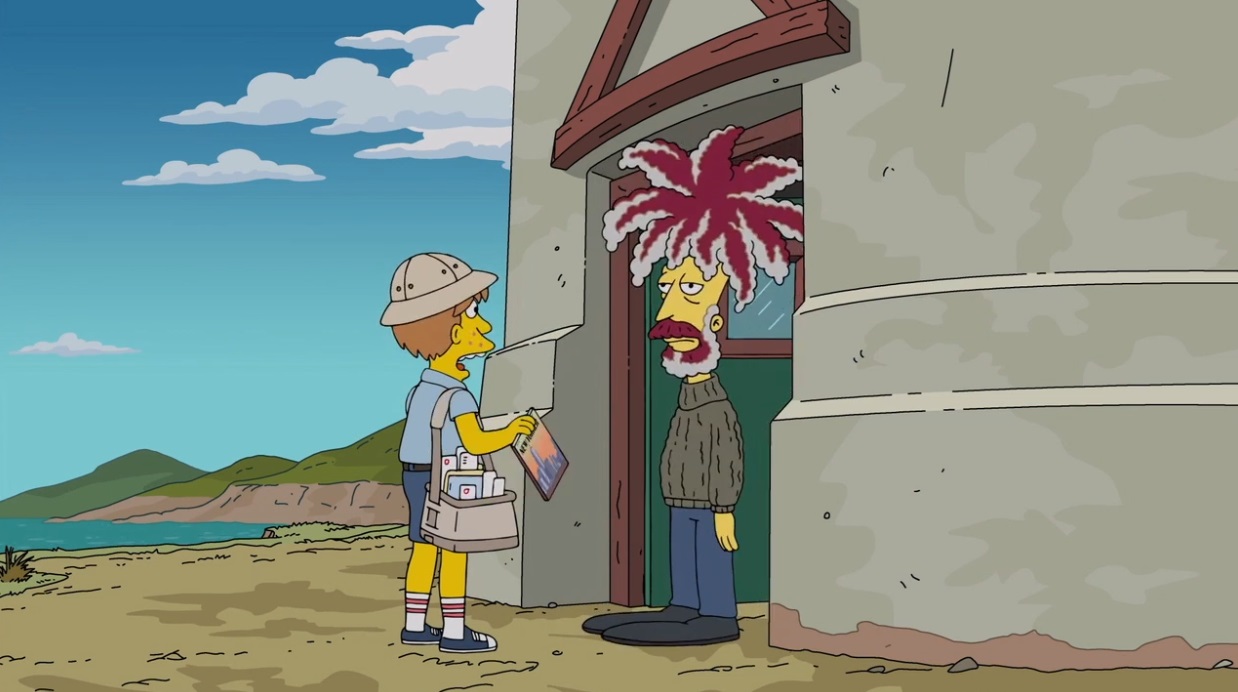
Six months later (so the titles say, but there's still snow outside - shouldn't it be summer by now?), we find Bob back with the prison psychiatrist, exhibiting a much more optimistic outlook on life. Bob admits that, for the first time in forever, he feels real happiness, and that he now has a whole new ambition of opening up a flower shop. Hey, if they seriously want to explore Bob's aspirations of becoming a florist in future episodes, then I'm all for it. Could it be that Bob is about to get a happy ending for a change? Kind of; it's a more genteel conclusion than Bob is used to, but there is an obvious limitation on his ability to change his situation. He remains weighed down by the consequences of the life choices he's made, as signified by his now having eight (I counted) weighted discs spread out across his chest and abdomen - he acknowledges that he'll first have to go through three consecutive life sentences before he can realise his new dream. Still, the episode treats us to an additional surprise in the form of an epilogue, flashing forward by many years to reveal an older Bob (I would guess somewhere in his 60s), now released and living in a lighthouse. It's not revealed if he ever got that flower shop he wanted, but it seems that he's chosen to isolate himself from the rest of civilisation, either out of shame or because it's the only way he can keep himself out of trouble. He gets an intermittent moment of human contact with the Squeaky Voiced Teen (or a descendent of the Squeaky Voiced Teen), who shows up at his door to deliver a copy of The New Yorker. Bob divulges to the Teen that his routine now consists of maintaining the lighthouse and wandering the beach, where he writes "DIE BART DIE" in the sand each day before the tide inevitably wipes it clean. What's that all about? Is he contemplating the futility of the twisted ambition he spent countless years pursuing, and how little of a mark he was able to leave on the world, or is this some kind of cleansing ritual that never quite gets the desired result? Either way, it's harrowing just how deeply the phrase has stayed ingrained in his thought processes, even if he's found a non-destructive means of channelling the associated impulses. Having transcended the thing that ostensibly gave his life meaning, Bob is left only to ponder the realisation that there never was any meaning; he remains haunted, less by Bart himself than by the extent of his obsession with Bart and how it consumed him. I will admit, when I saw they were flashing forward with Bob, I was trepidatious about what kind of prospective destiny they were going to pigeonhole him into, but this doesn't strike me as an altogether unfitting way for Bob to eventually end up, leading an existence that's basically peaceful, but suffused with regret. I appreciate that they went with a scenario that's thoughtful and quietly sad, as opposed to anything too knowingly silly, and one I can actually get something out of on an emotional level. Even the abruptness of the final punchline, so typical of anything with Al Jean's stamp on it, doesn't detract from the poignancy of the sequence. What Bob previously wanted more than anything was leverage, and now he absolutely has a message that others should hear - that life is too short and too precious to be spent on useless things like revenge - but Teen dismisses him as a nut and leaves him in isolation once more, telling him that if he installed a mailbox then he wouldn't have to knock. 

Perhaps the most troubling revelation is that Teen has fifteen other lighthouses to visit today, all of them populated by people whom he considers weirdos. Presumably, those fifteen people all have stories of their own about what drove them to such a secluded existence and the psychological baggage they now carry with them. Bob is hardly an outlier in this world; the route he's travelled may have been wildly off track but it's well-trodden nonetheless.

Finally, I want to draw attention to a scene where Bart, inside the bunker, goes through a collection of records and pulls out an album by a group of cartoon rodents known as Calvin and The Hipmunks. I hit the pause button so that I could examine the tracklist on the back of that thing, and they've a song called "Having A Ball At The Berlin Wall". Oh, you joke, Simpsons, but it happened.

Monday, 22 May 2023

Mike Teavee, The Sideshow Bob Effect and This Awfully Modern Malaise

Of the wealth of colourful and unforgettable characters created by Roald Dahl, I don't think there's one he ever did dirtier than Mike Teavee.

You'll recall how, in Dahl's 1964 novel Charlie and The Chocolate Factory, Mike was the fourth child to uncover one of Willy Wonka's elusive Golden Tickets, and also the fourth to be eliminated in Wonka's gruesome game of moral knockout. His particular vice was that he worshipped the chattering cyclops and the salaciously violent imagery it dangled before him; his undoing sprung from his being so enraptured with the television signal that he wanted to become one with it. He jumped at the opportunity to be the very first human to be sent via television, using the sinister experimental technology in Wonka's lab, and was seemingly unbothered when it caused him to come out a whole lot tinier at the other end. The television dominated him so that he allowed it to consume him and to literally diminish him. As was by then an established pattern in Dahl's story, his mishap was succeeded by an interlude from the Oompa Loompas, showing up to be our Greek chorus and to reflect, with minimal sensitivity, on the moral ramifications of what we'd just read. They did so through a humorous polemic about the war between television image and literature for a child's soul, a war that Dahl evidently still deemed relevant 24 years later, when he wrote Matilda (I've long suspected that Matilda's brother, Michael, was so-named as a nod to Dahl's more notorious television junkie). In the words of the Oompa Loompas, this is what television does to the mind of a callow spectator:


"His brain becomes as soft as cheese!
His powers of thinking rust and freeze!
He cannot think - he only sees!"


It's here that I detect a certain disingenuousness in Dahl's rhetoric. In his eagerness to condemn the presumed effects of television-binging on the young and the impressionable, he does a terrible disservice to the character of Mike. The Oompa Loompas' insistence that television impairs the viewer's ability to think is not exactly borne out by Mike himself, who is actually quite a bright and perceptive young man. If you pay attention to Mike, you'll notice he has a tendency to challenge Wonka whenever the baffling old confectioner is telling the group something fishy or that blatantly doesn't add up. In particular, he is the one character who picks up on the disturbing contradiction in Wonka's ethos, and has the guts to call him out on it - when Wonka condemns Violet's gum chewing habit as disgusting, Mike asks him, not at all unreasonably, why he contributes to the problem by manufacturing gum in the first place. Wonka ducks out of answering by pretending not to have understood Mike, claiming that he is mumbling. I realise that the disservice Dahl does to Mike is not altogether dissimilar to the way Wonka regards him - he gets around the character's pesky inquisitiveness, and his willingness to challenge adult authority, by simply ignoring it altogether. Mike's problem, so far as Wonka was concerned, wasn't that he was unable to think, but that he was too much of an independent thinker. That's why he knew the little fucker was going down.

But therein lies a problem. Mike is a smart child, and as such he really should have known better than to transport himself via Wonka's broadcasting device. He'd already observed the effect it had on a bar of chocolate, and should have anticipated that it might do something similar to his own body. Yet somehow he couldn't help himself. The desire to forge a more intimate link with his precious television was too overwhelming. Mike might have been bright and perceptive, but the one thing he couldn't wrap his head around, I suppose, was consequence. At first, Mike doesn't care about his severely diminished size because, as he points out, it needn't interfere with his day-to-day aspirations of watching endless television. It's only when Mr Teavee, appalled at what the technology has done to his son, threatens to get rid of the family's set that Mike comes up against a consequence he actually understands. He reacts as any child his age would, by throwing a tantrum (of course, he doesn't have a lot of weight to throw around any more). Fundamentally, he is a child, and he's at his most comfortable living in a fantasy world - but it is, as Dahl is keen to stress, the wrong sort of fantasy that Mike occupies. His is a corrupted state of childhood make-believe, not the pure unleashing of imaginative wonder cultivated by Wonka and his creations. Dahl's distaste for the character of Mike is at its most salient in the implication that prolonged exposure to television has left him desensitised to violence. Mike not only watches a lot of television, he likes to emulate the violent spectacle he sees therein with his vast collection of toy guns, which he takes strapped around his body to the factory with him. All that savagery passed off as entertainment has led him to believe that such violence is fun and aspirational. Says Mike, shortly after finding his Golden Ticket:


"They’re terrific, those gangsters! Especially when they start pumping each other full of lead, or flashing the old stilettos, or giving each other the one-two-three with their knuckledusters! Gosh, what wouldn’t I give to be doing that myself! It’s the life, I tell you! It’s terrific!”’


What Mike says here is all bluster, of course. He's a 9-year-old child, he has no first-hand experience with such things and he couldn't possibly understand what he's talking about. If we're going to condemn any of the characters for their callous disregard for life, then I would be at pains to point out that no one in the story is more savage and brutal than Mr Wonka himself. Wonka is a psychopath of the highest order. Depending on what version of the story you're experiencing, he might be a psychopath with a wad of charisma, or a psychopath with a fantastical, child-like ability to make the impossible possible, but a psychopath nevertheless. He gets off on abusing children, and on scarring them both physically and mentally. They were really rotten kids, you say? Meh. What it basically comes down is he's obese, she's orally fixated, she's a daddy's girl and he has ADHD. Last time I checked those were not war crimes, Wonka.

I realise of course that such thinking would be terribly out of the spirit of Dahl's novel. It is a children's morality tale, committed and uncompromising in its ghoulishness, and it appeals to an especially visceral child's-eye comprehension of morality, one in which the various excesses represented by the bad nuts seem reasonably inviting of cosmic judgement. To consume it according to any level of adult scrutiny is to have missed the point. Wonka is a higher power who operates above the law, and all laws of the universe; he assesses children according to their childhood purity, and the degree to which they remain uncorrupted by the pursuit of worldly gratification and by the shaky examples of the adults around them. Only those who retain that purity can access the full, world-changing splendour the factory has to offer. Yes, I understand that. But I'm allowed to feel for those bad kids all the same. For me it was always the bad nuts, and not Charlie or Wonka, who were the real beating heart of the tale. Charlie was merely a cipher with an elongated sob story; it was in the cautionary examples of Augustus Gloop, Violet Beauregarde, Veruca Salt and Mike Teavee that you could see bits and pieces of yourself, enjoy a giggle at your own expense, and maybe feel the sting of Dahl poking you a little too pointedly in the ribs. Let's face it - the overwhelming majority of us would not have survived Wonka's factory tour. I can only wonder for what vice Wonka would have judged and horrifically punished the younger me? Nail-biting, I'm guessing.

Which of the two big budget Hollywood takes on Dahl's book you prefer might well depend on which you grew up with, but in my experience, most prefer the 1971 Mel Stuart film starring Gene Wilder (Willy Wonka and The Chocolate Factory) to the 2005 Tim Burton film starring Johnny Depp (Charlie and The Chocolate Factory), which is a divisive beast all over. I see little reason to quarrel with that - in most regards I too prefer the 1971 film. And yet I will admit that, with all due respect to Paris Themmen, the 2005 Mike portrayed by Jordan Fry will forever strike me as the definitive take on the character. I always loved how John August's script and Fry's performance honed in on that very under-championed aspect of Mike - his shrewdness and his willingness to challenge Wonka - and brought it to the forefront of his characterisation. This Mike is a genius, and I am totally here for it. He is by far the smartest of the five winners, as reflected in the unconventional means through which he secures his Golden Ticket. But more than simply call Wonka out whenever he dispenses questionable information, Mike '05 presents a challenge to Wonka's very ethos, in that he vocally dislikes chocolate and dismisses the factory's various experiments and flights of fancy as the height of insignificance. I believe this was motivated by the fact that he survives the tour longer than any other child besides Charlie, thus the idea was to give him an arc in which he serves as a more direct antagonist to Wonka (and by extension Charlie, although the two have little interaction). From the start, Depp's Wonka appears to recognise a natural adversary in Mike; he despises all four of the bad nuts (compared to the book, where Wonka greeted all of the ticket winners with boundless enthusiasm, here he's not disguising the fact that he doesn't want any of these brats inside his factory), but there's a particularly sinister deliberation in how he turns and acknowledges Mike as "the little devil who cracked the system". Later in the film, it becomes apparent that Wonka's exceptional dislike for Mike is exacerbated by how reminiscent his candy aversion is of the stance his father attempted to impress on him growing up. In this version, when Mike meets his fate in the Television Room, he's basically getting Wonka's daddy issues taken out on him, poor kid.

Mike's nationality was not specified in the book, but adaptations have consistently portrayed him as American. Just as Veruca Salt works as a perfectly grotesque caricature of British privilege [1], so too does Mike serve as an appealing shorthand for an anger and destructive fascination baked deep into the bones of the American psyche. The 1971 film substitutes his fixation on gangster movies with one on cowboys and westerns, recalling America's violent origins, while the 2005 film has him hail from Denver, Colorado, a move obviously designed to evoke uncomfortable associations with the then-recent Columbine massacre. The 2013 West End musical relocates the Teavee household to a more nondescript American "suburbia", one evocative of mid-century sitcoms, in which Mrs Teavee's efforts to present her family as conventional and functional are persistently undermined by Mike's aggressively hyperactive outbursts, and her own ill-disguised admissions of the chaos she struggles to rein in on a daily basis. Here, the Teavees inhabit a world that, Mike's modern technological prowess notwithstanding, seems stranded in a vacuous nostalgia for a mythical America of the 1950s (in the song, "Strike That, Reverse It", Wonka even mocks Mrs Teavee for being "dressed for 1958"), clearly a facade designed to gloss over the violent disorder and general indifference that characterises their everyday reality. The Broadway version goes a step further, reworking the Teavees' introduction with a revised song, "What Could Possibly Go Wrong?", to make the character directly analogous to Donald Trump (poor Mike; he absolutely did not deserve that comparison). While I've no doubt that Dahl intended for his readers to see TV as the corruptive presence in Mike's life, with other depictions there tends to be more of a chicken and egg situation - did TV (and, in the more contemporary adaptations, video games/social media) make him so angry or is he simply using them to channel a rage that was already there, and possibly reflective of the broader cultural malaise in which he's been raised? A bit of both, maybe?

I have a particular sympathy for the Mike from the 2005 film. In my view, he's not such a bad kid. Rather, he's a highly precocious child, starved for stimulation and frustrated with a world that perpetually misunderstands him. Whereas Mike '71 was very much on the wavelength of the people who'd raised him - his father had promised him a real gun as soon as he turned 12 and his mother seemed inexplicably proud of the fact that he'd only ever eaten off TV trays, never at the table - with Mike '05 there's a visible disconnect between himself and his parents. The very first thing we hear from his father's lips is, "Most of the time I don't know what he's talking about." We get no insight into what Mike's life at school is like, but it's obvious that at home he isn't getting a lot of affirmation and his parents don't know how to relate to him or to support him in using his talents constructively. Mike's intelligence has left him isolated and unable to connect with other people, and while I'm not saying I think the level of anger he exhibits is healthy, I feel that I can comprehend where it comes from. It's why the running gag of Wonka pretending not to understand Mike, though lifted from the book and present in most adaptations, strikes such a raw nerve with me in this version; I get the impression it's a variant on the type of response Mike's already come up against a lot in his short time, only much more knowingly taunting. Alas, due to the nature of the story, the film is on Wonka's side - Mike's intelligence is regarded as a liability, the thing that disqualifies him from getting to participate in Wonka's candy-coated utopia, and I find that just a little disheartening.

This, friends, is what I will henceforth refer to as The Sideshow Bob Effect. When a character is blatantly the smartest one in the room, yet their intelligence is not valued, even regarded as a problem in itself, and everyone else insists on treating them like bloody shit...you can bet your bottom dollar that I am going to sympathise with that character. Call it a personal weakness. Bob and Mike might have opposing views on the worthiness of the chattering cylcops, but they are very much kindred spirits at heart. They each fought the status quo, and the status quo won. They are truly my people.

On the whole, my feelings toward Burton's version of the story can be described as ludicrously ambivalent. The parts I like about the movie (ie: Mike and the other bad nuts), I really, really like. The parts I don't like I find downright repugnant. For example, I do not like Depp's take on Wonka in the slightest. It is a singularly unpleasant performance, and yet, one that I can't claim clashes terribly with my own interpretation of the character. For Wonka is a singularly unpleasant person, and that is something Burton and Depp understood all too well. Their goal was clearly to bring out the nastier elements embedded in Dahl's novel, in contrast to the more whimsical approach of the 1971 film. And so they do. Tonally, it all goes a bit lopsided - sure, Wonka is creepy and evil, but you still need to balance that out with his enigmatic, visionary side. Otherwise, is there really any gratification to be had in watching Charlie embrace him and agree to follow in his footsteps? I don't want Charlie to emulate this Wonka. I don't think this Wonka should be allowed within 15 feet of any children, period (actually, no Wonka should, but this one's a particularly dire example).

What is lacking in the Burton film is fun. The 1971 film leans into the high camp of the scenario, and it works a treat - there, when Veruca goes down the garbage chute, having been judged as a "bad egg" (geese and not squirrels are Wonka's animal assistants in this version), and her dad wilfully throws himself down after her (inadvertently outing himself as another "bad egg" in the process), it's as hilarious as it is horrifying. Wilder's Wonka is easily the rottenest egg of them all, for his buoyant lack of concern about the possibility that the father and daughter might end up in the incinerator - and yet, you giggle, and you're gleefully aware of your own complicit nastiness in giggling. The 2005 film, by comparison, is high on cruelty and bitterness, light on any genuine twisted joy - there, when Veruca is deemed a "bad nut" and hauled off by a scurry of malevolent squirrels to a chute leading to the factory incinerator, I can't help but ponder what a profoundly horrible situation this is and wonder why Wonka does nothing to stop it. Is he really so unmoved at the thought of having this child's death on his conscience? Am I giving him too much credit in presuming he has a conscience at all? The Burton film is simply cold. Not helping matters is that I don't particularly like this take on Charlie either, even if it is closer to Dahl's text than the 1971 film. In fact, I would go so far as to say that I positively resent this Charlie. I do not intend that as a knock on Freddie Highmore, who does only what the script requires of him, but the requirements it makes are truly fatal. In giving flesh and form to Charlie's exaggerated goodness, and choosing to exaggerate it further, it teases out an element that may well have always been latent in Dahl's text, but becomes here impossible to ignore - that Charlie is a wildly condescending depiction of a child living in poverty, assumed to be angelic, uncomplaining and doggedly altruistic, as opposed to as imperfect and human as the rest of us. The Stuart film moved to make Charlie (played by Peter Ostrum) a little less innocent and a little more of a brat (but still recognisably a good nut, compared to the other contest winners), a move that reportedly angered Dahl, but that I personally consider quite prudent. Ostrum's Charlie feels real and relatable, a kid with just the slightest whiff of potential for wrongdoing, but who overcomes it and earns his happy ending. Highmore's Charlie feels cloying, manipulative and inauthentic, and I get no satisfaction from seeing him triumph. Team Teavee to the finish, I'm sorry.

Oh, but I loved the bad kids. The bad kids, and the talented young actors who portrayed them, were what really redeemed this picture for me. They deserved better. All of them. But especially Mike.

Isn't it weird how EVERY one of the winners happened to be an only child? I mean, what were the odds?

Augustus, admittedly, hasn't changed much - he's still Fat-Shaming Incarnate, with no attempt to add any new depth or dimension to his character (but then he doesn't last long anyhow). Veruca likewise isn't wildly different, in terms of what she does and what she represents, but I enjoy Julia Winter's more subdued, calculating take on the character (and I say that as a great admirer of Veruca '71, as portrayed by Julie Dawn Cole) - this Veruca has the face of a cherub, only showing her heated entitlement very intermittently. The way Burton's film was able to expand on Violet and Mike, bringing them more into line with kids of the 21st century, was a welcome move - here, Violet's gum-chewing is no longer treated as the problem in of itself, but rather symptomatic of a greater toxicity, and the extent to which her mother has molded her into a reflection of her own glory-seeking ego (something carried over into the 2013 musical, where Violet was a pawn in her father's aspirations for fame). As for Mike, he's now extremely tech-savvy, in ways that baffle his elders and put them to shame.

Mike explains to the press how he found his Golden Ticket: 


"All you had to do was check the manufacturing dates, offset by weather, and the derivative of the Nikkei Index. A retard could figure it out."

Okay, I'll admit that Mike '05 did do one thing that was very wrong. He should not have used the "R" word, and if he were my child I would have had some harsh words for him there. That much does not reflect well on him, fine. But in all other regards this kid should be celebrated, not beaten down.

In defence of Mike '05, I will point out that he's seldom seen to take his violent energies out on anything that's actually going to feel pain. He gets incredibly worked up during his gaming session, but that's all against computer graphics, not real living things. He also destroys a candy pumpkin in Wonka's chocolate room; when challenged by his father, he indicates that this is how he's inclined to enjoy candy in lieu of eating it. But it's not like Mike is ever violent toward other children, or to animals (more than you can say for Wonka, who apparently has cows strung up and whipped as part of his production process [2]). Heck, he's not even verbally antagonistic to other children - he just doesn't connect with them, period. Whenever one of his fellow bad nuts goes down, he always looks concerned about it; he gets no sadistic pleasure out of watching people suffer. The worst we ever see him do is aggressively shove a couple of Oompa Loompas aside when he's running through the Television Room. And despite being the film's main antagonist, for all intents and purposes, Mike poses no meaningful threat to Wonka - he's not trying to get the factory shut down or anything, he just has strong reservations about the value of Wonka's product and isn't impressed with what he sees. Mike '71 was, in theory, more of an active threat to Wonka, since he and his mother were conspiring to smuggle secrets out of the factory and sell them to Slugworth (unaware that this was itself part of Wonka's morality test). In the end I can't help but feel that Mike '05 is punished for his vicious non-conformity more than anything - he's a kid who doesn't like candy, and boy howdy, what could be more abhorrent and unnatural than that?

 à² _ಠ

A common charge I've seen made against Mike '05 is that, for all his criticisms of Wonka, he isn't exactly accomplishing anything constructive with his own brainpower. He calls candy a waste of time, but mostly likes to fill his own playing gory video games. He revels in destruction and understands nothing of the joy of creation, or of making others happy. And that's true enough. But I would counter that Mike is only 9 years old [3], and this isn't the be-all and end-all of what he'll be doing with his life; he has plenty of time in which to figure out how to usefully apply his knowledge. No, I think the movie's real problem with Mike is that he's lost touch with what it means to be a child; his pragmatism and his tech-savviness have distanced him from the kind of innocent wonder that gives meaning to Charlie's being. This much is spelled out by Mr Teavee, who, far from expressing pride at having sired such a brilliant child, laments that, "Kids these days, what with all the technology...it doesn't seem like they stay kids very long." Compared to other depictions of Mike, who at least occupied their own deranged, media-fuelled fantasy spaces, Mike '05 insists on seeing the world through a dogged rationality that's presented as cynical and at odds with Wonka's particular brand of virtuosity. The escapism he seeks, in first-person shooter games, is all geared toward venting his negative emotions, not elevating his imagination to exhilarating new heights. Mike would like to be able to change the world for the better, as is indicated during the Television Room sequence, but his rationality, and his assertion that frivolity should never enter into it is what leads (not entirely convincingly) to his downfall. His total disconnect from the childhood sphere is epitomised in his having no palate for chocolate, prompting George Bucket to decry the very notion of this self-confessed chocolate-hater gaining access to Wonka's candy Xanadu in the first place. To some, Mike comes across as a dog in a manger, since he has no use for the factory's product yet insists on taking up a place in the tour anyway. One could argue that Mike doesn't have to like eating the stuff to have a legitimate interest in the technicalities of how chocolate is made, but I suspect that what's actually driving Mike is (not unlike Violet) the need to prove himself. Wonka's contest gave him the opportunity to demonstrate his prowess and to stand out, and he took it. Well, good for him. Something tells me he wasn't getting the challenge he craved from his prosaic home life.

It would be disingenuous of me to not acknowledge that a love of candy is obviously not enough to get you far in Wonka's Xanadu, as we observed in his treatment of Augustus. Augustus certainly did not believe that candy was a waste of time, and was eager to let Wonka know how much his product mattered to him, but Wonka felt only contempt for him. For Augustus it was all about the indulgence of carnal desire, not the opening of the mind to fresh possibilities, so as far as Wonka was concerned he misused the tremendous gifts he'd given to the world. The kid to whom Mike stands diametrically opposed is obviously Charlie, who embodies all of the essential childhood virtues that Mike himself has turned his back on - not only does he love candy, he regards it with a religious reverence. It takes a while, but this does eventually give way to Mike and Charlie's only two-way exchange of the picture (even then, they don't actually make eye contact). During the glass elevator tour, Mike hits Wonka with his ultimate challenge, and asks why everything within his factory is completely pointless; Charlie responds with what is, presumably, intended as the film's big moral takeaway (aside from that stuff about family it tacked on rather awkwardly through its extended epilogue):


"Candy doesn't have to have a point. That's why it's candy."


Oh shut up, Charlie.

Burton's film would like for us to believe that Mike's lack of a sweet tooth is a sign of moral failing on his part. But...it's not. It really isn't. I suppose my sympathies for Mike are cemented by this one prevalent thread of cynicism I have - is the candy manufactured by Wonka really as sacred and as worthy of veneration as both Charlie and the narrative assume? I do not believe that Burton's telling makes out the case that it is. There is, very clearly, an ugly, less idyllic side to Wonka's production. By that, I allude not just to the fact that four children and one adult met with incredibly horrible accidents in his factory's walls, and that it runs on arguable slave labour and unethical experimentation (I'm not centring on the Oompa Loompas in this entry, but they are their own particular hornets' nest). Wonka's high-minded claims about his everlasting gobstoppers notwithstanding, he doesn't bestow his creations upon the world because he's a generous guy who's all about giving - at the end of the day, his is a business like any other, there's profit to be had, and his business is going to callously hurt the little people in pursuit of said profit. In the Burton film, the chocolate factory is explicitly linked to the same exploitative capitalistic system that's already caused the Buckets so much harm - Mr Bucket initially works in a toothpaste factory, but loses his job when the surge in sales of Wonka-brand candies leads to an increase in tooth decay, from which the toothpaste factory profits handsomely and then decides to replace a part of its workforce with upgraded technology. Wonka might have a deeper ulterior motive, in using the contest to locate an heir, but let's face it, the whole thing is also an ingenious means of increasing his own financial gain. Mike doesn't play by the rules of Wonka's game, and Wonka's early disdain for him is based on the fact that he "cracked the system", ie: he figured out how to get a ticket while contributing only the bare minimum in terms of lining Wonka's already deep-filled pockets. Wonka's candy, and the consumption thereof, represents the status quo; Charlie's devoted consumerism, and his unwavering trust in the Wonka brand, are equated with goodness and purity, while Mike is the one character who questions what it fundamentally achieves. I do not think he is wrong to do so. Unfortunately but unavoidably, he ends up paying the price.

It's here that Burton's film runs into an inevitable problem with Mike, in that it doubles down on the character's intelligence but the story ultimately still requires him to do the stupid in the Television Room and to transport himself via Wonka's device, despite his just having seen a demonstration of how it makes everything it teleports smaller. Book Mike and Mike from the 1971 film might not have cared terribly about this highly conspicuous consequence, but Fry's Mike is so smart and so serious-minded that it's harder to justify in his case. I remember watching this film for the first time back in 2005, and as we edged closer to that dreaded television sequence I was very consciously pondering how they were going pull this off. As it turns out, they attempted to make it into a matter of hubris - Mike '05 isn't motivated by giddy recklessness, but by his frustration with Wonka and his desire to demonstrate that his mind should be on more important issues than the proliferation of candy. Nice try, but I don't think it quite succeeds. It still requires Mike to disregard the fact that it makes things smaller, and we don't get sufficient insight into his thought processes, in this particular moment, to account for why he would do that. Mike '05 is, notably, the only version of the character who seems to immediately regret his decision to go through the transporter - most other Mikes at least enjoy the actual experience of appearing on Wonka's television, but for Fry's Mike it turns into an all-out nightmare from the get-go, as he is attacked and terrorised by the Oompa Loompas. Like all of the bad nut disposals in the Burton film, the sequence is ugly and mean-spirited without being much fun (ordinarily I would relish a Psycho homage, but not here - leave Norman out of this, please).

What do the Oompa Loompas have to say about Mike this time, as they jam up his skull with gratuitous trauma?


"His brain becomes as soft as cheese!
His thinking powers rust and freeze!
He cannot think - he only sees!"


Goddamnit, seriously?

The book's disregard for Mike's intelligence I can view as a curious foible, partially mitigated by the wittiness of Dahl's rhyme. Burton's film, I feel, has absolutely no excuse. It made Teavee's intelligence his most prominent trait; wherever his faults might lie (and to be sure, he does have them), it's blatantly more complicated than the same "TV makes you stupid!" hyperbole it ultimately still expects us to swallow. The lyrics that could be considered applicable to Mike '05 are the particular accusation that, "He can no longer understand a fairy tale, a fairyland," in reference to Mike's pragmatism and his unwillingness to indulge the fanciful stirrings championed by Wonka and Charlie. The rest of it refuses, almost wilfully, to take into account the specific ideas embodied and articulated by Mike, and as the character's pay-off, it merely aggravates. Like Wonka himself, it pretends it hasn't heard Mike and abruptly dismisses him.

So yes. Having expanded on Mike's character so intriguingly, and having awarded him with all that juicy extra nuance, Burton's film went on to do him even dirtier than Dahl. Fundamentally, it remained bound by the framework of Dahl's story, and struggled when it came to fudging his expansion into that pre-determined trajectory. It doesn't stop there, however. What happens to Mike next is also largely in adherence with Dahl's text - Wonka sends him to the taffy-puller to be gruesomely tortured and disfigured. And yet Burton's film still insists on making Mike the butt of the final joke involving the bad nuts, in a way not present in the source material. In Dahl's book, Wonka at least had the decency to assure us that the freakishly spindly Mike would be alright, since he would be sought after by every basketball team in the world. Such reassurance is denied to Fry's Mike. During the sequence where each of the bad nuts leaves the factory with their accompanying parent, I always found it so harrowing that Mike is the only child who doesn't exchange any words with his father. It felt like rubbing salt into the wound, a reminder that, on top of everything else, their communication issues remain unsolved and would likely fester going forward. In the meantime, what must be simmering in the mind of Mr Teavee? Well, we can speculate.

I'll profess to deriving greater satisfaction, in terms of how Mike ends up, from neither Dahl's book OR either of the movie adaptations, but from the West End musical. The Mike of the West End could be considered an amalgamation of the character's various manifestations over the years, with definite shades of the 2005 Mike in there - this version of the character also vocally dislikes chocolate, and Wonka, likes screaming "Die!" at the screen while playing video games, and obtained his ticket through unorthodox means that enabled him to circumvent the rules of brand consumerism (in his case, overtly criminal means; he twice admits to having found the ticket by hacking into Wonka's computers, although his mother insists these are "just allegations"). At the same time, he possesses the hyperactive recklessness of his literary counterpart (cranked up to 11), his favourite video game hero, Captain Knuckleduster of the futuristic rodeo, nods simultaneously to the respective obsessions of book Mike and 1971 Mike, and his love of toy guns has returned. This Mike is also clearly a lot more emotionally disturbed than all of his previous incarnations; as per his family's introductory song, "It's Teavee Time!", he has been placed under house arrest for a string of violent offences around his community, which include setting a cat on fire, chloroforming a nurse and stealing a German tank (okay, the cat thing's horrible, but those other two incidents really demand their own half-hour specials). Overall, I prefer Fry's aloof, brooding Mike to the overstimulated enfant terrible he is in the musical, but I still love this interpretation, particularly the dynamic he has with his mother - it always gets a laugh whenever she tells him to be nice and he flat-out ignores her. (In this version, Mrs Teavee accompanies Mike to the factory, since this Mr Teavee will scarcely acknowledge the existence of either of them. Which is probably the preferable arrangement - otherwise, as we saw in Burton's version, the last leg of the tour becomes a total sausage party.[4]) The musical also does significantly better than Burton's film in bringing the Oompa Loompas' judgement of Mike in line with his character's modernisations; his comeuppance song, "Vidiots", while still reinforcing some of the same old hyperbole about how electronic media rots the senses, cleverly updates its rhetoric, and Mike's predicament, to comment more on the dangers of compromising one's personal information in the social media age ("His secrets now are yours and mine, cos everything he's got's online"), which is a much more relevant concern for the current young generation.

Most importantly, Mike's fate in the musical differs from the book and either of the films; he still gets shrunken down via TV signal, but here Wonka never offers to reverse the process, insisting that "nobody ever goes back to normal once they've been on television". Instead, his mother accepts this outcome as a practical solution to her domestic troubles, having realised that Mike is back to being as small and helpless as he was as a baby, and she can now relive those glory days when he was entirely dependent on her to take care of him. It's a little creepy, but there is also a sweet side to it. Mrs Teavee isn't motivated by spite - she simply wants to recapture that more innocent dynamic they once had, before the world and its tech drove a wedge between them. Now Mike can look forward to a lifetime of being cosseted by his mother; as for Mr Teavee, he probably won't even notice the difference. It is, in its way, a warped answer to the problem posed by the Mr Teavee of the 2005 film, there left unsolved, about modern children not staying kids for long (also expressed in the lyrics of "Vidiots", which warn that, "The age of innocence is gone, when certain sites are clicked upon"). Wonka, in this version, may even feel some sympathy for Mrs Teavee, and helps her out by allowing her to keep her son in a state of permanent infantilisation - his trip through the Wonka broadcasting system could therefore be regarded as a rebirthing of sorts. On paper, that's no less fucked up than what happens to Mike in the default version, and yet strangely enough I am more at ease with this than I am the outcome in the book or the 2005 film. He avoids the horrors of the taffy-puller and instead gets confirmation that his mother has his back, and I'm just a sucker for that. (You know, all those bad nuts - for as harshly as Wonka judged them, they were each the fruit of someone's loins. Somebody loved them, and felt inclined to nurture them.) Besides, if we view Mrs Teavee as someone who's been screwed over by the patriarchy, ignored by her husband, beleaguered by her son and dismissed by the authorities, then there is something tremendously satisfying in seeing her triumph through the reassertion of her maternal mettle.

What can I say? If only there was some way to combine Ostrum's Charlie and Wilder's Wonka, Fry's Teavee and the ending with his mother from the musical (and also the mecha Oompa Loompas from the musical's recent UK tour, which sidestep the usual racist implications and are the coolest version anyhow). The perfect Charlie and The Chocolate Factory experience! But whatever the version, wherever Mike Teavee has the pluck to challenge Wonka, I'll be in perpetual admiration of the little techno junkie, and Fry's Teavee absolutely gets the gold star (it helps that the Wonka he's up against is in such desperate need of challenging). Seriously, why does the man make gum in his factory, if he has so much contempt for those who chew it? But then I think I already know the answer to that, and I suspect that Mike '05 did too. Four out of five consumers get nothing but disdain from Wonka - but as long as there's moolah to be had from your disgusting habit, you can bet he's going to exploit it.

[1] Dahl might have used Veruca to send up class privilege, yet a profound irony that does not escape me is that, of all the bad nuts, he privileges her - I'm sure going down that garbage chute was a properly traumatic experience for the girl, but she's the only one who doesn't end up with any kind of physical disfigurement for her sins. There's also no indication, in the book, that her parents are going to stop spoiling her. Then again, Mike does better than the other kids in the stage musical, in that he gets closure and to go home at the end, while the fates of Augustus, Violet and Veruca/Mr Salt are just left hanging. The musical might actually be the most brutal version of the story.

[2] Charlie thinks this is delightful, apparently. Really, and Teavee's the one who has the problem???

[3] Mike's biography in the tie-in trading card set created by Artbox gives his age in the 2005 film as 13, but I'm going to dispute that. Fry was younger than that when he played him, and I'd assume he's meant to be more-or-less the same age as he is in Dahl's novel; if Mike '05 is meant to be 13 years old, then he's on the puny side for a young teen.

[4] In the book, all four of the bad nuts were actually accompanied by BOTH of their parents, but I can understand why the adaptations have all insisted on that one adult per child rule. Otherwise you end up with too cluttered a cast.