Showing posts with label earth stories. Show all posts

Thursday, 27 March 2025

Homer's Barbershop Quartet (aka With A Little Help From My Friends)


On September 30th 1993, "Homer's Barbershop Quartet" (episode 9F21) aired, getting The Simpsons' fifth season off to a roaring start. They couldn't have picked a classier, more iconic debut if they'd tried,  and yet it wasn't always intended to lead the pack. The bigwigs at Fox had originally wanted "Homer Goes To College" to be the big season premiere, believing that the premise of Homer Simpson enacting a string of Animal House-style hi-jinks would prove irresistible to viewers, but in the end "Quartet" just had too much of an edge. By which I mean a guest appearance from a Beatle, with Homer's musical odyssey allowing him to cross paths with George Harrison a couple of times. Animal House parodies ain't got nothing on that! But then, as Harrison himself observes during his second appearance, "It's been done." It would be done again too. "Quartet" marked only the second occasion on which a Beatle had graced The Simpsons with their vocals, following Ringo Starr's appearance in "Brush With Greatness" of Season 2. Paul McCartney would later show up in "Lisa The Vegetarian" of Season 7, thus completing the surviving set (if John Lennon had lived to see the series, do you reckon they could have convinced him too?). What better way to cement the show's own status as a phenomenon for the ages than by having your legacy converge with that of another timeless phenomenon? Harrison's cameo is by and far the briefest and most frivolous of all the Beatles' guest appearances - whereas Starr and McCartney each enjoyed a prolonged interaction with one of the family and a meaningful impact on the resolution of their respective story, Harrison's role consists of popping up twice for a quick gag and immediately moving on. It's also more self-effacing than the other Beatles' appearances; Harrison receives none of the in-universe reverence afforded his bandmates, a great part of the joke being that no one even notices he's there (which is the very problem he faced as a Beatle, is is not?). It's a fitting summation of what's going on in the episode as a whole. The legend of The Beatles, those four Liverpool lads who became global sensations and changed the face of popular music forever, looms large over the events of "Quartet" but goes mostly unspoken. Outside of Harrison's appearances, the band is brought up explicitly only once, when Lisa asks if Homer's singing career was sunk because he screwed up like The Beatles and said his titular quartet was bigger than Jesus. (Objection! Only Lennon said that, not The Beatles as a collective, and while it triggered quite the backlash in the US at the time, it hardly brought about an end to the band. They hadn't even done Sgt Pepper's at that point.)

"Homer's Barbershop Quartet" opens with the family at a swap meet (or car boot sale, as we'd call it in the UK), where Bart and Lisa are perusing Comic Book Guy's stall and, after learning a little about the Rodent Invasion of the early 1960s, are surprised to dig out a record with Homer's face on the cover. Homer explains to them that, back in 1985, he was part of a barbershop quartet (alongside Skinner, Apu and Chief Wiggum) that used to perform regularly at Moe's. The group had a slow start, but eventually became a local sensation, at which point they were approached by a theatrical agent named Nigel who wanted to represent them, on the condition that they lose Wiggum, whom he considered "too Village People". On discovering Barney's hidden talent for singing, the group brought him in as a replacement and went on to record a hit record, "Baby on Board", under the name The Be Sharps. Alas, the taste of celebrity was sweet, but ultimately fleeting, and by the end of the summer the quartet had become an obscure footnote in music history. This is the story of their dramatic rise and fall.

We can technically count "Homer's Barbershop Quartet" as the fourth in the ongoing branch of "flashback episodes" that originated with "The Way We Was" of Season 2; doing so handily gives the branch a five-year streak that wasn't broken until Oakley and Weinstein took over as showrunners (one assumes that after "And Maggie Makes Three" they ran out of obvious subject matter). But "Quartet" would inevitably be the odd one out, in part because it's the only flashback episode, of that initial streak, that isn't focussed on the family. The other Simpsons are always somewhere at the back of Homer's mind throughout his rise to fame - there's a rather meagre subplot dealing with the mutual dissatisfaction that accompanies his being separated from his young family, but this has no discernible impact on how the episode ultimately resolves. But more glaring still is that is that the events of this particular flashback aren't events that conceivably fit with what we already know about the family. The other flashback episodes play out like the putting together of pieces in a puzzle, combining to give us the bigger story of the Simpsons' formation and how the family in its present state came to be. The questions they tackled were all very logical ones. How did Homer and Marge meet? How did they marry? What were the circumstances behind each of the children's births? How did Homer come to work at the nuclear power plant? When did the family move into Evergreen Terrace? "Quartet", by contrast, tells a story that is, by its own admission, a profoundly illogical thing to be retroactively working into the family's backstory this far into the series. Toward the end of the episode, Bart and Lisa (performing their intermittent duty as viewer substitutes) fire off a barrage of questions that directly attack the preposterousness of the tale their father has just related, the most insurmountable of which is, "How come we never heard about this until today?" Indeed. It would be one thing if a youthful Homer had been part of a music outfit that never went anywhere and left him a bit embarrassed as a thirtysomething. But for him to have been in a band that enjoyed chart success, toured Sweden, performed for the Statue of Liberty's centennial, won a Grammy, inspired a slew of tacky merchandise and still reunites for the occasional Dame Edna special...well, it surely wouldn't have taken this long for it to come up from an in-universe perspective? It's the kind of thing that ought to significantly rewire our perception of Homer as a character. Besides which, Santa's Little Helper is clearly glimpsed one of the flashbacks to 1985. The dog probably wasn't born until much later in the 80s, and he certainly didn't live with the Simpsons at this point, so CONTINUITY TORPEDOED! (Mind you, the dog in question is a different shade of brown to Santa's Little Helper, so is it possible the Simpsons owned another greyhound we'd also just never heard about? It would certainly be no more of a stretch than the mere existence of The Be Sharps.)

But then, The Be Sharps were not introduced with the intention that they have any serious ramifications for the series' world-building, as evidenced by how seldom they've been referenced in the seasons since. They were introduced purely so that The Simpsons could craft its own personalised love letter to The Beatles, and once we've accepted the distinctly self-contained nature of the story, its charms on that score are manifold. Writer Jeff Martin clearly had a great deal of passion for the Fab Four; that passion is palpable all throughout the script and certainly compensates for whatever conceptual quibbles we might have with the arrangement. If you know your Beatles history, then it's hard not to smile at some of the small ways in which the reality of the series is bent to accommodate the tribute - for example, Moe's Tavern was apparently known as "Moe's Cavern" in the summer of '85 - and the ways in which the quartet members act as embodiments of that history feels almost entirely natural and true to their characterisations. Wiggum is unambiguously the Pete Best of the equation, although none of the Be Sharps themselves serve as analogues for any one specific Beatle. Rather, they just recall bits and pieces of them wherever it fits. Barney starts out as Ringo, the newcomer, but ends up as John, with the Japanese conceptual artist girlfriend (about as on the nose as the allusions get, but at least it's consistent with what we'd later see in "A Star Is Burns", with Barney having an appreciation for the avant garde). Homer starts out as John, the de facto leader and the one who's already taken but encouraged to keep his marriage out of public knowledge, but by the end feels more like Paul (I love Macca, but I can totally hear that song about Mr T coming out of him). Apu being persuaded to adopt the pseudonym De Beaumarchais (on the grounds that Nahasapeemapetilon wouldn't fit on a marque, although De Beaumarchais isn't significantly shorter) likely alludes to "Ringo Starr" being the stage name of Richard Starkey. Skinner is tagged by the press as "the funny one", which was Ringo's designation back in the day (just as John was the smart one, Paul the cute one and George the quiet one). Various poses and fashion choices made by the band throughout directly echo the iconography of The Beatles - notably, a photo from the Let It Be recording sessions, which perfectly captured the divisions between the band members in its final days, here lovingly recreated right as the Be Sharps are nearing their breaking point. Most delectable of all, however, is the origin behind the band name "Be Sharps", chosen because it meets Skinner's requirement for "a name that's witty at first, but seems less funny each time you hear it". That's an accurate assessment of the pun in "Beatles", which is cute when you first notice it, but after a while you just forget is there.

What makes "Quartet" an interesting episode beyond the Beatles allusions is that it also represents a bit of bold experimentation in terms of broadening Homer's social connections. With the exception of Barney, with whom he was well-accustomed to palling around, the line-up of characters in The Be Sharps was a reasonably novel one. If a more contemporary Simpsons episode were to feature the premise of Homer forming a barbershop quartet, the remaining members would almost certainly be Moe, Lenny and Carl. All three of those characters work their way into "Quartet", but at this point in the series there seemed to be a general reluctance to use them much outside of their designated habitats of bar and power plant. Instead, the episode digs a little deeper into the supporting cast, pooling Springfieldians from various all of life in an attempt to settle on some new mates for Homer, some of which stuck while others didn't. "Quartet" seems to mark the turning point where Apu was depicted as one of Homer's close friends, and not simply the guy he'd interact with when he was out shopping for groceries, a move cemented later on in the season with "Homer and Apu". It seems far stranger to contemplate the possibility that the writers were toying with the idea of making Skinner a fixture of Homer's friendship circle, but there does appear to have been a genuine shift toward bringing those characters together during Season 5 - consider that he was included in Homer's vigilante group in "Homer The Vigilante", and they shared a hotel room while serving as jurors in "The Boy Who Knew Too Much". Skinner doesn't seem like the kind of guy who'd be in his element with Homer socially, but perhaps that was what made their combination so appealing. Skinner is the uptight straight guy who provides invaluable contrasts. When asked by a reporter if his aforementioned reputation as "the funny one" is justified, his deadpan, "Yes, yes it is," demonstrates why that's seriously no lie (it's also a bit strange how the reporter addresses him as "Principal Skinner", suggesting that his strict schoolmasterly persona has permeated his identity within the band too). The writers were onto something with the pairing, but I guess they just didn't know how to keep it going. As for Wiggum, while I don't feel there was such a conscious effort to make him one of Homer's friends in Season 5, it's worth noting that they would enjoy a more prolonged team-up in "Marge on The Lam".

Part of the underlying joke behind the Be Sharps is of course that barbershop is (as Bart points out) an old-fashioned music style associated predominantly with the turn of the century, and would have seemed really out of place within the popular music climate of the 1980s, despite Homer's insistence to the contrary ("Rock and roll had become stagnant. "Achy Breaky Heart" was seven years away. Something had to fill the void. And that something was Barbershop.") Still, our friend Bobby McFerrin had his own one-off chart success in 1988, so it wasn't as though there was no room for a cappella in the era of synthpop and New Romantics. And here's the secret ingredient that gives the episode that extra layer of conviction, for all its unlikelihoods - as a musical act, The Be Sharps are played more-or-less straight. Singing vocals were provided by then-current members of the Dapper Dans, the barbershop quartet that performs daily as part of Disneyland's Main Street Parade, and interlaced with those of Castellaneta, Azaria and Shearer, so they certainly have the mettle. "Baby on Board", the song Homer is inspired to pen after seeing Marge's latest purchase, a yellow warning sign designed to deter drivers from "intentionally ramming our car", has the benefit of sounding like an authentic a cappella standard and lampooning a contemporary obsession (much like Dexy's Midnight Runners, those "Baby on Board" signs stuck around for longer in the UK, but in the US I understand that their moment came and went in the mid-80s). Although maybe Homer was too quick to abandon that one about Geraldo and Al Capone's vault (somewhat anachronistically, given that the whole Mystery of Al Capone's Vaults fiasco wouldn't happen until April 1986).

"Quartet" is a delightful ride, although it has to be said that there's not a great deal to the story. You can tell, from the beginning, that the writers had difficulty stretching it to the full 22 minutes, because of what's going on with the couch gag; they mash three of them together, giving us something to the tune of a couch gag clip show. ("Cape Feare", its neighbouring episode, had the same problem, but used the more conventional solution of running the extra-long circus-themed variation). Conversely, it also feels like there are pieces missing from it; being one of the last episodes to emerge from Al Jean and Mike Reiss's turn as showrunners, it's got their trademark meandering structure, with not all of the narrative threads neatly combining. Did you notice, for example, that after a while the character of Nigel just disappears from the story altogether? He sets The Be Sharps up on the road to stardom and then apparently takes no interest while the group is disintegrating. It has crossed my mind that his absence might have been a deliberate choice, as an allusion to the death of Brian Epstein, but if we're meant to draw that conclusion it surely would have been helpful to have at least acknowledged him. There's also the matter of the Simpsons struggling while divided; a classic theme, but it doesn't really build to anything narrative-wise. The scene where Marge attempts to compensate for Homer's absence by constructing a dummy father for the young Bart and Lisa is a little unsettling and adds nothing (except for that timeline-muddling Santa's Little Helper appearance), but we do get a nice moment with Homer in his Hollywood hotel room, having a telephone conversation with baby Lisa about his Grammy success (Lisa, who at this stage can't be older than one, is already exhibiting precocious behaviours), before contemplating how much he's missing his family and how unfulfilling he's finding stardom. He's so disillusioned by that realisation that he attempts to give away the Grammy to a bellhop as a tip, only for the bellhop to reject it as not worth having. That joke at the Grammy's expense is as far as this particular thread goes - Homer's longing for his family doesn't come up at all in the third act, as much sense as it would have made to imply that his abilities as a songwriter waned because his heart wasn't in it - but I do like the moody, almost Hopper-esque tones that accompany his hotel-bound solitude. Meanwhile, there's an obvious parallel to be drawn between the raw deal Marge gets in the past and how direly underappreciated she still is in the present. In 1985, she's left alone with the kids and is purposely erased from Homer's public profile so that his teenybopper fans can retain their delusions of having a shot with him. In 1993, pay attention to what Marge is doing in the background of the framing narrative, and you'll see she's having yet another punishing time of it, forced to walk 12 miles when the family's car breaks down in the desert, and later receiving no help in changing the tire. Combine that with the sight gag in which Homer's parenting of toddler Bart consists of leaving him under a laundry basket in the basement, and the implicit message is that while Homer recognises that his real place is among the Simpsons clan, he can't help but take them for granted whenever he's with them.

Still, in the end the family becomes something of a red herring, to the point that they're given no payoff. The sequence where the quartet members, post-disbandment, are seen settling back into their regular lives is all padding, despite that hilarious bar order from our Yoko Ono parody, but does it strike you as strange that Homer's return to normality is all about him going back to the power plant (where he's implied to have killed Queenie the nuclear chicken...goddammit, Homer) and not reconnecting with the family for which he's been pining? The other Simpsons might be the gravitational pull that keeps Homer from feeling too at home in the world of celebrity, but they are not where the episode's real emotional grounding lies. Rather, the heart of the story lies with the friendships forged with his fellow Be Sharps during their moment of glory, and the feeling of nostalgic regret that ultimately emerges from Homer's recounting, as he looks back on those youthful ambitions that were never fully realised, and the good times that simply couldn't last. Whatever the underlying factor, The Be Sharps came to an end because their creative well ran dry, in spite of Barney's valiant attempts to take the barbershop genre to strange new places. The fateful moment that doomed them to obscurity came when Us Weekly declared them "Not" instead of "Hot". Here, it's possible to detect just a smidgen of the anxiety the series would explore in greater depth with "Bart Gets Famous", and which permeated much of Oakley and Weinstein's era - the idea that the Simpsons' own bubble might pop at any moment. Homer underscores the fickle nature of celebrity when he specifies that The Be Sharps' reign lasted for only five and a half weeks (which, mind you, seems a long time by today's standards). When Homer states that "what goes up must come down", only for Bart and Lisa to retort that Dean Martin, Tom Jones and Frank Sinatra were still going strong, it's hard to say if they're meant to represent the doggedly expectant fans or the defiant staff insisting that they'll keep going regardless. I don't believe such anxieties to be the real point of the episode, however. "Quartet" seems to me to be about something far less cynical than the idea that anything that reaches the top is destined for a sharp and brutal decline. As noted, it is an achingly sincere ode to the Beatles and the numerous lives their music touched. And it's just as sincere about the "what if" question that becomes particularly poignant as it nears its conclusion, when Homer feels compelled to get in touch with his fellow Be Sharps. What if it didn't have to end when it did? What if we could have made this last longer? What else could we have accomplished together? If we tried again, would anybody still care?

The thing I quibbled over earlier on this review, about how this isn't a backstory that logically fits with the the series, actually ends up working to its advantage. Hearing the story of The Be Sharps is akin to brushing up against an alternate reality, in which Homer gets to contemplate another road he might have pursued in life. It's a road he knows was never really for him, but he remains haunted by the suggestion that there was always something there of value, even if he couldn't get close to it for long. He's able to revisit that road, if only for a moment, by reigniting his connection with the friends with whom he once shared that common ambition. The episode ends with Homer meeting with the other Be Sharps on the rooftop of Moe's, where they give an impromptu performance of "Baby on Board" to the streets below, an obvious homage to The Beatles' rooftop concert of 30th January 1969, aka the band's final public performance. Crowds gather to watch, enraptured by what they're seeing. It's also hinted that Wiggum, who had to contend with being a media punching bag during The Be Sharps' success, might get his belated revenge, as he orders Lou to "Get the tear gas" (a nod to how the police intervened in The Beatles' own rooftop concert). Homer signs off by quoting Lennon: "I'd like to thank you on behalf of the group, and I hope we passed the audition." Barney laughs uproariously, then admits he doesn't get it - speaking, I suppose, for every audience member who was either too young or simply too unhip to know just what this episode was getting at.

The ending of "Homer's Barbershop Quartet" is a touching one on multiple levels. There is something immensely magical about the prospect of getting to go back and re-experience some bygone excitement from a time in our lives when things seemed so alive with possibilities. About giving something that seemed long-lost one final, unexpected breath of life. There's the faintest hint of knowing absurdity blended in with the wistful melancholy that accompanies The Be Sharps' reunion - within the show's internal universe, their turn in the spotlight didn't happen so long ago, and it's not as though Homer doesn't interact with two of the other members on a regular basis anyway. But then they're standing in for something far greater outside of the show's reality, that being our continuing cultural connection with The Beatles, a phenomenon that seems at once so tied up in a distant age and yet still so prevalent and perceptible in the present. In 1993, the possibility of The Beatles reuniting in this manner was long off the cards, for obvious reasons; we weren't then even 20 years removed from the band's official break-up, and already they represented something lost and irrecoverable. But their legacy refused to fade, both among the people who'd witnessed their rise to the top as it happened, and among the generations that had come along since, the Simpsons tribute being yet another step in that ongoing proliferation. "Quartet" is a heartfelt attempt, however quixotic, to recreate just a smidgeon of that Beatles magic by having Homer and co follow in their footsteps. The Simpsons might be the masters of deconstructing popular culture from all across the board, but I'm not sure how many other examples send out so sincere a statement of "We heard you. You mattered to us. Here's our little part in keeping your flame alive."

We'll end this review with a quote from Kurt Vonnegut: "I say in speech that a plausible mission of artists is to make people appreciate being alive at least a little bit. I am then asked if I know of any artists who pulled that off. I reply, 'The Beatles did'." True, and I'd like to think that Matt Groening and his crew achieved a bit of that too.
 
(PS: Looking at the episode's Wikipedia article, I can't help but notice that the current summary seems to grossly exaggerate the role that Barney's Japanese conceptual artist girlfriend plays in The Be Sharps' dissolution. Funny that.)

Thursday, 30 January 2025

I'd Rather Be In Sidcup (Signs That Say What Volkswagen Wants You To Say)

I'm not sure that I can adequately explain this, but "Left Bank Two", a popular De Wolfe library track recorded by Dutch outfit The Noveltones in 1963, is one of those musical compositions that automatically sets my hair on end. Take that series of advertisements for the Volkswagen Golf Mk4 from 1998, in which a succession of characters communicate, in lieu of spoken dialogue, by holding up a hand-written sign with some kind of revelatory statement about their innermost selves. I found the results creepy as hell, something I attribute 100% to their choice of musical accompaniment. It's a jaunty piece for sure, and any agency that opts to feature it in their advertising no doubt does so with the intention of relaying a sense of whimsy, but for myself that whimsy has always come in heavy quotation marks. "Left Bank Two" sounds to my ears like a strangely mocking tune, like there's a joke that everyone else is laughing at but I'm not getting - a joke that, for all I know could be at my own expense. Its presence invariably makes the atmosphere feel slightly cursed.

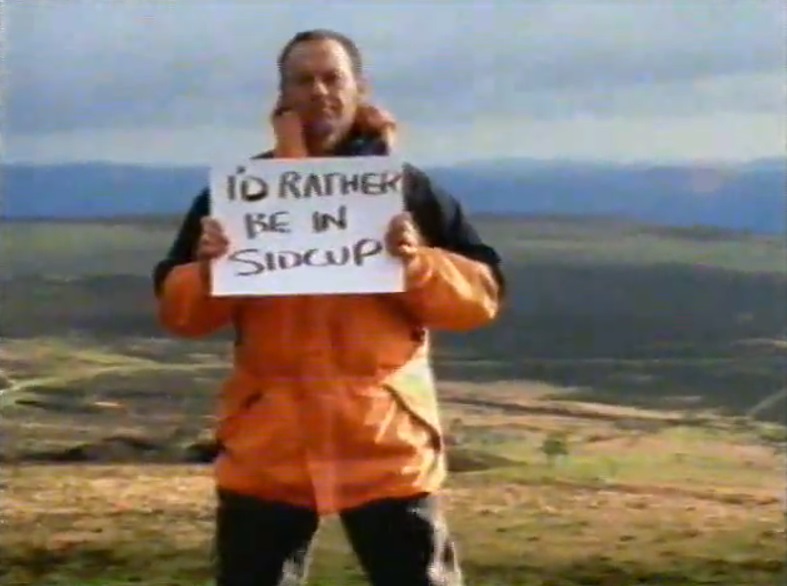
I could be in the minority, though. BMP DDB, who devised the campaign, likely selected the track for its nostalgic properties and because it has, for multiple UK generations, been a track associated with self-expression. "Left Bank Two" rose to prominence when it was used in the "Gallery" segments of BBC children's program Vision On (1964-1976), in which viewer-submitted artwork was showcased before the screen. The track became so iconic that it was retained for sequel series Take Hart (1977-1983) and Hartbeat (1984-1993), both presented by Tony Hart, who had co-presented Vision On, and for CBBC series SMart (1994-2009), which kept it relevant well into the 00s. Its appearance here is a clue that, just as those unassuming pencil sketches served as charming little windows into their young creators' souls, so too are the signs in the Golf campaign meant to be heartfelt statements on who their holders really are. In a way, my own interpretation seems perfectly fitting, since there is an extent to which the central joke of the campaign is very much at the viewer's expense. The nature of the signage is about subverting the narratives we might otherwise be inclined to project onto the subjects - the mismatch between what you see and what you get, as the tagline puts it. Some offer expressions of surprising vulnerability (the fisherman who complains of seasickness, the hiker who's reached the top of a rock formation only to decide that the experience is unfulfilling and he'd rather be in Sidcup). Other statements disclose traits that might not ordinarily be attributed to their authors, be they emotional (the "sensitive" nightclub bouncer), intellectual (the model with an IQ of 158 or, far more absurdly, the toddler who writes out a complex maths equation) or carnal (the very prim and proper woman in a supermarket car park who reveals her twin obsessions with chocolate and sex). Elsewhere, a businessman at a train station gestures to their fluid sense of identity, with the message, "At weekends my name is Mandy", the statement that most sharply encapsulates that discrepancy between how the subject presents for the sake of societal convention, and how they actually identify.

For these figures, the hand-written sign becomes a form of empowerment, a compelling shorthand for a secret being confided between the subject and the viewer, as an inner act of rebellion against the social constraints that would otherwise define them. Such defiance, the campaign suggested, made them soulmates of the Golf Mk4 itself, the humble exterior of which concealed a whopping 2864 improvements - as was boasted on the sign accompanying the vehicle in the closing image of each individual. I am aware of at least three different versions of the ad, each of which offered a slightly different arrangement of figures, and pictured a different character positioned beside the Golf at the end, as a further reinforcement of their spiritual alliance. In one, the bouncer. In another, the fisherman. In the third, the naturist who doesn't play volleyball.

The volleyball-shunning naturist stands out as by far the most puzzling of the subjects, given that the signage itself functions as a form of constraint that would at first appear to run contrary to the overall premise. Societal convention requires that she keeps her offending parts covered on daytime television, a purpose that her message, split across two strips of cardboard, conveniently serves. This does mean that she's denied the freedom of physical movement, lest the inoffensive arrangement be disturbed, a point emphasised by the highly animate nature of the other unclothed campers seen whizzing past on bikes and kicking footballs. Then again, her statement indicates that she wishes to be defined by her inactivity. Her dour expression, in contrast to the merriment unfolding around her, is a further indicator that she isn't the carefree, fun-loving naturist of stereotype. In one of the campaign's more touching situations, another subject, a man wearing a heavy frown, goes a step further and uses his sign, showing a drawing of a smiling face, to obscure his entire image, as a complete rejection of the outward narrative. He evidentially isn't great at expressing emotion, but wants you to know that he's a kindly soul within. (Did I say it was touching? The crude smiling face is honestly more disconcerting than the frown. But the gesture is noted and appreciated.)

The campaign was the cause of some controversy, when artist Gillian Wearing, a then-recent recipient of the Turner Prize, accused BMP DDB of having ripped off the concept from her 1992/93 project, Signs That Say What You Want Them To Say and Not Signs That Say What Someone Else Wants You To Say. In Wearing's case, members of the public were approached and given a marker pen and blank sign with which to create their own message. As with the Golf campaign, a large part of the appeal of Wearing's images lay in the disconnect between the subject and their selected statement - the most infamous had a well-dressed businessman holding a sign that said, "I'm desperate". Wearing contended that many of the scenarios used by BMP DDB were too similar to be coincidental (she felt, for example, that the nightclub bouncer holding up a sign that said "Sensitive" was evocative of her own image of a policeman holding up a sign that said, "Help"), but ultimately chose not to pursue legal action, citing a recent case in which director Mehdi Norowzian had sued Guinness and lost, following claims that their "Anticipation" campaign had borrowed excessively from his 1992 piece Joy. For their part, BMP DDB denied that they had stolen Wearing's idea, indicating that she was merely one of several sources that had fed their inspiration, (another being the iconic promo video to Bob Dylan's 1965 single "Subterranean Homesick Blues"). Myself, while I don't really blame Wearing for being cheesed off at what she saw, I think that some of the alleged connections are rather too tenuous to suggest transparent copying. I suspect that businessmen making "surprising" revelations were a feature of both because businessmen are an easy bunch to categorise as nondescript. A bouncer holding up a sign that says "sensitive" makes for a disarming image, but doesn't have quite the degree of troubling irony as a policeman holding up a sign reading "Help".  It would be inaccurate to suggest that the Golf campaign is devoid of social commentary (the ads are, after all, exercises in the unreliable nature of perception, and the toddler who's a maths whizz notwithstanding, there's no reason why the featured scenarios couldn't accurately describe any real-life people), but its main intention was presumably to be cute rather than challenging.

Regardless of whether or not the campaign pilfered its premise wholesale from Wearing, her objections highlight the other sense in which the joke here is ultimately at the expense of the viewer. As is noted by Russell Ferguson in the 1999 publication Gillian Wearing, "It is all the more painfully ironic...that the visual style of [Signs] has been repeatedly co-opted for commercial advertising - the epitome of signs that say what someone else wants you to say, of self-expression defined as your choice of commodities." (p.48) Whereas Wearing's work evokes the unpredictability and spontaneity of the everyday, the scenarios in the Golf campaign were entirely manufactured, and purposely designed to convince us that the ultimate form of self-expression is to buy a Golf. Just as the subjects' statements become shorthands for individuality prevailing in the face of society's preconceived notions, the Golf becomes a shorthand for their personal statements - to the point where there is nothing personal or individual about it. The apparent self-empowerment afforded to each figure, in getting to direct the course of their own narratives, inevitably steers us to the exact same conclusion, with the Golf Mk4 and its 2864 improvements. Still, with the sinister sauce of "Left Bank Two" at its disposal, it can scarcely fail to have its own eccentric vibe.

Thursday, 5 September 2024

Urban Deer (Canon Come and See)

In 2014 Jonathan Glazer teamed up with  JWT London for Canon's "Come and See" campaign, a series of ads encouraging us to get out there and gape at life's marvels, so long as we were gaping through the lens of a Canon camera. The first of Glazer's contributions, "Gladiator Football", was a wordless celebration of Florence's tradition of Calcio Storico (in a nutshell, a form of football thought to date back to the Renaissance era, in which players are expected to beat the living snot out of one another). It was a roaring, full-blooded snapshot of the action and intensity unfolding within the sporting arena, taking us closer to the drama than I suspect most casual spectators would care to venture. His second film, "Urban Deer", looks to have been purposely conceived as the very antithesis of that. This is spectacle of a meeker, almost furtive nature, characterised by its stillness and its quietness. Compared to the brightly-lit brawling in "Gladiator Football", this is a phenomenon that prefers to keep to the shadows, revealing itself only to those with the patience to see it. Turning its attention to Canon's capacity for capturing nighttime images, its subjects are the fallow deer that are a familiar seasonal sight in the Essex suburbs near Epping Forest, at times of year when the grassy verges offer more attractive grazing opportunities than the brambles in their woodland home.

The spectacle here comes from the mismatch between the natural and the artificial; immediately, the deer seem out of place beneath the relentless glare of the suburban streetlights, and sauntering over the patterned terrain of zebra crossings, but seem totally at ease in going about their business in these paved environs. The atmosphere (unlike that of "Gladiator Football") is one of total calm, offering few sounds beyond the patter of deer hooves on the asphalt and the background hum of wind and traffic. In lieu of narration we're left to draw our own conclusions about the significance of what we're seeing. Is it a testament to the adaptability of the deer, or does it say something about the tensions between human expansion and the balance of nature? Are the deer to be viewed as interlopers, or as reclaiming territory that was formerly theirs? There is, potentially, a haunting underpinning to the images - captured largely in silhouette, these shadowy cervines might be perceived as almost ghostly presences, the spirits of a bygone time and place long stripped away and buried beneath cement - but more perceptible still is the faint suggestion of quirkiness in the ad's presentation. Glazer's film seems to capture a feeling of dry humor in the very notion of deer making use of the most mundane features of human development. Take that wide shot of a deer approaching a zebra crossing, as though preparing to use it with as much confidence and casualness as any of the estate's diurnal residents. The film also incorporates what might be described as a comical interlude involving an intersection between three different species and their apparent indifference to one another. A strutting deer, scent-marking fox and cat in a hurry are observed moving along their own private trajectories, uninterested and unfazed by the others' presence (that running cat, a further symbol of convergence between the wild and domestic, makes for a priceless visual punchline). The film' slyest gag comes from a slight interference to its ambience - momentarily mixed in with the soundscape are the muffled noises of a logotone and the opening phases of what sounds like a news announcement, presumably the overheard noise from a television (or radio) in an adjacent living room. There's a sense of two spectacles competing with one another; the loud bombast of the television (or radio) purporting to offer our all-important window into the world, juxtaposed with the actual world as it exists right outside our windows.

Notable in "Urban Deer" is the total absence of any direct human presence, with all representation going to its technology and its architecture. The closest we come is in the vehicle seen disappearing into the distance at the start of the ad, before the deer feel safe to emerge from the greenery. This sets up a circular narrative, with the deer later scarpering to the sounds of a vehicle getting uncomfortably near, although the ad closes before it comes into view. It is in the intermittent presence of those vehicles that we get a sense of conflict, and of immediate threat to the deer (for all their adaptability, maybe this environment is not so ideal a place for a deer to linger), and the calm is accordingly broken. Once again, Man Was In The Forest, even if on this occasion the "forest" looks deceptively like our own turf.

As with many of these advertising ventures, you've got your choice between full 90 second version and the 60 second edit. Alas, the 60 second version makes something of a hodgepodge of the overheard television jingle.

Wednesday, 12 June 2024

Homer's Odyssey (aka Simpson, At Last We Meet)


My favourite gag in "Homer's Odyssey" (7G03) is the one that wouldn't even have qualified as a joke on its initial airing. This episode, only the third in the series' run, involves Homer losing his job at the Springfield Nuclear Power Plant and finding a new calling in spearheading a safety campaign against his erstwhile employers. It climaxes with Homer being invited to the office of the plant's bigwig, one C. Montgomery Burns, who's come up with an underhanded means of silencing Homer. "Ah, Homer Simpson," a glad-handing Burns declares, on coming face-to-face with his adversary. "At last we meet!" Truly the beginning of a beautiful friendship. What's so incredibly gratifying about this moment is the realisation that it would have meant nothing to those viewers who'd first tuned in to catch it on January 21st 1990. And yet for anybody who's gone back and watched it since, the line can't help but stick out like a sore thumb, seeing as it was the only occasion on which Burns could make that particular declaration and it be absolutely true. Ignore, for just a moment, any subsequent flashback episodes, like "I Married Marge" of Season 3 and "And Maggie Makes Three" of Season 6, which posited that Homer and Burns had met at earlier junctions in their lives. It wasn't necessarily the first time that Homer and Burns had crossed paths within the series' internal chronology, but it was the first time, so far as the viewer was concerned, that they were meeting. It's an ostensibly nondescript line, the significance of which could only be acquired retroactively, once the series had found the time to implement one of its strangest, most enduring running gags - Burns' baffling assumption, whenever he encounters Homer, that this is the first occasion on which he's dealt with this particular menace. They wasted practically zero time in getting it into motion; when Burns and Homer next met, in the following episode, "There's No Disgrace Like Home", Burns had already forgotten who he was. His selective memory blanking would only get all the more absurd as time went on, with he and Homer meeting every other week and the slate always being inexplicably wiped clean by the next. It's a gag that works on two levels - Burns' refusal to commit anything regarding Homer to his long-term memory is, on the one hand, a cruel denial of Homer's personhood, and of the notion that someone so lowly could have such a significant impact on someone as high in stature as Burns. But it's also a tongue-in-cheek denial from series of its own continuity; an acknowledgement that the characters cannot be allowed too much growth or self-knowledge, lest it threatens the very dynamics on which its perpetuation depends. Truth is, this denial is actually highly beneficial to Homer - if Burns had any awareness of what a persistent thorn in his side this one individual has been, he would have dealt him a harsh retribution a long time ago.

It doesn't stop there, however. There is yet another layer of juiciness to this particular snippet of dialogue, albeit one that's more accidental and much easier to miss without specific background knowledge on the series. For Homer would never meet this particular incarnation of Burns again, certainly not in such a head-to-head capacity. The Burns we see (or, more accurately, the Burns we hear) in "Homer's Odyssey", is a Burns from an alternate timeline, standing on the brink of a potentially very different trajectory for the series. I allude, of course, to the trivia that Burns wasn't always voiced by Harry Shearer; when production of the series was first underway, the showrunners had another man signed on for the role, by the name of Christopher Collins. Collins was already a highly experienced voice actor, having played such iconic 1980s cartoon villains as Cobra Commander in G.I. Joe and Starscream in Transformers. I'd imagine he would have been considered quite a catch for a fledgling series like The Simpsons. Unfortunately, it didn't work out, and Collins was dropped after recording lines for only a handful of episodes, reportedly because he rubbed people the wrong way. With Collins gone, Shearer replaced him as Burns, while a new voice actor, Hank Azaria, was hired and took charge of another role that had previously been allocated to Collins, Moe the bartender. "Homer's Odyssey" is one of only two Simpsons episodes in which Collins receives acting credits, and one of the few venues to preserve his performance as Burns. Or so it's widely accepted.

(Note that Christopher Collins was also known as Chris Latta, which is the name Transformers fans predominantly know him by. I believe that Latta was his birth name and Collins his stepfamily name, and he used both identities professionally. For the purposes of this review, I'll be calling him Collins, because that is the credit he used during his time on The Simpsons.)

I'll admit this is an issue I'm not 100% clear on. Over the years, I've seen a lot of conflicting opinion over whose voice it really is coming out of Mr Burns in "Homer's Odyssey". Some swear blind it's Harry Shearer, that Collins did originally record vocals for the character, but these were all dubbed over before the episode went ever to air, and if Burns' voice sounds in any way too scratchy or weird, we should chalk it up to the fact that Shearer, like everyone else, was still growing into his characters. I've seen at least one person claim that when "Homer's Odyssey" (and other early Burns appearances) first aired, they had Collins' vocals, but were subsequently re-dubbed with Shearer's for the sake of consistency and these are the only versions that exist now. Collins' name is, of course, retained in the credits, although in typical Simpsons fashion, it isn't stated what role(s) he's being credited for. The episode's DVD commentary is of little help on the matter, since Collins isn't mentioned at all (if there was that much friction between himself and the producers, then that's understandable; a DVD commentary isn't the place to be airing your dirty laundry about people you've clashed with). The commonly-accepted line, however, is that that is indeed Collins' Burns we're hearing in "Homer's Odyssey". IMDb credits him with the role; it also claims that he voiced Burns in "Simpsons Roasting on An Open Fire" and "The Tell Tale Head", although he isn't credited for either episode (Burns appeared in two other Season 1 episodes, "There's No Disgrace Like Home" and "Homer's Night Out", but I guess those performances were both Shearer's). If Shearer and Collins' respective takes on Burns really were that indistinguishable, then I'll admit that disappoints me; when I first heard that Burns was originally meant to be voiced by the man who did Cobra Commander, I'd imagined him sounding a lot closer to that character. There is, meanwhile, at least one other Collins performance that survives in the final mix, in "Some Enchanted Evening", as the presenter of America's Most Armed and Dangerous.

It should be noted that no such confusion exists over Moe. In his case it's accepted that all of his appearances (including "Homer's Odyssey") were re-dubbed by Hank Azaria before making it to air, and we can only speculate how Collins' take on the character would have sounded (I personally like to envision his Moe as sounding something like the Dalmatian he voiced in the movie Rover Dangerfield). Azaria weighed in on being hired as a replacement for Collins in a video interview given to GQ in 2018, although he didn't mention Collins by name:


"I didn't know til many years later, kids, that there was an original Moe the bartender voice that I replaced. I didn't know that! And I was like...that guy, you didn't like what he did? And Matt Groening was like, oh no, he was great. I'm like, so why did you recast him? (Groening said) like, he was just a dick. His voice was great, but he was just kind of jerky to everybody. Think about how awful like, that that guy could have been on The Simpsons his whole life. Lesson to you kids - always be nice!"


There's something about Azaria's statement, well-intentioned though is is, that just seems profoundly off. I agree with the general sentiment on always being nice, but it's the part about how Collins "could have been on The Simpsons his whole life" that bothers me. I'm going to hazard a guess that Azaria wasn't aware of this when he gave the interview, but Collins' "whole life" really wasn't that long. He died on June 12th 1994 from encephalitis. He didn't live to see The Simpsons' amazing longevity, nor to contemplate how he'd missed out on what could've potentially been a lifelong gig. He was only 44 years old. That is the kind of detail that gets me thinking, "How awful".

 
Christopher Collins, the orig on Evening at The Improv

All evidence points to Collins being ousted due to some degree of friction, but I'm inclined to take Azaria's testimony with a pinch of salt. Partly because he is only repeating what someone else had said to him (those probably weren't Groening's exact words, either), but partly because I've seen other claims (admittedly all stemming from internet hearsay) that it was specifically Sam Simon with whom Collins clashed, not absolutely everyone involved. Collins' fellow Transformers alumni have certainly indicated that he could be a something of a loose cannon (in the fondest possible way, mind you), but I've heard some pretty wild anecdotes about Simon too, so who knows what really went on between them? It's not like Collins is around to give his side of the story, or Simon for that matter.

The possibility that, had chemistry been more amenable, Collins would have stayed as Burns and Moe raises more "What if"s for the series than you might first imagine. We wouldn't simply have had the exact same show with a few different voices here and there. For one, Azaria might never have been hired had Collins' departure not left a vacant spot in the cast - in which case, various iconic characters that grew out of Azaria's unique talents, such as Dr Nick and Professor Frink, might never have existed. Instead, we could have seen some completely different supporting characters that were tailored to Collins' own strengths as a voice actor. Likewise, characters voiced by Dan Castellaneta or Harry Shearer might otherwise have gone to Collins, and received completely different vocal interpretations. The uneasiest question, though, has to do with how the series would have handled Collins' premature death. Given its nature, it's hard to see how his being retained as a Simpsons cast member would have made any difference. After a few years of voicing the characters, as opposed to a few scant episodes, Collins would presumably have found the time to develop each of his roles and make them his own, so swapping him out for another actor would have been a much more daunting process. Would Burns and Moe have been retired, along with any other characters he happened to voice, out of respect for the deceased Collins, as would happen with Doris Grau (for a time, anyway) and Phil Hartman? Or would Burns and Moe have been deemed too integral to the series to just be dropped? Obviously Grau and Hartman were sad losses, but their characters were basically peripheral enough that they could be phased out without creating too much disruption to the pivotal dynamics. The loss of a core cast member would have been more challenging to weather, to the point where you have to wonder if it might have cast doubts on how much life was reasonably left in the series. It's hard to speculate, because over the years The Simpsons has been so inconsistent in its handling of deceased cast members. With Grau and Hartman, I'm pretty sure that few people in the mid to late 90s envisioned the series going on for that much longer anyway, so quietly retiring their characters seemed the most sensible and tactful option. The loss of Marcia Wallace in 2013 led to her character being formally laid to rest within the show's continuity (in a manner clearly intended to conflate with Wallace's real-life passing). By contrast, Russi Taylor's characters were promptly recast following her passing in 2019. Grau's character, Lunchlady Doris, was eventually un-retired, with Tress MacNeille as her new voice, but was renamed Lunchlady Dora, in concession to the sad reality that the "Doris" part of her had long departed. It's a terribly morbid topic, I know, but one I've seen come up with increased frequency in recent years, with the awareness that a lot of the cast aren't getting any younger and the series having seeming ambitions of remaining an unstoppable force for decades to come. For now it will likely remain a matter of crossing that unfortunate bridge when they come it. Sobering to think that, had Collins stayed, they might have crossed it thirty years ago.

Irrespective of who voiced him, it's clear that "Homer's Odyssey" was intended to be our introduction to Burns as a character, and that's a purpose it effectively still serves. He'd previously made a brief appearance in "Simpsons Roasting on An Open Fire", the first episode aired (if not produced), and it was his heartless denial of a seasonal bonus to the plant's blue collar workers that kicked that particular story's conflict into motion. This, though, feels like the first time we'd gotten properly acquainted with the magnitude of his malevolence, and the chilly shadow he casts over not only his workforce, but Springfield as a whole. Burns has only limited screen time in "Homer's Odyssey"; he doesn't appear until the third act, nor does the build-up ever mention him by name. When the children of Springfield Elementary take a field trip to the plant at the beginning of the episode, Burns doesn't greet them in person, but sends his PA Smithers (who's looking distinctly off-colour in his first onscreen appearance) to deal with them on his behalf. When Homer is fired, it's not by Burns himself or even by Smithers, but by some random nobody slightly higher up the ladder (well, not quite so random in that he's established to be the father of Bart's classmates Sherri and Terri, but I don't think we ever saw him again). And yet when Burns does finally appear, it feels as if he's always had a very active role in these events, an omnipresent threat lurking persistently out of sight, surveilling the masses below for any indication of weakness or insubordination. His introductory sequence shows him doing exactly that, panning upwards to reveal him glowering over the tiny figures in Homer's rally and looking eerily inhuman, even for early Season 1 when backgrounds and crowd scenes were all swarming with the most outrageously freakishly-designed of extras. Often, Burns' hunched posture and hooked nose give him an avian appearance, like a buzzard preparing to swoop down on prospective prey, but here I'd go a step further and say that the exaggerated emphasis on his cranium has him looking positively alien (foreshadowing the ending to "The Springfield Files" seven years before the fact). I'm put in mind of those Martians from The War of The Worlds who spent a long time watching humanity and drawing plans against them.

"Homer's Odyssey" was definitely the most ambitious Simpsons episode to air at this point, having its sights less on surveying the Simpsons themselves than on the world around them and the family's place within. It feels like the first real attempt to explore Springfield as a character in its own right, a sure sign that the show was already feeling confident enough to start branching out from the more limited storytelling possibilities of the Ullman shorts, in establishing a fully functioning community beyond the Simpsons' doorstep. It's for this reason that the first act plays, deceptively, like a protracted bit of plot misdirection. You'd be forgiven for initially assuming that this was going to be a Bart-centric episode - the school field trip takes up the first seven minutes, and only as the first act ends does it become apparent that this is actually going to be Homer's conflict. But those early moments with Bart and co are hardly filler, since they do a lot to establish exactly what it is that Homer will be fighting for much of the episode. The bus journey alone between the school and the plant, which encompasses the town's toxic waste dump, tyre yard and prison, reveals everything that's sordid and depressing about the Springfieldian soul (in the one the script's biggest WTF moments, we hear that the school's previous field trip was to that last venue). The kids wave gleefully to each of these establishments, seemingly desensitised to the grim implication that they represent the various possible futures awaiting them after leaving school - although the nightmare scenario of never escaping the school system in the first place (the driving conflict of the forthcoming "Bart Gets an F") is also evoked when Otto's odd idea of a shortcut takes them back past the school. Along the way, we get to know a few more of Bart's classmates, and further banes of his academic existence. In the spotlight this time are the devious twins Sherri and Terri, supplements to Bart's ever-increasing stockpile of antagonists (a role that, other than a scene in the aforementioned "Bart Gets an F", where they deliberately feed Bart the wrong test answers, they never went particularly far with) and Wendall, a quiet and unassuming kid for whom Bart expressly has no ill will, but whose perpetual queasiness makes him a nightmare to be seated next to on turbulent bus rides. Hard relate there.

The real behemoth of the episode, though, is the plant itself. It represents the grimmest of all possible futures, and everything toxic and inescapable about Springfield in the present. "Homer's Odyssey" establishes the plant as a dominating force not only in the Simpsons' own lives, as Homer's place of employment, but for the town as a whole. It looms over Springfield, an ugly, ominous, polluting beast run on incompetent labor and unethical business practices. While a Level 7 disaster waits in the wings, the plant is already poisoning the town, slowly and insidiously, as signified by the appearance of Blinky the three-eyed-fish, who'd play a more central role later down the line in the Season 2 episode "Two Cars In Every Garage And Three Eyes On Every Fish". There is, all the same, an extent to which that terrible plant is nothing more than a warped reflection of what's already corrupt and polluted in the town's collective psyche. Springfield in general is run on incompetence, and there's not a lot that its various authorities can do right - we get a taster of this during the town meeting, when Chief Wiggum, in his debut appearance, gives an update on the situation with the mysterious graffiti artist "El Barto" and has drastically failed to comprehend the nature of what he's up against ("El Barto" is yet another early detail that I don't think went anywhere in the series proper, although it was the basis of a few comic book stories). Homer makes an even bleaker discovery, that the town at large has a problem with simply not caring about its fellow residents' welfare. The characters who best encapsulate this pervasive negligence are the Winfields, the elderly couple who lived alongside the Simpsons and were keen on passing judgement on them, until they were formally written out of the show in the Season 4 episode "New Kid on The Block". In their first appearance, we find them seated out on their porch late at night as Homer staggers by, having tethered himself to a boulder with the intention of throwing himself from the Springfield bridge. The possibility that Homer might be looking to kill himself explicitly occurs to them, but they can't decide if he isn't just taking the boulder for a walk. Either way, they don't seem particularly concerned. Much as his neighbours are gleefully aloof, his ostensible allies are casually cruel; a cash-strapped Homer was earlier refused a drink on credit by Moe, who informs him that he has zero confidence in his prospects of finding another job and ever paying him back. "Don't worry, we're still friends", Moe adds, as if that means anything at all.

Homer's desperation for a Duff beer, with its promise of temporary refuge from his unemployment woes (expressed through the Siren song of the chattering cyclops [1]), is what prompts him to take drastic measures and raid Bart's piggy bank in the hope of scraping together enough change. When this fails, Homer concludes that his family would be better off without him; hence, he straps a rock to his body and heads dejectedly for that fateful bridge. It's this particular plot point - Homer's suicide ideation - that I suspect tends to throw some viewers off about "Homer's Odyssey", which in my experience seldom seems to be anybody's favourite of Season 1, an already undervalued batch of episodes in general. Having Homer desire to kill himself is a manifestly extreme direction in which to take his unemployment arc - as a narrative choice it was certainly bold, although tonally it gets a little ambiguous, with it not always being obvious where the levity is intended to lie and where the genuine pathos. Take the suicide note Homer scrawls out to his family (on a sticky note with the header "Dumb Things I Gotta Do Today"), which includes the statement, "I can only leave you with the words my father gave me: stand tall, have courage and never give up". Are we meant to find it sad or hilarious that Homer himself clearly doesn't see anything worth heeding in those words? (Mostly, I just find it hard to envision Abe saying anything so encouraging to Homer.) Homer's chosen method of death is also cartoonishly impractical, a measure conspicuously designed to keep the attempt from feeling too real. It's a tough tightrope the episode has to walk. We're not supposed to take Homer's ideation overly seriously, but not so lightly that we're immune to the Winfields' callousness.

The one aspect of the episode that definitely feels dated now concerns the minor plot point of Marge stepping up to support the family while Homer looks for work, by returning to her old waitressing job. It doesn't go any further than a single sight gag (the revelation that Marge is a roller carhop), but there seems to be a regressive assumption that Marge becoming the family breadwinner is a further indication of Homer's failings as a patriarch (Homer basically cites as much as a reason for accepting Burns' job offer at the end). The expectation that Marge would give up her job immediately after marrying makes more sense later on, with the revelation that she was heavily pregnant with Bart at the time, but here it feels like an old-fashioned supposition even for 1990. Despite taking such an active role in family proceedings, her narrative function is essentially passive - three episodes in and Marge's characterisation remained quite wishy-washy, her ill-suppressed agitation at Otto's rudeness being the only foreshadowing of her latent fire. The dynamics of the Simpson clan are not, in general, at the narrative forefront, but Homer's relationship with his family provides the emotional grounding throughout, in that all he wants is to do right by them and live up to the responsibilities he sees as unquestionably his. At this stage, the relationship between Bart and Homer was still the most prominent and developed of all the family connections, and there is a through line of Homer feeling particular shame wherever he's screwed up in the eyes of Bart. What makes Homer's firing at the end of act one particularly hard to bear is that it happens in front of Bart. In act two, it's not Homer's failure to find employment per se that brings on his suicidal despair so much as the realisation that his alcohol cravings have caused him to actively wrong his son. And when his family follow him to the bridge to intervene with his attempt, and Homer instead saves them from being hit by a van on the hazard-filled street (all while still being tethered to his boulder), it's the fresh understanding that he needs to secure them a safer environment that convinces Homer his life is worth living. He campaigns to have a stop sign installed on the road, and on discovering how unopposing people are of the motion, vows to keep fighting for additional safety signage the town over. Eventually, he gets emboldened enough to take on the big dogs in the form of that monstrous nuclear power plant, having realised that his gestures for a safer Springfield are all futile whilst they're living in its tyrannical shadow. Homer knows, better than anyone, how dangerous that place is, because he's been on the inside. As he puts it: "Our lives are in the hands of men no smarter than you or I, many of them incompetent boobs. I know this because I've worked alongside them, gone bowling with them and watched them pass me over for promotions time and time again. And I say this stinks!"

The title of the episode, in addition to getting a particularly obvious cultural reference out of the way (if you've a character named Homer, then it's basically law that you'll have to acknowledge The Odyssey at some point, much as you'll have to get in a pun on the Mona Lisa if you've a character named Lisa), alludes to Homer's journey to reclaim his self-respect after being pushed to his very lowest ebb. He goes from being deemed unemployable, derided by his neighbours and refused a favour by a self-proclaimed friend to being cheered by the entire town (other than on the measure of implementing a 15mph speed limit on Main Street; there are a number of audible boos when it's cited by an extra who could be a proto Ned Flanders). Having taken heed of the town's fatal lack of regard, Homer aspires to seize control of it and remold it in his more conscientious image. This ultimately means going head-to-head with Burns, who may as well be the human (though just barely) manifestation of the callousness that's characterised the town up until now - in that respect, he and the plant are practically the same entity. When Homer is summoned to Burns' office for that decisive collision of wills, Burns lays down the ultimate Faustian bargain - he will hire Homer as the plant's new safety inspector, on the condition that Homer immediately steps outside and assures his legions of supporters that the plant poses no threat to them. Burns recognises that being cut loose from the plant workforce is what gave Homer leeway for his rebellion, and that a sure-fire method of neutralising the man is to bring him back under his thumb. And Homer recognises that his becoming safety inspector is the very sort of critical absurdity he's just been explicitly lobbying against - with his prior track record, he's the last person qualified for that position. Faced between the principles on which he's built his newfound self-respect, and the temptations of job security, Homer chooses the latter, although he does a little arm-twisting of his own, wheedling Burns into allowing him to conclude his campaign on his own terms. Instead of assuring the town that the plant is safe, Homer urges them to protect themselves independently. He states that he's going to have to live without their respect and awe, an admission that he might have forfeited his right to such things, but the rally happily receives the news that he's been appointed safety inspector as nothing less than the fitting conclusion to the narrative in which they've been eagerly invested - even as Homer slips in the obviously self-serving detail about the job coming with a boosted salary.

That's another thing that potentially throws people off about this episode - the ambiguous ending. Is it a happy ending or isn't it? Outwardly, it has all the trappings of a triumphant deliverance, with Bart proudly acknowledging Homer as his father, and the episode coming full circle from the mortal embarrassments of that first act. It's an equally nice touch that the Winfields, who previously wouldn't lift a finger to help Homer, are now among the people cheering for him. Still, there's little dancing around the fact that is is Burns who comes out on top. His one concession is in failing to secure Homer's leverage for selling the public a positive image of the plant, but he is able to make the opposition go away, which seems victory enough. The townspeople are certainly no safer than they were before, and are potentially worse off with Homer overseeing the plant's safety procedures, yet they clearly think they've won. There's a level on which writers Jay Kogan and Wallace Wolodarsky appear to be skewering the mindlessness of the town's mob mentality (a topic that would come up a whole lot more frequently with Springfield), and our own desire for a happy ending, however facile. On another level, we are being invited to identify with Homer's struggle, and the sincerity of his desire to better both himself and the world around him. He heads to his new position with a thread of that sincerity still intact, however dubious it seems that he'll be capable of putting it into practice. Homer himself implores, "You have to learn that there's a little Homer Simpson in all of us," ie: basically fallible, but navigated by the best of intentions. The ending of "Homer's Odyssey" accepts that as a cause for celebration in itself.

We wrap up now, with Saturday Morning Rewind's tribute to Christopher Collins.

 [1] Has anyone tried to make the events of this episode correspond with the actual Odyssey? You know, just for fun?

Thursday, 18 April 2024

The Case For Sidney's Family Tree (aka Knighty Knight Bugs Is A Stupid Cartoon)

There have been many, many contentious Oscar rivalries across the decades, but few quite so endearingly offbeat as that between Looney Tunes mega star Bugs Bunny and Terrytoons newcomer Silly Sidney the elephant, who in 1959 went against each other for the Academy Award For Best Animated Short Film (or Best Short Subjects, Cartoons, as it was then known). Actually, when Bugs' entry, Knighty Knight Bugs, triumphed and Sidney's Family Tree was sent away empty-handed, I doubt it was considered a terribly earth-shattering outcome from anyone within the industry. After years of languishing in the shadows of Disney and MGM, Warner Bros were increasingly becoming the studio to beat for Short Subjects; Knighty Knight Bugs represented their fifth overall win, four of which had occurred within the past decade (Knighty Knight Bugs would prove to be the last of their victories, as the 1960s were a spectacularly unkind time to the Looney Tunes, and to theatrical animation in general). Terrytoons, meanwhile, seldom had their shot at Oscar glory, with Sidney's Family Tree being only their fourth nomination in the history of the award, and the taste of victory was consistently denied them. In the years that followed, it seems unlikely that many people lost sleep over the match-up, or even gave it a second thought. And then, 31 years after the fact, it suddenly gained retroactive notoriety, when it became the basis of the Tiny Toon Adventures episode, "Who Bopped Bugs Bunny?" It was 1990, and Sidney was back from the abyss of obscurity...in a manner of speaking. The elephant in question went by the name of "Sappy Stanley" and his character design was given a grotesque modification, courtesy of John Kricfalusi, so that his mouth was located inside his trunk. It was patently obvious that this was meant to be Sidney, however. He was still bitter about losing to Bugs after all these years, and apparently vindictive enough to kidnap the rabbit and steal his Oscar (or Shloscar, as it was called in-universe), setting Daffy Duck up to take the fall along the way - a startling turn of events for an elephant who, in his original series of shorts, was never depicted as having a mean bone in his body. [1] That's what the sting of losing to Knighty Knight Bugs had done to him!  This portrayal of Sidney (sorry, "Stanley") was voiced by Jonathan Winters, and for an entire generation of children (yours truly among them) he would have been their introduction to the character. And what a first impression! Casting him as a villain with such a vicious axe to grind might seem like a terribly mean-spirited move (this was, after all, a written-by-the-victors scenario, with Warner Bros mocking a character they'd already defeated once), but they made a singularly cool antagonist out of the neurotic elephant. Far from defiling Sidney's legacy, they gifted it with a fun and affectionate new twist.


When confronted by Babs and Buster, Stanley's justification for his crimes was that he deserved the award by right for good taste, since "Knighty Knight Bugs is a stupid cartoon". That's a sentiment to which I am honestly very sympathetic. While I wouldn't necessarily go so far as to call Knighty Knight Bugs "stupid", I do find it astonishing to think that the ONLY Oscar of Bugs' entire rich career was for this cartoon. They couldn't have picked a more pedestrian, more middle of the road example of his work if they'd tried. There is nothing outstanding about it other than that it happens to be Bugs Bunny's sole Oscar win. That it won the award while the phenomenal What's Opera, Doc? (1957) wasn't even nominated a year prior feels like a sick cosmic joke in itself. But then nominations for Bugs shorts were surprisingly sparse in general - only two shorts, A Wild Hare (1940) and Hiawatha's Rabbit Hunt (1941) had previously attained the honor. The success of Knighty Knight Bugs is a blatant example of the Academy handing out a win not on the merits of the nomination itself, but in compensation for their having overlooked a body of much stronger works to an artist's name. On that basis, I think Sidney/Stanley has every right to feel aggrieved.

Could Sidney's Family Tree actually have beaten Knighty Knight Bugs in a battle based solely on the respective merits of each cartoon? Here's where Sidney's Family Tree would still be at a hot disadvantage - there is little getting around the fact that the animation in Knighty Knight Bugs is of a considerably higher quality than that of Sidney's Family Tree. Terrytoons was, after all, renowned for doing things on the cheap. Studio founder Paul Terry infamously cared more about the quantity of his output than the quality and never had any pretensions to making serious art. Sidney himself came about as part of a new wave of Terrytoons characters created after Terry retired in the mid-1950s, leaving his studio in the hands of Gene Deitch (remembered chiefly for his infamous run of Tom & Jerry shorts in the early 1960s). Deitch's strategy had been to move away from the studio's existing store of characters (Mighty Mouse, Heckle & Jeckle, Little Roquefort & Percy) in favour of implementing new blood, and with only a fraction of the budgets of his already notoriously frugal predecessor. A former apprentice of United Productions of America, Deitch applied that studio's approach of limited animation against basic, undetailed backgrounds (techniques that would prove instrumental with animation's impending shift to being a medium of television) [2]. And lo, the look of Terrytoons got even cheaper. A second's glance at Sidney's Family Tree would clue you in that this was a considerably less prestigious production than Knighty Knight Bugs.

Likewise, it is important to acknowledge that the competition for Best Animated Short of 1958 was hardly a two-horse race, three contenders being the category's bare minimum. Sidney had not just the heavy-hitters at Warner Bros to worry about, but Disney too. The also-ran who's largely been squeezed out of this discussion is Paul Bunyan, the House of Mouse's take on the overgrown lumberjack of American folklore. But then again Disney, the undisputed kings of this award in the 1930s, had fallen quite vastly out of favour by the 1950s. Toot, Whistle, Plunk and Bloom (1953) was their only win for Best Animated Short that whole decade. At a hefty 17 minutes, Paul Bunyan was certainly the most epic short in contention that year, although that might even have worked against it. It goes on a long time and offers rather a wishy washy pay-off. I can see why Academy voters might have felt underwhelmed by it. Whatever their shortcomings, Knighty Knight Bugs and Sidney's Family Tree do have the virtue of being short.


Somehow, it's my impression that 1958 wasn't the strongest of years for short animation, and Academy voters weren't exactly left with an embarrassment of riches at the end of it. They had their choice of the mediocre Bugs Bunny cartoon, the interminable shaggy dog story from Disney, or the unassuming, frugally-animated short about the unknown elephant. "Oh jeez. Well, everyone loves Bug Bunny, and this is his first nomination in 17 years. Let's just give it to him now while we have the chance, and take a load off our consciences." It's not fair, but it's where we are.

Am I really poised to argue that Sidney's Family Tree was the worthiest of the three nominees after all? I'm sure that part of the joke, in Tiny Toon Adventures, was in Sidney/Stanley ever seeing himself as a serious contender to begin with. And yet where Sidney's Family Tree is at an advantage, at least in my eyes, is that, unlike Knighty Knight Bugs, it actually feels like it's about something. That something being neediness. The characters have a loneliness and a vulnerability that makes them endearing, even if it exists largely within the subtext. It may not be the most technically accomplished of the three entrants, but is the one to which I am the most warmly-disposed.

Sidney's Family Tree was only the second of Sidney's adventures (he'd made his debut earlier that same year with Sick, Sick Sidney).  Directed by Art Bartsch, it follows Sidney (voice of Lionel Wilson, better known to modern viewers as Eustace from the early seasons of Courage The Cowardly Dog) in his efforts to find himself an adoptive family. The whereabouts of his biological parents are accounted for in a verse recited by Sidney during the opening credits; they joined a circus and left him alone in the jungle. Initially, his plight is met with little sympathy by the other animals, who remind Sidney that he's 44 years old. Which is one of Sidney's main running gags - his crippling anxieties about having to live in the adult world whilst being a perpetual kid at heart. And really, who couldn't relate to that? The guy's cast off and alone in the world, being in his 40s doesn't preclude him from still not having a clue what he's doing, and all he yearns for is a whisker of emotional security and validation. He tries taking his case to a passing hippo and giraffe, but gets brushed aside in both cases. They've already got offspring of their own, and don't have time to be indulging a neurotic elephant on the side. (The giraffe, incidentally, is named Cleo, and she would become a recurring character in Sidney's subsequent cartoons. For now, Sidney addresses her only as "Mrs So-and-So", which probably isn't going to score him many points in the courtesy leagues. She seems to know exactly who he is, however.) 

Sidney's luck changes when he runs into an animal also looking to fill an emotional void, a female chimpanzee who's desperate for a baby of her own, but doesn't have one. She eagerly agrees to be Sidney's adoptive mother, but her mate isn't so thrilled when she breaks the news that this two-ton elephant manchild is moving in with them. It's through what's implicit in the chimpanzees' interactions that the short adds a dash of hidden substance to its subtext. The male chimpanzee is every bit as keen to start a family as she is, and when she indicates that they've made good on that aspiration, his immediate assumption is clearly that she's pregnant. This is even reinforced with a cheeky subliminal visual gag, wherein he joyously squirts an obviously phallic banana out of its skin on thinking that he's finally managed to sire offspring of his own. It's not a point that the script particularly lingers on, but it's easy enough to read in between the lines and interpret the chimps as a couple who want to procreate, but haven't had much luck with the conception process. The female chimp sees Sidney as the answer to their problems, but the male isn't so willing to accept him as a baby substitute. The interplay between Sidney and his grudging adoptive Pop is where most of the narrative focus lies, as he first attempts to cope with the arrangement and then aspires to get rid of Sidney, but it also takes the time to establish a bond between Sidney and his mother, incorporating a tender moment where she knits him a trunk cozy and bids him a good night. The connection between the two seems heartfelt enough that you genuinely feel a sense of her pain at the end, when her mate announces that Sidney is out of their lives for good.

Sidney's Family Tree is an extraordinarily gentle cartoon. Possessing neither the loftiness of Paul Bunyan nor the anarchic aggression of Knighty Knight Bugs, it coasts along considerably on basic geniality. The very darkest thing that happens is when Sidney's adoptive father attempts to ditch him by trapping him inside a cave, which he obviously doesn't get far with. Even the frugal production values, and the all-round lack of technical sophistication, come together in ways that play to the film's merits. The plain, predominantly yellow backgrounds dusted with crude floral outlines are barebones as can be, yet they radiate a warmth and vibrancy. Phil Scheib's flute and percussion score is repetitive, but adds to the soothing ambience of the piece.

Sidney remains too naive and trusting to ever cotton onto the fact that his adoptive father doesn't want him around, interpreting his hostility as tokens of affection. His priorities seem to change, however, when a female elephant happens to wander past and catch his eye, and Sidney is compelled to follow after her, seemingly forgetting about his simian kin. The male chimp is giddy with delight, attempting to sell the outcome to his heartbroken mate as a case of nature running its course, an empty nest an inevitability she signed up to when she chose to take on a baby. His relief proves to be short-lived; as it turns out, Sidney still has no intention of taking his place within the adult world, reaffirming his commitment to his protracted childhood by inducting his new mate Hortense into the fold. The elephants show up at the chimps' tree and announce that they'll be moving in with them until they find their feet (as if that's ever going to happen). Sidney believes that they make the nicest family in the jungle, and while the closing visual gag, in which the branch collapses under their combined weight, would ostensibly undermine that, what's important is that they all go down together - a chaotic and unconventional unit, but ultimately as valid as any other, connected firmly by the basic need to be needed on both sides. I'm sure the male chimp will come round eventually (or maybe not - later Sidney shorts appear to indicate that Cleo the giraffe wound up becoming his parental figure after all, along with a lion who was ironically named Stanley).

Sidney's failure to beat Bugs to the Oscar did not deter him from enjoying a prosperous enough run of shorts. His cartoons continued up until 1964, by which point he had made the transition from theatrical animation to television (such were the changing times), finishing up his career as a supporting segment on The Hector Heathcote Show. Since then, he hasn't exactly remained at the forefront of public consciousness (few, if any, Terrytoons characters honestly have in the 2020s). An elephant never forgets (nor forgives, as his thinly-veiled resurfacing on Tiny Toon Adventures would bear out), but the world forgot Sidney long ago. His 1990 grudge match against Bugs, Babs and Buster, far from being a mean-spirited dig, was a real shot in the arm of relevancy for a character who'd been otherwise consigned to stagnation. My only regret is that they restricted Sidney/Stanley to that one episode and he did not become a recurring nemesis for the Tiny Toons gang. It was not, however, his last hurrah - Sidney was a featured character on Curbside, an attempted Terrytoons revival project made by Nickelodeon in 1999, in which he was voiced by Dee Bradley Baker, although this never got further than the pilot. As to whether we'll ever see Sidney again, who knows? Paramount Pictures currently owns the rights to the Terrytoons characters, but don't appear to be doing a great deal with them.

At the very least, Sidney has an Oscar nomination to his name, and that's something that can never be taken away from him. It's also one more Oscar nomination than Daffy Duck ever received (sad, but true).


Now if Tiny Toons Looniversity would just do something as awesome as to bring back Sappy Stanley, it might even be worth my while to watch it. So far as I can tell it hasn't happened, so the revival gets a hard pass from me.

[1] Although a latent dark side was arguably hinted in the short "Meat, Drink and Be Merry". This is the one where Sidney attempts to become a carnivore, and the way it plays out is so weird and unsettling, like he's aspiring to be the neighbourhood serial killer.

[2] Mind you, while Terrytoons never won this award, there was precedent for UPA doing so twice, with the Mr Magoo shorts When Magoo Flew (1954) and Magoo's Puddle Jumper (1956).

Thursday, 29 June 2023

It Sucks To Be Me #6: Hard Cheese (Survival)

 
We come now to the final edition of Survival, and one of only two contributions by John Norris Wood (here supplying text and photography but not the illustrations, which are credited to Derick Brown). And "Mouse" is, honestly, a pretty good note to bow out on, not quite up there with "Squirrel" and "Otter" but still one of the series' stronger titles. On the whole, I found the level of challenge to be relatively easy, but thoroughly satisfying. Coming off the occasional arbitrariness of Wood's previous effort, "Frog", the death endings in "Mouse" (we're back to a total of six once again) are all perfectly well-incorporated and readily attributable to faulty thinking on your part. There's not a lot about the gameplay of "Mouse" that' especially innovative, but it gets the job done fine.

Above all, I give "Mouse" credit for being possibly the quirkiest installment in the Survival series - there is at least one choice (possibly two) you can make where the outcome appears to be something of a joke. Something I likewise find endearing about "Mouse" (besides the murine-orientated content), is that it is the Survival edition in which your player animal comes the closest to conveying something of a personality. I get the impression that this mouse is a proper little scrapper, and that feisty, determined spirit makes it hard not to warm to it as your murine manifestation. As with "Frog", you're playing as a very small animal, and there is naturally a lot of emphasis on how vulnerable you are, in a world where everything seems dead set upon devouring you, or at the very least beating you up and taking your food stores. And yet I would say there is just as much emphasis, if not more, on how surprisingly tough and capable you are of meeting the challenges that world throws at you. Being a small animal does not make you a pushover, and "Mouse" contains a lot of situations, probably more than any other edition of Survival, in which you're prompted to make bold decisions on whether it's advisable to stand and confront something that could potentially deal you a wad of damage. Do you take on a marauding squirrel? A legless lizard? A hive of bees? A cartoon-friendly mousetrap? Where are you inclined to draw the line? Part of the allure of the Survival series is in the fragile barrier it so elegantly (and harrowingly) depicts as fluttering between life and death, but "Mouse" equally provides a crash course in what a deluge of adversity you're capable of living through.

If I have one nitpick with "Mouse", it's that Wood doesn't make compelling use of the game's points system, in either of his contributions, but then this was something that Tabor before him was really inconsistent with. "Fox" and "Squirrel" were the only two in which it was possible to lose points for non-fatal mistakes - with every other book, so long as you keep advancing through the narrative, you'll gain points, only losing them if you run into a death ending. And the number of minus points allocated for each death, while ideally reflecting the obviousness of your misjudgement, also seem kind of arbitrary in practice. Personally, I was always invested in Survival for primarily the narrative/puzzle element, and found the points aspect really hard to give any attention to. Maybe it's more fun if you're looking to compare your results with a friend's, as the introduction suggests, but I am a lonely Survival-ist.

The points system does have one practical application in "Mouse", however. One of those aforementioned aggressors you can either fight or flee from - Wood actually gives you contradictory information with each potential outcome, suggesting that both choices were perfectly valid responses. One scores you twice as many points as the other, however, making it obvious which you should have gone for.

One last time, then. What horrors and wonders await our intrepid murine explorer as they venture into the big wide open? Click below for all of the answers. But a word to the wise - I personally found "Mouse" the easiest and cheapest edition of Survival to get a hold of, so I'd recommend you look into sourcing your own copy before spoiling.