I suppose I'm unusual in that my own first-hand experience with the short-lived clear cola craze of the early 1990s was rooted exclusively in Tab Clear, ie: the contender that generated zero nostalgia and, as per later revelations, was never built with longevity in mind. Its principal rival, Crystal Pepsi, might have suffered a swift demise by '94 but has clung to a degree of relevance as a fuzzy cultural memory from a bygone era - enough so to have eventually become the subject of several internet petitions, which in turn led to a series of limited revivals in recent years. Tab Clear, meanwhile, remains stranded in Stagnation Ville, a mere footnote in the Crystal's more illustrious (by comparison) career, albeit one that certainly left its mark. Nowadays, it's public knowledge (thanks to the divulgings of ex-Coca-Cola marketing officer Sergio Zyman) that Coca-Cola formulated Tab Clear not with the intention of competing with Pepsi's hot new product, but of nipping it in the bud - the idea was that you would see this uninspiring product on the shelves beside Crystal Pepsi, assume they were all much of a muchness and bypass them altogether. That's why they used the lesser Tab brand, and not Coca-Cola, so as to not risk muddying their flagship beverage with another high-profile fiasco, following on from the then still relatively recent business with New Coke. What made the Tab (or TaB, if you prefer) juxtaposition particularly lethal to Crystal Pepsi was that Tab was a sugarless drink whose particular market niche had already suffered a severe diminishing with the introduction of Diet Coke in 1982. Pepsi's strategy revolved around promoting a sense of wellness in a way that circumvented the usual ignominy of being a diet cola - its great boast, from a nutritional standpoint, is that it was caffeine free (the idea behind the clear cola fad being that consumers were intended to associate clarity with purity, regardless of how much merit there was in that particular equation) - whereas Tab Clear was only too eager to hype up all of the attributes that made a cola appear strictly for the calorie-conscious, with "Sugar Free" and "Calorie Free" being right there in big bold lettering upon the side of the can. Coca-Cola set out to sabotage Pepsi's clear revolution by wilfully producing a soft drink to look as uncharismatically dorky as possible, and apparently it worked like a charm. Not that dumb and not that smart, say you?
And there's an extent to which all of that leaves me with quite a bitter taste in my mouth, because as a child I was positively enthralled by the novelty of Tab Clear, a product whose own creators, unbeknownst to me, regarded as ingeniously lousy, and were busy basking in their own duplicitous cleverness right while I was pestering my parents to buy me a bottle. Crystal Pepsi had slipped right under my radar, but Tab Clear felt like big news - a soft drink that tasted (somewhat) like Coca-Cola, but was incongruously transparent. At the same time, there was something about the beverage that struck me as somehow profoundly unnatural. Its very existence seemed like a freaky distortion of the laws of reality. It's so-called purity - the fact that we were being called to regard sugarless and colourless as synonymous - struck me as somewhat hard to swallow. Tab Clear was not a product I especially trusted, and yet my morbid curiosity compelled me to swig the dubious substance into my digestive tract anyway. My fascination was intense, but short-lived, and I'm not convinced I even noticed when the product was quietly withdrawn from the market soon after. But for a moment there, it really had me.
With hindsight, it's not exactly a mystery as to why Tab Clear should have caught my eye while Crystal Pepsi didn't - the former's ad campaign was significantly stranger. And for a product supposedly earmarked as a sacrificial lamb from its conception, I was certainly bombarded with ads for Tab Clear incessantly enough throughout the spring of '93 - in particular, the one claiming that Bigfoot, as glimpsed in the infamous and much-debated Patterson-Gimlin footage, was really German emperor Kaiser Wilhelm II, on the run from the fall-out of World War I and leading a secret life as a tourist attraction in the Oregon wilderness (not actually where the Patterson-Gimlin footage was filmed, but perhaps that's unimportant), and that Tab Clear was supposedly at the centre of life's sticky web of perpetually unravelling chaos. It seems a world apart from the Crystal Pepsi tactic, which was to roll out as much cheerful imagery and trite reassurances ("Right now only wildlife needs preservatives") the average eyeball could take to the sounds of Van Halen's "Right Now" (the premise of the ad, with its use of evocative subtitles, was modelled upon the song's original music video). Pepsi's campaign was built on an overflow of colour (somewhat ironically, given the product's most prominent attribute) and on the exaltation of a glorious present where anything was possible, while Tab Clear looked back to the unsightly mess that is human history, played with a tongue-in-cheek fondness for urban legends and conspiracy theories, and steeped in a sense of flippant paranoia. Both of them made some parallel between the transparency of their product and a dawning age of heightened enlightenment, but the Tab campaign was much more openly at ease with the fact that what it was spouting was absolute drivel. Tab, for one, embraced the notion (which had seemed so obvious to the younger me) that there was something inherently warped and off-kilter about a clear cola - the "Chain of Mystery/Sinister Connections" campaign was built around that intrinsic sense of wrongness, effectively positing the product as the unfathomable cosmic energy fuelling a parallel universe that, among other things, seemed to follow a confoundingly different temporal sequence to our own (there, the fall of the Berlin Wall apparently occurred before the disappearance of Flight 19). Secondly, there is something tauntingly ironic in the very idea that Coca-Cola would use a campaign poking fun at conspiracy theories to market a product they had conceived with the dirty ulterior motive of failing and dragging a rival initiative down with it. Were they possibly daring us to see through their baffling razzmatazz and comprehend exactly what they were up to?
On that note, we might assume that the campaign, in line with everything else we know surrounding Coca-Cola's conception of Tab Clear, was not expected to win the public over to to the merits of the beverage - and I have seen criticism of "Chain of Mystery" centred on how the product it's supposedly hawking gets sidelined for so much of the ad that the viewer never has a chance to get a firm grasp on what Tab Clear is and what it actually has to do with any of this, beyond the most arbitrary of connections. Yet, while I didn't exactly become a Tab Clear loyalist in the long-term (or as long a term as the drink's brief shelf-life would have allowed), I can credit the campaign in that I never forgot it, or just how confused it made me feel as a child. My callow brain could barely comprehend anything going on in those purported chains of mystery - I had a limited understanding of the bulk of the historical occurrences and conspiracy theories to which they alluded, and I was still too young and inexperienced to have a handle on just how crazy the adult world could be about that sort of thing. To me, it was just a lot of weird stuff that happened, and from a thematic standpoint it made a vague amount of sense, because Tab Clear the product was also weird. A clear cola? Now that's just twisted.
I'm aware of at least three TV ads in the "Chain of Mystery/Sinister Connections" series. There's the aforementioned one speculating on a perceived connection between Kaiser Wilhelm II's reckless foreign policy, UFO sightings in Idaho and alleged Bigfoot encounters (the Kaiser's fortunes were caused by a reaction to drinking Tab Clear, which set everything else in motion). Another posits that, after the fall of the Berlin Wall, the alligators reputed to roam New York City's sewers were revealed to be Soviet submarines, which were consequently abandoned and - somehow or other- caused a squadron to go missing over the Bermuda Triangle (though they later showed up alive and AWOL in a bar in Vegas). Naturally, Tab Clear had a hand in all of this too. Finally, there was an ad linking the inexplicable popularity of Australian media star Bert Newton (turns out, Tab Clear was the secret of his immense sex appeal) to a cosmonaut disappearance and the creation of Kata Tjuṯa - you can correct me if I'm wrong, but I'll hazard a guess that that last one was made exclusively for Australian television, as I doubt the late Bert Newton was prominent enough elsewhere for the joke to have played with international viewers. There was also a radio ad with a droid at Stonehenge monologuing on the beverage as one of the great paradoxes of human existence (and how interesting to note that mobile phones were regarded as frivolous technology back in 1993).
The paradox, as depicted in the campaign, was that Tab Clear represented such a disturbing deviation on our preconceived notions of what a cola should be while still retaining that same robust and familiar cola flavour. Turns out, we were not actually expected to swallow that, no more than we were expected to seriously ponder if Bigfoot might really be an exiled German emperor caked in moss. Still, there is something strangely poetic about the campaign's ideation of an alternate universe in which the off-centre attributes of the transparent cola made it the driving force behind all of the important events and legends of the century past, while in this universe, it wasn't meant to be. Tab Clear was an abhorrent interloper that was rapidly ejected from our own timeline, but not without having altered the trajectory for cola consumption in the years ahead. The clear revolution was halted outside the gate, and while we'll never know for certain that Crystal Pepsi wouldn't eventually just have fizzled out at its own pace, Tab Clear ensured that it never got the chance to gain a stronghold in the market. But I suppose with Crystal Pepsi's current status as a beneficiary of nostalgia, it remains to be seen if Coca-Cola really had the last laugh. It sure did have the tangier campaign, though.
Incidentally, I distinctly remember finding the taste of Tab Clear to be close enough of that to regular cola to have me satisfied in 1993, but I was still a young kid and I'll concede that my palate was probably a lot less sophisticated back then. Although that does account for why I would end up losing interest in the product anyway - if it all went down the same to me, there probably wasn't much to keep me requesting Tab Clear once the novelty had worn off.
This is a post it was on my mind to make all the way back in March of 2019, following the death of Luke Perry at the tragically young age of 52, but it got placed on the back-burner on account of the fact that I couldn't locate an English-language upload of the ad in question. Three years later, and I've finally figured out where one was hiding, so let's proceed.
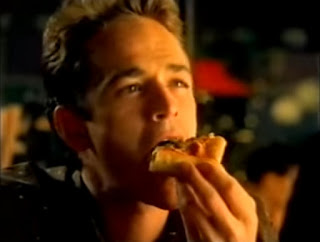
Dreamboat Luke Perry was best known for his work in such teen-orientated fare as Beverly Hills 90210 and Riverdale. He also made memorable guest appearances playing animated versions of himself in The Simpsons and Johnny Bravo. But if you were watching TV in Europe in 1997, you might also remember his as the valuable face associated with Pizza Hut's hot new product, The Sicilian, a pizza marketed on the virtues of its particular herb combination, and the presence of corners, although that particular virtue isn't touted until the end (what are the advantages of having a square pizza anyway? Easier to hold?). Somewhat unusually for a celebrity endorsement, Perry does not, himself, explicitly sell us on the pleasures of The Sicilian; in fact, he has no dialogue whatsoever. He is represented as an idealised dining companion, every 90s romantic's wildest fantasy, the punchline being that he ends up playing second fiddle to The Sicilian, here depicted as the kind of impossibly perfectly perfect pizza that should exist only in fantasy, much as the average person's prospects of ever dating a celebrity of Perry's magnitude could happen only in the very idlest of wool-gatherings. The ad, developed by Abbott Mead Vickers, follows a young woman who describes how her ideal date would play out - Luke Perry would appear at her door and accompany her to Pizza Hut, where they would order the exciting Sicilian, only for both objects of her girlish desire to collide in an explosive conflict. A love triangle develops between the protagonist, Perry and The Sicilian, prompting the protagonist to reassess where her loyalties lie and to eject Perry from her fantasy - or, rather, she assigns him a new role, one where he is unable to come between her and her Sicilian.
There is an implicit narrative, of sorts, underpinning the protagonist's charming flights of fancy; as the ad opens, we see her seated in a prosaic living room beside a man we might assume to be her actual partner, although this is not made explicit. We're shown just enough of this scenario to conclude that her dreams of Perry and The Sicilian represent the escapist fantasies of a woman bored out of her skull at the prospect of what we suppose to be an umpteenth evening on the couch. That she dreams of running away to something as mundane as a Pizza Hut feels almost comical within itself, which leads me into what I ultimately find most fascinating about this ad - how it succeeds in creating a sense of unreality from such a banal situation (the presence of Perry notwithstanding), which functions on a more immersive level than the protagonist's ability to change the details of her date with a snap of her fingers. That Perry himself remains entirely silent certainly helps to reinforce the sensation that he is, in spite of being right there in the flesh, somehow not real - he registers as only a surface representation of himself, an uncanny replica to be used and repurposed at the protagonist's whim.
The real driving force behind the character of the ad, though, would be its choice in low-key background music, which carries overtones of the mirage. I am, regrettably, unable to put a name to the composition in question (if it turns out to be something by Cocteau Twins, then my apologies in advance), but it has a distinctively Muzakian flavour, the kind of audio one would expect to hear whilst riding up a shopping mall escalator or following announcements on the weather channel. Muzak, which commonly answers to the derisive moniker of "elevator music", could be described as the soundtrack of corporate banality, the kind of music to which were not necessarily primed to listen, but which meets a supposed subconscious need. It is as inconspicuous as it is omnipresent. The music's close associations with consumerist culture have made it one of the building blocks of the vaporwave movement, which seeks to shine a spotlight on the raw underbelly of the sonic encounters we are ordinarily conditioned to ignore. The term "elevator music" regulates the form to its allotted role as music to occupy the backdrop of various functional scenarios, but also alludes to the manner in which it accompanies us through life's "in between" moments - transitory moments where we're shifting from Point A to B, and which, in themselves, seem to offer so little in the way of substance and consequence that they seem destined to evaporate from conscious memory. The function the music plays is in appearing to plaster over life's numerous voids, whilst shepherding us ever onward down our unending path of consumption (usually the cause of said voids), but in a manner so anodyne that this process is not designed to register. The overriding sensation of elevator music is one of uncanny reassurance, but also uneasy artificiality, its purpose being to effectively numb us to the vapidity of our surroundings. In the Pizza Hut ad, such music is used to imply a disconnection from reality, with the fusion of fantasy and consumerism here suggesting the overwhelming inescapability of corporate culture. Dreams can themselves be viewed as "in between" moments, fulfilling the same function as that elevator music in that they cover up the vapidity in between the portions of life that command our active engagement. Dreams, though, are assumed to be driven by personal agency, but here they are clearly serving the ends of the corporate. There is an undercurrent of irony in the implication that the protagonist evades the tedium of an inert existence dictated by the television set by disappearing into a television commercial.
There are two moments in the ad when the music does not feature and we are faced with a soundtrack of silence - at the opening of the ad, when the protagonist's fantasy has yet to be established, and during the punchline, to emphasise the abruptness of Perry's departure. Silence is equated with reality; a date with Luke Perry might be an out there prospect, but the ad ultimately posits it as less valuable than the readily obtainable Sicilian, which anybody can wander into a Hut and order. The protagonist finds empowerment in the rejection of the idle wool-gathering embodied by Perry, and in the embracing of concrete consumption, with the trio of woman seated behind the protagonist acting as a kind of subtle visual echo to her epiphany - notice how they suddenly all seem to be smiling in her direction when she figures out what she really wants. The theme of female solidarity is expanded on in the ad's sister spot, in which the protagonist fantasises about a dream night in where, in lieu of providing her with dining companionship, Perry (clad in black leather, no less) is delivering a Sicilian straight to her door. Again, she expels Perry from the scenario so that she can focus on the pizza, but here she seems less adverse to having to share The Sicilian - a group of friends appear in Perry's place and they gather around the pizza together. The ad can thus be seen as celebrating friendship, and a contentment with every day pleasures, so long as there's enough corners and oregano to go around. In the original ad...I suppose it also celebrates self-sufficiency. She pays her own way.
When Pokemania gripped the West in the dying embers of the 20th century, the then-callow Japanese import swiftly gathered infamy for being totally irresistible to kids and beyond incomprehensible to adults. Certainly, no addition to the Pokémon canon emphasised this division more than Pokémon The First Movie, the American treatment of the anime's premier big screen outing, released in theatres in late 1999. This was the first real occasion on which a significant number of non-converts were forced to sit down and watch a Pokémon adventure from beginning to end and, as soon became apparent, it wasn't the most agreeable way they could have popped their Poké cherries. For years, Pokémon continued to be something the adult crowd simply didn't get, but after the movie I couldn't help but notice that the discourse shifted from one of general bemusement to outright resentment.
Among other things, parents were unpleasantly surprised to discover that Pokémon The First Movie was actually a double bill, a practice all but dead in the US - despite Quentin Tarantino's valiant efforts to re-establish it in the late 2000s - but still pretty standard in Japan, particularly for children's pictures. The first film on offer was the 20 minute Pikachu's Vacation, a head-spinning fluff piece centred on the cuter Pokémon that might have been palatable had it been about 15 minutes shorter. The juicier part of the package, and what most fans had come to see, was Mewtwo Strikes Back, which promised to go up close and personal with what was (at the time) the biggest and baddest monster of the lot, the titular Mewtwo. A fiendishly powerful, genetically engineered Psychic-type Pokémon resembling a bipedal Sphynx cat, Two entered the world "For Science!", briefly finding himself under the control of local crime lord Giovanni, before going rogue, blowing up a building or two and retreating to a secluded island to get to work on nurturing his own team of cloned Pokémon. (Note: Pokémon, like Care Bears, are best regarded as androgynous, at least for the purposes of this film, which came about before genders were implemented into the games' mechanics - but since Mewtwo was given such a distinctly masculine voice, courtesy of Philip Bartlett (or Jay Goede, as I believe he's actually called), I intuitively see him as a male). Some time later, he lures a group of specially selected trainers to the island, with the intention of harvesting their Pokémon's DNA and using it against them. Meanwhile, the source of Mewtwo's own corrupted DNA, the elusive, kittenish Mew, has arrived there under its own steam, edging toward an inevitable confrontation between original and clone.
(I sure hope you didn't get your hopes up about that so-called "Pokémon Match of All-Time", incidentally. When Mew and Mewtwo finally do come to blows, all they do is slam into one another a few times in cheerful-looking rainbow-coloured bubbles.)
Pokémon The First Movie proved a hit with Pokemaniacs the world over, but was critically reviled and secured a lasting reputation among parents who were dragged along for the ride as one of the worst and most confusing children's pictures of all time. Myself, I have to admit that while, going in, I was absolutely stoked to be getting a big screen Pokémon adventure, my sympathies have always been with those parents. I did not particularly enjoy the actual watching of Pokémon The First Movie. To me, it was awkward, leaden and above all, not much fun. The most entertaining part of the experience was this little kid who insisted on loudly name-checking each Pokémon as it appeared on screen, but got at least a third of them wrong (mind you, so did the movie itself - there were a few incredulous murmurs during that one moment where a trainer addresses his Pidgeot as "Pidgeotto"). I was a lot more satisfied with Pokémon The Movie 2000, which, obnoxious title aside (by the time it came out in the UK the year 2000 was nearly over and most people were sick of seeing that number arbitrarily plastered across everything) was more in line with what I'd expected from a Pokémon feature; nothing groundbreaking, but a cheesy adventure story made to a somewhat bigger scope than the anime. It also fared marginally better with critics (but only marginally), although box office receipts told a different story. At the time, it was easy to dismiss Pokémon as a passing fad that would be all but forgotten in a couple of years, and from a western perspective (I can't speak for the situation in Japan) that certainly seemed to be the way things were headed at the dawn of the new millennium - each theatrical film made significantly less money than the one before it (to the point where they eventually stopped exhibiting them in theatres altogether), the toys were increasingly becoming bargain bin fodder, and the anime had few loyalists by late 2001. Nevertheless, the franchise would endure - not only is Pokémon still alive and kicking in 2022, but is now regarded as a quintessential part of millennial nostalgia.
A beneficiary of this bolstered goodwill has been Pokémon The First Movie, currently a fondly-remembered childhood classic for those who'd subjected their nonplussed parents to it back in 1999. Ask numerous old school Pokemaniacs, and they'll tell you thatit's the best of the Pokémon movies, though I've a sneaking suspicion that a number of these devotees are privileging it for being The First and haven't actually kept up with the many Pokémon features that followed. I myself have only seen a slim minority, but of that sample, I certainly wouldn't rate Mewtwo Strikes Back above the likes of 2000 and Heroes. Then again, it's not as though I've been in a rush to revisit it since that awkward theatrical screening I attended at the turn of the millennium - for the longest time, my opinions of the film were based predominantly on the listless first impressions I'd formed as a teenager. I only recently made the effort to get properly reacquainted, just to see if it would play any better to my nostalgic adult sensibilities and...for the most part, it doesn't. The last eight minutes or so I quite enjoyed - there is some delectable cheese to be had from Ash's "death", his Pokémon tears-enabled resurrection (puts me strongly in mind of the "We care!" sequence from The Care Bears Movie II), and Mewtwo's abrupt eleventh hour change of heart. But everything leading up to that is so fucking drab, despite Team Rocket's valorous attempts to sneak in a little levity with their comically wonky Scandinavian accents. Even at a skimpy 75 minutes, it drags on for way too long.
What did leap out to me more on this particular viewing is what a jarring experience the film is sonically. See, when I say that this was only my first time revisiting Pokémon The First Movie, I should be clear that I am referring strictly to the English dub; I saw a subbed version of the
Japanese original some time during my uni days, and while I couldn't
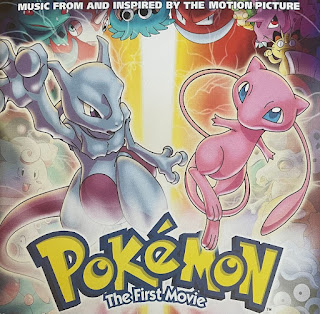
vouch for the accuracy of the subtitles themselves, the film certainly sounded much more coherent. Nowadays, it's common knowledge among western Pokemon buffs that the version of Mewtwo Strikes Back they received (courtesy of media company 4Kids) was a poor representation of what audiences in its native Japan had seen. The most egregious alterations, from a narrative perspective, are that the English-speaking Mewtwo was given loftier, more overtly murderous ambitions that put him better in line with your archetypal Hollywood villain (in the Japanese original, Mewtwo was less concerned with genocide and world domination than with demonstrating - to himself, as much as anyone else - that his Frankenstein genesis didn't make him inherently inferior), while the moral of the story was changed significantly to impart the message that "fighting is wrong" - a message which, as many critics were quick to point out, was just about the last one this particular franchise was qualified to be making. No less impactful were the various soundtrack switcheroos, with the English dub having a lot of teen-orientated pop shoehorned in, sometimes in truly baffling places, purely for the purposes of compiling a tie-in album they could flog to the same crowds who'd lined up for cheap Pokémon freebies in their Kids Club meals. The resulting soundtrack has very little sense behind it other than synergy - of the total sixteen tracks, exactly half are featured in the film itself, and while the cover brazenly claims that the remaining eight were "inspired by the motion picture", if there was a Pokémon influence on any aspect of their production, I'll eat my hat. The first track, the "Pokemon Theme" performed by Billy Crawford, is the only place in the entire compilation where you'll actually hear the word "Pokémon". It's also one of the few tracks where you'll find even the vaguest references to what the franchise is about - ie: capturing, battling and exploration. The rest are mostly either soppy love ballads or would-be party anthems - which goes along with the territory of teen pop, sure, but what does any of it have to do with a story about a vindictive mutant Sphynx cat searching for its place in a culture dominated by inoffensive cockfighting?
The most positive thing to be said for the Pokémon The First Movie soundtrack is that, on its own, it does make for quite a nice little time capsule of the pop music scene back in 1999. There are a few obscurities here and there, but overall the round-up of names is fairly impressive - Britney Spears, Christina Aguilera, *NSYNC, Billie Piper, B*Witched, an ex-Spice Girl and a Backstreet Boy's kid brother - so if you like that sort of thing I'd imagine this would be quite the nostalgia trip for you. As a companion piece to a film about "oddly unpleasant creatures" (in the words of Halliwell's Film Guide), it is, at best, bemusing and, at worst, a textbook example of how arbitrarily-placed pop music can seriously undercut whatever emotional gravitas your flick has been carefully germinating. As noted, a total of eight tracks from the album are heard throughout the film. The "Pokémon Theme" is obviously there, and that one gets a free pass. Two of the insert songs, "Vacation" by Vitamin C and "Catch Me If You Can" by Angela, occur during the Pikachu's Vacation segment and, besides the "Pokemon Theme", are the least harmful of the lot (it's already a fluff piece; a couple of frothy pop numbers aren't going to hurt it any). There's one insert song during the main Mewtwo Strikes Back Feature, "Brother My Brother" by Blessed Union of Souls, and its inclusion is really quite odious. The remaining four are messily jammed into the end-credits sequence, meaning that there's barely enough time for each song to get going before another abruptly takes its place. This whole practice of trying to tag as many tracks from your tie-in album as possible into the closing credits was hardly unique to Pokémon The First Movie
- The Rugrats Movie followed the exact same formula just a year prior.
The transitioning between the truncated tracks at the end of The Rugrats
Movie was much more skilfully done, however, with none of the awkward fade-outs and slapdash tonal clashes that the Pokémon The First Movie end credits are littered with (Christina Aguilera isn't even allowed to get all the way through the chorus before they chop her). In subsequent Pokémon features, the end credits typically serve as
epilogues to the main conflict, allowing various supporting character
arcs and smaller narrative threads to get tied up. Mewtwo Strikes Back has little to offer visually besides a selection of generic travelling scenes
with Ash, Misty, Brock and Pikachu, followed by a short reappearance
from Mew at the very end, although in the Japanese original these were accompanied by a (single) melancholic track, "Kaze to Issho ni", giving them an unexpectedly haunting quality in their simplicity. Needless to say, this same effect is not preserved in the English dub. Additionally, whereas the final appearance of Mew had, if I recall correctly, originally synced with the closing notes of "Kaze to Issho ni", here it's just a random add-on; rather than attempt to align it with M2M's talk of marital prospects, the English dub reprises the instrumental theme associated with the character throughout the film.
The Pokémon The First Movie soundtrack is such a rollicking mess in general that I feel compelled to dig through each individual track, just to try and make some sense of what in the name of Sam Hill it's actually doing here. Songs not appearing in the film itself are italicised. (Oh, and incidentally, I am aware that the soundtrack changes in Pokémon The First Movie go way beyond the teen pop inserts; the film was also extensively re-scored for the western market, meaning that you'll hear very different background music in each version. For the purposes of this review, however, I'm only going to be sticking to what was included on the official soundtrack release.)
"Pokémon Theme" by Billy Crawford: You all know this one. It's catchy (for better or for worse), it's iconic and inevitably it was going to show up here. As noted above, it's also the only track on here with any genuine Pokémon credentials. Appears soon after the Mewtwo Strikes Back prologue, during Ash's ridiculous battle with the proto-Aqua grunt.
"Don't Say You Love Me" by M2M: The last of the tracks heard during the closing credits, this was also released as the soundtrack's official single, and really, I couldn't imagine a song less relevant to the plot of Mewtwo Strikes Back, or to the franchise in general. Let's see: "Don't say your heart's in a hurry/It's not like we're gonna get married/Give me, give me some time". To which hastily-forged union is this meant to be referring? Mewtwo and Giovanni?
"It Was You" by Ashley Ballad feat. So Plush: It becomes something of a running theme that, with a number of these tracks about relationships and the redemptive power thereof, it's not always 100% clear which of the movie's relationships it's supposed to be reflective of. This one is all about the merits having a close friend by your side, so it seems likely that we're intended to take it as a standard friendship song about Ash and Pikachu. It should be noted, however, that outside of the climax of the film, when Pikachu leads the crying that revives the unresponsive Ash, their relationship isn't amazingly front and centre to the plot of Mewtwo Strikes Back. Since the lyrics describe how life has more meaning with the second person, I'd be half-tempted to take it as a reflection of Mewtwo's renewed perspective by the film's conclusion, but for the fact that he doesn't actually stick around to become anyone's friend.
"We're a Miracle" by Christina Aguilera: Clearly intended as the film's answer to that quintessentially 1990s trend of tacking a rousing power ballad to the end of your feature, a practice that took off with Robin Hood: Prince of Thieves and just about peaked with Titanic. In general, these ballads tended to be entirely interchangeable and only tenuously linked to the film in question, so it seems churlish to knock Augilera's contribution for following suit. And, to be fair, some of the lyrics do actually fit with the plot specifics of Mewtwo Strikes Back. The references to a passing storm and to a tears-facilitated reunion are fairly generic, sure, but I'll take them over whatever disconnected nonsense is going on in the M2M contribution. This track definitely feels more romantically-inclined than the above Ashley Ballad track, although from a plot perspective it only really works when taken as a commentary on the relationship between Ash and Pikachu, which tickles me. All the same, as these rousing 90s power ballads go, I'd rate "We're a Miracle" as rather a boring one, and I can't say I blame the movie for being in such a rush to get it out of the way and onto the peppier Emma Bunton piece.
"Soda Pop" by Britney Spears: This one I can see being included as a sly little wink to Pokémon buffs, as "Soda Pop" was the name given to a healing item in the original Nintendo games. As a bonus, the lyrics mention Fire and Ice, two Pokémon element types. It's still a very tenuous addition to this tracklist, but I guess Britney was too big a name to pass up in 1999.
"Somewhere Someday" by *NSYNC: As with the Christina Aguilera track, a few generic references to storms and tears keep it from being totally plot-irrelevant. Actually, based on the first verse I was expecting this to tie more heavily into Mewtwo's existential crisis ("And you don't know who you are any more/Let me find what you've been searching for"), only then the vocalist went and addressed the subject of the song as "Girl", and that completely threw me off. Minus that, and the multiple instances of the word "Baby", and I could have bought this one as being about Giovanni's empty promises to Mewtwo.
"Get Happy" by B*Witched: This one squanders whatever credibility it might have had on a Pokémon album straight out the gate, when it opens with the lyrics, "Don't be a brontosaurus..." Yo, this is the Pokémon world, and nobody here has a clue what a "brontosaurus" even is (the rejected plot for Movie 3 notwithstanding), so if you're not going to get with the program and substitute "brontosaurus" with "Aerodactyl", you may as well not play at all.
"(Hey You) Free Up Your Mind" by Emma Bunton: I feel like I'm grasping at straws at here, but the song contains the lyrics, "See me, I had no soul", which might be a reference to Mewtwo's Frankenstein's monster complex. Continues Bunton: "...til I found myself with the rock n roll," and it's not as though the resolution to Mewtwo's conflict was achieved through rock n roll music. So nah, just forget it.
"Fly With Me" by 98 Degrees: A song with near-identical sentiments to those expressed and the featured *NSYNC track, and copious instances of the term "Girl", which make it similarly confusing as to just how it's intended to fit in with the plot of Mewtwo Strikes Back. Otherwise, my best guess would be that this refers to Mewtwo flying off with Mew at the end of the film. Besides Corey's weathering the storm on the back of "Pidgeotto", I can't think of any other particularly significant instances of two characters flying together, can you?
"Lullaby" by Mandah: You know, I'm grateful that the producers of this track were considerate enough to slip in a helpful tip-off in the form of a crying Jigglypuff at the opening, otherwise I would probably be speculating that this alluded to Mewtwo and the various ways he asserts his psychic influence throughout the film. I would probably not have guessed that this had anything to do with Jigglypuff, on account of the fact that Jigglypuff is not inPokémon The First Movie! Well, okay, I think one might have been glimpsed briefly somewhere in the Pikachu's Vacation segment, but the classic Jigglypuff character - the one with the propensity for following Ash and friends around and randomly singing them to sleep, as recounted in this song - is certainly nowhere to be seen. What's more, the lyrics here have a weirdly sexual, borderline threatening vibe that I'm not convinced is terribly becoming for the cutesy Balloon Pokémon - we get yet more disconcerting usage of the term "Baby", although at least here the boot is on the other foot and the subject of the song is identified as "Boy" for a change (since this Jigglypuff identifies as a girl, although I'm not sure if a gender was ever confirmed for the recurring Jiggly in the anime).
"Vacation" by Vitamin C: As noted, I can't take too much umbrage with the tracks added to the Pikachu's Vacation segment. Besides, musically speaking, I would rate this as by far the most interesting track on the album, which has a lot to do with the "Rumba Guitar" sample at the start, and the pleasingly retro 1960s surf rock vibe that intermittently permeates the song.
"Making My Way (Any Way That I Can)" by Billie Piper: The future Doctor Who companion chips in with an upbeat ode to the pleasures of journeying and overcoming obstacles. I can see how that fits into the general territory of Pokémon, although I much prefer the "Viridian City" track from The 2.B.A. Master album, which is more-or-less the same thing.
"Catch Me If You Can" by Angela: This one gets tossed in during the sequence in Pikachu's Vacation where Squirtle and Marrill race one another. It's pretty much the same idea as the above Billie Piper track, with the added bonus that the titular hook also alludes to one of the core objectives of the Pokémon series, which is to catch the little buggers.
"(Have Some) Fun With The Funk" by Aaron Carter: Err, well, the word "vacation" shows up in the lyrics, which is possibly supposed to pertain to the premise of Pikachu's Vacation. Otherwise, I draw a blank on what this track is doing here - much to my chagrin, though, I have to admit that it is insanely catchy.
"If Only Tears Could Bring You Back" by Midnight Sons: Hurrah, a track with conspicuous plot relevance from the outset. Poignant title aside, I find the song itself a bit of a bland one; it plays like the kind of thing you would expect to find nestled away in one of the filler spots on an album by one of the boy bands of the era, one you'll hastily skip past searching for "Pop" or "Larger Than Life".
"Brother My Brother" by Blessed Union of Souls: We round things off with the single most controversial item on the tracklist, a cheesy guitar ballad inserted into the English dub during the portion of the story where the original and cloned Pokémon proceed to beat the living shit out of one another. Some fans like this song, and consider it a cozy part of the wider nostalgia package, while others fervently resent the addition on the grounds that it causes the sequence to play out very differently, tonally speaking, to its Japanese equivalent. I would hazard a guess that 4Kids strategically put this song where it is to counteract concerns that the sequence might otherwise have proven too rough for younger viewers - when the clones and originals go at one another, they fight in a very animalistic fashion that looks worlds apart from the fantasy violence that characterises your regular Pokémon battles (which doesn't make the "fighting is wrong" stance of the English dub feel any less flagrantly hypocritical, mind). They snap, snarl, claw and swat at each other...all in all, it's a very harrowing sequence to watch in its original form. I assume the addition of some gentle guitar music was intended to take the sting off, but it does have the effect of pushing things too far in the opposite direction and making a serious moment seem inordinately goofy. Honestly, my gut reaction when I see Pokemon lacerating one another to this music is just to snicker. It doesn't help that the vocalists has to compete with the incredibly loud screaming of the combatants all the while...surely a more sensible approach, if this song had to be there, would be to have muted out all diegetic sound, instead of having them all play out together in a grand chaotic slurry?
What else is there to be said about thePokémon The First Movie soundtrack, except that it's a baffling product of its time? Something I probably should acknowledge about the picture itself, however, is that there are now even more versions of it out there. So great is the film's nostalgic clout that they went and remade it in 2019, this time in eye-popping 3D animation. I haven't watched the newer take in full, but I did check out the end-credits song for the English dub, "Keep Evolving" by Haven Paschall, and I'll consider it a step-up that they at least picked a track germane to the franchise for this one. I also watched a couple of clips, including one of Mewtwo's sinister Pokémon harvest, and will credit the remake for addressing another issue that stuck out as particularly egregious on my
recent rewatch - the way Misty grabs and runs with Togepi but
effectively abandons Psyduck to its fate (she reacts after the fact, but still). In this version, she attempts to protect it before it gets abducted, and so much the better.
One of my favourite pieces of writing of 2021 was this Vice article by Amelia Tait, which posed the all-important question that might not have been at the forefront of our concerns in the current global climate, but had nevertheless lurked uneasily at the back of our skulls for quite some time - whatever happened to Ronald McDonald? Actually, I suspect that most of us kind of already knew the answer, but there is a fascinating yarn to be unpicked in delving into the specifics of his discreet decline - keeping in mind that, in the latter stages of the 20th century, the burger-hawking clown was on a par with Mickey Mouse in terms of American icons who'd effectively achieved world domination. It didn't take long for the 21st century to start getting rough on the once unassailable brand mascot, with his various McDonaldland cohorts - Grimace, Hamburglar, Officer Big Mac and co - facing eviction from McDonald's eateries and promotions in 2003. For the time being, Ronald himself was left standing, but has been officially retired from McDonald's advertising in the UK as of 2014, while his appearances have been largely scaled back in his native US. It's a significant comedown for a character who, according to a poll cited by George Ritzer in The McDonaldization of Society, was once identifiable among 96% of school children, an honor bested only by Santa Claus (p.8). So where did it all go wrong for Ronald?
As it turns out, Ronald McDonald was a casualty of not one, but two cultural shifts that made a smiling clown an undesirable thing to have at the forefront of your branding. Firstly, over the past two decades we've become a lot more leery about fast food marketing geared specifically and unambiguously toward enticing the very youngest of consumers. Traditionally, McDonald's has always been a family brand, a place you took the kids after swimming lessons when you were too exhausted to cook for them, when you were in another town and your offspring were way too fussy to be up for anything local and unfamiliar, or just when they really eager to get their hands on whatever giveaway was being offered in Happy Meals that week. By all counts it still fulfils all of those functions. But in the mid-2000s, McDonald's underwent a massive image overhaul designed to counteract the tidal wave of negative publicity they had accumulated with Morgan Spurlock's hit documentary Super Size Me and growing concerns about childhood obesity, a somewhat inevitable consequence of years of general indifference toward the messages children were actually receiving in between their favourite programming (I grew up in an era when junk food promotions were not only slapped over every inch of commercial children's media, but could get away with pushing themselves as healthy snacking options, if they were sneaky enough about it). Happy Meals and the promise of free plastic haven't gone away, but McDonald's was toning back on its kid-zeroed marketing, as the emphasis moved more toward courting the next most receptive demographic, ie: students. Secondly, in recent years we've undergone a drastic revamp in terms of how we look at clowns. The general consensus is that clowns are no longer benign purveyors of innocent birthday party capering, but sinister, grotesque deviants who signify something very corrupted in the childhood vista. The 2016 clown invasion and the popularity of the 2017 adaptation of Stephen King's It appear to have cemented this notion in the public consciousness. Coulrophobia itself is hardly a novel phenomenon, but it's only relatively recently that clowns have effectively been ranked alongside spiders and vertical drops as something that people are almost expected to fear by default; nowadays, if you don't have any profound dislike of clowns, you can consider yourself the anomaly. All in all, the 21st century just hasn't been the kindest of climates for a grease-peddling joker.
One of the last notable artefacts of Ronald McDonald's uncontested reign of terror was The Wacky Adventures of Ronald McDonald, a series of forty-minute direct-to-video animated adventures specially created to be sold as add-ons to consumers purchasing drinks and ice creams, beginning with a Halloween-themed video, Scared Silly, in October 1998 (a clip from the series was featured in Super Size Me, where Spurlock incorrectly identified it as a television cartoon). The cartoon was unmistakably the work of Klasky Csupo, the animation studio founded by husband and wife team Arlene Klasky and Gene Csupo in 1982 that went on to become a children's entertainment powerhouse in the 1990s/early 2000s, engineering such hit Nickelodeon shows as Rugrats, The Wild Thornberrys and As Told By Ginger. The studio was also responsible for animating The Simpsons during its first few years of life, before disputes between Klasky Csupo and Gracie Films prompted the latter to switch to Film Roman. Despite the company's ubiquitousness through many a millennial's childhood, in my experience Klasky Csupo are an extremely decisive studio; their output is fondly remembered by many, but just as many others are alienated by their visual style, rating it as ugly and unappealing. Additionally, a high number of millennials report having had their first logophobic experience by unwisely sticking around to the end of any Klasky Csupo production's closing credits and seeing just what horrors were lying in wait - particularly during the studio's peak years when they were using what has been affectionately dubbed the "Splaat" logo. If you think clowns are grotesque, then you should get a load of the nightmarish mouth they had blurt out the studio name, in eerily emotionless, computerised tones, at the end of each adventure with Eliza or Ginger (although it was at least handy for those who, myself included, were unsure of the pronunciation). Put a pin in that, because Klasky Csupo really are overdue their own Logo Case Study on these pages.
Like any Klasky Csupo production, The Wacky Adventures of Ronald McDonald has built up its share of detractors and devotees, with some regarding them as junky promotional tools and others nostalgic essentials - such nostalgia tends to be less prolific than that for KC's Nickelodeon cartoons, however, due to the limited availability of the videos. A total of five VHS tapes were available in McDonald's restaurants
between 1998 and 2001, with a belated sixth adventure finally seeing the
light of day in January 2003, albeit exclusively through Klasky Csupo's official
online store. The series was never
upgraded into the DVD age, presumably owing to the decision to retire
the McDonaldland characters soon after. I've also not seen a wild
amount of evidence to suggest that the videos were sold in many, if any,
locations outside of the US (they certainly never made it to UK restaurants), capping their impact even further. Their modern status as animated curios naturally makes them irresistible to me, although I did have another, slightly more esoteric motive for wanting to dust off the series at this point in time. We're currently in the early stages of 2022, a year that has long stood out to me as being of immense significance owing to the fact that it is the year in which Soylent Green takes place. It's been on my mind that I ought to do something to commemorate the Year of The Suspicious Foodstuff, and nothing struck me as more savoury than a year-round retrospective dedicated to particularly strange or unique fast food promotions.
Most of the classic McDonaldland characters appear, albeit adapted to fit the Klasky Csupo visual style. Grimace (Kevin Michael Richardson) looks more-or-less the same (I guess there aren't a whole lot of options when you're working with a giant purple blob). Hamburglar (Charlie Adler), on the other hand, looks nigh-unrecognisable, still favouring the striped convict motif but having swapped out the bulk of his burglar attire for dark glasses and a trendy sports coat, and looking for all the world like an all grown up Rocket Power reject (compared to previous Hamburglar incarnations, who spoke mostly in gibberish, he's also unusually articulate). Other familiar faces include Birdie the Early Bird (Christine Cavanaugh), a character originally introduced to plug breakfast menu items, and, more nightmarishly, the Fry Kids and the McNuggets. I say "nightmarish", because while I can handle more generic characters like Birdie and Hamburglar just fine, the McDonaldland residents who are meant to be physically comprised of McDonald's foodstuff have always struck me as aesthetically and conceptually disturbing (among other things, wouldn't it make cannibals of them to actually eat at McDonald's?). The Fry Kids are a mild example - in their case, it's not altogether clear to me if that shaggy matter hanging off of them is intended to be off-colour French fries, or if they're just walking puffballs nominally affiliated with processed potato sticks. But those McNuggets...here, they've been given little beaks, wings and combs so as to resemble the farmyard critter they're made of, and I seriously can't be the only person who finds that design choice a bit sick (puts me strongly in mind of Banksy's "Village Pet Store and Charcoal Grill" exhibit). On that note, it's something of a relief that the two burger-headed characters are largely ignored - Mayor McCheese (Bob Joles) makes an appearance in just one of the adventures, Have Time, Will Travel, while Officer Big Mac is conspicuously absent. Oh well, nobody likes authority figures, right? There are also a handful of new characters, the most prominent being Ronald's sardonic talking mutt, Sundae (Dee Bradley Baker - for years, I harbored under the misconception that Sundae was voiced by the same actor who does Squidward from Spongebob Squarepants, but a quick check of the cast list reveals not), and a couple of human kids who are chummy with Ronald, Tika (Jazmine A. Corona) and Franklin (Alex D. Linz).
Each video opens and closes with live action segments
showing the familiar flesh-and-blood Ronald (Jack Doepke or David
Hussey, depending on what video you're watching) hanging out in his surreal McDonaldland residence. In the first three adventures, he is accompanied by Sundae (actually Verne Troyer, best known for playing Mini-Me in the Austin Powers films, in a Sundae suit), and there's a transitional sequence where Ronald and Sundae take a chute down into the world beyond, assuming their animated forms along the way. I've come across more than one person ascribing a bout of grisly childhood nightmares to the live action Sundae, and that's understandable enough. Because Sundae was a completely original character, his default design was in the Klasky Csupo style, and the efforts to translate that directly into live action aren't the easiest on the eyes (it doesn't help matters that the zipper on the Sundae suit is also very visible across his underside, making it look as though he's recovering from heart surgery). That said, I think the least appealing thing about Sundae visually applies to both his animated and live action forms, which is to say his unpleasant-looking mouth. Freaky pronounced animal lips are a bizarre design choice favoured by Klasky Csupo in general, as evidenced all throughout The Wild Thornberrys - here, they're also seen on a beaver, a sinister talking grizzly who stalks the gang at random intervals during the adventure, a stuffed and mounted swordfish, and those creepy deep fried miniature chickens - but Sundae's a particularly egregious example, what with his bright red lips, the coulrophobic-taunting layer of white clown make-up around his muzzle (albeit only really visible in his animated form) and his distinctly human-looking teeth. Between this and the Splaat logo, I'm detecting that Arlene and Gene have a possible fetish for ugly mouth visuals. Well, good for them.
Scared Silly opens with the revelation that both Ronald and Sundae are connoisseurs of vintage B-movie horror, which is honestly not a bad place to start. The film they're watching, identified by Ronald as Attack of The Dinosaurs, is actually the silent 1925 classic The Lost World, plucked safely from the public domain, and dubbed over with some comically hammy dialogue. Ronald then receives a video call from Tika, who invites him to go camping with her and the rest of the McDonaldland gang in Far-Flung Forest. She later reveals that she's always been too scared to venture into the forest, owing to local lore about it being haunted by a Phantom. The gang make it to nightfall without anything in the way of major incidents, but are caught off-guard in a rainstorm and decide to seek shelter in a suspicious-looking, seemingly abandoned manor that transpires to be riddled with various booby traps, causing the party to become increasingly splintered. What kind of nefarious forces will they discover pulling the strings?
The inevitable deal-breaker with Wacky Adventures for many viewers is going to be the odiously commercial, not-so-ulterior motive behind their productions - there is little getting around the fact that they were 40-minute long advertisements designed to make children hungry for empty calories, and I can wholly understand anybody disliking them on mere principle. The thing is, in an alternate universe where the McDonald's brand never existed and these were entirely original characters having wacky adventures in their own stand-alone world, I could see these titles becoming hot cult classics for their sheer weirdness. If you didn't know anything about McDonaldland and you saw this series, wouldn't this just strike you as the most random assortment of characters imaginable? Approached from that angle, the series offers a pretty enjoyable mix of visual strangeness (particularly in the live action segments) and quirky humor - nothing especially ground-breaking, but they are objectively stronger and more competently made than I had expected, given their dubious origins. And, for as mean as I've been about Sundae's character design, he's actually a pretty funny addition to the McDonaldland roster; his deadpan personality makes him a perfect foil to the perpetually upbeat Ronald. On a narrative level, my only real gripe with Scared Silly is that it could have stood to be at least ten minutes shorter. There is quite a lot of padding, particularly in the first half of the story which has the gang rambling somewhat aimlessly around the forest - it takes them a long time to get into the real heart of the adventure involving the haunted manor. Prior to that, the characters sing a couple of songs (pretty standard, inoffensive children's fare, but 100% filler) and Hamburglar pranks the others into thinking the Phantom has arisen, but all that goes on in the woods that's of any genuine import is its becoming increasingly apparent that a) the gang's every movements are being tracked by surveillance cameras and b) Tika clearly knows more about the situation than she's letting on (for one, she lets slip with Ronald that, contra her claims to have always been too terrified to set foot in the forest before, she actually knows her way around it pretty well). Still, Far-Flung Forest is kind of a screwy place, even before we get to the supposedly cursed section - in addition to that creepy talking bear Hamburglar inadvertently summons, there's an odd sight gag where Sundae chases after a squirrel, only to discover that that squirrel has one heck of an intimidating ally, namely a human-sized, body builder squirrel in army boots and khaki shorts, whom I just know, without googling, must be the subject of a ton of furry fan art.
The second half of Scared Silly is stronger than the first, as it's here that the story becomes focussed on a clearer objective, with the gang entering the manor and, on discovering that they're now trapped there and at the mercy of the so-called Phantom, having to navigate their way through its labyrinth of rooms, solving various puzzles in order to find the correct way out. You could say that it turns into a kid-friendly version of Christopher Manson's Maze, except that here the clues have the benefit of being halfway comprehensible. Characters who get it wrong get separated from the others, as the Fry Kids and McNuggets find out. Through it all, Ronald manages to keep his head, reassured that the manor is all an illusion, that the reality is a lot less nefarious than it seems, and that the gang can get through it with the use of teamwork and co-operation.
The most entertaining scene occurs at the climax, when the remaining characters are confronted by the Phantom, who challenges them to a final game of riddles. As a particularly fiendish touch, the Phantom uses the correct answer to each riddle to suck the losing contestant into oblivion. So, for example, Tika is challenged with the question: "What is it that the more you take away from it, the bigger it gets?" It's a fairly well-known riddle, and I suspect a good chunk of the video's target audience would be qualified to respond correctly, but Tika comes up with a completely different,more smart-alecky answer that, to her credit, actually does fit the criteria of the question: "A restaurant! The more you take out..." (I can't help but feel that this constitutes a slight Freudian slip on behalf of McDonald's, in admitting that their global empire depends on your insatiable custom). The Phantom still isn't having it. "Way too complicated - and wrong!" he bellows, before ejecting her down an actual hole. Next up are Birdie and Hamburglar, who are asked: "What is you can feel outside, hear inside, but never see it unless it's full of dust?" Again, a fairly easy riddle, but the participants once again manage to screw it up by overthinking - Birdie suggests a dust mop, and Hamburglar mothballs. Too bad, the answer was the wind, and they both get sucked away by a tornado. Finally, it's up to Ronald, Grimace and Sundae to turn things around, as the Phantom poses: "What is is that costs nothing, but is worth everything, weighs nothing, but lasts a lifetime, that one person can't own, but two people can share?" My guess would have been "love", but Ronald comes up with "friendship", which wins him the game, much to the Phantom's chagrin. I suppose love can be unrequited, whereas friendship is typically thought of as being a two-way thing (neither is guaranteed to last a lifetime, however), but still, I would argue friendship is a variation of love, so I could have gotten through on a technicality, right?
The twist in the tale is that the "Phantom" is actually a holographic simulation, and that the man (or boy) behind the curtain is none other than Franklin (he will become a recurring character throughout the series, but here the McDonaldland crew are clearly meeting him for the first time). He and Tika have been secretly manipulating Ronald and the gang into becoming unwitting participants in their elaborate room escape game (it also transpires that the McNuggets, of all characters, were in on the deception - as we'll see from the subsequent video, The Legend of Grimace Island, the zombie chickens are easily led). It's revealed that Franklin's father is a scientist who specialises in virtual reality technology, which accounts (kind of) for how he'd even have access to all of this funky equipment. Franklin concedes victory to Ronald, and Tika apologises for deceiving Ronald and the others, stating that she didn't think they could be persuaded to participate knowingly. Fortunately there are no hard feelings; everyone is reunited, and they resume their outdoor camping trip. Scared Silly ends with a live action epilogue, with Ronald and Sundae back in their living room, and Attack of The Dinosaurs II about to start up on the box. Ronald questions the wisdom of watching a scary movie this late at night, but Sundae assures him that he can handle the experience knowing that Ronald is with him. The adventure bows out with a somewhat less wholesome message, where Ronald directly addresses his audiences and makes explicit what blatantly been on the production's mind this entire time - that, next time, he wants to see them "live and in person at McDonald's". All the same, I give Scared Silly kudos for its refreshingly positive outlook on the horror genre, here celebrated as an opportunity for bonding between two friends. The final item on the tape (besides the credits and our good friend Splaat) is a preview for the next adventure, The Legend of Grimace Island, arriving in 1999. I'm assuming that they didn't have an awful lot of finished animation ready at the time, because the preview consists entirely of still images.
Note: efforts to develop the McDonaldland crew into animated characters actually weren't limited to their Klasky Csupo swansong. Everyone's favourite purveyors of 1980s animation, DiC, had already tried their hand in 1990, with a precursor to the Klasky Csupo series, a one-off direct-to-video special entitled The Adventures of Ronald McDonald: McTreasure Island (meaning that you can watch a Ronald McDonald adventure with an even dodgier closing logo than Splaat). Before that, there was an animated short, Ronald McDonald and The Adventure Machine, but that never received a commercial release, having been produced to be shown exclusively within McDonald's restaurants. The best animated depiction of Ronald McDonald, though, would have to be his turn in the 2009 short Logorama, which certainly caters better to contemporary perceptions of the character. Clowns in general too.
A defence of Nora Ephron's much-derided feature adaptation of the classic fantasy sitcom Bewitched, starring Nicole Kidman and Will Ferrell, is frankly something I had never anticipated writing, not least while I was actually watching the thing on its release in 2005. But how time makes fools of us all.
I remember the summer of '05 being rather an underwhelming one for blockbusters. I know Batman Begins had a lot of devotees, but it was not my cup of tea. The Hitch-Hiker's Guide To The Galaxy was a crushing disappointment (with hindsight, I've no idea why my expectations were ever so high - if there was ever a thing Hollywood was guaranteed to screw up, it was Douglas Adams), The War of The Worlds had a few technically sound moments, but was overall one of Spielberg's lesser efforts, ditto Burton and Charlie and The Chocolate Factory, and I utterly loathed Madagascar. Bewitched had never struck me as all that promising from the outset, and I only wound up seeing it, on release, because I went as part of a group; I'd had my eye on a different picture altogether, but got outvoted, so on my first ever viewing I was a tad resentful that I was having to sit through this total fluff piece because the rest of my party couldn't cope with something more cerebral. It didn't help that, at the time, I was also quite weary of Will Ferrell in general; as a student, I belonged to a cinema club that was overseen by a group
of rabid Ferrell cultists (feral Ferrellists, as a friend of mine
once dubbed them) who liked to quote Ron Burgundy ad nauseam. Anything with Ferrell was guaranteed to get a
screening, no matter how well-received, so of course they snapped Bewitched up the following autumn. And, despite my cool reaction the first time around, I watched it again, because what else was I going to do on a Friday night? Years onward, and I've reached the worrying stage where Bewitched now registers as something cozy and nostalgic to me, seeing as I associate it with those Friday nights from a bygone age when I was a callow undergrad with nothing better to do than to watch movies in a chilly auditorium. (Oh, and incidentally, that "cerebral" film I had wanted to see - it was a little film called Crash, which you might have heard of. Needless to say, it turned out to be an absolute piece of shit, and Bewitched the superior picture in every way. With hindsight, my friends had the right idea all along. As I say, time = fools of us all.)
Bewitched '05 wasn't your mother's Bewitched, a fact that earned it few admirers at the time. Critics were unsparing and audiences indifferent. Those hoping for something in the vein of When Samantha Met Derwood were vexed as to why Ephron had chosen such a bafflingly postmodern approach to the material. Was there not a perfectly fun and charming picture to be mined from a more straightforward treatment of the beloved sitcom? To an extent, I think that Ephron was merely catering to her strengths - the juxtaposition of two parallel narratives, one modern and "real", the other familiar and fictional, puts me in mind of her earlier hit Sleepless In Seattle (1993) and its affectionately parasitic relationship with An Affair To Remember (1957). No doubt she was hoping to create a similar dynamic here, but with an overtly outlandish, reality-blurring vibe in the vein of Spike Jonze's then-recent Adaptation. (2002). It didn't pay off, but I can give Ephron props for at least trying to think outside the box and do something a little unexpected in lieu of a routine remake. It's easy to question why after the fact, when you're stuck with an unsuccessful product, but there are a high number of popular and acclaimed risk-taking pictures (Adaptation. included) that feel as though they could so easily have gone the other way. Enough of the right ingredients were certainly in place for Bewitched to have been a smashing success; in its case, the stars just didn't align, but I can buy that it looked like a great idea on paper.
I should admit upfront that I am hopelessly unqualified to comment on how successful the film is in capturing the essence of the original sitcom, which debuted in 1964 and ran for eight seasons, none of which I have had the pleasure of viewing first-hand. Growing up, it was just not something on my radar, and I think Ephron's film may have even been my formal introduction to the very existence of the series (there is a Simpsons opening that has Bart writing "Bewitched does not promote Satanism" on the chalkboard, but when I was a kid the only "Bewitched" I knew was the Irish girl band B*Witched, and I probably assumed he was referencing that). I do, however, get the gist of what it was about - a suburban housewife, played by Elizabeth Montgomery, who was secretly a witch, and whose marriage to a mortal milksop (played by Dick York for the first five seasons, and Dick Sargent for the remainder) was a subject of serious contention among her magical family, who were constantly interfering in their day to day lives. Plans for a feature Bewitched adaptation had been drawn up as early as the 1990s, when actor/director Ted Bessell bought the rights and began developing ideas with the help of one-time Babysitter Bandit Penny Marshall. The project was shelved following Bessell's death in 1996, but it's easy to see how the more conventional adaptation then being shepherded would have fit right in with the cinematic climate of the 90s, when Hollywood was going through a full-blown love affair with the 1960s television the current crop of producers had presumably grown up watching (among others, there were feature film remakes of Dennis the Menace, The Brady Bunch, The Flintstones, My Favorite Martian and Flipper). By the time Bewitched came to fruition in the mid-00s, the cycle had largely passed, and the film had adjusted its nostalgic specs accordingly, applying greater distance from the source by going all meta and retooling itself as a modern romantic comedy set against the making of a 21st century take on Bewitched. What was in right now was Will Ferrell and his personal brand of manic improv humor, and that's something the 2005 picture was going to amp up for all it was worth. I actually don't feel that my lack of familiarity with the source puts me at too big a disadvantage, as overall the finished product seems less interested in being a heartfelt love letter to a beloved sitcom than in trading on something familiar from popular culture while regarding it with a tongue-in-cheek remoteness suggesting new milliennium hip; the various shout-outs and references to the original sitcom all appear to have quotation marks around them. Take, for example, the left of field appearance in the climax of a
character named Uncle Arthur; the film operates on the assumption that
I'll know who the character is, which I don't (beyond what's already self-explanatory)...but I do get that I'm watching Steve Carell doing a Paul Lynde impersonation, and that
feels like it might very well be the joke in itself.
Kidman plays Isabel Bigelow, an idealistic witch whose pursuit of a fresh start has led her to Los Angeles, where she intends to pass herself off as a mortal and live the nondescript life of which she's so enamoured - much to the disapproval of her warlock father Nigel (Michael Caine), who insists that she'll never be able to survive out there without falling back on her magical abilities (to be fair, it does make life so much more convenient when you can adjust reality with a simple snap of your fingers). Meanwhile, Ferrell plays Jack Wyatt, a self-obsessed actor dangerously close to hitting rock bottom, although it wouldn't do for a man of his ego to admit it. His previous film, Last Year In Kathmandu, was such a career-derailing disaster that it managed to shift a grand total of zero DVD copies, and his personal life isn't much rosier, with his wife Sheila (Katie Finneran) having separated from him under humiliating circumstances. His only recourse is to turn to television, and to accept the role of Darrin in an upcoming reboot of the 1960s sitcom Bewitched. Jack, however, has this one big reservation about the project: Samantha, and not Darrin, was the star of the original series, and that's something he's determined to change in this particular go-around. He asserts enough creative control over the series to stipulate that an unknown actress be cast in the role of Samantha, with the intention of minimising her input and keeping himself firmly at the centre (not having seen the original series, I can't say for certain, but I'm going to assume there's something inherently absurd in the very idea of trying to make it all about the non-magical Derwood). Naturally, he crosses paths with Isabel and, noting the uncanny resemblance between her nose and that of the original Samantha, coaxes her into joining the project, unaware that he's tangling with an actual witch. Isabel's idealism can only blind her to Jack's egotistical machinations for so long, however, at which point she puts aside her aspirations for a magic-free lifestyle and sets her sights on getting even with Jack. And you know how this game goes. First the resentment and misunderstandings, then the inevitable magnetism.
The first really obvious problem Bewitched has riding against it is its flimsy yet incongruously fussy plotting, which never comes together to create a coherent and satisfying narrative. Instead, we get lots of episodic, miniature conflicts that better resemble the experiencing of watching multiple installments of a half-hour TV series stitched together to create a single unconvincing feature. When Isabel gets wise to Jack's nefarious ploy to shut her out of the spotlight, she first has some fun using her powers to manipulate his on set behaviour and sabotage several scenes to show off her own comedic chops. Then she's persuaded to cast a hex on Jack that, as an unintended consequence, causes him to fall head over heels in love with her; to her surprise, Isabel discovers that she could make it work with this brainwashed version of Jack, but her reservations on the ethics of a magic-induced romance eventually get the better of her and cause her to (quite literally) reverse the entire hex narrative arc. In its place, Isabel chews Jack out for his self-absorption and threatens to quit the series, but Jack, impressed by this display of moxie, agrees that she be given a fuller role and falls in love with her for real. Jack and Isabel have thus resolved all of their major differences with the movie barely past the hour mark, leaving the third act a bit strapped for momentum. It has Jack's wife show up out of the blue, apparently intent on rekindling their marriage now that his career might be picking up, but she doesn't stay long enough for anything to come of this (besides one of the script's better physical gags). Finally, it hangs its climactic action on the crisis of confidence Isabel is suddenly feeling regarding keeping her real identity as a witch hidden from Jack, and Jack's reluctance to accept this when the bombshell is eventually dropped on him. There's also a subplot involving Nigel's pursuit of one of Isabel's co-stars, Iris, played by Shirley MacLaine, and his beginning to suspect that she too might be a witch, a narrative thread that's only half-resolved. Many of the individual jokes are decent enough (I enjoy an animal wrangler's desperate attempts to get a non-compliant dog to run in a specified direction) but there's no cohesive effect.
Bewitched is a glorious mess from start to finish, but more harmful than the chaotic story structure would be the total lack of chemistry between Kidman and Ferrell, which keeps it from succeeding on its own terms as a sweet romantic comedy, and was egregious enough to earn the film a Golden Raspberry Award for the year's worst screen couple. I can't really argue with the Razzies on this one - the two are like ketchup on apple pie. Largely, it's a reflection of the project's skewed priorities. The grand irony that appears to be lost on the film is that the central problem keeping the lead characters occupied (at least for the first hour or so) is mirrored in the interplay between the two leads - which is to say that there's too much emphasis on making this another Will Ferrell comedy vehicle when Kidman should frankly be the star. Ferrell may have been the film's greatest asset from a marketing standpoint in 2005, but he's also its biggest problem. I wouldn't go so far as to claim that Ferrell single-handedly derails Bewitched, but I think he is, in no small way, responsible for the tonal dissonance that pervades the picture and prevents it from ever settling down and figuring out what it's about and to whom it's supposed to appeal. Ferrell can be a joy to watch when he's given the right material (case in point, we all know how much of a hoot he is in Elf). Here, I feel he was misdirected, and possibly even miscast altogether. In depicting Jack as the kind of cartoonishly buffoonish man-child we can delight in rooting against, he's perfectly within his element, but he has more trouble when it comes to depicting Jack as the kind of inwardly sensitive romantic lead we can comfortably see our heroine ending up with. Ferrell approaches the role from an entirely irreverent angle that always seems to be wanting to take the picture in a more arch, Frat Pack-friendly direction - something closer in spirit to his recent hit Anchorman: The Legend of Ron Burgundy - which can both suit and disturb the story depending on what stage of its trajectory we're at. During the portion of the film where Jack is hexed into falling in love with Isabel, he does an enjoyable parody of a man twitterpated out of his wits. When he later becomes romantically involved with Isabel for real, their non-existent chemistry still feels as though it's in the exact same quotation marks. Which might have been less of an issue in a version of the story that enabled all of the players to be on the same page, but that's not the case here. Kidman approaches the role of Isabel with a sweet sincerity that feels indicative of the project's origins as a more reverent and faithful translation of the series. She is, in a word, charming - but the film underestimates Kidman's charm, instead favouring Ferrell's aggressively domineering comedy style and allowing the warmth and likeability she brings to be completely suffocated. The two of them barely belong in the same feature, let alone the same romantic pairing.
At the heart of Bewitched is the disarming fantasy of a naive witch trying
to give up on magic and figure out how to survive in the real world. Bewitched itself seems to forget about this for despairingly long stretches, so hung up is the film on the delusion that this is Jack's story and that his neurotic outbursts are the main event. But that story thread is nevertheless there, and it's why I've come around to kind of sort of liking Bewitched, in spite of Bewitched. Kidman is just too darn likeable for me to write the whole picture off as a failure. But I find that a lot of the film's eccentricities and downright baffling decisions have also grown on me over the years - not least, the curious wrap-up where Isabel decides that the key to thriving in the real world is to duck out of it altogether. At the end, she and Jack find mutual refuge from their self-doubts by assuming the identities of the fictional characters they've been playing. Despite Ephron's insistence that she had no interest in creating a film that functioned as a prequel to the series (as was apparently the approach of everybody else who had worked on the project before her), the final scene makes it clear that she has done exactly that - the film ends precisely where the sitcom scenario would be expected to pick up, with Isabel and Jack marrying and moving into a house resembling the one inhabited by their on-screen counterparts, before spooking Mrs Kravitz across the road by magicking up a tree in their front yard. I surely can't be the only one unable to shake the feeling that they've ditched their own reality by retreating into a fictional world in the manner of Howard Duff's character from the classic Twilight Zone episode "A World of Difference"? The most comparable film I can think of would be Karel Reisz's 1981 adaptation of John Fowles' The French Lieutenant's Woman, in which Meryl Streep and Jeremy Irons play Anna and Mike, the lead actors in an in-universe adaptation of John Fowles' The French Lieutenant's Woman, sequences from which are interspersed with episodes from the actors' backstage affair (the film was scripted by Harold Pinter, who did love his stories about role-playing lovers). Fowles' book was itself very meta and regularly broke the fourth wall, so for Reisz's film the whole "making of" angle was a logical means of incorporating an equivalent kind of interplay more appropriate to the world of cinema. Fowles' book also concludes with an invitation to the reader to choose between two possible endings, one hopeful, the other bitterly unhappy, with the warning that each is ultimately as plausible as the other; Pinter's strategy of adapting the story into two parallel narratives enables the film to likewise show both endings, more-or-less - Hollywood naturally favours the more optimistic ending, while the "real" world offers no such clemency. In the closing sequence, Mike makes his last ditch plea to Anna by addressing her by her character's name, "Sarah", raising questions as to whom he has really fallen for - the real woman, or an abstract ideal embodied by a fictional character. Something very similar occurs at the end of Bewitched, when Jack professes love to Isabel, but mistakenly (or not?) calls her "Samantha". Unlike Streep in the aforementioned film, Isabel reciprocates by calling him "Darrin", granting us the happy ending that was beyond Anna and Mike, but prompting similar questions regarding their final relationship with reality.
Isabel's climactic dilemma comes from being caught between two worlds and feeling that she belongs in neither; it should come as no surprise that both worlds, "real" and magic, are entrenched in fantasy. At the start of the film, when discussing her magical prowess and her desire to step away from it, Isabel uses language analogous to overcoming a drinking habit; there's a lot of talk of "falling off the wagon" whenever the temptation to cast a spell gets the better of her. An equally apt comparison, given Nigel's repeated interjections, would be family endowment, with Isabel wishing to be self-sufficient and to forge her own independent path in life without having to fall back on the resources she's lucked into by birth - her magical powers are figurative credit cards (in one sight gag, they take the form of a literal credit card, or rather tarot card) granting her access to seemingly limitless funds, and giving her a head start on living out the consumerist fantasies that characterise aspirations in the real world. Isabel's first action, on arriving in Los Angeles, is to secure a swanky abode with the use of magic (albeit one that's located just down the street from a Denny's, so there's always a catch), where she is swiftly initiated into the joys of lawn sprinklers, microwaved popcorn and cable television. One needn't squint too hard to see a parallel between the instant gratification she criticises among the inhabitants of the magical realm and the real world banalities for which she feels such deep fascination; in her new terrain, she is surrounded by technological luxuries in which everything is similarly accomplished at the touch of a button. More crucially, she acquires, with ease so ludicrous it could only be magic, the kind of bourgeois paradise the average denizen would struggle to attain. Her life in the real world is a materialist sham, birthed from a culture that thrives on insatiable consumption (this omnipresent consumerism is further underscored in a sequence where Isabel is out shopping and Nigel ambushes her by transmuting his form into a variety of brand logos), one that Isabel ultimately deems to be no more nourishing than the falsehoods she was accustomed to swallowing among her fellow enchanters. Toward the end of the film, she asks Nigel where home is,
actual is advised "Wherever you've been the happiest." Isabel responds by
abandoning her brick and mortar house and flying out to the studio set where she
has played the role of Samantha; it is in her staged and scripted life as
Samantha that she has found her greatest fulfilment, and it is here that she wishes to remain, an epiphany fortified by Jack's proposition that Samantha's (fictional) existence constitutes an ideal middle path between the mortal and magical realms, and that Isabel might live by following her example. He reasons that Samantha lived happily ever after, before admitting that, "Of course, there's no way to tell because she went off the air..." The suggestion that Samantha's narrative ultimately ended in irresolution introduces an element of disturbance into his proposed nostalgic anchor. After all, the appeal of nostalgia lies in knowing exactly what you are getting, and in replicating the spirit (or an approximation of) of a bygone era that seems, with hindsight, like a simpler time, primarily because it appears so safely removed from the uncertainties of the present. Jack's words imply that Samantha vanished from the airwaves due to a disturbance in the timeline, and are an invitation to Isabel to remedy that by herself becoming Samantha - that fantastical ideal that exists only in televisual (or, in this case, cinematic) fiction - and validating the survival of her breezy sitcom world, not simply for her own benefit, but for a here and now that yearns for the oldfangled reassurances she brings. The discussion around Isabel's wanting to occupy the mortal world whilst embracing her magical heritage might suggest that a balance is desirable between reality and fantasy, yet the closing sequence appears to wholly privilege the latter - it shows a convergence between the two narratives, with Samantha restored to her rightful place, opposite the Kravitzes, and the present attaining its final redemption by disappearing into its past.
Like everything else, Bewitched has a mostly ambivalent attitude toward nostalgia and implications thereof, tending to vacillate between backhanded mockery and genuine reverence in its representation of its sitcom mother. This ambivalence is best epitomised in a sequence where Isabel discusses her new acting gig with her friend Maria, played by Kristin Chenowith (Chenowith's casting is itself something of an in-joke, as she played another of popular culture's iconic witches, Glinda The Good Witch, in the Broadway musical Wicked), who gushes about how much she loved the original show, only to let it slip that she's actually confused it with I Dream of Jeannie, a rival fantasy sitcom from the same era - which, strangely, doesn't hinder her ability to give Isabel a passionate run-through all the beats of the Bewitched title sequence. In another scene, Jack monologues about how much he liked the character of Uncle Arthur and a running gag involving a cracked mirror; it's the kind of thing I'm sure is very fun to watch first-hand, but there's an inevitable tedium in hearing somebody else describe it back to you, and it's hard to say just how knowing this is on the film's part (we later see Jack laughing hysterically at a Bewitched re-run, but his reaction is so exaggerated that it's similarly unclear if we're supposed to be nodding along with his rampant enthusiasm or sniffing at his absurdity as a human being). Meanwhile, the in-universe charge that the Bewitched revival is "a crass attempt by the network to market nostalgia, rather than take a risk on new ideas" comes off as the obligatory sprinkling of pseudo self-deprecation any truly hip reconstruction needs to demonstrate that it's a good sport, with Jack's response ("This isn't the old Bewitched, it's been refocussed") enabling the film to go explicitly on the defensive. By the final sequence, the film seems to have settled on an predominantly celebratory perspective on nostalgia, with Isabel and Jack finding security in taking up permanent residence inside a world reassembled wholesale from pop cultural memory. The reverence with which the characters regard the original Bewitched, however overblown, is likewise vindicated, with the film appearing to make the case for the value of escapist fantasy. At the beginning, Isabel complains to Nigel that her inability to live as she pleases is akin to being "pressed against a glass window...it's right there on the other side. I can see it but I can't feel it, I can't touch it." While ostensibly alluding to the reality in which she so yearns to participate, what she more deftly describes is the plight of the television viewer looking to be absorbed into an on-screen fantasy world for half an hour or so - something Isabel successfully achieves at the end when she makes the fictional world of the original sitcom her literal reality. It does mean closing with the implication that Isabel failed in her mission to live in the real world. But then, Bewitched supposes, who does want to live in the real world? Isabel finds fulfilment in making gentle fantasy re-accessible to mortals who'd otherwise have only the consumerist constants of Denny's restaurants, Coffee Beans and the Jolly Green Giant to distract them from the terrors of uncertainty (a fantasy that's as market-tested a product as any other, but sometimes magic happens in between the cracks).
Naturally, Isabel feels at home in assuming the role of Samantha because she is Samantha, more-or-less. The uncanny symmetry between Isabel's life and that of her fictional counterpart are evoked repeatedly - she has the same abilities, and a meddling magical family, including an Aunt Clara and (possibly) an Uncle Arthur - reinforcing our intuitive understanding that she has always been the displaced protagonist of a fantasy sitcom and never known it. She is a fantasy figure who, much like Pinnochio, wishes to become real, but finds that reality is neither desirable nor desired of her. She exudes an airy, ethereal romanticism, one that is blatantly not of the Los Angeles she arrives in, and which, the instant she touches down, is just waiting to be snapped up and utilised by a world that has survived more than three decades with Bewitched regulated to the re-run heap, but is all the rosier for its restoration. The problem Jack poses, regarding what became of the "original" Samantha, might well be echoed in an otherwise unresolved loose end, subtler than that involving Nigel and Iris, that was, in all likelihood, leftover from an earlier draft of the story, and that has to do with the whereabouts of Isabel's mother. It is established during her opening conversation with Nigel that Isabel's parents are separated, and when Nigel asks her what her mother makes of her newfound aspirations, Isabel responds, "She's disappeared again." It looks as though they're setting up for Isabel's mother to come up again later as a plot point, or at the very least a brick joke, but this doesn't happen. She is alluded to when Isabel informs Jack that when anyone in her family gets angry, "we usually just disappear". Otherwise, the only really explicit reference to Isabel's absent parent is her mentioning that her mother fixed the world series. So what gives? I remember anticipating that Iris might turn out to be Isabel's mother, which would tie in both with her playing Endora in the in-universe show and the gradual revelation that she too is a witch, although presumably having heavily modified her appearance, given that neither Isabel or Nigel seem to recognise her. But no. Iris herself, or at least her magical abilities, turn out to be something of a non-sequitur - nothing much comes of it other than a couple of moments where she cockblocks Nigel at a party and Uncle Arthur randomly disclosing that she's a witch to Jack. (I find it odd, actually, that there is this other witch wandering around in the backdrop, one who's blatantly already figured out how to live among mortals, and she plays no part whatsoever in the story's resolution - again, earlier draft?) Once we've ruled out Iris, my next best guess would be that Isabel's mother is the original Samantha...although perhaps not literally, and more in the sense that there's a thematic parallel to be drawn between the unexplained absence of Isabel's mother and Samantha's having gone off the air. In both cases, they upped and left, and it falls upon the next generation of benevolent witch looking to hide out in the real world to take up the mantle and demonstrate that Samantha's world is still just as sunny and spotless three decades on. The absence of Isabel's mother leaves the space vacant for Samantha to become her metaphorical mother, a connection aacentuated in the guidance Isabel seeks from Samantha throughout the film.
Alternatively, I am just as happy to entertain the possibility that Uncle Arthur may be Isabel's mother incognito.