Sunday, 6 January 2019

Wallace and Gromit Go Chicken (aka Aardman Should Lay Off The Crackers and Cheese)


Back in the summer of 2000, Bristol-based claymation studio Aardman Animations were about to take a bold leap into the dark unknown. Over the past decade, one Aardman employee, Nick Park, had attained breakout stardom with a trilogy of shorts about an absent-minded inventor named Wallace and his mute mongrel Gromit (and a standalone short, Creature Comforts, which provided inspiration for a popular series of electricity ads in the early 1990s). After snagging three Oscars for Best Animated Short, Park had proven that he was no one hit wonder, and Aardman as a whole had caught the eye of a number of major movie moguls interested in turning their Plasticine craftmanship into gold. Now they would get to see if there was a market for their brand of tea-sipping whimsy in mainstream Hollywood, with their first ever feature film, Chicken Run, directed by Nick Park and Peter Lord and co-produced with DreamWorks Animation, set for a major theatrical release. The BBC aired a documentary "Wallace and Gromit Go Chicken" as part of their late-night documentary series, Omnibus, on Wednesday 28th June 2000 in anticipation of the film's UK release on 30th June (check out the genome listing here). I happened to get the whole thing on tape and, thankfully, my recording survived the mold epidemic that wiped out most of the VHS tapes at my parents' house in 2005. I had the documentary transferred onto disc so that I could preserve it forever. And now, go through it with a fine comb, and eighteen and a half years' worth of hindsight, in order to reflect on how things have worked out for Aardman in the long-term, and where they presently stand in an animation industry that has expanded considerably since the dawn of the millennium.

"Wallace and Gromit Go Chicken" was narrated by a pre-House Hugh Laurie.

Chicken Run was one of the early releases of DreamWorks Animation, which was founded in 1994 by director Steven Spielberg, former Disney executive Jeffrey Katzenberg and music mogul David Geffen, and consisted largely of animators from Spielberg's previous, less successful attempt at creating his own major animation studio, Amblimation. The intention was to establish a Hollywood animation studio that could provide serious competition for Disney, who were currently enjoying immense success with their 90s Renaissance and had had the playing field pretty much to themselves for decades (Don Bluth's challenge to the throne in the mid-1980s being one of the few blips in the road). Katzenberg, of course, had left Disney on famously bad terms, and the box office warfare between Antz and A Bug's Life in 1998 was an an early indicator that the rivalry was not going to be an especially amicable one. In 1997, DreamWorks entered into partnership with Aardman Animations, whose profile had increased considerably in recent years thanks to the triple Oscar victories of the upstart Nick Park for Best Animated Short, and who were looking to secure financing for their first feature film, a love letter to The Great Escape starring a plucky squad of captive poultry with their sights set on freedom. Katzenberg was professedly a great fan of Park's first Oscar-winning short, Creature Comforts, and had long wanted to work with Aardman, although if he was hoping to establish the same kind of long-running, highly profitable symbiosis that Disney has with Pixar, it was not to be. The partnership was terminated in early 2007 after a total of three features - Chicken Run, Wallace and Gromit: The Curse of the Were-Rabbit and Flushed Away.

"Go Chicken" is an interesting documentary to watch now, not merely because of all the positivity it lavishes upon a professional relationship that ultimately proved to be quite ill-fated, but because it came out right before some very significant turning points within the Hollywood animation industry. The monster success of Shrek in 2001 was obviously the major game-changer, both for DreamWorks as a studio and Hollywood animation as a whole. Before that, DreamWorks Animation were plainly struggling to find their niche - they were keen to establish themselves as an edgy contender to Disney's throne, one that made the kind of bold, subversive pictures the House of Mouse wouldn't touch with a fifty-foot pole, but at the same time they needed to remain close enough to the Disney model in order to exploit its commercial viability. And the early results were mixed. The Prince of Egypt (1998) was well-made and well-received but The Road to El Dorado (2000) was a confused and confusing mess, a film that just couldn't decide what the fuck it wanted to be. It didn't help matters that, by the time DreamWorks had set up shop and entered the fray, the Disney animation Renaissance of the 1990s was almost over. With hindsight, the success of Toy Story in 1995 might seem like an obvious harbinger of doom for traditional animation, but truth is that Disney were already seeing a decline in box office receipts before 3D animation had really had the chance to cement itself as a cultural force in its own right. Their late 90s offerings still made money, but not as much as anticipated based on trends that appeared to be gathering steam around the middle of the decade. DreamWorks Animation was hardly unique in having gotten to the 2D animation party just a little too late - 20th Century Fox and Warner Brothers had also established animation departments in the mid-90s only to find that, by the time their first features were ready for release at the back-end of the decade, the golden egg-laying goose was not looking so perky. The Hollywood animation explosion of the 90s looked as if it might crash and burn before it had even taken flight.

Then Shrek happened, and suddenly we had the novel phenomenon of a non-Disney/Pixar animated feature that everyone was talking about. Shrek was a meaner, grosser creation than anything Disney would have dreamed up, and the movie-going public, bored stiff with Disney's McDonaldized treatment of its recent features (honestly, I think this was a far greater factor in the decline of 2D animation than Pixar's appearance, at least in the short-term) embraced the explicitly anti-Disney snarkfest with both arms. The wildly enthusiastic response to Shrek was everything Katzenberg had ever dreamed of, and the film would prove to be arguably the most influential animated feature of the 2000s. Pixar may have been the animation studio with all the pedigree as we entered the age of the CG-animated toon, but Shrek was the flick to whom the other studios looked for inspiration. The future was fart jokes. And Aardman, bless them, were maybe just a little too purposely quaint to survive in this increasingly perverse market. But Shrek was still the better part of a year away at the time that "Go Chicken" aired. The future of Hollywood animation seemed a little more up in the air at this point and the UK was genuinely excited to see its major animation studio rubbing shoulders with the big boys in Tinseltown. We were all expecting great things, and the Omnibus documentary encapsulated the thrill of the moment, as well as some of the trepidation.

"Go Chicken" opens by acknowledging just how enthusiastically the world had embraced Park's signature creations Wallace and Gromit, who were now such an iconic duo on an international scale that they had even starred in a Japanese commercial for Glico pudding in 1999 - as such, Laurie comments on how surprising it is that the Yorkshire inventor and his nonplussed pooch "don't even get a walk-on" in Aardman's first shot at feature success. (Side-note: I recall reading an interview with Park from around the same time in which he confirmed that they did indeed consider giving Wallace and Gromit a cameo in Chicken Run, but ultimately decided that they didn't fit with this particular world. Good call, although I feel they missed a trick in not giving Feathers McGraw, the thieving penguin who is able to masterfully disguise himself as a chicken, a background cameo.*) One of the funniest parts of "Go Chicken" is when Park admits that he finds it "very embarrassing" to compare the animation in the first W&G short, A Grand Day Out, to their later adventures, and goes so far as to state that "I'd be hesitant to even hire someone who was of the standard of A Grand Day Out now."

There's a lot of talk throughout "Go Chicken" about Park's animation, and Aardman in general, being so quintessentially British, although what does that mean, exactly? Peter Sallis, who gave Wallace his vocals and characteristic Yorkshire accent, and is otherwise best known for playing Norman Clegg in the long-running BBC sitcom Last of The Summer Wine, is cited as one key ingredient in instilling the W&G films with their authentically English flavour. Park himself suggests that what makes his work so identifiably British is that "it's so expressive with the eyes." That and the characters drink tea.


Renowned film-maker and former Python boy Terry Gilliam has own his stab at defining the qualities that have made Park's creations so endearing to the world:

"There's an Englishness that I think the world wants, and it seems to be more cosy, more calm, more reflective, more - less frenzied, I think...maybe it's just a reaction to the frenzy that's around us. Everything in the world's getting faster and noisier and we're inundated with stuff. And if you then slide back to the teapot, an English teapot, or tea, or anything...aah, this is comfortable, this feels good, it's simple, it's quiet...and I think the way Aardman's work always functions is it's a small world with just a few little people, very simple problems and, er, it's not shrieking and shouting at you, it's very calming and funny."

Already I see a paradox shaping up. Gilliam suggests that the qualities that make Aardman so fundamentally Aardman are their simplicity and relatively small scopes, and yet Hollywood productions are traditionally the antithesis of such things. How were the calm tea-drinkers of Bristol to run with the big dogs of Hollywood without compromising everything that their fans had grown to love them for in the first place?


Park then takes us into his parents' attic, where he spent a lot of his childhood making a bunch of animated films starring a character named Walter Rat, whom Park states he'd always dreamed would be his Mickey Mouse (Walter has not appeared in any of Park's subsequent projects - unless he's one of the rats in Wallace's basement in A Grand Day Out - but, hey, there's still time to give the angling rodent his turn in the spotlight). Says Park, "I always thought I'll never get anywhere if I watch telly all my life, so I used to force myself to come up here and carry on with all these projects." Ah, that's where the rest of us went wrong, then.

"Go Chicken" then gives us the obligatory run-down of the history of the studio as a whole. Park is of course the most famous creative mind at Aardman, so a lot of people assume that he founded the studio. FALSE! In actuality, Aardman Animations was initially established by young animators Peter Lord and David Sproxton in 1972 (and named after the star of their very first commissioned piece, a 2D animated skit featuring an accident-prone superhero - I do not know if Aardman the character has appeared in anything since, but his legacy certainly lives on). Lord and Sproxton formally set up shop in Bristol in 1976, and Park joined as an employee about a decade into the Bristol studio's lifespan. Before Park, Aardman was most famous for a Plasticine character named Morph, and for various skits they did for Vision On, a BBC series targeted at hearing impaired children, but they also did a lot of experimental pieces for the then-fledgling Channel 4 (back when the channel intended to establish itself as an avante-garde alternative to the Beeb and ITV). Other Aardman projects in the 1980s included a variety of advertising assignments and the award-winning music video to Peter Gabriel's 1986 hit "Sledgehammer".

There's a protracted sequence where Lord talks about Morph and demonstrates his techniques for changing Morph's expressiveness by applying tension to different areas of the figure's body. I find it terribly hard to keep a straight face during this sequence as I'm reminded heavily of the "If I move his finger just a tiny amount..." sketch from that episode of The Fast Show.


Lord acknowleges how indebted he and Sproxton always were to the reigning king of stop motion wizardry, Ray Harryhausen, who pioneered a technique known as "Dynamation" that allowed him mix up the backgrounds and foregrounds of pre-recording live action footage and give the impression that his stop motion models had been integrated into a live action world. Lord states that seeing Jason and The Argonauts (1963) for the first time was a much more exciting experience for him personally than seeing Star Wars for the first time, as he was fascinated by the stop motion creatures; they had presence and personality, and it was not immediately obvious how the effects were done (I would certainly agree - the Talos sequence from Jason scared the snot out of me as a kid and I still think it looks amazing today). Harryhausen is interviewed briefly and talks about his techniques, including his remarkably articulate skeleton figures with all the ball and socket joints of a real skeleton. During this sequence, my eyes cannot help but be drawn to that tantalising VHS collection behind him, and I really regret that the resolution isn't good enough for me to zoom in and identify some of the titles.


The wittiest bit of editing in "Go Chicken" must be credited whoever had the idea to follow up footage of the skeleton fight from Jason and The Argonauts with footage the more benign skeleton from the Scotch VHS cassette ads that were animated by Aardman in the late 1980s. The skeleton, who was voiced by Deryck Guyler, had a seriously catchy music routine in which he would strut up and down and extol the virtues of Scotch's Lifetime Guarantee, whereby every new recording would be as good as the last, or they'd give you your money back. Presumably, Scotch's definition of "lifetime" didn't extend beyond the lifetime of VHS as a format (thinking about it, 2000 might also have been the very last year in which you could buy VHS tapes over DVDs and not be viewed as some quaint old fogey), so don't bother sending them your degraded Scotch VHS tapes now.


It's also noted that Aardman were currently doing a series of commercials for Chevron in the US. Conceptually, these were quite similar to the Creature Comforts ads, although nowadays they look like an eerie predecessor to that one Pixar franchise that no one likes.


I should admit at this point that there are a few areas in which "Go Chicken" really gets my hackles up - crucially, its ruminations on what Park's success did for the studio. "Go Chicken" might give Lord and Sproxton their due in terms of their importance to the history of the studio, but equally it seems all-too eager to impart the narrative that Aardman were headed down a dangerous path before Park came along and effectively "saved" them - namely, that they had fallen into the pitfall of trying to make their animations serious ("increasingly downbeat", in the words of Laurie's narration). Serious animation, "Go Chicken" would have us believe, is the stuff of artsy fartsy fantasy. It simply cannot be. Cartoons must all be manic and zany, as the gods intended. For this, whose expert opinion would they consult but that of Mike Scully, who was currently working as the showrunner of The Simpsons, and chips in here to deliver easily the most enraging statement of the entire documentary:

"I think animation just really lends itself to comedy much more than drama, because you want to take advantage of the fact that you are animated. So you want to do things with the animation. If you want to have a character's head spin around or their eyes pop out or execute some crazy stunt that you can only do in animation, then funny is the best way to do it. If it's done right and you really know what the character is feeling and how important whatever is going on is to them, then that's where...I think the drama is in there. Kind of, you know, sneak it in. In between the laughs."

Ugh.

To put this into perspective, when Scully took over as showrunner for The Simpsons, the series went from being one of the most innovative and intelligently-written of its generation to a pale shadow of its former self that couldn't make a hyena laugh, and I think his above words are actually very revealing as to what made his direction of the series so misguided. Under Scully, The Simpsons lost all sense of restraint and subtly and took a deadly plunge into the maelstrom of the wacky. Apparently, Scully was a staunch believer that wackiness was animation's raison d'ĂȘtre. I do not agree that animation is inherently better suited to comedy than to more dramatic material. I think the wonderful thing about animation is that you can do and create absolutely anything with it. You can have haunting, sombre animation, like Jimmy Murakami's When The Wind Blows (1986), highbrow, experimental animation like Walt Disney's Fantasia (1940), full-on horror animation like Dave Borthwick's The Secret Adventures of Tom Thumb (1993) and mind-blowing, psychedelic animation like George Dunning's Yellow Submarine (1968), to name but a few. I appreciate that early Aardman was so raw and experimental, and I regret that they ultimately abandoned that side as Park's aesthetic became the defining one. Creature Comforts and the Wallace & Gromit shorts are great films, of course, and Park's breakout success was very well-deserved, and I'll certainly concede that Aardman would likely not have achieved mainstream success had they stuck with esoteric arthouse pieces in the vein of Going Equipped (see below). All the same, I think it's a genuine shame that a project as ambitious and unreservedly desolate as Babylon would probably not get made at Aardman today. Babylon is not mentioned in "Go Chicken", as it seldom is in Aardman retrospectives. This might be because the project was conceived and written by an outsider, David Hopkins, who commissioned Lord and Sproxton to direct it as part of his Sweet Disaster series, but I think it has more to do with the fact that the film is the complete antithesis of everything that Aardman eventually became. Odd then, that Babylon is my personal favourite Aardman short, perhaps even my favourite Aardman film, period. I admire it for all the reasons that Aardman are probably quite reluctant to bring it up now - it's so dark, bleak and nightmarish, and it deals with the kind of knicker-wetting subject matter (an impending nuclear apocalypse) that I doubt the studio would go for today.

Going Equipped, Peter Lord's contribution to the 1989 Channel 4 series Lip Sync, is singled out as an example of one of Aardman's near-fatal flirtations with the lure of solemnity. Lord talks about about this film (an animated monologue in which a young robber on probation reflects on how his life of crime has defined and entrapped him) and seems entirely willing to fall in line with the narrative that Aardman was on the wrong track before Park came along. He doesn't exactly talk up his work on this one:

"We'd made a lot of these films with characters talking that were really very naturalistic - especially the last one I made, which was called Going Equipped, which was highly naturalistic, where the figure was quite close to human proportions. Cartoony, but quite close. I kind of lost faith in it, because I thought that I was just moving closer and closer towards realism, which is actually fairly futile...what I wanted to do was to be expressive. I wanted characters that would act really well, and my solution was, if human beings act so well and so subtly, the smallest gestures, then the closer I get to that, the more expressive I could be. Which maybe is true, but it got to be a bit self-indulgent, I think, and wasn't communicating terribly well..."

Lord states that he felt Park landed on a winning formula with Creature Comforts in terms of being both funny and subtle at the same time. In that respect he is correct. Creature Comforts works precisely because it's such an eye-poppingly weird concept that, by its very nature, never explicitly acknowledges how eye-poppingly weird it is. We have one pygmy hippopotamus commenting upon the overall grottiness of their living conditions while another hippopotamus shamelessly unpacks its bowels before the camera. It's the perfect mix of the sublime, the absurd and the dirtily bestial. And it's poignant too. Many speculate that Park was influenced by Russell Hoban's Turtle Diary (which was adapted into a feature film directed by John Irvin in 1985), in aligning the plight of captive animals with the restricted, highly artificial lifestyles of modern humans in their concrete jungles. Though a family of polar bears speculate that life in the wild would probably be a lot harder than in the zoo, the final word goes to a Brazilian feline, who insists, with barely-concealed desperation, that he plans to relocate to any part of the world with a warmer climate. "Name it, and I'll go." Ultimately, Creature Comforts does leave you feeling quite a bit more unsettled than Going Equipped (not Babylon though!), despite its deceptively more cheerful exterior. Which is not to say that Going Equipped doesn't have a lot going for it also. It is a wonderfully atmospheric piece; the tiny little nuances and painstaking attention to detail that Lord seems so down on are precisely what make it so rich.

Since "Go Chicken" is all about how Park's success revolutionised Aardman, not a whole lot is said about some of the other individual talents who have emerged from the studio over the years - the shorts of Richard Starzak (who created Rex The Runt and went onto helm the Creature Comforts and Shaun the Sheep TV series and movie), Darren Walsh (the creator of Angry Kid) and Steve Box (who would co-direct Curse of The Were-Rabbit with Park) are restricted to a brief montage, although it must be said that these guys took Aardman to some gruesomely demented heights that may prove disorientating to those only familiar with Park's work. Box's short Stage Fright (1997), for example, looks beguilingly like something Park could have put together but is actually a far nastier, more psyche-scarring piece than would ever have Park's thumbprints on (I sometimes wonder if that was Box's sick little joke all along). What Gilliam said earlier about Aardman being cosy and comfortable...nope, not here. I suppose what I'm getting at is that when Gilliam talks about all that simple, calm tea-sipping, he is specifically describing Park's work, as opposed to Aardman as whole. Anyone who owns a copy of the Aardman Classics DVD from 2000 knows what a twisted grab bag of nightmarish delights it is. Aardman are a melting pot of talent, and their output can be sad, serious, vulgar, freakish, quaint, charming - the works. Park landed a formula that seemed to get the best of all possible worlds, the Wallace and Gromit shorts being tremendous hits with the general public while impressing film intelligentsia with their innovative techniques and loving tributes to suspense and action cinema (Leonard Maltin appears briefly in "Go Chicken" to praise The Wrong Trousers for "using every conceivable kind of cinematic storytelling technique.") Somewhere along the line, Park's approach became synonymous with Aardman as a brand. To an extent, this is an inevitable part of Aardman's growth and expansion as a studio - as their projects have become bigger and more complex, they've become a lot more collaborative, more geared toward crowd-pleasing and less the passion projects of individual animators laboring to get their demented visions out on late-night TV.  Still, since Aardman entered the feature film business, I'd argue that they've actually suffered from being too Boxed In by Park's aesthetic.** Of the seven feature films released by Aardman to date, only one - Arthur Christmas (2011) - has a visual style that deviates significantly from that which is Park's signature. The others, even those that Park did not oversee, adhere very closely to his preference for characters with wide mouths and big toothy grins. There is often a drive to replicate Park's brand of cheese-and-crackers whimsy matched with zany action set-pieces. I get the appeal of having a unified look and feel to solidify the sense of an Aardman brand, but I don't think it would hurt the studio to diversify their approach a little, to give their films greater sense of individuality and allow directorial voices that aren't Park's to shine through. You get that with Pixar - Pete Docter's films have a very different tone and texture to Brad Bird's, for example. Disney has its own signature style, and yet they are usually careful to differentiate it according to the needs of each individual feature, eg: the characters in Hercules have a very different visual flavour to the characters in Mulan.

Speaking of Disney, it's acknowledged in "Go Chicken" that they had also been eager to establish a partnership with Aardman, but it hadn't worked out. We all know that there was some serious bad blood between Katzenberg and Michael Eisner when the former went his own way, and that DreamWorks Animation was established with something of an agenda - not merely to challenge Disney's industry dominance, as Bluth had done a decade or so previously, but to really stick it to The Man (or Mouse). Katzenberg wanted to Disney to know that his middle finger was extended and perpetually pointed at them, and had Shrek made just to prove it. Aardman had chosen to back DreamWorks' pony, at least in the short-term, and a bit of that anti-Disney sentiment appears to have wormed its way into "Go Chicken" - the House of Mouse is here brought up very briefly, but the vilification isn't exactly subtle. The specific analogy chosen to describe the failed negotiation tactics of "The Mighty Disney" was that it had "set its sights on swallowing Aardman whole." Sproxton states that Aardman were courted quite heavily by Disney after Park's Oscar success, but Disney's idea of what constituted a relationship had put them off: "We always felt they came in from a kind of, well, guys, you know, we're going to own you. Just sit back, relax and we'll just run the ship. And that's what we wanted to avoid happening." Lord seems more ambivalent on the matter. He admits that the deal Disney were offering was "perfectly respectable" and that a lot of Aardman were not against it, but that in the end, "the chemistry wasn't right." Laurie tells us that DreamWorks had more success because they were able to broker a deal that allowed Aardman to hold onto a greater sense of independence. All the same, the specific clip from The Prince of Egypt selected to accompany this portion of the documentary - an extract from the "Playing With The Big Boys Now" musical sequence - seems both subversive and hilariously prescient, as if the BBC felt that Aardman were being slightly naive in assuming that Katzenberg's studio would treat them any better than would Disney. Yes, it was blatantly intended as a joke, but with hindsight it seems strange to have all this optimism about Aardman being granted the freedom to remain fundamentally Aardman when that plainly wasn't the case. A commonly cited factor in the relationship's relatively speedy breakdown was that Katzenberg was actually quite a bit stingier with creative control than Aardman had hoped. I get the impression that Park did not particularly enjoy the process of making Curse of The Were-Rabbit, if this statement he made while promoting his fourth Wallace and Gromit short, A Matter of Loaf and Death in 2008, is any indication:

 "It's nice to be out of that feature film pressure now. I don't feel like I'm making a film for a kid in some suburb of America - and being told they're not going to understand a joke, or a northern saying...I'm making this for myself again and the people who love Wallace and Gromit."

What made it tougher for Aardman to dig in their heels against this DreamWorksian tyranny was that their films post-Chicken Run struggled to find an audience at the US box office (sadly, this has remained a constant since their departure from DreamWorks). Curse of The Were-Rabbit may have been a smashing success at the Academy Awards, but it failed to turn a profit in terms of tickets sales. Audiences didn't take to Flushed Away, Aardman's first stab at a CG-animated feature - Aardman purists were no doubt alienated by the studio's apparent abandonment of their trademark medium (it must be said that those faux-Park designs didn't look nearly so charming in CG, which is perhaps why Arthur Christmas, their second CG feature, went for a different look altogether), while general audiences presumably figured that Pixar's Ratatouille would clearly be the better film. Still, I suspect that the major factor in terms of DreamWorks and Aardman's strained relationship was the film that we'll never get to see (more on that below). Incidentally, we have heard that Flushed Away was made in CG animation because the extensive amount of water-based action throughout the film would have been too fiddly to render in stop motion. All the same, I recall listening to a radio interview with Lord in 2007, shortly after Aardman had entered into a new deal with Sony, in which he was asked to elaborate more on the areas where Aardman and DreamWorks hadn't seen eye to eye. He disclosed that DreamWorks weren't wild about Aardman's Plasticine devotion, feeling that the future of feature animation lay entirely with CG and that Aardman was merely wasting time with their painstakingly slow claymation process. No more surefire way to rob a studio of its identity than to deprive it of the defining tool of its trade and make it just like everybody else.

For now, Katzenberg seems more willing to feign enthusiasm for claymation, and its place within the future of Hollywood animation:

"They knew from the very beginning what they wanted to do, they knew what story they wanted to tell, how they wanted to tell it and, you know, it was great. And we wanted to do it with them. And as the first movie made in this form of stop motion animation, I think it really is a breakthrough moment, in just sort of the history of film-making. It's a first."

I have to stop you there, Jeff. Was Chicken Run actually the first claymation feature film? I mentioned The Secret Adventures of Tom Thumb above, and while that example is debatable, given that the film was a combination of stop motion and pixilation (a process by which live actors are shot frame-by-frame to give them the jerky mannerisms of stop motion figures), Will Vinton's The Adventures of Mark Twain (1985) certainly beat Chicken Run by fifteen years.

I brought up Chicken Run, briefly, when I covered Aardman's Oscar victory at the 78th Academy Awards, and described its tone as "weirdly compromised". Actually, I do think that Chicken Run is a very strong animated feature and has a lot going for it. There are many respects in which it feels really atypical for a major Hollywood-backed animated feature of the time, not least its extensively female-led cast. The protagonist is female, the main antagonist is also female, and the majority of the supporting cast are female. Not bad when you consider that it took Pixar until 2015 to yield a film with a female-majority cast (and 2012 just to have a female lead, period). I suppose I should be upfront that the real sticking point for me would be Mel Gibson's presence, not just because of all the controversy he was poised to stir up a few years down the line, but because he struck me as too self-conscious an attempt to shoehorn in some A List celebrity voice talent in order to better market the film to mainstream audiences. There's something about Gibson's brand of brash, aggressive celebrity that strikes me as being inherently out of place in an Aardman project (even when the character he's playing is meant to be a bit of an obnoxious knob) and more akin to the kind of celebrity cast-whoring that would shortly become one of DreamWorks' trademarks. I can accept that as a necessary evil, however, given that it was Aardman's first film and they needed to win over a much bigger viewership than those who were already familiar with Wallace and Gromit, etc. (Gibson, incidentally, is the only cast member who's interviewed in "Go Chicken". He professes to be a fan of Aardman and to have been eager to work with them.)


Oh blech, I'd forgotten that Harry Knowles was in this. He shows up briefly at the end to express his concern that this might not end well for Aardman, as there was always the potential that they would become to DreamWorks what Pixar are to Disney (that didn't happen, for which I suspect Aardman and DreamWorks both feel quite sore). You might question what the problem would be there, given that Pixar have made many excellent and successful films under Disney, but it's worth keeping in mind that at the time that "Go Chicken" aired, Pixar had only released three feature films, Toy Story, A Bug's Life and Toy Story 2, and it remained to be seen how their own gamble in Playing With The Big Boys would pay off in the long-term. Gilliam is similarly skeptical as to how this will ultimately work out for Aardman, and succinctly articulates the main concern that I suspect a lot of people with knowledge of the animation industry were feeling - "If it's Jeff Katzenberg they're working with, then good luck. Good luck, boys!"

Lord is asked what he thinks the outcome will be if Chicken Run is not a hit. What does he anticipate DreamWorks asking them to do differently? Says Lord: "If a film flops, then I know there'd be pressure to change...they'd say, "never mind being so English and Aardman-ish, give us something commercial." So that's the danger that I am aware of, that obviously encourages us not to flop, basically." "Go Chicken" closes on an optimistic note, in pointing out that Aardman's next animated feature was already slated be a Wallace and Gromit one, so even if audiences don't take to the chickens, for the next round they'll have have familiarity on their side. The final word goes to Katzenberg, who muses that, "They make you care a lot about clay." (Not enough in your case, clearly.)

What "Go Chicken" doesn't explore, in a great deal of depth, is the inception and development of Chicken Run as a feature. We get glimpses of the painstaking production processes that go into making a film of this nature, but there's little about how the characters came to be or what really attracted Park and Lord to telling this particular story. If you're interested in that, then you'd do better to read the official tie-in book Chicken Run: Hatching The Movie, which was written by Brian Sibley and published by Harry N. Abrams in 2000. We learn there, for example, that in earlier versions of the story Ginger had a kid brother named Nobby who was axed at the insistence of Katzenberg, who stipulated that there be no child characters in the film for fear of diminishing its adult appeal (this is entirely consistent with the notes Katzenberg is reported to have left Pixar during the making of Toy Story - apparently, he believed that adults would have an innate aversion to any film with the word "Toy" in the title). But by far the most fascinating nugget of information to be gleaned from this book occurs right in the final pages, when Sibley touches on what the future was set to hold for the boys of Bristol. Aardman's next feature film was to be a Wallace and Gromit movie (they were very upfront about this while promoting Chicken Run, possibly to take the sting off for Wallace and Gromit fans still sour about Aardman's refusal to tip the hat to their signature characters in their very first feature) but Sibley sheds some extremely limited light on an additional feature they had in the works - a feature adaptation of the classic Aesop's fable The Tortoise and The Hare, which never completed the gestation process and wound up languishing in the annals of Aardman history as the studio's first vapor-movie.*** Aardman prefer not to talk about Tortoise Vs Hare, so any little information that we can garner about the project is precious. Here's what's teased in Sibley's book:

"To begin with", says Nick, "we couldn't find a hook for it; we needed an original angle - then we found it." That angle was to recreate the well-known tale in an unexpected, but familiar format: an animated documentary with vox pops that looked back to those early Aardman series, like Conversation Pieces and Lip Sync that won Aardman much praise and - with Creature Comforts - their first Academy Award. (p.186)

The project was also referenced, briefly, in Andy Lane's book Creating Creature Comforts, published by Boxtree in 2003. Lane confirmed that the project had been postponed and indicates that the staff at Aardman were unwilling to open up about it for his writing (p.78).

Despite the early success of Chicken Run, DreamWorks seemed to figure out very quickly that Aardman would not become their Pixar and were keen to cut ties with them. The split was officially announced in early 2007, but rumours of the breakup had begun circulating before Flushed Away was even released. There were a number of probable factors in the relationship meltdown, including the lacklustre box office of Curse of The Were-Rabbit and the rising industry dominance of CG animation at the expense of other forms - the fact is that claymation will always be a slow and costly process, and at the time DreamWorks were gravitating toward a "more is more" strategy of releasing multiple pictures a year (a strategy which wound up hurting them in the long-term). A further factor would have been the troubled production of Tortoise Vs Hare, which was put on hold in 2001 due to script issues, resulting in 90 staff lay-offs, bruised morale at Aardman and who knows how much lost money. Despite early indications that the project would be resumed after a thorough retooling, the Aesopian mockumentary ultimately vanished without a trace.

We don't have a lot to go on where Tortoise Vs Hare is concerned, but my gut instinct tells me that a feature film based on the Creature Comforts format was never likely to work. As hilarious, wonderful and inspired as Creature Comforts is, it's the kind of thing that really needs to be partaken in bite-sized chunks. The original short is five minutes long. For the TV series made for ITV in 2003, episodes were no longer than eight and a half minutes, which is about as long as you could reasonably hope to extend this kind of vox pop spoof before the central gag begins to wear thin. Aardman learned this the hard way in 2007 when they tried their hand at a version of the series made specially for American audiences, Creature Comforts USA, which adhered to a more conventional 22 minute run time per episode and suffered a quick but painful death in the ratings war, being slapped with cancellation after just three episodes (I tried watching Creature Comforts USA; the animation and sight gags are as sharp as anything in the ITV series, but you just get so restless and bored eight minutes in). There's also the problem that Aesop's fables are probably no better suited to prolonged storytelling forms than is Creature Comforts. There's not a whole lot to your typical Aesop's fable, which is part of what makes them so evergreen - they're so short, elegant and to the point, offering little ambiguity when it comes to their obligatory morals. Aesop's fables do not make great foundations for feature films. "But Pixar's A Bug's Life was based on the Aesop's fable of The Grasshopper and The Ant," you might be inclined point out. In response, I would quote Niles Crane - "I believe that's what's called the clincher!"

Which leads me into another question that's been lingering at the back of my mind this entire time - were Aardman ever that well-suited to being contenders in the cutthroat savannah of mainstream Hollywood? We've heard Gilliam argue that their strengths lay with smaller, simpler productions, which would suggest that Aardman were always going to struggle to make the transition and keep all of their trademark charms intact. And yet, where Aardman's forays into feature films have worked, they've typically worked very well. Despite Park's comments on the matter, I personally think that Curse of The Were-Rabbit is a great film, and as faithful to the spirit of Wallace and Gromit as one could realistically hope under the circumstances (for one thing, Sallis was allowed to stay on as the voice of Wallace, which DreamWorks must have had some reservations about, given that he's not exactly a multiplex-filling name). Conventional wisdom would have dictated that the small screen adventures of Shaun the Sheep might have trouble translating to a theatrical format, being as short and devoid of dialogue as they were, and yet The Shaun the Sheep Movie (2015) wound up being their best film in a decade. Aardman have demonstrated that they can tell a larger-scale story and retain their whimsical sense of humour, their witty use of mise-en-scene and their sharp eye for minute character details. Still, Aardman have likewise demonstrated that their approach isn't terribly commercial, at least where US audiences are concerned. What made Chicken Run the one exception? A mere case of beginner's luck, or a testament to the star power of Mel Gibson back in 2000? Is it the case that Aardman's films are simply too quaint, too quirky and, above all, too self-consciously British to resonate with American audiences? Ray Bennett of The Hollywood Reporter suggested as such when he remarked, while reflecting on the US box office prospects of The Pirates! In an Adventure with Scientists (2012), that, "unless there's a key American character in one of their animations - Mel Gibson was the main voice of Chicken Run back in 2000 - I'm not so sure American audiences respond to it, except in niche fashion." (He could be onto something, although a lack of key American characters didn't prevent the recent Peter Rabbit film from doing surprisingly good business at the US box office last year). Perhaps audiences were a bit more open to Aardman's brand of quaint British whimsy back in 2000, then Shrek came along and zeitgeist did not swing in Aardman's favour. I'd also keep in mind that Aardman aren't the only purveyors of stop motion animation in the feature film biz right now - Laika Studios, the modern incarnation of Will Vinton Studios, have a lot in common with Aardman, in that their films have consistently netted praise from critics and animation fans and been regularly nominated for the Academy Award for Best Animated Feature (in Laika's case invariably, although unlike Aardman they have yet to win even once - such is the dominance of Pixar and Disney in the category), while at the same time never presenting much of a challenge to the major studios in terms of box office grosses - Kubo and The Two Strings (2016) went down like a lead balloon at the box office, despite being Laika's most powerful and accomplished film to date. Tim Burton's stop motion animation films, Corpse Bride (2005) and Frankenweenie (2012), likewise didn't exactly set the multiplexes on fire (although in their case the sinister subject matter and Tim Burton brand name might also have been a turn-off for family audiences). Like it or lump it, CG animation still rules the roost in the Hollywood animation; stop motion, by comparison, is much more of a niche market all-round.

Still, I would go back to what I said earlier about Aardman being Boxed In by their need to always cater to the exact same elements - that quaint, quirky cheese-and-crackers Englishness that Park perfected in his early films. As such, I have to question if Aardman have really grown or developed much since Chicken Run in terms of their narrative aesthetic? An important factor in why industry juggernauts Pixar stayed ahead in the game for so long is because at their peak they were able to keep on pushing and challenging themselves, and consistently surprising audiences with the directions in which they were willing to go - for example, the incinerator sequence in Toy Story 3, the first third of Wall-E and the first several minutes of Up (I'd say that the opening portion of Up goes a long way toward single-handedly refuting Scully's ridiculous comments that animation isn't as well-suited to drama as comedy). How many of you would like to see Aardman step out of their comfort zone and do something on a par with that opening sequence from Up? There's an extent to which Aardman seem so wary of their avant garde Channel 4 roots that they come off as almost afraid to be serious. Pirates! especially was wild, zany and nonsensical to the point that it never seemed particularly sincere about anything - the film's big "emotional" sequence was accompanied by "I'm Not Crying" by Flight of The Conchords, for eff's sake. I think, certainly, that Aardman are at the point where they'd benefit from doing something more out of left field. Aardman's most recent feature, Early Man (2018), which was also Park's first directorial stint in years, presented a paradox, in that it was technically something new and at the same time marred by a heavy sense of deja vu. Many viewers noted that Dug the caveman might as well have been a younger, denser Wallace while Hognob the boar was basically Gromit all over again - it felt like Park working squarely within his comfort zone as opposed to bringing anything amazingly fresh to the table. Of all Aardman's features, Early Man felt as if it had benefited the least from being told at feature-length - it is a little, unassuming film, and not in the best of ways. Perhaps the idea would have worked better as one of Aardman's thirty-minute television pieces. Or maybe it was just the wrong film for the wrong time - the film's celebration of a little English tribe endeavoring to preserve its little, English ways in the face of foreign encroachment rings entirely hollow amid the present atmosphere of non-stop Brexit debacle. And yet, such is the immense craftmanship and dedication that goes into the entire claymation process that it's hard not to be endeared by it. You can't watch an Aardman claymation and not marvel at the love, heart and soul manifesting in the visible thumbprints of the people who moved those infernal puppets.

And finally, what of the future for Aardman? A Matter of Loaf and Death was the last Wallace and Gromit film to date. Following the death of Sallis in 2017, who knows if there will be any more? But then again, perhaps Aardman no longer regard Wallace and Gromit as their flagship characters. Shaun the Sheep may well have usurped them as Aardman's superstar, his second big screen outing being set for late 2019 with Farmagaddeon: A Shaun The Sheep Movie. It looks as if Aardman are about to begin digging out the old brand familiarity guns elsewhere - Chicken Run 2 was announced in April 2018, with Flushed Away co-director Sam Fell attached to direct. The original film has been around for just shy of two decades, so perhaps Aardman are also banking on the nostalgia factor, which has proved quite lucrative in Hollywood in recent years, but can also be quite hit-or-miss. They aren't the only ones returning to familiar territory in an effort to win over audiences who may have passed by their more recent output - Aardman's former bedfellows at DreamWorks have been talking about reviving Shrek for some time and are apparently now very serious. Shrek may have revolutionised the Hollywood animation industry back in 2001, but a glut of diminishing returns sequels resulted in it being good as booed out of the arena by 2010. Since then, DreamWorks have discovered what a fickle bunch audiences are, with many of their recent films failing to turn a profit and Illumination recently displacing them as Disney and Pixar's big industry rivals. Will the gambit pay off? Is the world ready to fall in love with fart jokes all over again? Okay, so that is undoubtedly the silliest question I've raised thus far - when did the world ever stop being obsessed with farts?


* Although I can't claim to have gone through every scene in Chicken Run with a fine enough comb to say definitively that he's not there. If you see Feathers, then by all means let me know.
** If you get the pun, then I love you.
*** I specify first because it appears that The Cat Burglars, first announced in 2007, might have vanished down the same alley. Anybody want to fill me in on what happened there?

Sunday, 30 December 2018

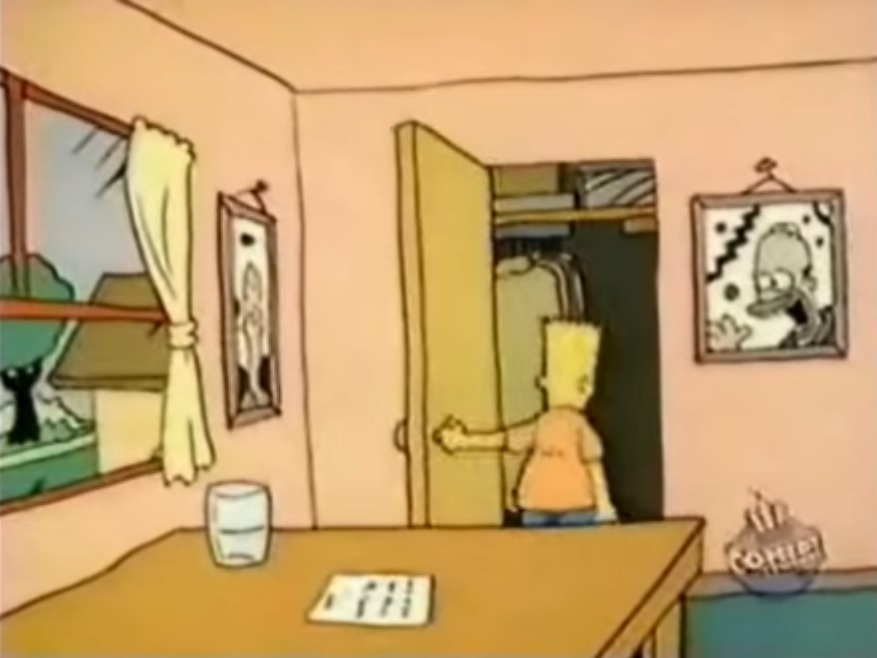
Crudely Drawn Filler Material: The Simpsons in "Closeted" (February 21, 1988)


"Closeted" is yet another Ullman short examining Bart's inbuilt aversion toward adult authority. This one, however, has the added twist that neither Simpsons parent appears directly in the short, but their presence is felt extensively, and uncomfortably, throughout thanks to the array of background art adorning the household walls. Bart hears Homer calling him and, assuming that he's being summoned for some spirit-crushing chores, runs off to find a convenient foxhole in which to lie low until the coast is clear. Except there's a running gag that, no matter where Bart runs, he is perpetually confronted by Homer and Marge's disapproving gaze, perfectly encapsulated in the series of static framed images positioned at every turning of the Simpsons' house. It's actually hilarious just how consistently, aggressively stern Homer and Marge appear in these pictures, to the point where you're compelled to question why anyone would want to plaster images of themselves scowling all up and down their corridors. Obviously, one way to read it is that they're manifestations of Bart's guilty conscience. But they also hark back to the slightly more surreal tone of the earlier Ullman shorts, which incorporated a number of bizarre background gags to reward the eagle-eyed - not least, the artwork in the Simpsons' house would exhibit an uncanny life all of their own and tell some surprisingly macabre tales.

The Simpsons lived in a stranger universe in those days, but this extensive collection of furious Homer and Marge imagery also ties in with the uneasy underlying feeling that pervades "Closeted", in which Bart is effectively treated as a pariah by his family. "Closeted" is an oddly disturbing Ullman short, not so much for the sense it conveys of an omnipresent parental disapproval, but rather its overwhelming sense of cosmic mockery; the feeling that if we step out of line or play loose with the rules, the universe and our loved ones alike will take only too much pleasure in turning on us. When Bart becomes trapped in the closet, his family do not help him in his hour of need, possibly as a deliberate means of punishing him for attempting to shirk his domestic responsibilities (although it would be a mite unfair to pick on Bart when Lisa pulls the exact same stunt). Only Maggie responds to Bart's pleas for help from inside the closet, and her ultimate reaction is to turn Bart's self-serving indolence back on him, when Bart naively implores Maggie to do what he would do if he was in her situation, whereupon she retreats to the living room and gives the television her undivided attention.


Bart pays a heavy price for his lack of responsibility. Not only does he have to endure the discomfort of being trapped in a dark closet, but by the time he gets the door loose again, having realised that the sensible thing would just to be to knuckle down and do his chores, it transpires that those prospective menial tasks were all just a false alarm anyway. Bart discovers that Homer has left him a note, informing him that the family have gone out for Frosty Chocolate Milkshakes and that he's sorry he was unable to find Bart. Bart looks out the window just in time to catch sight of his family driving away for the promised treats, and for his gaze to make contact with Maggie's as she peers at him tauntingly from the back of the car. Despite Maggie's obvious awareness, there is nothing to indicate that the family's abandonment of Bart was done out of spite, or as a knowing reaction to his sneaky attempt to avoid doing chores. Perhaps it is merely a case of fate dealing Bart a bum hand on this occasion. And yet, the adjacent pictures once again add their own layers of meaning to the ending.

On the left-hand side of the above shot, there is a picture of an unidentified individual whom I initially assumed to be some Simpsons relative we've never met (possibly one of those great uncles Homer will occasionally bring up whenever he has an inheritance to claim). On closer inspection, I was struck by how much of a resemblance he bears to the excessively shaven Bart in the short "Bart's Haircut", which had aired earlier on in The Tracey Ullman Show's second season, and was later referenced in the hit single, "Deep, Deep Trouble". In this short, Bart has his trademark spikes lopped off by an incompetent barber and returns home to face no shortage of ridicule from his schadenfreude-indulgent family (between "Bart's Haircut" and "Closeted", you get the sense that the rest of the Simpsons clan really loves to show Bart up). Thus, Bart's desolation at the end of "Closeted" is accompanied by a snapshot of himself at his most brutally humiliated. In the final shot, we see that to Bart's right, overlooking both Bart himself and the shaven Bart image, there is a picture of a troublingly jubilant Homer that stands in startling contrast to the considerably meaner-looking Homer and Marge images that have dominated the mise-en-scene up until now. Ultimately, it is adult authority that has the last laugh, as Bart slinks dejectedly past the leering eyes of his silently derisive father and conceals himself back inside the closet, having decided that he prefers the dark embrace of confinement to the smirking callousness of the world beyond.

Tuesday, 18 December 2018

Radio Bart (aka Hey, this Christmas Party's Getting A Little Too Quiet...)


The Simpsons may have made an annual tradition of letting their hair down and the bugs out each Halloween from their second season onward, but for a while they were reluctant to revisit the holiday that provided them with their very first standalone outing back in 1989. It would be a further six years before they produced a second festive-themed episode, "Marge Be Not Proud", in Season 7, so great was the writing staff's fear of not being able to measure up to that iconic first episode (which was never intended to be the first episode, mind). After that, the floodgates were opened and more and more Christmas episodes slowly started to trickle out, but Mike Scully's tenure as showrunner was almost upon us and the show was nearing the end of its classic era. That means that if you and your friends are planning a marathon of seasonal Simpsons episodes and wish to remain within the show's golden age (debatable, but most feel that this covers seasons 1 to 9), you are limited to just three episodes - "Simpsons Roasting on an Open Fire" (damn, is that a scary title, even if the cultural allusion is obvious), "Marge Be Not Proud" and "Miracle on Evergreen Terrace". And too bad that "Miracle on Evergreen Terrace" also happens to be one of the most hated episodes of Season 9. It's nowhere near as controversial as "The Principal and The Pauper", of course (because very few things in life are), but there are still plenty of fans out there who'd prefer to skip that one. So that leaves us with "Roasting" and "Marge Be Not Proud". Unfortunately, "Marge Be Not Proud" is not a universally beloved episode either - at any rate, the folks over at Dead Homers Society have it pegged as the only truly bad episode of the show's original eight seasons. Personally, I happen to think that "Marge Be Not Proud" is a very good episode and I was genuinely taken back to read Dead Homers Society's diatribe of it, but I'll save my defense of the episode for another year. If you want to play it safe, maybe you had better stick to just the first episode. Unfortunately, you might get one of those awkward folks with the opinion that, "Early Simpsons suck! The show didn't get good until Season 3!" (I have very little patience for such people, but they're out there.) In which case you really are stuck. This is what you get for trying to please all of the people all of the time.

At this stage you might want to start scouring the Simpsons archives for additional episodes which could be seen as "unofficial Christmas episodes", ie: episodes that don't actually take place at Christmas but can somehow be incorporated to the seasonal theme. "Mr Plow" of Season 4 would be a strong contender, since most of the episode takes place in heavy snowfall. "When Flanders Failed" of Season 3 might work, given that the ending borrows so extensively from that perennial Christmas favourite, It's A Wonderful Life (1946). My top recommendation, however, would have to be "Radio Bart" (8F11), also of Season 3, which is a wonderful episode indeed, and one I make a point of trying to slip in a viewing of at some point in the Christmas countdown. What makes "Radio Bart" such a pertinent episode to the holiday season? Because it's taking the piss out of Band Aid, whose ugly, malodorous legacy has been one of the real bugbears of the season since its genesis in 1984. Or, more accurately, it's taking the piss out of USA For Africa, the American attempt to replicate what Band Aid were up to. Either way, it's performing an important service in reminding us of the overall shoddiness of charity records where a bunch of celebrities get together to sing one or two lines apiece, possibly with an eye more toward improving their own public profile than with making a notable difference to the flavour-of-the-month cause in question. If, like me, you loathe Band Aid (or USA For Africa) with every fibre of your being and resent having its pseudo-piety forced upon you every yuletide (or whenever they tend to play USA For Africa) then "Radio Bart" is the Simpsons episode for you.

Even before we get onto the business with Band Aid/USA For Africa, "Radio Bart" sets itself up as a strong contender for the most bitingly satirical episode The Simpsons ever produced. It certainly wastes no time in baring its fangs at a wide array of targets. The episode first aired on January 9th 1992, at a time when digs at German pop duo Milli Vanilli were still in vogue - hence, "Radio Bart" kicks off with with mention of a Milli Vanilli pastiche, Funky See Funky Do, whom we're told will be back shortly to "lip sync another one of their hits". Milli Vanilli, of course, had been the subject of controversy a couple of years prior when it was revealed that they did not perform their own vocals; in this fleeting cultural allusion, we find our first inkling of the fraudulent nature of celebrity and hollow media posturing that the episode as a whole takes such delight in skewering.

As the episode opens, Bart's birthday is just around the corner and the family are concerned with buying him fun and meaningful presents. Homer, ever the devoted worshiper at the alter of the telly box, goes after the first shiny thing the chattering cyclops dangles before him, the Superstar Celebrity Microphone, a pastiche of an existing product that was marketed in the late 1970s/early 1980s, Mr Microphone. Straight away, you can see what I mean about "Radio Bart" being an episode that takes no prisoners. Its send-up of the actual commercial used to promote Mr Microphone is just SAVAGE.


I have to admit, when I watch the above commercial, the most prominent thought running through my head is "Why the hell don't I have one of those things?" It's the guy at 0:23 who really sells it.

It's honestly heartbreaking how much of a contrast exists between Homer and Bart's respective outlooks on the Celebrity Superstar Microphone in the early stages of the episode. Homer sincerely believes that he's snagged Bart the greatest gift ever, but come the big day Bart takes one look at it and isn't even willing to feign enthusiasm. I know that we're supposed to think that Homer picked out the dorkiest gift imaginable, but as a kid I would have killed for a toy like the Celebrity Superstar Microphone and couldn't understand why Bart was being so down on it. Now I'm adult, I've seen the ad for the actual gadget the Celebrity Superstar Microphone was spoofing and I want one more than ever. What the hell is wrong with you, Bart? Eventually, Bart does come round to Homer's gift, once he realises how much potential it has for playing pranks on gullible and unsuspecting souls. And it's here that "Radio Bart" really kicks into gear. Like "Homer Badman" of Season 6, it is an episode preoccupied with media manipulation, only whereas "Homer Badman" went for contemporary targets, like the 1990s tabloid television show Hard Copy, "Radio Bart" is more concerned with evoking the Ghosts of Media Past that continue to haunt American's collective cultural psyche. The initial prank that Bart plays on Homer, in using the Celebrity Superstar Microphone to convince him that aliens have invaded the Earth (and eaten George H. W. Bush), is an obvious nod to the widespread panic attributed to Orson Welles' radio dramatisation of The War of The Worlds in 1938. The episode's pivotal prank, in which Bart lowers the radio into a well and convinces the townspeople that he's Timmy O'Toole, a hapless young orphan who's gotten himself stranded down there, echoes the true-life story of Kathy Fiscus, a three year old girl who became a media sensation when she fell down a well at San Marino, California on April 8th 1949. Kathy's plight and the subsequent rescue efforts attracted a great deal of attention from various media outlets, including the recently-established KTLA television station, who broadcast live coverage of the events outside the well. Sadly, the story did not have a happy ending, for Kathy had already died of asphyxiation by the time the rescue party reached her. Kathy's tragic tale remained ingrained in America's consciousness as it entered the 1950s, and is cited as one of the key inspirations for Billy Wilder's 1951 film Ace In The Hole, which deals with the media circus (both literal and figurative) that springs up in a town in New Mexico in response to the plight of a local man trapped inside a cave (and the efforts of an unscrupulous journalist, played by Kirk Douglas, to exploit the incident for his own personal gain). Ace In The Hole clearly had a few ardent fans among The Simpsons production crew, for there is a sequence in "Radio Bart" that's recreated pretty lovingly from Wilder's film, in which crowds of people are seen gathering around the grounds of the well amid the incongruously buoyant strains of fairground music, whereupon the camera pans up to reveal the grotesque sight of a big wheel rotating above what is, when all is said and done, the site of a thoroughly distressing mishap (if it were actually true, that is).

Crucially, no one is doing anything to help the fictitious Timmy, who is essentially left to rot in his underground tomb while the townspeople enjoy the carnival up above (complete with popcorn snacks* marketed - somewhat unappetisingly - as Timmy O'Toole Baby Teeth) and make a big show of Timmy's apparent nobility in enduring his plight (as if he has any choice in the matter). Eventually, the story attracts celebrity attention, in the form of local entertainer Krusty the Clown, who figures that the best way to help Timmy is to assemble a bunch of his showbiz friends and write a song about it. Hence, we get "We're Sending Our Love Down The Well", The Simpsons' vicious send-up of the kind of "supergroup" charity records that became lucrative business following the success of Band Aid in 1984. Band Aid, the mother of all insufferable charity supergroups, had been the brainchild of Irish rock musician Bob Geldof, lead singer of The Boomtown Rats, and his wife Paula Yates, who were moved by the BBC's coverage of the then-ongoing famine in Ethiopia and were ultimately inspired to record a single to support the humanitarian aid. For this, they assembled a swarm of musical chums in the form of Sting, Bono and various other representatives from the hottest British pop acts of the age, including Duran Duran, Heaven 17 and Bananarama. And good grief, did these guys churn out an absolute stinker. "Do They Know It's Christmas?" is a detestable song on just about every conceivable level. Some people are inclined to give it a pass for being such an appalling piece musically on the grounds that it was all in the name of charity, but even then we have the problem of the song's extremely odious and condescending attitude toward the very people it purports to be helping. "Do They Know It's Christmas?" is not a song with a whole lot of love or respect for Africa - rather, it clearly posits Africa as the Western world's intrinsic inferior, inserting the jaw-droppingly myopic lyrics "Tonight thank God it's them instead of you", and telling us over and over what a grotesque and inherently unlivable place Africa is. The problems arising from the crisis in Ethiopia (for some bizarre reason, the song puts a lack of snowfall on the same footing as drought and famine, which is indicative of how little thought went into the lyrics) are ascribed to be characteristic of the entire African continent, presumably under the assumption that all Africans are alike in the eyes of dumb Westerners. But then the purpose of "Do They Know It's Christmas?" was never to encourage you to feel respect or a genuine affinity for the people of Ethiopia. Rather, it's more about selling you a perfectly gift-wrapped vision of these wretched Africans in dire need of white saviours, so that you can pat yourself on the back and feel good about the fact that you threw a small sum of money at a problem in the hope that it would go away. Really, you would expect an extensive collaboration between the top talent in British pop to come up with something considerably less limp than this. (Although come to think of it, would you? I suppose not.)

Don't get me wrong. What happened in Ethiopia in the early 80s was appalling and people were right to be concerned about it. But this representation of Africa as the land of the impoverished other, as endorsed by Geldof and his cronies, is a shameless display of Western prejudice, one which I've long suspected ultimately promotes more distance than it does unity. I went to school at a time when it was still fashionable for teachers to play Band Aid during assemblies (irrespective of whether it was Christmas or not) and get us to contemplate what a mud hole of eternal misery and starvation Africa was and how fortunate we were to be far-removed from it. We seldom, if ever, got any broader perspective of Africa, a diverse continent as rich in culture and heritage as any other.

To my mind, "Do They Know It's Christmas?" is an easy contender for the worst record of all time. Regrettably, the song has racked up quite a gargantuan legacy, for not only does Geldof have an established pattern of resurrecting Band Aid every decade (though the tepid response to Band Aid 30 in 2014 did at least suggest that the public are tiring of being presented with the same repackaged, hopelessly outdated nonsense every ten years), it inspired a whole sub-genre of supergroup charity records that was set to plague the world for the rest of the 80s. Every time a new fashionable cause came about, you could bet there'd be a bunch of celebrities linking arms and singing some generic fluff about caring and togetherness. One of the more successful of these was "We Are The World" by USA For Africa, an American answer to Band Aid penned by Michael Jackson and Lionel Richie that was released in March 1985. Come to think of it, I'm not even sure if I've ever heard "We Are The World", although I'm certain I've seen the thumbnail pop up a few times while binging Hall & Oates videos on YouTube. If it's even a fraction as terrible as its British counterpart, then I don't want anywhere near it (sorry Daryl, but I'm only prepared to follow you so far).

The Simpsons: A Complete Guide To Our Favorite Family specifies that Krusty's collaboration is a send-up of "We Are The World" and certainly, of the two I suspect that "We Are The World" would be the recording with which American audiences were more familiar, but the presence of original Band Aid member Sting would also appear to link it to its predecessor across the pond. Still, if you listen to the episode's DVD commentary, then you'll learn two very interesting facts about the inception of "We're Sending Our Love Down The Well". Firstly, Sting was not the guest celebrity in the original script, USA For Africa alumni Bruce Springsteen having been the writers' first choice, only he turned them down (Stevie Wonder was also considered before Sting came on board). Secondly, the actual inspiration for "We're Sending Our Love Down The Well" was not Band Aid or USA For Africa, but a more recent celebrity collaboration, "Voices That Care", which was recorded in 1991 to give moral support to US troops in Operation Desert Storm. "Voices That Care" is widely derided as being a bit of a fiasco, not least because by the time it aired on Fox on February 28, 1991, Desert Storm was over. Also, it sounded like this:


I know I just made a point about refusing to listen to "We Are The World", but in this case I actually sat and watched the whole thing. All seven minutes of it. My morbid curiosity was just too overwhelming. And goddamn. As much as I've ragged on Band Aid and will never forgive Bob Geldof for penning such a witless and grossly condescending piece of trash, I will credit him with this much: when Band Aid was first assembled back in 1984, this kind of charity supergroup was a relatively new innovation and nobody could have known how it was going to work out. There might have been something bold, refreshing and genuinely exciting about the opportunity. By 1991 I'm sure this just looked dated and naff, a bunch of flavour-of-the-month celebrities (remember when Kevin Costner was the hottest leading man of his day? Remember when we all thought James Woods was cool?) clambering aboard the bandwagon to have their egos petted (notice how the emphasis in the above video is clearly on the awesomeness of the celebs involved as opposed to the stories of the people they were supposedly helping). The Simpsons were right to show it no mercy.

Right from the start, the futility of Krusty's venture is made woefully plain. Everything about the enterprise comes of as so hilariously ill-fated and wrong-headed, from the sheer banality of Krusty's non-anecdote about arranging a meeting with Sting, Sting's professedly vague understanding as to what the cause he's supporting is even about, Sideshow Mel and Rainier Wolfcastle's delectable exchange within the song ("Though we can't get him out we'll do the next best thing..." "...and go on TV and sing, sing, sing!") and finally Krusty's hazy explanation as to what he's planning to do with the royalties: "We gotta pay for promotion, shipping, distribution...you know those limos out back, they aren't free. Whatever's left we throw down the well." On top of everything else, it's not entirely clear how this leftover money is intended to help Timmy, for nobody in Springfield can produce any half-way practical ideas about how to retrieve the unfortunate kid from the well. By the time we get onto Krusty's bit, the response to Timmy's plight has degenerated into a grotesque farce of empty posturing, with nobody wanting to help Timmy so much as make an extravagant display about how much they'd like to be able to help Timmy, if that were possible. From what little we hear of "We're Sending Our Love Down The Well", it's at least an infinitely better song than "Do They Know It's Christmas?", but then it had a really low bar to clear in that regard.

(Anyway, fun fact - the "We're Sending Our Love Down The Well" sequence provided Sideshow Mel with his first ever speaking role. Mel was introduced in the Season 2 episode "Itchy & Scratchy & Marge" but had remained completely silent up until now. I've mentioned this before, but Mel's voice is apparently Dan Castellaneta's attempt at a Kelsey Grammer impersonation.)

Bart's prank is not exactly harmless. At its genesis, he feeds the townspeople a malicious lie about Principal Skinner, in telling them that Timmy was denied a place in Springfield Elementary by Skinner because his clothes were too shabby (and Skinner momentarily becomes the voice of reason, in screaming out "HE'S A LIAR!" to a crowd that does not care to listen). Bart pulls this entire stunt because he's a hooligan who enjoys the sensation of having the entire town hanging on his every word, not because he has any kind of point to prove. Nevertheless, and even as we grow increasingly concerned as to just how far Bart can reasonably hope to extend this prank, the townspeople do not exactly command our sympathies. When Lisa gets wise to the deception and berates Bart about how "the thought of a boy trapped in a well brought out the kindness and love of the entire community," we are not going to see eye-to-eye with her. The community of Springfield might think that the non-existent boy's plight has brought out the best in them, but plainly it hasn't; if anything, their reaction has only revealed what a staggeringly incompetent and superficial bunch they are. In the end, the "kindness and love" that Lisa speaks of amounts to nothing more than a display of shallow conformity, with all of Springfield gathering around the well to profess their adoration for little Timmy (and ride the big wheel) while accomplishing effectively nothing.

Of course, this kind of mindless conformity has its dark side too, as Bart discovers when he returns to the well, having finally decided that the prank has gone too far (once he's remembered that there's incriminatory evidence on the radio that could potentially be linked back to him) only to become trapped down there himself. Bart confesses to everything, hoping that his honesty will inspire clemency, but...it doesn't. You can't blame Springfield for feeling peeved with Bart. And yet, the central narrative hasn't really changed. There's still a helpless kid trapped down a well, and common decency dictates that the right thing to do would be to help him out. But the townspeople willfully abandon Bart, angered that the perfect little orphan who served so obligingly as a sounding board to their own egos was just an illusion. Crucially, to help Bart would require them to put aside their egos, in overlooking the fact that he made such fools of them all, and nobody in Springfield is quite willing to swallow their pride to that extent. Hence, Bart becomes public enemy number one, and the townspeople gleefully rally around the narrative that Bart's miserable fate is nothing more than the natural conclusion to his life of misdeeds. Bart's grim prospects are reduced to the taunting schadenfreude expressed in a particularly cruel schoolyard skipping rhyme, while the adult set turns away in search of new and entirely vacuous distractions to occupy their minds, which they find in the latest pop fakery from Funky See Funky Do and a squirrel who bears an uncanny resemblance to Abraham Lincoln (only to die for it...R.I.P. Lincoln Squirrel). The fickle world of popular consciousness has moved on, content for Bart to be literally and figuratively buried.

Ironically, it is another facet of this mindless Springfieldian conformity that ultimately saves the day, though it takes the resolve and fierce individualism of one denizen - Homer, who decides that he will dig Bart out single-handedly if need be - to set it into motion. As Homer toils away tirelessly, his efforts are observed by Groundskeeper Willie, who yields the punchline to the entire kid-down-a-well affair - "Why didn't I think of that?" - and rushes over to help. Suddenly, the entire town is flocking together with shovels to join the rescue effort. Have they finally forgiven Bart, or are they just falling in line with the latest turn in popular action? Or is it futile to even begin attempting to distinguish the two? Jasper's summation of events - "It's an old-fashioned hole-digging; by gar, it's been a while!" - would imply that the participants are less fussed about the particulars of what they hope to achieve than they are surrendering to the giddy thrills of being part of a major event. For as stirring as the episode's climactic sequence is, it's careful to keep itself tempered with a healthy dash of cynicism (even Bart's heartfelt display of remorse, which moves Homer into action, is a tad disconcerting - he recognises that he's done wrong, and yet what really distresses him is the thought of all the bad things in life that he'll now never get the chance to do). Before long, Sting is back in Springfield - his return is even heralded by the appearance of a canary in a coalmine - and getting his hands dirty for the sake of the fan whom he believes needs him (Marge begins to question the actual degree of Bart's devotion to Sting, but is advised otherwise by Homer). Sting often gets flak for being big-headed, but the fact that he participated in this episode suggests that he must have a really self-deprecating sense of humour. Sting is afforded essentially no glamor in this episode; even after achieving the heroic feat of finally breaking through the walls of the well and getting through to Bart, he is unceremoniously shoved aside by Homer, who is eager to be reunited with his son.

The episode ends with Homer assuring Bart that measures are being taken to ensure that nobody ever falls down the well again - namely, Groundskeeper Willie has erected a "Caution" sign beside the well, and we close on his satisfied grunts of "That should do it!" It is a risibly facile solution to the problem of this potential deathtrap lying right in the middle of a Springfield field. And yet there is something strangely reaffirming about the mere practicality of such a tiny, unassuming gesture - it isn't showy, it isn't glamorous, it simply wants to alert passers-by to the dangers of the well. It's not much, but it represents a small drop of enlightenment for a town whose hearts, up until now, have never quite seemed to be in the right place. We are content, much like Willie, to leave the well resigned to obscurity once again, hopeful that a marginally more optimistic future lies ahead.

Oh, and while researching for this piece I did actually look up the lyrics to "We Are The World". It is as hideously schmaltzy as I'd imagined, although to its credit it contains nothing about specifically about Africa being a world of dread and fear, or any lyrics as hopelessly on a par in crassness with "Tonight thank God it's them instead of you" (jeez, Geldof). I'm sure it's still a total chore to listen to, however. As for Sting, he was a part of Band Aid, so...he'll always have that riding against him. That being said, I will admit to being a fan of Sting, and while I really should have learned my lesson by now about making promises for the coming year that I'll potentially never keep, in 2019 I hope to finally tackle The Sweatbox, the feature documentary about the making of The Emperor's New Groove that Disney, for some inexplicable reason, tried to bury deeper than Bart in that well. You and your grandmas have all had the opportunity to see it by now, I assume?


* Those are bags of popcorn, right? I take it that guy isn't walking around selling bags of actual children's teeth?

Sunday, 16 December 2018

Crudely Drawn Filler Material: The Simpsons in "Simpson Christmas" (December 18, 1988)


The Simpsons famously got their start as a standalone series with a Christmas episode, "Simpsons Roasting on an Open Fire" (which was actually the eighth episode production-wise, and moving it to the front of the queue created a few mild continuity issues - notably, Homer is already the power plant's safety inspector, a job he wasn't assigned until the third episode, "Homer's Odyssey"). Prior to that, however, the family had already had one festive venture, "Simpson Christmas", as part of their last season on The Tracey Ullman Show, which gave us a glimpse into a typical yuletide within the Simpsons household. The series proper has possibly conditioned you into supposing that a "typical" Simpsons yuletide involves Homer having to moonlight as a department store Santa, Bart burning down the Christmas tree or the town being invaded by ungodly Furby knock-offs, but compared to subsequent Xmas-themed Simpsons adventures, "Simpson Christmas" is a relatively uneventful affair. Here, the family don't do anything that most families probably don't do upon the big day. The kids get a little rebellious, the adults get their patience tried, it all ends with the lot of them zoned out in unison upon the couch before the soporific holiday scheduling (Itchy and Scratchy make an appearance but look to be in an unusually peaceful mood). This is the kind of nice, quiet, everyday Christmas that the family were permitted to have before they had a full twenty-two minutes to support.

The short consists of Bart reciting a heavily modified version of "The Night Before Christmas" by Clement Clarke Moore (maybe...authorship of this much-loved poem is disputed), as he describes how his attempt to get in a stealthy preview of his presents in the early hours of Christmas morn was thwarted by Homer's vigilance and aggressive temperament. Homer's hot-blooded parenting provides the most disturbing element of an otherwise fairly laid-back Simpsons outing - there is something appealingly off-kilter about the rhyming of Bart's declaration that his present is "rad, man" with his apt description of Homer's shadow looking like a madman, and Homer subsequently ordering his children back to bed before he kills them all. (Note: Homer actually gets his daughters mixed up, for he belts out the wrong names while pointing at each child individually. We also get a rare example of him calling Bart "Bartholomew" for the sake of a rhyme).

"Simpsons Christmas" is obviously a very materialistic celebration of the holiday, pivoting on the fact that those kids simply can't wait to get under the tree and making mincemeat of the wrapping paper concealing their presents, but such is the allure of the festive season when you're a child. Speaking as someone who grew up to have a very Ginny Grainger-esque view on Christmas, I find this short to be a very honest, even borderline poignant window into my faded youth, when Christmas meant being physically unable to remain still for the sheer excitement of what was to come. I could shed a tear through it, even as Homer dishes out the empty death threats.

Two minor notes - firstly, Binky and Bongo, the rabbits from Life in Hell, make a cameo in plush doll form. Secondly, I don't know why but I love the generic dance music playing during Lisa and Maggie's dancing candy bar vision. It sounds for all the world like they just threw in the first piece of library music they happened to pluck from their archives - not in the slightest bit festive-sounding, but damn, that is some sweet dreamin'.

Tuesday, 11 December 2018

The World's Most Horrifying Advertising Animals #7: Cola Polars


If you've been following my retrospective on horrifying advertising animals since its inception back in June, then you might have figured out by now that I've been applying a very flexible definition of what constitutes as "horrifying". The initial focus, for the first three entries, was on advertising critters that provided nightmare fuel in a predominantly aesthetic sense, although as the series continued I started branching out to mascots that were unsettling through much broader means, either because there was there was something odd or highly questionable about the character's implicit narrative (as with Spuds McKenzie), they were tied up in a particularly infamous and odious crossover marketing ploy (as with the Taco Bell Chihuahua) or they were simply a sinister albeit truly magnificent bastard (as with Clive the Schweppes Leopard). If you're wondering how I'm going to affix the "horrifying" tag to a campaign as warm, fuzzy and seemingly innocuous as Coca-Cola's long-running seasonal Polar Bear series, then actually I've got two possible approaches. The first of these is purely aesthetic and by far the less interesting of the two, so we may as well get it out of the way right now. The first few ads in the series were created using 1990s computer animation, which as we all know has generally aged rather gracelessly (although the original Toy Story still looks great provided you don't linger too long on the humans' faces). So the early bears may look a bit odd and clunky to modern eyes. There are clunkier efforts out there, however (they still hold up better than the humans from the original Toy Story, for example). Oh, and one of the early ads features a live action Santa who just randomly appears out of nowhere to dispense Coca-Cola to a polar bear who's fallen on his fuzzy white butt. Okay, that is kind of surreal. I'm not entirely sure what's meant to be going on in that particular spot.


The second approach is a lot more compelling, for it's here that the warmth, fuzziness and general innocuousness of this much beloved campaign may actually be starting to turn against it. The Coca-Cola Polar Bear is an interesting example of an ad campaign that's been on Earth for long enough to have witnessed a dramatic shift in perceptions of the real-life creature from which it draws inspiration. We look at the polar bear and we don't quite see the same creature we saw a quarter-century ago, when Coca-Cola first hit upon the tremendous marketing potential of using the magnificent white ursines to promote its wares during the chilly winter months. In theory, Coca-Cola should have their work cut out in convincing me that a cold soft drink is the one thing I'm really craving when it's so nippy outside, and yet they really caught onto something by inserting a cola bottle into the paws of an animated polar bear, making it seem like the quintessential accessory for a thirsty bear on the trot, and an entirely natural part of the winter milieu.

The Coca-Cola Polar Bear is actually a much older creation than many people realise, having made its debut close to a century ago in a French print ad in 1922. For many, however, the polar bear's status as an iconic soda shill didn't really take flight until 1993, when Ken Stewart of Creative Artists Agency came up with the initial "Northern Lights" spot as part of the wider "Always Coca-Cola" campaign. The innovative ad featured CG animated polar bears (animation courtesy of Rhythm & Hues) trekking across the ice in order to attend the Arctic equivalent of a picture show - nature's light show, the aurora borealis. As the bears stared up in awe at the magnificent display, it was revealed that each had come prepped with a bottle of cola, just to make the experience that much more felicitous. According to this article, Stewart was actually inspired by a desire to immortalise his beloved Labrador Retriever, Morgan, whom he thought looked like a polar bear and used as the model for the CG bears. (I have to say that based on the picture featured in the article I don't see the resemblance, but maybe you had to experience Morgan first-hand).


Honestly, aside from the mildly grotesque close-up shot of the main polar's face at the very end, I find it difficult to fault the original 1993 Northern Lights spot. The CG animation, while undeniably primitive-looking by today's standards, hasn't aged too hideously, and there's something endearingly minimalist about the ad's approach to its quirky concept. It doesn't drag out the central gag any longer than it needs to, it eschews dialogue in favour of an array of charming sonic touches (the whirring winds, the ursine grunts, the squeaking of paws against the snow), giving the whole thing a wonderful sense of atmosphere, and its depiction of the natural world is the perfect melting pot of Disneyfication and self-conscious daftness, something that subsequent ads were able to expand upon beautifully. Take the ad in which a young polar bear loses its ball to the Arctic waters and a seal magnanimously retrieves the wayward toy (despite the fact that polar bears and seals are mortal enemies and those bears have undoubtedly chowed down on a selection of that seal's mates). For a few gut-wrenching moments, it looks as if the ad is about to get unBEARably saccharin. Then the adult polar pushes a bottle of cola in the seal's direction as a token of thanks and we're back in the territory of comfortable absurdity. If you're going to incorporate something as far-out as the halt in a conflict as relentless and primordial as that between polar bear and seal, then you might as well signify the truce with the preposterous imagery of the critters exchanging a cola bottle.

The Coca-Cola polars have become a recurring feature of the holiday season (although more recent installments have been animated by Australian studio Animal Logic, the same team behind the Happy Feet and Lego Batman movies, who also gave the bears their own short film in 2012), but in recent years the campaign has taken on a somewhat darker subtext, despite their content remaining as genial as ever. Viewers these days are more accurately aware that the ads represent nothing more than an idyllic fantasy. Oh sure, we've always appreciated that they're fantasies in the sense that polar bears don't drink cola and they don't go skating and receive handouts from Santa. Obviously, no sane person took these ads to be an accurate depiction of polar bear biology (and Werner Herzog will gladly be on hand to give you a clip around the ear should you seriously propose that a polar bear would be interested in rewarding a seal with a cola instead of devouring said seal). Rather, we're consciously aware that the ads are a fantasy in a much deeper, more symbolic sense, in that the polar bear is no longer a species we associate with carefree fun and bubbly frolics in a distant, immaculately white Arctic paradise. Over the past decade or so, the polar bear has undergone a dramatic image transformation, from an awe-inspiring symbol of a majestic, untamed wilderness to a creature driven to the very brink of survival; moreover, it has become the very first species that springs to mind when we contemplate everything that's getting increasingly screwed up about our fragile planet. The Coca Cola campaign depicts a polar utopia that's no longer there, and the cuddly escapism offered by the ads is itself becoming threatened.

Mya Frazier underlines this dilemma in this article written for the New Yorker, where she notes that Coca-Cola are hardly unique in adopting an endangered species as their brand mascot, citing Tony the Kellogg's tiger as another example. Tony, however, has proven generally more successful in convincing the public to dissociate his own cereal-hawking lifestyle from the harsh reality facing the vanishing felines, possibly because he's an immensely more anthropomorphic creation (nevertheless, Frazier does cite one example in which the company's association with the iconic tiger was used against it by protestors). In the UK, Fox's Biscuits use a mafioso panda, Vinnie, as their product spokesperson, although the official narrative insists that he's not a pure-bred panda and has traces of dog in him too (however the hell that works). Clearly, when the narrative for your fun-loving mascot's flesh-and-blood equivalent is less than sunny, it helps to create a little distance between the two. The Coca-Cola Polars are at a disadvantage in that regard, for while investing the bears with human characteristics has always been an integral ingredient in the campaign's success, they also draw immeasurably from the fundamental charms of the inquisitive white bears as a species. There's the additional problem that they take place against the background of that immaculate white Arctic, a projection of our infantile fantasies for a spotless winter wonderland that seems increasingly less relevant as the polar bear's actual habitat continues to dwindle. In her article, Frazier acknowledges that Coca-Cola have made monetary donations toward polar bear preservation efforts, but poses the obvious question as to whether the sum of money given ($2 million) is anywhere near enough, particularly in light of how much Coca-Cola have gained from their association with the bear.

As it is, the Cola polars have become less of a reassuring reminder that holidays are coming, and more like a Ghost of Christmas Past that annually appears in order to confront us, much like Ebeneezer Scrooge, with a haunting reminder of our waning world, and of our own lost innocence as a species. Let's hope we never reach a point where the image of the magnificent white bear roaming its natural habitat becomes as fantastically ludicrous as that of a polar bear handing a seal a Coke.

Friday, 7 December 2018

Blinky Bill's White Christmas (2005)


Flashback to 1992, and there were major changes in the air for the Australian animation squad at Yoram Gross Film Studio. To date, their legacy had been largely founded on a series of films chronicling the adventures of Dot, a heroic young girl with the ability to converse with animals, but the studio were thinking about retiring Dot (who received her final feature outing in 1994) and were eagerly in search of a new signature character to lead them toward the modern age of the approaching millennium. They found it in a fresh interpretation of Blinky Bill, a much-loved literary character created by New Zealand children's author Dorothy Wall, and a lucrative new animated franchise was swiftly born. A feature film, Blinky Bill: The Mischievous Koala, debuted in 1992 and was followed by a spin-off-TV series in 1993, which proved a smash hit not only on its native Australian soil but also in several European territories. The Adventures of Blinky Bill initially ran for two seasons between 1993 and 1995 but was given a new lease of life in 2004, when Yoram Gross, through a recently-formed partnership with German media company EM.TV (the same media company who also had The Muppets at one point in time), brought the series back for an additional season (somewhere in between, there were also unsuccessful efforts to give Flap, Blinky's platypus sidekick, his own spin-off series, but we're not talking about those today). The culmination of this revival was a Christmas special in 2005, Blinky Bill's White Christmas, which was directed by Guy Gross (son of the studio's eponymous founder) and would prove the last hurrah for the 2D incarnation of Blinky, before Yoram Gross Film Studio put him back into cold storage for a further decade and eventually rebooted him as a CG animation franchise in 2015.

Clocking in at just under 80 minutes, Blinky Bill's White Christmas was technically our second Blinky feature film, albeit made specially for television. How does it compare to The Mischievous Koala? When I reviewed that film earlier this year, I rated it as being fairly chaotic on the narrative front, what with its reliance on extensive and digressive flashback sequences, its insanely dragged out climax and its curiously abrupt ending, although I gave it strong enough marks for atmosphere and emotion. Blinky Bill's White Christmas beats its predecessor hands-down in terms of narrative consistency (White Christmas doesn't have an amazingly fleshed out story, but there's at least coherent progression from Point A to Point B), but in all other areas the 1992 feature has it licked. For one, White Christmas is nothing to write home about visually speaking. The Mischievous Koala utilised Gross's signature aerial imaging technique of superimposing animated characters onto live action backdrops, resulting in an ostensibly primitive look that's surprisingly effective at emphasising the innocence and fragility of its protagonists when stacked up against the big and tumultuous world. This was not exported into the 1993 TV series, which went with a more traditional painted background approach. By the time of the 2004 revival, the animation industry had changed significantly and a digital ink makeover was in order; as a result, the third season has a significantly altered, more vibrant and less detailed look that's difficult for me to comment on without betraying my personal preference for hand-painted cel animation. I need only glance at a frame from Season 3 and I feel over-stimulated by the immense amount of colour saturation going on. Compared to the garish simplicity of Season 3, White Christmas boasts some fairly detailed background imagery that's easier on the eye, but the mood and character of Blinky's earlier adventures is very much missed. On the plus side, original voice actors Robyn Moore and Keith Scott are still on board (with the additional voice talents of Sarah Aubrey and Shane Withington) and do as fine a job as ever.

Blinky Bill's White Christmas functions as the grand finale to The Adventures of Blinky Bill, although long-term fans of Gross's Blinky should note that two major characters from the TV series, Marcia the marsupial mouse and Shifty the dingo, are conspicuously absent here, but for a handful of very brief blink-and-you'll-miss-them cameos during the opening montage. This would be less galling if the special didn't also waste so much time with random incidental characters we've never met before and (this being the final bow for this incarnation of Blinky) won't ever see again. The main narrative arc sees Blinky and Flap travel to the fabled Wollemi forest in search of a rare pine tree, but there's also a superfluous subplot involving Miss Magpie's efforts to assemble a school choir from the talentless tykes she teaches, meaning we get lots of useless filler sequences with nobodies like Angela the possum, Johnny the weak-bladdered rabbit and Tim and Tom, bandicoot twins who trade identities on a daily basis. The purpose of this narrative thread, other than to pad White Christmas out to the full 80 minutes, feels as if it's to further impress the special's big musical centrepiece, "Christmas in Australia" by pop singer Christine Anu, onto the viewer. I can't find any evidence that the song received a proper commercial release, but the special's tendency to keep periodically emphasising its existence does have the air of an odious marketing ploy about it.


As Miss Magpie's shrill assembly of pint-sized choir animals are eager to inform us over and over, it's Christmas in Australia, and if you know nothing else about the Australian climate then know this - Australia is in the Southern Hemisphere, so over there Christmas occurs in peak summertime. The traditions and iconography of the Australian Christmas are still very heavily rooted in those of its European counterpart, however, so it is not at all uncommon for Aussies to exchange cards depicting wintry scenes and Santa Claus heavily clad in his Coca Cola-endorsed reds, right before they hit the beach for a glorious day of surfing and sunburn. Keeping in mind that Blinky had by now established a strong fanbase in Europe as well as Australia, I don't find it too far-fetched that the plot of the special was purposely designed with an eye toward bridging the gap between the sweltering Australian Christmas and the traditional European white one. Blinky picks up on the curiously discordant nature of the former when he asks Wombo, his elderly wombat mentor, why Santa would wear such a ridiculously bulky suit in the middle of summer. Wombo explains to Blinky that many of the holiday traditions with which they are familiar originate in the Northern Hemisphere, where Christmas is associated with cold and snow. Blinky finds the entire notion of a frosty Christmas to be very far-fetched at first, so Wombo shows him a home movie of a trip he made to Europe as a younger wombat, where he was able to experience one of their legendary white Christmases first-hand. During his visit, Wombo acquired a snowglobe, which he has cherished ever since, for looking upon it always reminds him of his glorious Christmas in the frozen North. The instant Wombo produced the snowglobe and explained very clearly what it meant to him, I had a sneaking suspicion that it was very unlikely to survive the special intact - the snowglobe looks extremely fragile, it's just received a wad of exposition and, let's face it, Blinky is a ticking time-bomb - and sure enough, it isn't long before Wombo's much-loved artifact is reduced to a shattered heap. Remorseful at having broken Wombo's snowglobe, Blinky decides that the only way he can possibly compensate is to recreate Wombo's white Christmas experience right there in Greenpatch. Blinky delegates the task of creating snowfall to Splodge the kangaroo and Nutsy the girl koala while he and Flap venture out into the wilderness in the hopes of bringing back another staple of the European Christmas, a decorated pine tree. Rumor has it that some rare specimens can be located in the distant Wollemi Forest, although said forest is also reputed to be home to a variety of fearsome prehistoric creatures, so most Greenpatch residents are smart enough give it a wide berth.

The antagonists of the special are a couple of professional "plant poachers" named Chopper and Sly, who also have their sights set on plundering the mysterious goodies of the Wollemi Forest. They might as well be Harry and Joe from the original film, and in fact they come across as versions of Harry and Joe that have been purposely watered down in order to appear less intimidating to younger viewers (not that Harry and Joe themselves made for particularly formidable foes during their climactic showdown with Blinky and his gang, but they were at least capable of dishing out destruction of truly cataclysmic proportions toward the start of the film). Chopper and Sly are easily my least favourite aspect of White Christmas, for their sequences are frankly even more of a chore to sit through than the aforementioned filler with Miss Magpie and her choir. If you read my review of The Mischievous Koala, you might recall me noting that Yoram Gross's take on Blinky Bill attracted some controversy for its negative portrayal of the woodchipping industry. The original feature was careful to cover itself with a disclaimer emphasising that its villains were into illegal woodchipping practices only, but I've found at least one source claiming that the Australian forest industry took offense when the lyrics "Save us from that woodchip mill!" were incorporated into the TV series' theme song. White Christmas plays things as safe as humanly possible, by giving Chopper and Sly an extensive amount of dialogue in which they plainly discuss the criminality of their own plant-harvesting actions, just so there's no confusion as to which subcategory of woodchipper Yoram Gross are condemning. Needless to say, Chopper and Sly's villainy is painted in very broad strokes, and they make for fairly unengaging antagonists, too on the nose in their misdeeds to have any kind of authenticity but also too dense and ineffectual to seem capable of causing any real harm. It doesn't help that they're a variation on the same stupid-little-skinny-guy-and-slighty-less-stupid-but-still-pretty-stupid-fat-guy schtick we've seen replicated hundreds of times in the wake of Laurel and Hardy.


Despite the 80 minute run time, there's not a whole lot actually happens in White Christmas. Blinky and Flap have various run-ins with Chopper and Sly and are eventually cornered in a cave, where they befriend a large wombat-like creature they name "Wol" (on the basis that that's the only thing he can seemingly say). Wol's species is never formally given, but he's a Diprotodon, a type of extinct giant burrowing marsupial related to the wombat (I know this, not because I'm amazing proficient in marsupial paleontology, but because Lobe once referenced the species in an episode of Freakazoid!). Wol, of course, is one of the prehistoric residents of the Wollemi Forest, but Blinky and Flap don't twig this right away. The most curious thing about Wol is that he wears a diaper, presumably as an easy shorthand to clue us in that he's only a baby, although later on when we actually get to the Wollemi Forest and meet the rest of its oddball menagerie they turn out to be largely non-anthropomorphic and are quite content to strut around in the nude, so...who among them forces Wol to wear a diaper for his modesty/convenience? Then again, we don't really get to spend a lot of time in the Wollemi itself. The obvious dilemma Blinky faces, as he finally reaches the forest, is whether or not it's ethical for him to cut down and make off with an endangered tree, even for something as ostensibly unselfish as a friend's Christmas celebrations. This is where the bulk of the special's drama lies, for we never sense that Chopper and Sly pose much of a threat to the forest (and indeed, Wol's father is quite capable of seeing unwanted encroachers off himself, without the aid of Blinky or Flap). It's here that White Christmas would really have benefited from a sprinkling of the trademark melancholia that ran rife throughout the Dot features and The Mischievous Koala, in order to convey a sense of the Wollemi Forest being something very special and vulnerable. As it is, the Wollemi is really just a bland forest populated by slightly odd-looking creatures who don't talk or wear clothes (Wol's mysterious diaper notwithstanding). Evidently, it's meant to be a place that time forgot, but not enough is done to instill it with its own unique atmosphere or mystique. In the end, Blinky decides that he cannot cut down one of the wollemi pines and risk destroying the homes of any of the forest's residents, but regrets not having anything to show for his troubles to Wombo...whereupon Wol gets him out of his spot by gifting him with a small potted wollemi seedling. A sweet gesture, although it does raise further questions, such as where did Wol even manage to get hold of that pot in the first place? Like his diaper, it somewhat undermines the implicit idea that that these creatures are meant to be untouched by civilisation, be it that of humans or anthropmorphic bush critters.


Overall, most of what I've had to say about White Christmas has probably sounded overwhelmingly negative, so I should emphasise that I don't dislike the special, I just don't think that it benefited in any shape or form from being dragged out to feature length. There's probably just enough plot here to fill out a standard 22 minute episode of the regular TV series. Trim off the subplot fat involving the choir animals and Splodge and Nutsy (whom we keep checking in on intermittently), along with any conversation between Sly and Chopper that goes on for more than five seconds, and you'd be left with a much slicker (although still unremarkable) product. At 80 minutes, White Christmas is a pleasant but soporific experience, one that will likely struggle to retain the interests of older viewers.

The juiciest aspect of Blinky Bill's White Christmas occurs in the last few seconds of the special, when it decides, quite out of the blue, to throw a genuine curiosity at us. Blinky and Flap return to Greenpatch with an additional souvenir in the form of Sly and Chopper's woodchipper (possibly a deliberate callback to Blinky and his gang hijacking Harry and Joe's vehicle at the end of the original film), to discover that Splodge and Nutsy's efforts to create genuine snowfall have all ended in failure. That's when Blinky hits upon the idea of creating a kind of faux snowfall by feeding the woodchipper old newspapers and sprinkling the cut up shreds of paper over Greenpatch like confetti (I was somewhat surprised that a special with such an explicitly eco-friendly story would go with a solution that's basically tantamount to littering, but so long as the residents of Greenpatch are prepared to chip in to clean it up afterward...). The outcome seems to satisfy Wombo, and the special ends with all of the animals gathered together beneath Blinky's paper storm, singing one last rendition of that infernal "Christmas in Australia" song. That's when we pan away to reveal that the entire scene is actually just something Blinky is observing inside a snowglobe, just before he turns to wish the viewer a merry Christmas. And that's how the 2D version of Yoram Gross's Blinky permanently signs off. I...have no idea what to make of that ending, but I instantly get flashbacks to another TV show that infamously opted to end with the inexplicable implication that the entire series was nothing more than an idle daydream going on inside the head of a child with a snowglobe fixation. Are we supposed to draw similar conclusions about Blinky Bill's entire canon? I don't know, but I'm happy to step back and let the fan theories commence.