Monday, 3 October 2016

The S From Hell (2010)

The S From Hell from Rodney Ascher on Vimeo.

Is there anything out there that taps quite so profoundly, and so inexplicably, into the dark recesses of childhood fear and uneasy nostalgia than an oddly-designed corporate logo? Far more terrifying than the monsters dwelling in your closet were the faceless monsters in your TV set that appeared at the end of certain shows and communicated their desire to tear your soul from your body through a tinny, screechy little burst of cheaply-produced audio. At the forefront of this phenomenon are the Unholy Trinity - Viacom's "V of Doom", Paramount's "Closet Killer" and, last but not least, Screen Gems' "S From Hell", but it's a terror that's spanned across multiple generations, and I suspect that most of us can recall a media logo that left us royally unsettled in our childhoods. In my case, I recall feeling, if not fear, then immense confusion at that DIC "Kid in Bed" logo that popped up at the end of my Sylvanian Families VHS tape. At age six I was apparently savvy enough to know that "dick" was one of those words that adults really didn't like you saying, so I was greatly perplexed that this innocuous cartoon about fuzzy woodland animals seemed to want to imprint it upon me by flashing up a spelling variation in large bright letters and having a disembodied young voice cry out "DICK!" (and yes, I know that technically it's pronounced "deek", but "dick" is what I invariably heard).

This irrational fear of corporate images is now popularly known as "logophobia" (if you can excuse the hijacking of the established term for an altogether separate phobia, the fear of words), and holds an odd captivation among hordes of online logo buffs, perhaps due to the simultaneous buttons it pushes both for simple childhood nostalgia and for the deeper, more inexplicable Pavlovian urges which have us welling up in terror when confronted by the demons of our TV-watching past. Rodney Ascher's short documentary The S From Hell is a lovingly-crafted tribute to the strange and alluring world of the logophobe, examining the phenomenon by focusing exclusively on one of those aforementioned demons; the Screen Gems logo that first appeared in 1964, combining primitive animation with the cheapest, nastiest and now most deliciously iconic synthesized melody one could imagine. Ascher's film was screened at multiple film festivals, including Sundance Film Festival in 2010, keeping the spirit of The Personification of All Things Evil well alive into the 21st century.

The synopsis on the film's official website sets out its mission statement thus:

"Not an exhaustive historical documentary, THE S FROM HELL is a subjective film whose aim is make the audience feel the same fear and confusion as the children who were first confronted by the vexing, unfolding sights and mournful, dissonant sounds that hid in the cracks between their favorite TV shows."

Indeed, the purpose of The S From Hell is not to provide any kind of in-depth look at the history of Screen Gems, or of the logo itself (beyond the very brief context presented at the beginning of the film), or to form any kind of convincing argument as to how something so mundane (if rather crudely-designed) could inspire such intense feelings of dread in such a high proportion of young viewers, but rather to recreate something of that irrational fear by incorporating it into the lexicon and iconography of horror cinema. What we essentially have are a tiny collection of anecdotes from people who can recall that, as young children, they were absolutely terrified of that television logo that used to pop up at the end of Bewitched, for reasons that they've never quite been able to rationalise (although some do here take a crack at it - one interviewee speculates that her childhood fear of The S was rooted in an unconscious recognition of the logo's resemblance to a radiation warning sign, while another observes that the dot in the middle looks as if it's being devoured by the two parallelograms). Ascher takes their experiences to altogether more disturbing heights by filtering them through a dislocating mishmash of archive footage, old cartoons and, in one particularly tongue-in-cheek case, a modified extract from Halloween III: Season of the Witch. The film then looks at how The S became interwoven into the wider landscape of childhood terror - you could flee and take cover behind your couch whenever the end-credits of The Flinstones were rolling, but were there other, more invasive ways in which The S could seek you out and threaten to have its wicked way with you?  These range from one interviewee recollecting how his sister used to torment him by pinning him down and chanting "Screen Gems" over and over to another who recalls a nightmare in which she was chased by The S (albeit incorrectly-coloured, which the interviewee attributes to her subconscious trying to shield her from the full extent of the evil). This is all accompanied by an electronic soundtrack which, while nowhere near as memorably nasty as something Eric Siday might have composed, keeps the tone of the film consistently eerie throughout.

Ascher's approach in combining the documentary format with more playful and subjective representations of the matter in question (for which he has cited the late 70s conspiracy theory/paranormal phenomenon TV series In Search Of... as a key inspiration) tends to be quite divisive, if the mixed reaction to this film, and to his feature documentary Room 237 (2012), a collection of assorted ramblings on the "hidden meanings" that various individuals claim to have unlocked in Stanley Kubrick's The Shining, is any indication. His tone, tongue-in-cheek while being genuinely spooky, convoluted without being particularly in-depth and, above all, appearing to deliberately shy away from offering up any more obvious meaningful observation than, "Well, this sure is strange, is it not?", seems to thrill the pants off some viewers while getting messily stuck in the craws of others.  Figuring out what, if anything, Ascher intends to say beneath the winding trail of muffled monologues and archive footage can be a struggle in itself - I've seen numerous viewers dismiss Room 237 on the grounds that, "the director can't possibly expect us to take any of these oddballs seriously, can he?" while others defend it as a satire on the kind of obsessive tunnel vision that enables people to construct such bizarre and unlikely theories - the joke is on the theorists and those who might be inclined to take them seriously, in other words.  I'd say they're only half-right. Myself, I doubt that Room 237 intends for us to walk away wholly convinced that any of the readings therein accurately reflect Kubrick's intentions, no matter how enthusiastic or insistent the proponent might be, or necessarily even suspecting that any of them contain any essence of genuine merit, although it undoubtedly intends for us to be a little weirded out by the oddities and coincidences identified throughout.  For Ascher, one suspects, being weirded out is half the joy of being alive. And, certainly, I think that Room 237 wants us to marvel at the observational skills of these seeming fanatics, and to genuinely enjoy getting caught up in their idiosyncratic ways of thinking, even when our skepticism alarm bells are ringing at full volume.  If nothing else, it's an invitation to view The Shining a little differently for a hundred minutes or so, much as The S From Hell invites us to view an ostensibly harmless logo from the perspective of someone who lived in utter terror of it (or, alternatively, to relive those childhood phobias) for just short of nine minutes. In both cases, the allure lies in seeing the familiar through a pair of oddly-coloured novelty spectacles.

The S From Hell is only too eager to highlight the ridiculousness, from an entirely rational standpoint, that a simple television logo could have instilled such strong emotions in its viewers, and to have some fun at its expense - the clip from Halloween III and the closing imagery, illustrating how The S literally became the stuff of nightmares for at least one viewer, are dead giveaways in that regard. And yet it also recognises and respects that fear is a powerful emotion that works in mysterious ways, particularly for small children still in the process of figuring out their place in the world, and all-too-often rationality never enters into it. Above all, The S From Hell revels in highlighting this cultural curiosity, functioning best as an unabashed celebration of the fact that such paralysing horror could lurk in the most unexpected of places, and of the dark, overlooked crevices of popular culture that ultimately had a wider-reaching impact than anyone could possibly have envisioned.

As for The Personification of All Things Evil, it's actually re-emerged from the netherworld since Ascher's film debuted. Check out what it's been up to more recently:


Finally, here's the S From Hell fansite that inspired Ascher to make the film: http://jsf3.homestead.com/

Saturday, 1 October 2016

Confessions of a Family Dog Viewer: "Dog Days of Summer"


Original air date: 21st July 1993

It would no doubt be extremely generous of me to describe "Dog Days of Summer" as "Enemy Dog done right" (even in its finest moments, Family Dog could never quite get high up enough to grasp perfection) but, nevertheless, this is easily the more likeable and sweet-tempered of the show's twosome of episodes structured around what is essentially a very similar theme: namely, the Binfords butting heads with unwanted company whose enmity is epitmised in the brutish manner in which their dog terrorises the living snot out of our dog.  Unlike in "Enemy Dog", the Binfords aren't here totally indifferent or insensitive to the suffering of their dog (a scene in which he's nearly drowned notwithstanding); in fact, Skip and Bev are probably the most tolerable that they've ever been at this point in the series, and Buffy thankfully isn't given a whole lot to do, leaving Billy as the sole Binford who poses any kind of a problem.  In terms of the family's behaviour, "Dog Days of Summer" is certainly a whole lot easier to swallow.

The one area where "Dog Days of Summer" falls short compared to "Enemy Dog" is the central conflict, which feels a heck of a lot hokier than the Binfords' rivalry with the Mahoneys.  Shallow as it was, the antagonism between the two neighbouring clans was at least believable and clearly motivated, with the Mahoneys always feeling the need to rub their superiority in the Binfords' faces and the Binfords naturally resenting them for it.  The two families were essentially stuck with one another, so it followed that familiarity would have bred contempt on both sides of the street.  Here, the Binfords go to the beach and come to blows with a trio of pimply teenagers who are harassing Billy for no particular reason, other than, grrr, those dang Generation-Xers running wild, I guess?  There's never any explanation for why this bunch of total strangers should go so out of their way to upset the Binfords, beyond the episode assuming that unsupervised teenagers have nothing better to do with their time than to spoil the fun of suburban families who've come to enjoy a traditional day out at the beach.


One thing which I do really like about this episode are the dogs' dream sequences, which rank as some of the weirdest and intermittently most unsettling in the series' run.  The episode opens with one such sequence, in which the dog gathers bones from the night sky and assembles two canine skeletons upon the ground; in doing so, he's able to summon the ghosts of his departed parents (it seems safe to assume that those dead dogs are his parents, at any rate) in a manner which carries an almost vaguely Tim Burton vibe (think of the scene in which Scraps is resurrected in Corpse Bride).  The dog then proceeds to lead the ghosts around the house and garden, showing them each of the sleeping Binfords individually, and taking great pride in showing off his personal territory and how well he has done for himself.  This is swiftly shattered when K-10, making his first appearance since "Enemy Dog", suddenly looms over the fence and barks at our dog, sending him scurrying off to his kennel in terror.  As he sits there trembling, he becomes visibly ashamed at having shown his parents just how low down in the local pecking order he really is.

I'd say that this sequence is well-done, and a testament to just how weird, charming and inventive this series could be in its better moments with its non-dialogue narration.  It's oddly hilarious seeing the ghost dogs gazing at their son's food bowl in total awe, as if having one ranks among the greatest accomplishments a dog can boast, and the sequence as a whole is an effective way of communicating the dog's fears and anxieties and establishing a clear insecurity for him to overcome throughout the course of the episode.  He's puny and easily intimidated by other dogs, but he yearns to be able to stand up for himself, in spite of his stature.

The transition from this sequence into the main story is also fairly neat, with the glow from the two ghost dogs transforming into the glare of the morning sun.  We've joined the Binfords on Fathers' Day morning, and it happens to be a particularly scorching one, so Skip is intent upon lazing around and doing nothing; that is, until a busted air conditioner throws a wrench into his plans.  Much to his chagrin, Skip winds up conceding to take the family to the beach instead, which delights the children but not Bev, who's feeling insecure at the prospect of appearing in public in a bathing suit.  At first, the family are quite set upon leaving the dog behind (particularly Billy, who complains that he always gets stuck with him), but Bev changes her mind when she sees just how much he's also feeling the heat and convinces Skip to bring him along.  Of course, once at the beach the Binfords quickly tire of the dog's antics and, much as he predicted, Billy finds the dog hoisted off onto him to keep occupied.

Somewhat predictably, Billy doesn't take his pet-sitting responsibilities terribly seriously (although he's happy to grumble about them), and while he's off teasing a crab with a stick the dog is left to lollop around the sands completely unsupervised.  It's at this point that the dog encounters his nemesis-of-the-day, a snarling bulldog named Scud who's at the beach with his three spotty teenage cohorts.  As Scud lunges at him, our dog finds himself so terrified that he panics and bolts directly into the waves for safety, where he quickly finds himself overwhelmed by the tide and sinks beneath the surface of the water (all this happens without Billy noticing, it seems).  It's here that we get our second dream sequence, as the dog's lights slowly go out and his life starts to flash before his eyes.  A life of pitiful misery it is too - as the runt of the litter, our dog was constantly struggling just to reach one of his mother's teats, and when the puppies are offered up for sale in a pet shop, our dog quickly finds himself stagnating in solitude upon the shelf.  There's a particularly depressing moment during the pet shop sequence in which the dog, completely alone, sees a passing woman stop and apparently take an interest in him, but in a tragic twist it's revealed that she's only checking out her own reflection in the window and as such never even noticed the dog.


Confused, disappointed and above all, unwanted, our dog's next stop is the local animal shelter, where he seems doomed to rot away his days - that is, until fate plays a sinister trick on him, and the Binfords (sans Buffy, who presumably wasn't born at this point) show up in search of a mutt for their ankle-biting son.  A visibly younger Skip and Bev invite an audibly more pip-squeaked Billy to pick out any dog that he wants, and he quickly settles upon our dog.  At first, our dog seems delighted, until Billy moves closer and it becomes plain what a grotesque little monster he's about to be saddled with.  The dog's final hopes of a happy existence are smothered horrifically in Billy's malevolent laugh, which makes it all too plain that he went for the puniest-looking dog he could find so that he would have no problems in bullying it.  The joy in our dog's expression evaporates into total dread, and the sequence ends there, rounding off with a re-appearance from the two ghost dogs from earlier, who gaze forlornly at their drowning son from inside a couple of rising bubbles.

There are number of legitimate criticisms one could make of this sequence, namely that it goes on for much too long, that it's complete and utter padding that adds nothing to the overall story (other than emphasising that our dog's been an underdog all his life, which anyone who'd seen at least one episode of the show would certainly have picked up on by now), and that it focuses extensively upon the misery and suffering of the dog in a manner that's not exactly funny or endearing.  All very valid, but I find that I can't be too hard upon it.  It's far from pleasant viewing but it's got that genuinely unsettling, nightmarish quality that I find strangely entrancing, and above all it's nice to have some kind of backstory explaining how our dog came to be stuck the Binfords, and one that feels appropriately unsentimental at that.

Having sunk all the way down to the ocean floor, our dog suddenly regains consciousness and summons the will to claw his way back up to the surface.  With renewed determination, he attempts to fight his way back to the shore, but gets engulfed by another wave along the way, leaving him washed up on the sand in a crumpled, gasping heap.  Billy finds the dog and, apparently failing to notice that he's any worse for wear, begins reprimanding him for lazing around.  Just then the three teenagers reappear with their ferocious bulldog, whose huge, slavering jaws are enough to send even Billy's confidence racing for the hills.  The teenagers tauntingly suggest that he come and play with their dog, but Billy wisely declines and runs squealing back to the rest of the family, unaware that the teenagers are set upon following him.  Before the Binfords know what's hit them, these snotty-nosed punks have set up base right beside them, and are blasting their boombox at full volume down their ear-holes.  As a parody of the kind of ear-splitting garbage the Family Dog writers assume that kids of the early-mid 90s were into, the lyrics of the song are fairly witless, essentially just "This song is loud, it's really, really loud, it's not kind of loud, it's mega, mega loud..." over and over.  Bev and Skip become painfully aware that everyone else on the beach is starting at them, although Billy is impressed by their flagrantly offensive brand of noise pollution and starts dancing with the teenagers.  I'm not fond of how Billy behaves in this scene - no real surprise there, of course, but it bothers me how readily he goes from being visibly terrified of these jerks to voluntarily leaping up and shaking his tush with them.  Actually, I can't help but contemplate just how much better fleshed-out this scenario might have been if, instead of straight-up harassing the Binfords for no apparent reason, the teenagers had taken Billy under their wing and had him behave in ways that the rest of the Binford clan didn't approve of.  I wouldn't have expected anything particularly ground-breaking to come of it, but the conflict here is just so meagre.

Skip decides to intervene and marches up to two of the teens to demand that they take their boombox and move further down the beach, unaware that the third teen is preparing to sic Scud on him from behind (side-note - Skip says "crap" in this scene, which might be Family Dog's only instance so far of using mildly "edgy" language).  Bev attempts to warn him, but Skip is too caught up in his lecture to hear.  Our dog is also surveying the scene in horror, but suddenly has a flash of inspiration, and just as Scud is all poised to chow upon Skip's bare leg, all attentions turn to the sound of the boombox malfunctioning, as our dog pushes it down the shore and into the waves.  As the offending item is consumed by the seawaters, the crowd on the beach erupts with cheers and even the Binfords are showering their dog with praise for a change.  Naturally, though, the teenagers aren't quite so appreciative - the girl teen (who addresses her two male companions as Shaggy and Quasi, but herself goes unnamed for the entirety of the episode) sees red and finally unleashes Scud.  Our dog may have had the audacity to do away with the teenagers' stereo, but he recognises that he's no match for Scud in direct combat and beats a hasty retreat across the beach, although Scud gets him in a pincer movement and very soon has the hapless mutt wedged nose-first between his jaws.

A key factor enabling "Dog Days of Summer" to avoid the pitfalls that made "Enemy Dog" such an unpleasant episode to watch is that the Binfords do here seem genuinely distressed at the thought of their dog being messily devoured by a bigger dog, and actually make the effort to help him this time around.  Skip seizes the beach umbrella and attempts to beat the bulldog into submission, but Scud doesn't so much as bat an eyelid.  Meanwhile, Bev has the good sense to race off to alert the authorities (taking Buffy with her, so I don't have cause to accuse her of shoddy parenting), with the result that a medic shows up on the scene and, reassuring Skip that the most their dog will suffer from the ordeal is a little brain damage, shoots Scud with a tranquilizer dart and knocks him unconscious.  Skip pries his chewed-up dog from the bulldog's jaws, before the sleeping Scud is banished from the beach along with his teenage masters (who vow to stick to the water slides on future outings).

For our final scene, we see Billy tormenting Buffy by demolishing her sandcastle, as the sun sets over the beach and Bev asks Skip (who's too far gone to answer) if he enjoyed his Father's Day.  The dog (now bearing bandages around his snout), looks up at the evening sky and sees the clouds momentarily morphing into the shapes of his own departed parents, who smile down upon him warmly before disappearing again.  Satisfied that he's proved his protective mettle and done his parents proud, the dog too smiles and rests his head down contentedly upon the beach towel.  It's one of show's most genuinely touching final images, closing off what is, on the whole, a pretty solid instalment of Family Dog.  Torturous near-death experience notwithstanding, it feels warmer in tone than the majority of its predecessors, and certainly that's half the battle.


The obvious weakness of "Dog Days of Summer" lies in just how altogether skinny it is.  There's not a lot going on story-wise, and the episode struggles to stretch itself out for a full twenty minutes (hence the drawn-out, incidental dream sequence we get midway through), while the antagonists are entirely one-dimensional and, one suspects, reflect some rather nasty prejudices on the part of the writers.  Really, for this episode's assumptions that unsupervised teens represent the natural enemy of everything good, pure and decent about the suburban nuclear family, Billy still comes across as being a thousand times more repugnant than any of those pimply punks (the episode ends with him kicking sand in his sister's eyes, for Pete's sake).  Still, I enjoy the fact that our dog manages to get the better of them in a more resourceful manner than simply (and implausibly) summoning the strength to confront Scud head-on (much like how he ultimately one-upped K-10 in "Enemy Dog") and it's refreshing to see the family go out of their way to help their much-neglected pet for a change.  Sure, there are numerous problems in here if you're intent on finding them, but I'm not left with such an uneasy aftertaste this time around, and for that reason I'm inclined to show this one a little clemency.

Tuesday, 27 September 2016

Confessions of a Foyer Girl (An Animated Conversation)


Confessions of a Foyer Girl, along with Down and Out, was one of Aardman's earliest attempts at using an audio recording of a real-life situation as the basis for an animated short, and formed part of the Animated Conversations series conceived by Colin Thomas and Bill Mather for BBC Bristol in the late 1970s.  In this instance, we hear a foyer girl who works at an adult film theatre reflecting upon a variety of subjects, from her own hectic lifestyle to the sexual orientation of a friend, to a gruesome murder case making the headlines.  She's nearing the end of her shift and cannot wait to get off (she's utterly exhausted, though hasn't ruled out the possibility of another night on the town), but still has plenty of words to share with her quieter colleague Jane.

Confessions of a Foyer Girl finds Lord and Sproxton in an unusually arty mode, juxtaposing the animated sequences with snippets of stock film footage, and regularly positioning the claymation girl in front of the live action images to give off the impression that she's talking before a screening in a darkened auditorium.  The title of the short is an obvious nod to the raunchy British sex comedies that were popular throughout the decade, starting with Confessions of a Window Cleaner in 1974 and ending with Confessions from a Holiday Camp in 1977, although it also refers to the manner in which the cinema functions here as a kind of confessional, enabling the girl to divulge assorted information about her personal life before an audience of voyeurs.  The titular "confessions" are not, in actuality, particularly sensational, the most unsettling revelation concerning her extreme sleep deprivation.  Between work and her nightly routine of wild partying, she doesn't have a lot of time left over for sleeping and has apparently been functioning on caffeine pills for the past few days.  Even her reflections upon the darker aspects of the world around her (namely, the postmortem of a murder victim, as reported in The Sun) are framed within the context of more mundane conversation, the discussion instantly switching to the much more trivial topic of facial masks and which are the best on the market.  Cynical viewers might be inclined to dismiss the various stock film images interspersed throughout - industrial sparks, car chases, police arrests - as flashy attempts to enliven an inconsequential monologue, but they provide an effective contrast between the action-packed imagery of the cinema screen and the more muted, everyday drama playing in the foyer outside.  A particularly striking moment involves the girl becoming momentarily startled by a giant pair of eyes behind her, evoking a self-conscious sense of voyeurism, and that we are surreptitiously observing the private musings of an individual whose activities would normally escape our attentions.  In this sense, the conversation happening upon the sidelines of the cinema has effectively become its main attraction.

As a pastiche of those aforementioned 1970s sex comedies, the title images of Confessions of a Foyer Girl are lovingly-constructed (check out that spoof classification card from the British Board of Fish Fingers) and the character animation, though not quite as smooth or detailed as Lord and Sproxton's later efforts, is delightful.  Overall though, the film lacks the drama or emotional involvement of Down and Out, and its reliance upon stock footage, while effective for the most part, does intermittently threaten to overwhelm the animation.  Whereas Down and Out established the template for Conversation Pieces, and for the kind of highly naturalistic animated film that had all but vanished from Aardman's output by the 1990s, Confessions of a Foyer Girl feels a total one-off, a highly abstract, experimental piece which Lord and Sproxton never really attempted to replicate (the considerably darker Going Equipped (1989) being about the closest thing to it).  I wouldn't expect the film to enthrall many beyond the most rabid of Aardman/experimental animation devotees, but for those who fall into that category it offers a multitude of pleasures - among them the opportunity to survey Lord and Sproxton's developing craft, and the utterly charming portrait they create of a strangely vulnerable individual attempting to burn the candle at both ends.


Availability: Included on the Aardman Classics DVD.

Saturday, 24 September 2016

Down and Out (An Animated Conversation)


Peter Lord and David Sproxton's Conversation Pieces (and by extension, Nick Park's Creature Comforts) had their roots in an earlier series, Animated Conversations, which was commissioned by the BBC in the late 1970s.  Animated Conversations was the brainchild of BBC Producer Colin Thomas and BBC graphics head Bill Mather and, much like Conversation Pieces, revolved around audio recordings of real-life situations which were then reinterpreted using animated figures. Outside of its Aardman connections, the series as a whole remains something of an obscurity, so I do have The Lost Continent animation blog to thank for doing a considerable chunk of the research for me on this one.  The series consisted of six short films (according to Derek Hayes' official website - Lost Continent claims there were seven, but maybe the pilot short, Audition, isn't included as part of the official total), these being Albion by Derek Hayes, Archi-Type by Henry Lutman, Filling Time by Andy Walker, Bill Mathers' own Hangovers, and two contributions from Lord and Sproxton, Confessions of a Foyer Girl and Down and Out.  According to a few other sources, like this retrospective on the history of Aardman, the BBC ultimately declined to broadcast the two Aardman shorts.  Did anyone else's contributions fare any better?

Down and Out takes place inside the lobby of a Salvation Army hostel and follows the efforts of a homeless pensioner to communicate his predicament to the staff on duty.  Unlike the visually experimental Confessions of a Foyer Girl, Down and Out remains firmly grounded within the realism of the situation, the emphasis being on bringing the central figure to life in a manner that conveys the loneliness and quiet desperation implicit in the dialogue.  Down and Out is an unusually pathos-driven slice of Aardman; it is apparent from the pensioner's uneasy shuffle upon entering the hostel that this is a man with no literal or figurative place in the world. He appears painfully exposed in the open space of the lobby, which seems cold, grey and impersonal, the various motionless figures clustered along the sidelines affording him no acknowledgement.  Lord and Sproxton demonstrate right off the bat their knack for creating visual narration through the understated movements and mannerisms of their characters, which are meticulously implemented, with each subtle little twitch, tremble and hand gesture adding immeasurably to the humanity of the characters, and to our understanding of the troublesome realities merely hinted at by their words.

The pensioner states that he has come from the hostel across the road on the understanding that he requires a ticket from this particular hostel in order to get a meal in their cafeteria.  As the man at the front desk attempts to make sense of what he is saying, it becomes apparent that the pensioner may have had the doors closed on him by the unseen hostel across the road - at one of the most illuminating points of the conversation, he asks the Captain on duty, "Who did you ring?" and insists that, "I've never done them no harm, none of them."  With each of his statements essentially amounting to a pitiful, disconcerted plea ("I'm disabled, in a way", "I can't cross the roads...bad nerves"), he is in every respect an outcast, struggling desperately to articulate his despair and ultimately failing to make any kind of connection.  The extent of his dislocation is emphasised in a particularly harrowing moment when the man at the desk consults the Captain and the pensioner turns and wanders off on his own around the lobby, apparently unable to keep a firm footing in wherever he stands for long.

The film ends, inevitably, with our perpetual castaway being escorted out the door, having been told that he does not need a ticket from them in order to access the cafeteria in the hostel across the street (although the underlying predicament goes unresolved).  As the hostel staff discuss what might have caused the confusion, the focus remains upon the pensioner, and the film adds one final image of him lingering at the doorway, making one last feeble attempt to set foot inside once more but ultimately turning and shuffling dejectedly away.  It is a haunting conclusion, showing a man cut off on both sides; unable to go back the way he's come but blatantly not desired in his current location either, all he can do is slip away silently into oblivion.


Availability: Included on the Aardman Classics DVD.

Wednesday, 21 September 2016

Sales Pitch (A Conversation Piece)


Early Bird and Palmy Days were both examples of Aardman's budding adroitness for taking real-life audio recordings and transforming them into something altogether weirder and wilder by significantly re-imagining the context.  Sales Pitch is right at the other end of the Conversation Pieces spectrum, with its straight approach to the source material and commitment to total realism, something which Peter Lord and David Sproxton dabbled with a number of times in the early years of the studio.  By the 1990s, Aardman's naturalistic streak appeared to have all but faded - the last of their projects to pursue this degree of thorough-going realism was Peter Lord's Going Equipped, created for the Channel 4 series Lip Sync in 1989.  Sales Pitch is a reminder of just how wonderfully engrossing this lost and heavily underestimated Aardman art was.  Unlike Early Bird and Palmy Days, which strove to be as zany as possible in their interpretations of their source material, the aim here was to emphasise the drama in the mundane, the complete and utter ordinariness of the setting and situation being precisely the point.  In this particular case, we follow a door-to-door salesman with a suitcase full of cleaning equipment as he spars off against an elderly couple and runs through what we suspect from the outset will be an unsuccessful sales pitch.

The film opens from the perspective of the elderly woman, who opens her door to find the salesman standing on her doorstep, dispensing some fulsome spiel about the present weather conditions.  Immediately, his garrulousness and excessive sunniness puts us on our guard, and yet as the film progresses he exhibits an increasingly underdog air that attains our sympathies.  He's an oily character alright, but his failure is so inevitable that we end up rooting for him all the same.  We watch him run through his routine, repeatedly countering the couple's insistence that they have everything they need with lighthearted jibes, anecdotes and the occasional bit of flattery, all while struggling to engage their interest in the rather unexciting gadgets he's looking to unload on them.  For their part, the couple are entirely amicable and address the salesman with good humour, but there's a definite sense that the verbal exchanges on both sides are little more than false pleasantries to disguise a mutually awkward situation.  To the couple, the salesman is at worst a pest and at best a mild diversion, and it seems a foregone conclusion that, despite the smoothness of his technique and his determination to persist with the pitch for as long as possible, he will not succeed in getting them to change their position.  He manages to get as far as taking them through the contents of his briefcase before his own interest begins to wither; at this stage, the couple are already starting to wander off onto tangents that have nothing to do with the products in question and more to do with the intricacies of their own lives (the husband refers to his friends' gambling routines while the wife arbitrarily brings up her aunt) and the salesman, sensing that he's commanded their attention as far as he likely ever will, makes his final apprehensive bid for their custom.  The discussion climaxes in an awkward silence that stands in contrast to the non-stop flow of dialogue that has filled the film until now, before the elderly couple finally reiterate what they've been saying all along - namely, that the salesman has nothing to offer them that they don't already have.  The situation dissolves with the salesman shaking hands with the couple and assuring them that they can still be friends, a gesture which barely disguises the underlying sense of defeat being suffered by the salesman, as reflected in his dejected expression upon leaving the property.

Sales Pitch imbues the scenario with a gentle visual wit that, compared to the surreal sight gags in Early Bird, remains grounded within the realism of the film's setting.  Humour tends to be subtle and is largely implemented through the mannerisms of the characters, which are charmingly rendered (I particularly love the wife swerving to avoid her husband's elbow as he goes into a particularly impassioned speech about the kinds of household devices being advertised nowadays).  There's an undeniable warmth to the film which resonates from just how "human" each of these plasticine creations are, with each minute character detail and expression enhancing our appreciation of the situation, and what it means to each of the figures involved.  The background ambience adds immensely to the authenticity of the scenario, and in one instance the film makes particularly deft use of the sounds of an aircraft flying overhead by having the wife's gaze wander up in its direction to indicate her lack of interest in the salesman's anecdote about some American tourists who were particularly eager customers of his.

The film also expands upon the physical environment of its three speakers by adding in a couple of silent characters: a neighbouring woman who eavesdrops upon the conversation and the couple's dog, who comes sniffing around the salesman's briefcase as he gets deeper into his pitch.  By twist of fate, both of these characters seem more interested in what the salesman has to offer than do his intended audience - particularly the latter, whose affection for a blue brush which was casually discarded during the course of the salesman's pitch provides the closing image of the film.  In an ending which feels at once comical and poignant, we see the closest that the salesman ever comes (albeit unwittingly) to finding an appreciative consumer for his wares - somewhat ironically over an item that he himself wasn't so much as prepared to talk up.


Availability:  Included on the Aardman Classics DVD, as part of the complete Conversation Pieces.  In the US, Sales Pitch was also included on the Lumivision LaserDisc release New British Animation: The Best of Channel Four.

Monday, 12 September 2016

Confessions of a Family Dog Viewer: "Call of The Mild"


Original air date: 14th July 1993

"Call of The Mild" is an unusual episode of Family Dog, in that the family themselves are largely absent throughout, and instead the dog spends most of the episode running around with a pack of feral dogs who have taken up residence in a vacant lot close to the Binfords' house.  He gets to experience what life would be like if he wasn't such a family-friendly mutt, in other words.  I've routinely stated that the Binfords are by fair the weakest aspect of the show, so how does this episode fare by keeping them predominantly on the sidelines?  Well...I'd be lying if I said that "Call of The Mild" was automatically a better episode for the lack of Binford-brand unpleasantness.  Oh sure, it's nice to have a solid eleven minutes in which we don't have to tolerate their ugly antics, but "Call of The Mild" still suffers from tedious, directionless plotting which fails to do anything particularly interesting with the change of setting.  Our dog simply runs away to live on the streets for a bit, the only really significant outcome being that, once we've compiled enough footage to fill up an episode, he inevitably has to go back home.

"Call of The Mild" opens with the Binfords finishing off their evening meal, which apparently has not been too easygoing an experience.  Skip and Billy are complaining because Bev has served them a dinner of homemade cream corn souffle instead of allowing them to eat take-out pizza (yep, it's that old "health food is weird" chestnut again) which then moves onto a lively debate as to whether bodily gas is "better out than in".  It's a typically tiresome bit of Binford banter, the only vaguely intriguing bit being when Skip references a TV show in which "they made the kid bring the cow back" and had pictures of it "all spread open like that" - intriguing, because I'm left wondering if this is a genuine cultural reference which the viewer is expected to pick up on.  Skip then moves onto complaining about a nearby vacant lot, which is currently home to a pack of feral dogs who keep raiding their trash and disturbing them with their incessant barking.  Our dog seems a lot happier about having them around, however, as they appear to be awakening some of his more deeply-suppressed primal urges.  Lulled to sleep by their barking (and by Billy's incessant yapping about beasts of the night ripping guts out), he enjoys a wish fulfillment fantasy in which he's a wild beast living in prehistoric times.  Despite his looking more like a sabre-toothed rat than any kind of plausible ancestor to the modern dog, the local canids all look up to him as their alpha, thanks to the impossible tenacity with which he can bark down a couple of raging T-Rex.  Dream on, little pipsqueak.


The dog's dream is suddenly interrupted by the nightmarish sight of a Godzilla-sized Buffy rising out of a canyon.  Sure enough, the repugnant little brat is standing beside his basket, and has woken him up purely so that she can drag him off to play some obnoxious game called "TV Time", which involves sticking a paper bag over the dog's head and parading him around inside a cardboard box before an audience of dolls and stuffed rabbits.  Billy then walks in, shoves Buffy over and laughs that he can see her underpants and...ugh, this is just another hunk of pointless filler which serves no real purpose other than to reaffirm why the Binford children should both be muzzled and sterilised.  The dog flees outside, where he hears the sounds of the feral dogs howling and tries to respond to them.  Skip figures out that the dog is taking an unusual interest in the local strays and tries to steer him back toward the path of domestication, assuring the children that the last thing their dog wants is to get mixed up in the lifestyle of the kind of dogs you see sniffing around streets and car washes.  That night, however, the dog becomes restless yet again, and heads back into the garden in order to howl with the feral dogs.  Skip and Bev observe him from their bedroom window, and we then get another gag about their troubled sex lives, because obviously we need to squeeze in at least one saucy sex gag in order to maintain the interest of the adult demographic.

Finding the urge to rough it with his feral brethren too strong, the dog escapes the garden (in a slick sight gag, he's shown to leap onto his kennel and then over the fence, apparently forgetting that there's a convenient hole a little further along the fence big enough for him to have crawled through).   He then makes his way to the vacant lot comes nose-to-nose with the feral dogs, but fails to impress their alpha, a scruffy saluki who pointedly rejects him.  Our dog then learns that there is one thing which even the biggest and most hardened of feral canines live in fear of - the local dogcatcher, who in the absence of the Binfords is going to be our main speaking character for the next eleven minutes.  He shows up, ranting and raving about how much he wants to impound the dogs, and if he comes across as a little too manic and emotionally invested in his line work, it's because he does, in fact, have an axe to grind - a stray dog bit him in the nose, leaving it all mangled and swollen, and now he harbours a personal grudge against all of the local strays.  The saluki's gang flee the lot and to the city and, finding himself unable to go back the way he came, our dog follows on after them.

Weaving his way through a labyrinth of streets and alleys while trying to stay out of the dogcatcher's sight, our dog finds the ferals feeding out a dumpster and attempts to join them, but they still won't accept him as one of them and send him packing.  Confusingly, in the next sequence we see the dogs preparing to cross a freeway, and suddenly they appear to be fine with our dog, because he's standing right beside them and no one's objecting.

The feral dogs are able to time their crossing so that they make it across unscathed, but our dog is a little more hesitant - that is, until he gets an ostensibly lucky break when the stoplight switches to red and there suddenly isn't a vehicle in sight.

Now seems like as good a time as any to comment upon the soundtrack to "Call of The Mild", which is jazzier than usual and fits the tone of this particular sequence rather well.  It's appropriately frenzied and it helps to emphasise the feeling that the dog has stepped into another world entirely and is now well beyond his comfort zone.  Also effective are some of the perspective shots we get of the dog standing beside the freeway, and of the city lights and buildings in the backdrop, giving the visuals a pleasing if still rather nondescript urban flavour.  The biggest problem with this sequence is the overwhelming predictability of it all - from the moment the road clears and the dog begins to walk across, it's painfully obvious how this is going to play out.  Sure enough, the stoplight switches back to green with our dog right in the middle of crossing, and suddenly a whole barrage of traffic comes hurtling down upon him.  Frantically dodging the merciless vehicles, our dog is forced to retreat and winds up right back where he started.


Fear of one evil shortly overcomes the fear of another, however, for the dogcatcher sneaks up on him from behind and forces our dog to make a desperate bolt across the freeway.  He's very close to reaching the other side, when he suddenly sees a huge lorry tearing down upon him and becomes paralysed with terror, but is rescued by the saluki, who yanks him out of the vehicle's path.  This seems to lift our dog's spirits, for he feels that he's finally been accepted by the ferals.  Okay, but why exactly?  What did our dog do, precisely, to convince them that he belongs in their pack?  Have they just taken pity on him because he's so small and helpless and blatantly won't survive on the streets on his own?  Or are they genuinely impressed by his persistence in having followed them this far?  Whatever, they've decided that they like him now, and allow him to accompany them to their new hang-out down by the railway tracks.

Once we move out into the city and into the railroad setting, the soundtrack adjusts itself accordingly, switching from the jazzy trumpet score to more of a blusey harmonica sound, which is a nice touch.  Unfortunately, it's also at this point that the entire feral dog plot thread begins to wear out its welcome, feeling less like the episode is making any kind of satisfying narrative progression than it does a single sequence is running on ad infinitum.  We see the dog still struggling to live the life of the wild rogue but just about managing to hang in there; in another scene with an all-too predictable outcome, the dogs corner a small cat that seems defenceless enough, until our dog decides to get in on the fray, whereupon the cat turns vicious and completely savages him (this leads to the saluki actually breaking the fourth wall, by giving the viewer an incredulous sideways glance).  I'm certainly not adverse to a bit of non-verbal storytelling - in fact, the show's reliance upon visual narration is one the things that I find interesting and unique about it - but I feel that "Call of The Mild" struggles to sustain interest in its central scenario for long, mainly because what we're shown isn't particularly interesting.  If anything, the shift away from the series' usual suburban setting feels like a missed opportunity for some inventive atmospheric work.  We do get a smattering of neat little visual moments, such as when the dogs' shadows are cast against the train carriages and our dog gets a momentary confidence boost from seeing his shadow as big as the others, but these are few and far between.  Above all, there's no real sense of the dog's wild experiences building up in any specific direction - he learns repeatedly that life is hard (a lesson he could learn over and over simply by staying at home) but it's never implied that he misses his life as a house dog, or that he's slowly adjusting to the life of a feral dog.


In another sequence, the dogs steal sausages from a pair of hobos, the only particularly interesting thing going on here being that one of the two (who only appear in silhouette form) is implied to be Al from the episode "Doggone Girl Is Mine"; we hear him talking about one Vina who was seduced away from him.  The ill-fated Al/Vina relationship actually does resurface a few times throughout the series as a running gag, although Al's implied presence here as a hobo residing in a box car does raise a few questions with regards to continuity.  For example, what's become of his dog Katie?  And isn't he supposed to be running a doughnut shop in South Dakota right now?  Al's supposed to be a down on his luck guy, so you could infer that his business failed and that Katie ditched him, although that doesn't fit with what's later shown in the tenth and final episode and - well, we'll get to that.

Finally, the dogs settle down to sleep in one of the box cars, only to be approached by a pack of rival dogs who feel they've muscled in upon their territory.  The saluki's gang are certainly up to their challenge, but our dog finds it all too horrific and scarpers beneath the box car to hide, which turns out to be an entirely sensible move, as the dogs will soon have more to worry about than just one another.  The feral dogs are so caught up in their confrontation that they fail to notice the dogcatcher's wagon approaching until it's too late - most of them are able to flee, but the dogcatcher seizes the saluki leader, who can only writhe around helplessly in his grip.  At this point, our dog suddenly summons the audacity to leap out and bite the distracted dogcatcher in the hand, forcing him to drop the saluki, but getting his own hide busted in the process.  Our dog finds himself impounded in the local animal shelter, where he's thrown into a pen with some distinctly unsympathetic mongrels.


As the Binfords arrive to collect their dog in the early hours of the morning, we get a glimpse inside the dogcatcher's office, and it's revealed that he's a fanatical cat lover.  Because nothing indicates an intense dislike of dogs quite so much as being seriously keen on cats, am I right?  Or maybe the whole point is to show that he's really a softie deep down inside, despite the flagrant sadism he exhibits while stalking the feral dogs (actually, there is a somewhat amusing bit earlier on where he pauses one of his anti-mutt tirades to proclaim his weakness for little kittens).  The Binfords discover their dog in a less than stellar state, having had the stuffing ripped out of him by the other dogs.  Buffy starts chiding him for being a "bad doggy" and suddenly I have a new appreciation for those long-winded box car scenes in which she was at least well out of the picture.

As the Binfords drive their dog back home, they wonder what prompted him to run away, with Billy brazenly suggesting that he bolted to escape his mother's cooking.  As Bev jadedly declares that the family can eat take-out pizza every night for all that she cares, our dog hears the feral dogs howling off in the distance and becomes momentarily roused by their calls, but finally settles down dejectedly upon the car seat.  Buffy then pats him and says, "I love you, my favourite little doggy," which seems to lift his spirits, although the sheer glibness of this ending has me reaching for a barf bag.  Really now, if "Call of The Mild" was looking to make a statement about the dog ultimately being better off where he was then it fails rather dismally.  As noted, the we're never given any reason to suspect that the Binfords' home was ever on his mind while he was roughing it with the feral dogs, or that he intended to give up the wild lifestyle once he'd started.  He ends up going back purely because he gets caught and impounded.  And he gets caught and impounded because of the one thing he does in the episode's entirety to suggest that he might have a bit of killer instinct in him, not because he ultimately couldn't make it as a feral dog.  Not to mention, the lifestyle that awaits him at home involves having a paper bag shoved over his head and being forced to dance around inside a cardboard box.  (Having the saluki and co show up howling in the distance at the very end, while it does make for a lovely closing image, also seems like a glib means of rounding off their story - more of an acknowledgement of their continued existence than a convincing indication of our dog's relationship with them having reached its natural conclusion.  Not that there was ever a massive sense of relationship-building with these dogs in the first place.)

Overall, "Call of The Mild" is a curious but ultimately not very satisfying attempt at creating an episode with minimal dialogue, one which basically takes its central scenario of the dog roaming with feral dogs and stretches it as far as it can go without any genuine feeling of structure or development.  The result is one of the more "different" episodes of the series' run, but also one of the most dull (although with the Binfords largely absent it's at least tolerable).  The only especially striking elements are the city sequences which, while not as visually adventurous as they perhaps could have been, nevertheless do a decent job of showing the dog in unfamiliar territory in which he's even more dwarfed and overwhelmed than usual.  The potential for a dark and arresting romp through the nocturnal world of the urban fleabag was definitely there, but "Call of The Mild" approaches the matter rather too mildly for its own good.

Friday, 9 September 2016

A Day or a Lifetime - Lou Breeze (R.I.P. Jon Polito)


Note: This entry is a tribute to Jon Polito, who passed away on 1st September 2016 at age 65, leaving behind a rich and prolific legacy of character acting which includes appearances in five Coen brothers films.  Among them was Barton Fink, where he played the role of Lou Breeze, the quiet and much-abused personal assistant of Capitol Pictures big cheese Jack Lipnick.  The Coens had written the part of Lou Breeze specifically for Polito, but ironically Polito was more interested in the role of Lipnick, which he considered by far the juicer job, and initially turned down their offer.  As recounted by Polito in this A.V. Club interview, it was thanks to a conversation with fellow Coens regular Frances McDormand that he was persuaded otherwise.

Lou, who appears in three scenes throughout the film, is a deceptively subtle character, one who initially appears to be little more than a mumbling dogsbody to a much more powerful and imposing presence, so perhaps it's understandable that Polito worried about the role not being challenging enough.  By the end of the film, Lou reveals himself to be a far shrewder and more manipulative figure than Barton could ever have pegged him for.  One of the recurring themes of Barton Fink has to do with the falseness of Hollywood; the notion that no one whom Barton encounters upon his increasingly disorientating journey is ever quite what they appear, and the more sordid realities which occasionally manage to seep their way through to the surface.  The relationship between Lipnick and Lou is one of the more muted examples of these falsities in action, but also one of the most fascinating.

For much of the time, Lou acts as an obvious foil to Lipnick's excesses; whereas Lipnick is brash, aggressive and overblown, Lou is largely silent and, what with his hunched, shuffling movements and hushed tone of voice on the scant occasions that he does speak, appears timid and uneasy.  What little Lou does say tends to be sensible, observant and to the point.  As Lipnick prattles on endlessly about that "Barton Fink feeling" and how excited he is about it, Lou seems to recognise Barton as being severely out of his depth from the start, suggesting that the studio write a treatment for the Wallace Beary wrestling picture before handing it over to him, a reasonable idea that is immediately shot down by Lipnick.  Lou spends a good chunk of his first and second appearances shuffling back and forth in order to supply Barton with beverages, although his primary purpose is to act as a kind of whipping boy for any displays of incompetence or naivety on Barton's part; someone whom Lipnick can continually rubbish in order to make Barton seem valued and important by comparison.  Lipnick never misses an opportunity to undermine Lou in front of Barton, asking him questions which he then does not allow him to answer, belittling him as a "poor schmuck" who used to have shares in the company but "muscled out" behind his back and openly ridiculing him as having less perspective upon the ins and outs of the picture business than Barton (and poor Lou looks so dejected when he does).  The noticeably rough, wordless manner with which Lou directs Barton around Lipnick's office and later removes him at the end of the scene suggests a very different story, one in which Barton is plainly several rungs lower down than Lou upon the studio ladder, and the studio's inevitable disdain for Barton as a writer is always faintly evident.

Lipnick's apparent maltreatment of Lou reaches its climax during their second meeting, which takes place out in the open beside Lipnick's pool, in another display of colourful grandiosity that comes off as startling compared to the claustrophobic squalor in which most of the film takes place.  Barton, now having to deal with the shock of Audrey's sudden demise on top of his writer's block, attempts to bluff his way through the meeting, and out of having to disclose to Lipnick the details of his non-existent screenplay.  Lou, who seems wise to Barton's floundering, suggests that he let Lipnick know exactly what he has been doing if he wishes to remain employed.  A reasonable injunction, which nevertheless appears to backfire dramatically when Lipnick launches into a furious tirade over his audacity in daring to tell an artist like Barton what to do.  When Lou defiantly refuses to grovel in humility before Barton, Lipnick dismisses him, much to Barton's shock.  The writer, we have been told, is King of Capitol Pictures, and Lipnick is seemingly quite happy to roll the heads of anyone who dares to infer otherwise.  It is, however (and not at all surprisingly), an entirely false gesture, one that Lipnick and Lou are strongly implied to have colluded in on previous occasions with writers who have been similarly non-compliant.  Judging by the look of suppressed fury on Lipnick's face, he isn't buying Barton's "work in progress" ruse, but for now it's Lou who is required to take the fall, in a blatant display of theatrics designed to spare Barton for as long as the studio's interest in him lasts.  Perceptive viewers might have noticed the subtle non-verbal exchange which takes place between Lipnick and Lou before the latter turns to address Barton.  With Barton choking out his feeble defence, we see Lipnick make a sideways glance toward Lou, who nods in understanding.  Having delivered his warning to Barton, Lou turns back to Lipnick, a distinctly knowing twitch in his eye.  To echo sentiments expressed by Barton during his second meeting with Charlie, Lou is a man who truly knows what's expected of him, or "the drill", as it were.  Sure enough, when Barton heads back to Lipnick's office for the final time toward the end of the film, we see that Lou is still present, and still very much in Lipnick's employ.

Notably, Lou's statements to Barton carry the implicit threat that, "the contents of your head are the property of Capitol Pictures", at which point he momentarily dips into Charlie's lexicon, with the head serving as an embodiment both of power and entrapment (it is through the presumed ownership of quite another head, of course, that Barton finds his apparent liberation). Lou's warning is borne out by the end of the film when Lipnick informs Barton that his failure to produce a usable screenplay has stranded him in screenwriter limbo: "Anything you write will be the property of Capitol Pictures.  And Capitol Pictures is not going to produce anything that you write.  Not until you grow up a little."  Having demonstrated that he won't be much of an asset to Capitol Pictures, Barton's fate now is to be completely broken by the system, and Lipnick implements this by ensuring that Barton is perpetually trapped with the contents of his head, which he is told no longer belong to him, forced to continue writing under the studio but with no real means of mobility or expression.  In this sense, Barton's head has essentially been severed from his body, deprived of all agency, and boxed up in a manner that mirrors the more literal treatment given by Charlie to Audrey.


One of the most striking changes to the established order of business at the final meeting is that Lou, who'd previously positioned himself at an almost uncomfortably close proximity to Barton, now maintains a firm distance from him, except for at the very end when he gets to eject him in the usual manner.  There are few more telling signals of Barton's fall from grace than in this supposed dogsbody no longer having to maintain the illusion of being on a close or comparable footing to him, much less run back and forth fetching cups of coffee for this lowly and undesirable writer.  It was Lou, we also learn, who actually read Barton's screenplay for The Burlyman and reported its merits (or lack of) back to Lipnick; Barton's fate has essentially been resting in Lou's hands the entire time, rendering Lipnick's overblown rants about that "Barton Fink feeling" completely meaningless.  Lou may be a bootlicker to the core, to the extent that he's willing to be mocked and humiliated whenever Lipnick is looking to butter up the new blood (when Geisler telephones Lou at one point in the film, he taunts him by asking "how's Lipnick's ass smell this morning?", an insinuation that seems entirely astute), but he himself is no fool, and he ultimately doesn't suffer them (save Lipnick himself, of course) for long.

Wednesday, 7 September 2016

Palmy Days (A Conversation Piece)


Palmy Days is among the more obscure additions to the Conversation Pieces series, in that, unlike Early Bird and Late Edition, it didn't make the rounds on early Aardman video compilations, and prior to its inclusion on the Aardman Classics DVD released in 2000, must have been one elusive beast indeed to get a hold of.  Shame that, because at this point in Lord and Sproxton's career it might just have been the weirdest, most wickedly inventive film they'd devised so far.  Even today, it still holds up as one of the genuine oddities of Aardman's output, and is an absolute must-see for fans of experimental animation, or those with a particular interest in the history of the studio.

One of the few Aardman biographers to give Palmy Days any kind of extensive focus is Andy Lane, in the book Creating Creature Comforts (published by Boxtree in 2003), in which he identifies the film as the precursor to Nick Park's Creature Comforts (1989).   Lane reports that the audio recording used as the basis for Palmy Days proved difficult to stage as an animated short due to the disjointed and meandering nature of the conversation.  In the end Lord and Sproxton were forced to be a little more inventive in how they envisioned this one, resulting in a film that strayed quite markedly from the series' original vision of replicating the reality of each recorded scenario while creating something altogether fresher and quirkier - according to Lane, "...the episode stood out well from the rest because the drama came not from the words but from the obvious discrepancy between what the audience was hearing and seeing." (p.52)  Lane is incorrect in suggesting that Palmy Days was the only film in the Conversation Pieces series to do this - as we've observed, Early Bird thrived on upon the discrepancies created by a visibly weary disc jockey with a perky on-air persona, or the combination of mundane radio dialogue with the surreal happenings inside the studio.  Still, as much fun as Early Bird had with piling on one loopy sight gag after another, it nevertheless preserved the original context of the audio recording - fundamentally, it was always about a morning DJ presenting at a regional radio station, give or take a random frog or an even more random taxidermic cat.

Palmy Days, by contrast, changes the context of its own recording quite significantly, adjusting the setting and using a variety of visual cues to infer a backstory that is not implicit in the characters' dialogue, but which nevertheless radically alters our perception of their discussion.  As with Creature Comforts, the film functions primarily as an exercise in how you can change the meaning and implications of a sample of dialogue by taking it out of its original context.  In this case, the dialogue derives from a group of seasoned globe-trotters discussing their past experiences with air travel, along with their views on their current living arrangements, and ultimately reflecting that they wouldn't like to live anywhere else now.  As far as the conversation itself goes, it's certainly less focused than the others in the series, which all came packaged with their own in-built miniature narratives, be it a door-to-door salesman struggling to impress an elderly couple in the equipment he's flogging, a young offender reluctantly having to negotiate for time off from a session with his probation officers, or a disc jockey taking us through his morning routine before finally handing things over to his unusually articulate parrot.  In all cases, there was some obvious progression from A to B which provided the basis for the narrative shape of each short.  This is what the conversation used in Palmy Days essentially lacked; broadly, it consists of little more than a collection of anecdotes, with no particularly obvious cumulative effect.  Instead, Lord and Sproxton took it upon themselves to work in a narrative, re-envisioning the speakers as a rugged band of desert island castaways who've been stranded for so long that they've become wholly adjusted to the lifestyle, and remain oblivious to a potential source of rescue that surfaces throughout the course of the film.

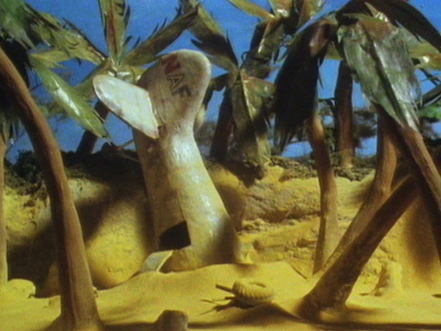
The opening images of the film show the remains of a crashed aircraft partially submerged in the sand, which gives us a clue as to how our heroes ended up in their current predicament, before panning over to a small hut fashioned from twigs and thatched with palm leaves, where we find five elderly figures gathering for a round of tea.  That's right, despite being stranded out in the middle of nowhere and with zero contact from the world beyond, these folks are still enjoying the luxury of a traditional cup of tea, albeit brewed in a teapot woven out of sticks and (it's implied) through recycling the same teabag over and over.  Much of the film's humour derives from how they manage to keep all the familiar components of civilisation ticking along, and from their resourcefulness in adjusting to the island environment - one character uses a bone to casually stir her tea, while another rests his cup upon the back of a moving tortoise - their cultivated behaviour providing a playful contrast with the tell-tale rips in their clothing and their tendency to take the occasional munch from a raw fish or octopus.  The tropical setting itself is beautifully constructed; lush and colourful, and with sight gags and background details aplenty, from the rat revealed to be nesting in one gentleman's beard to the three bird skeletons seen adorning one of the walls of the hut in the manner of a set of flying duck ornaments.  An interruption in the soundtrack (unexplained within the dialogue itself) in which the speakers are heard to gasp and tut is also wittily incorporated into the environment of the film, shown here to be in reaction to a coconut falling through the roof of the hut.

Initially, we find the characters reminiscing about past adventures, with one man recalling a particularly turbulent flight in which one of his fellow passengers was violently ill (the punchline to this anecdote is revealed later on in the discussion, when he muses how, shortly afterward, he encountered the same individual at an airport cafe, wolfing down a plate of greasy chips).  The short really begins to pop, however, whenever the focus shifts onto the present situation, with the characters mulling over how their eating habits have changed since their arrival, and finally agreeing that they now feel very well-settled where they are, with no aspirations of relocating (in that sense, the film's concerns are very similar to those of Creature Comforts, which also deals with the complexities of having to adjust to living arrangements that are isolating or alien).  It's here that Lord and Sproxton's added-on narrative really comes into play, radically changing what we make of these character reflections.  The story we get, communicated largely through the inventiveness of the visuals, is one of individuals formerly gripped by wanderlust, who've now been confined a single spot for so long that they no longer entertain any thoughts of leaving.  Arguably, they have found serenity in the simplicity and solitude of their surroundings, but Lord and Sproxton throw in an additional, hilariously cruel twist, by having a prospective means of rescue finally show up long after they've apparently made their peace with the situation.

Although only four speaking voices are heard in the audio, there is an additional, mostly silent figure who sits apart from the rest and whose key purpose (other than to have a rat pop comically out of his beard) is to provide a humorous but also downright harrowing contrast to their words of stoic contentment.  Toward the end of the short, he becomes aware of a ship on the distant waters but is so overwhelmed by shock and excitement that he immediately collapses, whereupon he attempts feebly to point out this potential means of escape to the others but fails to attract much notice.  Such is the extent of the others' complacency that they have learned to tune out any foreign or external noises - the sound of the ship's horn bellowing out across the sea comes just as one character muses that he really appreciates life on the island because "you don't hear any noise - at least I don't think so."


Availability: The Aardman Classics DVD is your only bet.