Wednesday, 12 April 2023

New Kid on The Block (aka Hertz, Don'ut?)

 "New Kid on The Block" (aka 9F06) is a real oddball episode of The Simpsons, but it's oddball in deceptively low-key ways. Debuting on November 12th 1992, around the middle of the show's fourth season, it tells an uncharacteristically modest story for its era, one that's small in scope but, when you pick it apart, actually quite high in ambition. There's a lot going on, yet it's a relatively quiet episode, relaxed in its pace. It is, in many respects, about the inevitability of change, something that seems to permeate the episode all over (the title is a nod to the 1980s boy band New Kids on The Block, although it might also be a little meta, in that this was the first script from Conan O'Brien, who came in just as some of the older writing staff were moving on). And yet few of the changes it implements were of particular consequence in the long run. It offers (on Bart's end of the story, anyway) an honest and relatable exploration of a pre-adolescent rite of passage - the faint awakening of sexual curiosity, and the withering realisation that being a child means that nobody takes you particularly seriously. Like the season's other great outlier, Selma's Choice, it's a story that wouldn't have felt at all out of place in one the show's earlier seasons, but feels all the more convincing for having come along slightly later down the line in Bart's development, when we'd seen him play the irrepressible hellion for long enough to know what a bombshell it is to see these strange new feelings in him. This is, after all, the same Bart who, just last season, had struggled to comprehend those very feelings emerging in his best friend Milhouse, and who'd insisted, of the opposite sex, "They all look alike to me". And now here he is, falling head over heels in love - check that, falling in love with his babysitter, an authority figure it would ordinarily be within his nature to mercilessly obliterate. The whole premise is off the charts in its adorableness, and one of the absolute best things "New Kid on The Block" has to recommend it is Nancy Cartwright's suitably endearing performance as the artless puppy lover - I particularly love the way she chokes out "I please to aim" when Bart goes to meet Laura inside the treehouse. Like a lot of the Bart classics, it gets its mileage from showcasing his hidden vulnerabilities, Bart being at once self-conscious about how out of his depth he is around Laura, but steadfast in his eagerness to impress her. We know from the outset that Bart is setting himself up to have his callow heart broken, so there is tremendous pathos in his efforts.

On paper, "New Kid on The Block" feels like a monumental episode, for various reasons. It opens with a coming and a going. We see the back of the Winfields, the Simpsons' other neighbours for the first three seasons (actually, I don't think they were established to be the Simpsons' immediate neighbours in preceding episodes - rather, they appeared to live a little further along on the same street, but since this is their last hurrah I'll let it slide). This in itself wasn't such a massive shake-up, since the series never found a whole lot of use for those characters, other than to dish out the occasional murmur of judgement - they were a lot less tolerant of the Simpsons' eccentricities than the Flanders, and rarely said anything that wasn't openly hostile to them. It's a niche that feels better suited to the earlier seasons, when the premise lent slightly more toward the Simpsons being this singularly ignominious unit whom respectable people looked down upon, and less toward Springfield being this intrinsically rotten burg that no respectable person would inhabit, period (a notion advanced in "New Kid on The Block", with the revelation that TIME magazine has formally declared Springfield to be "America's Worst City"). The Winfields had their moments (such as their cameo in "Simpson and Delilah"), but I can't claim to have felt their absence terribly. 

The Simpsons getting a whole new set of neighbours, on the other hand, feels like the kind of development that should have opened up a wealth of additional avenues. In the Winfields' place we gain the Powers - Ruth (Pamela Reed), a divorced mother, and Laura (Sara Gilbert) her teenaged daughter - both of whom strike up an immediate rapport with the family that feels natural, fresh and genuine. Of course, the producers might have shot the characters in the feet straight out the gate by enlisting guest stars to play them, as opposed to members of the series' regular voice cast - Reed and Gilbert are both great in the roles, but presumably this limited how much we were ever likely to see of them. As it turned out, Ruth had only one other major appearance on the horizon, in "Marge on The Lam" of Season 5 (in which Laura was referenced, but never appeared), after which both Powers just kind of fizzled. Laura was good as forgotten, while Ruth continued to make regular appearances as a background character, but nothing more substantial than that. She eventually garnered a third speaking role, in "The Strong Arms of The Ma" of Season 14, where it was established that she was no longer the Simpsons' neighbour (paving the way for Sideshow Bob to acquire her house, but that's a story for another occasion). On the DVD commentary, they make some ironic wisecrack about how "Ruth Powers went onto become everybody's favourite character", but if you ask me she was a wonderful addition to the neighbourhood and the series' failure to go particularly far with her is certainly not any reflection of her limited potential as a character. For one thing, she gave Marge something that had been sorely lacking in her life up until now, and that's a female friend with whom she could open up about her problems and actually have something resembling a social life away from her family. This would be utilised in greater depth in "Marge on The Lam", although you see the roots of that affinity forming here, during a scene where Marge goes to present Ruth with a welcome basket and they briefly touch upon on their respective husband troubles (and since Marge has such an appalling time of it elsewhere in the episode, it's nice to see her at least getting one sweet thing from the arrangement). Other possible angles suggest themselves - Ruth explicitly asks Homer to hook her up with one of his friends, in a scene that seems to be purposely laying the ground for future story material, but it ends up going nowhere (of course, I figure Ruth would change her mind the instant she caught a whiff of Homer's social circle).

The real reason why Ruth was doomed to obscurity might simply have been that the writers were never overly invested in developing her character. The DVD commentary is awfully revealing in that regard, as it gives the distinct impression that nobody on the production staff was all that enthusiastic about making this episode, other than James L. Brooks, who had pushed to have a single mother to move in near the Simpsons. It didn't surprise me to learn that this should be his idea - he was the producer who, in the show's early years, had championed for it having a strong undercurrent of heart and drama to equilibrate the comedy, and the opportunity to explore contemporary social issues like divorce and single parenthood would have fed right into that. As a bonus, it allowed the series to make concessions to the fact that the modern family didn't always conform to the 2.5 kids model reinforced by the Simpsons themselves. His intentions were good, but in the era where Al Jean and Mike Reiss ruled the roost, these kinds of slower, more down-to-earth character dramas were fast becoming an endangered species; writing this Brooks-mandated story was deemed an unenviable task among the top brass and dumped into the lap of newcomer O'Brien, who had a noble stab at it. The result was a sweet (if mildly uneven) case for why the Powers' introduction was a worthwhile endeavor. Alas, in the long run, The Simpsons was determined to remain Ruth-less.

Laura, though? If not for the fact that she slipped into oblivion faster than her mother, a part of me would seriously wonder if she represented an attempt to further broaden the show's appeal by adding a character more openly geared toward courting the hip Gen-X crowd. To that end, she in no way reeks of the same cynical corporate programming as Poochie, but I can see how she might potentially have been conceived to fill an obvious gap in the Springfieldian line-up - The Simpsons didn't have many characters within the teen to young adult bracket and certainly no positive depictions (it's been established that the show was, at one point, under pressure to add a teenage relative to the family, which provided inspiration for the one-off character of Roy, so presumably this was a concern of somebody backstage). The teenage years have traditionally been treated quite unsympathetically within The Simpsons, but then again, what hasn't? Younger teens, like Jimbo and his crew, are there to be an endless source of antagonism to the weaker children they relentlessly pummel, while older teens, such as the Squeaky-Voiced Teen (though he was not fully established as a character at this stage in the series) are there to look awkward and pathetic in dealing with the demands of the adult sphere. Laura is cut from a very different cloth, in that she occupies a beautiful middle ground between childhood and that other direction that's slowly but incontrovertibly calling. I'm not clear on Laura's exact age, but I'm guessing she'd be about 14, maybe 14 going on 15 - young enough to still be a kid at heart and up for some mischief with her smaller charges, but old enough to have that all-important air of adolescent mystique that both makes her so alluring to Bart and sets her firmly out of his league. She has the kind of worldly wisdom Bart admires, in being a few rungs ahead of him on the pranking ladder. (I'll admit that I still find the part with Laura's palm reading trick difficult to watch - not so much because it's gross (although that too), but because as a kid I once fell victim to that exact same prank...thankfully, the perpetrator in question was nowhere near as good at expectorating as Laura and their saliva mostly missed my hand. Mostly.) She's also warm and nurturing in how she connects with the younger Simpsons - there are some lovely moments during her initial babysitting session with her introducing them to the delights of waltzes and labna. (I'll also admit that I don't get quite what the joke is meant to be with that Two Guys From Kabul restaurant - was there some negative buzz around Afghan cuisine in 1992 that's been lost to time? - but the dynamic between the two guys themselves is hilarious.)

Bart's first instinct, on falling for Laura, is to make himself more dapper, by donning a lounge jacket and blowing on a bubble pipe in an effort to emulate Hugh Hefner (which, handily, doubles practice for when he'd get to meet Hefner for real at the end of the season). He then consults various adults for advice, but quickly discovers that they have nothing valuable to offer - if there's one lesson this series has taught us repeatedly, it's that most adults don't have a clue what they're doing, either. Apu approaches Bart, having picked up on the fact that Bart likes Laura, but doesn't impart anything other than the mere observation. Bart then goes to see Abe, who tells him about the time he failed to impress the oldest woman alive by wearing a 15-pound beard of bees - a fascinating anecdote, sure, but it does sod-all for Bart's predicament. Finally, Bart gets desperate enough to talk to Homer, who got his preliminary sexual education from watching animals on heat (to be fair, I think most of us did), and accumulated little to no wisdom beyond that - he does, however, figure out how to segue a frank discussion with Bart about the facts of life into an excuse to down several cans of Duff. There seems to be a vague running gag all throughout the episode with Homer getting his lines perpetually crossed when it comes to sexual metaphors and similes and the veneration of food and beverages. But then, as one other character making his debut appearance so delicately puts it, he is more stomach than man.

The episode's most impactful move, in the long term, was the introduction of old salt Captain McCallister, one of the show's more outlandish supporting characters, who plays an instrumental role in the B-story and whom the writers swiftly adopted as their bit-player of the month - which is to say, the character they'd insist on shoehorning into the most random of places for a sizeable stretch of the episodes thereafter (in just the right doses, he is hilarious, but you can have too much of a good thing - I thought they were overdoing it a bit by the time of his entirely disconnected appearance in "So It's Come To This: A Simpsons Clip Show"). He was a character who joined the cast through pure serendipity - the original pitch had Homer getting into a feud with comedian Don Rickles, only Rickles wasn't game (as per the DVD commentary, he didn't appreciate how mean the script made him out to be outside of his comedy routine), which necessitated a total revamp to instead have Homer grappling to salvage his wounded pride - and unsatiated hunger - when a restaurant owner has him ejected from the premises before he's eaten his fill. The Homer story definitely feels like it's there to counterbalance the more grounded elements of the Bart A-story, in that, tonally speaking, it seems to be taking place in another galaxy entirely. It's less off the wall than his sugar-peddling adventures in "Lisa's Rival", but with hindsight does play like the evolutionary ancestor to that very model of storytelling, with Homer's cartoonish appetite and bullish indignation feeling like they were lifted more from a Looney Tunes short than the trials of the everyman. I give the subplot points for how logically it intermeshes with the main story, in providing not just one, but two instances of the family requiring Laura to babysit, and McCallister is on fine form for his first appearance ("Would ye sooner eat a bilge rat than another burger?"), as is Lionel Hutz in his small role (I kind of want to hear more about his case against The Never-Ending Story). What does bother me, and in some respects makes that sugar subplot preferable, is the subtly unpleasant way that Marge is made to endure this entire debacle. I tell you, "New Kid on The Block" is a phenomenally punishing episode for Marge; I get that she's dragged along to act as Homer's foil (ie: the voice of reason who's perpetually ignored and shouted across), but the episode seems strangely at ease with just how colossally insensitive he is toward her for the duration. First, he takes her to a restaurant where she can't eat anything on the menu due to her seafood allergies and expects her to sit there for hours while he stuffs his face. He then insists on pursuing a lawsuit against McCallister when Marge pleads with him to let it go, with the result that Marge is made to testify in court in his interest, which she finds painful and humiliating. When we hear how, after being ejected from The Frying Dutchman, Homer had them driving around until 3:00am looking for another all-you-can-eat fish restaurant and, failing that, had them go fishing, my thoughts are entirely with Marge and how she hadn't eaten anything that whole evening except for some Tic Tacs she had in her purse. Surely she must have been dizzy with hunger by the time they got around to the fishing? (I'm just saying, Jacques would never have treated her that way...even if he is now, regrettably, a slice of cantaloupe short of a brunch.*) Even the resolution, which sees Homer and McCallister reaching an out of court settlement where McCallister allows Homer to eat endless food in exchange for using him as a sideshow attraction, entails the continued humiliation of Marge for some reason. There's actually no reason why Homer even needed to bring Marge along in the first place - if he was so eager to dine at the Frying Dutchman, then couldn't he have gone by himself? I know the answer there is that if Marge had stayed at home it would have ruled out the need for a babysitter and then we've got no A-story, but I'm still compelled to pout on her behalf.

Where the two stories intersect thematically is in showing just how unapologetically petty father and son both are in pursuing their respective ends. The only character I consider more short-changed than Marge by the episode's out is its eventual antagonist, Jimbo Jones. For a while, the A-story looks to be spinning its wheels, when it consists of Bart wandering from adult to adult in his fruitless quest for wisdom, but it figures out where it's going by the third act, when Laura announces to Bart that she and Jimbo are officially an item. He's scratching her itch for life on the edge in a way that the cute, Hef-emulating Bart most definitely is not, having impressed Laura with his willingness to poke corpses with sticks (what is the subtext behind that particular tidbit of information, anyway? Are we to assume that Mayor Quimby or one of his aides killed that man?). To Bart, this is a betrayal on multiple levels - it's bad enough that Laura would fall for another boy, and all the more unbearable that it should happen to be a natural adversary like Jimbo. But it also signifies Laura's increasing desire to move away from the sphere of childhood revelry of which she and Bart are still mutual occupants, and into more adult pursuits like dating and kissing. Hence, Bart is in danger of losing the connection they already have. The warning signs are there, in how Laura's attachment to Jimbo transforms her approach to babysitting - she goes from being an attentive babysitter who bonds sincerely with her charges to an indifferent one who packs the kids off to bed so that she can make out with her boyfriend on the couch (and did Laura even ask for Homer and Marge's permission before inviting Jimbo over? I'm guessing not.). Still, to be totally fair to Jimbo, his status as episode antagonist is rooted squarely in the fact that he has something Bart also desires - there's a flashback reminding us why Bart and Jimbo aren't exactly the best of friends under ordinary circumstances, but in the present Jimbo doesn't really do anything that's so egregious, outside of calling Bart a dork. It's not as though there's evidence of him mistreating Laura or anything. Bart's reasons for wanting to wreck Jimbo's relationship with Laura are entirely self-serving and blatantly malicious - but then, as Laura is at pains to remind us, he is just a kid. And, if I'm honest, I much prefer this approach to either Bart or the episode harbouring any delusions that he's somehow "protecting" Laura by interfering with her love life.


It's a conflict that resolves itself quite iffily, albeit in a way that's somewhat salvaged by the clever use it makes of the series' established lore - Bart rings up Moe's tavern and convinces the gullible bartender that Jimbo is the mysterious prank caller he's spent the last few years threatening to horrifically mutilate. Moe impulsively runs off to Evergreen Terrace to butcher Jimbo with a rusty knife (question - does Moe not recognise this as his friend Homer's abode? I'm certain he'd been there before in at least one other episode), only to have a change of heart when Jimbo breaks down in tears and begs for his life. And then Laura goes and dumps him, for not being manly enough to show no vulnerability when cornered by a raging sociopath who was threatening to stick a whopping great knife into him. Seriously now, that's a situation that would have most grown adults pissing themselves in terror; I think a teenager like Jimbo can certainly be excused for his reaction. At the end of the day, he's just a kid too. If anything, it makes Laura look a trifle callous, for casting Jimbo aside at a time when he's visibly still reeling from the trauma of what's just happened. But then I suppose that she's also just a kid. Kids really are a rotten bunch. (They flag up on the commentary how objectively unfair the resolution is, so it's nice to to hear that they are at least self-aware about it, even if it doesn't come across in the episode itself.)

All of this threatens to end the story on absolute bummer, but the magic ingredient that keeps it afloat is the input from the raging sociopath himself. It's here that we should address the other truly significant thing that happens in "New Kid on The Block", being that it provides what can effectively be considered closure to one of the series' earliest and most iconic running gags: those prank calls that Bart used to make to Moe every few episodes. By the writers' admission, these were getting increasingly hard to write, so it probably was time to put them formally to bed. They had already been thin on the ground for a while - I actually couldn't remember, offhand, when was the last prior occasion that Bart had got on the line to Moe, so I did something very out of character and consulted the Simpsons Wiki for the answer. Apparently it was "Burns Verkaufen der Kraftwerk", all the way back in the middle of Season 3. And, honestly, THAT episode looked as though it might have been toying with the idea of bringing the gag to a culminating punchline of sorts, in having Moe and Bart finally meet in person, and Moe still being none the wiser. So it might be more accurate to say that they revived an already-retired gag for the sake of plot convenience here. Still, it's a worthwhile revisit, yielding not only Amanda Huggenkiss, one of the funniest of all the pun names, but also the opportunity for Moe to act upon (or at least gear himself up to act upon) the blood-lusting urges he's been threatening all these years. As a bonus, it allows the episode to homage the old slasher convention of having a homicidal maniac drop in on an abode where an unseasoned babysitter is all they have to contend with, or anywhere else where lusty teens, far removed from adult oversight, are on the verge of letting their hormones hang loose. Given that, at the time, Jimbo seemed to be testing just how far he could take things in his make-out session with Laura, it turns Moe into the unwitting moral guardian, by ensuring that those kids keep their pants on.

The climax's most inspired joke (and a fitting punchline to the prank calls as a whole), is in how instantaneously Moe loses interest when confronted with the sobbing Jimbo ("I wasn't really going to kill you, I was just going to cut you...aww, forget it"), as if it's suddenly dawned on him how reprehensible he's being in aspiring to carve up a youngster. Holding the punk accountable is something Moe has fantasised about for the longest, yet Jimbo proves so plaintive an opponent that he sees no satisfaction to be had in the ravaging, using the "Ouch, I'd better go check on Barney" observation as an excuse to remove himself from the awkwardness of the situation. As a survival tactic on Jimbo's part, you can't say that all that crying and pleading wasn't effective.

Sucker that I am, I find the closing gag with Ivana Tinkle to be almost poignant, knowing that it is the last bow for a particular vestige of the early era, one that the show is here conceding it needs to jettison for its own longevity. You'd find the occasional throwback to Moe and Bart's routine in the later seasons (in "Homer The Smithers" and "Bart on The Road" of Season 7, for example), but they ceased to be a regular occurrence after the search for Ms Tinkle. As is befitting for an episode that's all about change, and embracing life's various comings and goings. Yet the final message of "New Kid on The Block" leans more in favour of the value of taking time to savour a good thing before it's gone - change is indeed inevitable, and it's for precisely that reason that you shouldn't be in such a rush to let it all go. The matter of Bart's crush is resolved on a note of compromise - obviously, Bart can't get the girl, but Laura admits that if Bart was of an appropriate age, she would happily date him, thus enabling Bart to remain in his pre-adolescent stasis and still have Laura acknowledge him as an equal. Bart's ultimate victory, however, is in convincing Laura, before she comes of age, to momentarily rejoin him in that middle ground, indulging her inner child by giving us one last encore for the prank calls. Order is restored in the universe, as is reinforced by the image of Homer and McCallister enjoying a keg together, with children of all ages coming together for a final snicker at the expense of Moe. Eventually, the episode teaches, you'll have to move on - but don't be in a hurry to do so, particularly when it's a matter of ditching the recreation of childhood for the formalities of adulthood. The adult world sucks, anyway. All it has to offer is booze and litigation.

Finally, "New Kid on The Block" gave us this immortal line: "As usual, a knife-wielding maniac has shown us the way." Strange, Bart, we never see you applying that philosophy whenever Sideshow Bob's in town. I suppose at this point in the series we'd yet to actually see him wield a knife.

* Sit tight. My thoughts on "Pin Gal" are coming.

Sunday, 9 April 2023

It Sucks To Be Me #1: Back In The Rut (Survival)

My love/hate affair with the Survival series began all the way back in 1995, when I was browsing the shelves of my school library, and came across a hardback book with the provocative title "Could You Be A Frog?". That was not a challenge that the younger me was going to see and just let pass. The book was essentially a Choose Your Own Adventure story, in which you played at being a frog trying to navigate your way through the wide and distinctly un-frog friendly world, catching butterflies and avoiding getting picked off by the hidden nasties lurking in the grasses. Most of the book was comprised of an assortment of double page illustrations, each with a selection of choices, any of which could obliterate the paper-thin barrier between life and death. Such is the life of a wild critter. I was doing quite well at being a frog, until I got to a page where I had the option of jumping off onto a bank or into a cool, refreshing stretch of water, and chose the water. I turned to the page number specified to be met with a Grey Screen of Death, and the rebuke that, "You did not see the water snake!" I guess I didn't. I turned back frantically and tried to identify the rapacious serpent that had allegedly just swallowed me whole, but for the life of me I couldn't. All I saw was a murky collection of vaguely-defined pond weeds and shadows, any one of which felt as though it could have transformed into that elusive snake if you gazed at it long and hard enough (which I did). At one point I thought I saw the snake's jade green eyes leering up at me from just where the light appeared to glisten on the water's surface, and it chilled me to the bone, but by that point my mind was blatantly playing tricks on me. Eventually I had to return the book to the library, leaving that phantom snake forever etched upon my psyche and conceding to the fact that my snake-blindness meant I'd flagrantly sucked at being a frog.

Somehow or other I got to ruminating on that snake again in the latter half of 2022, and how much it troubled me that I had never found it, and it dawned on me, why didn't I buy my own copy of that book and have another crack at looking these older, adult eyes? I'd bet it'd be embarrassingly easy to locate now, so I could put the mystery to bed and have a good giggle at the expense of my childhood self into the bargain. Easier conceptualised than done - the book was obviously long out of print, and what sellers were asking for their second-hand copies was generally way out of my price range. It was here that I discovered that the book was in fact part of a series, and that I could also have the opportunity to live (and die) as a deer, fox, otter, squirrel and mouse, if I was willing to fork out the required cash. Most of these titles weren't exactly going cheaply either, but I figured that with enough time and persistence I'd be able to snag copies without breaking the bank. Time and persistence were indeed my friends. By January 2023 I had five of the six books in my possession, including the Frog edition (yes, that snake was embarrassingly easy to spot now, but at the same time I can see where the callow me went wrong in trying to find it). I became obsessed with the series, and I knew it was something I absolutely wanted to sing the praises of here. The one book that continued to elude me was the dratted Deer edition, and this stalled my plans for a Survival retrospective for a couple of reasons - a) "Deer" was one of the earlier installments, and I would have preferred to go through them in a rough kind of order and b) I feared that bringing even the most minimal of attention to the series would increase the competition and make it that much harder for me to ever acquire a copy. So I kept my mouth shut and hung fire, checking online listings on a daily basis for months on end, waiting for the prices to drop to an acceptable level. Once again, time and persistence proved to be sure-fire allies. In the dying days of March 2023, "Deer" finally dropped down onto my doorstep, and now the coverage can finally begin. And I wish anybody else aiming to collect the full series the utmost of luck.

The Survival books follow the same basic format, allowing you to play as a given animal going about a day in its life - which could end up being the last day of its life, if you don't make all the right decisions. Either you'll keep going until your player animal has returned to its place of safety, ending the story, or you'll meet a Grey Screen of Death, indicating that you just made a fatal error, prompting you to head back to Page 1 and start from scratch. These are accompanied by a harrowing image of your animal's lifeless body (your animal always leaves a clean corpse, even in situations where the cause of death probably should have entailed blood and entrails). In all of the books there are three sections that, in place of the usual double page illustration, are broken down into four separate squares, each containing a different outcome - it's in these sections that you'll find all of the death endings, but a number of them are also green, indicating that you just made a good decision or at least one that didn't kill you. It's here that we should address the slight design flaw in how the books are put together - whenever you turn to these pages, it is somewhat inevitable that you're going to notice which squares are grey and which are green and, even if you're trying desperately hard not to, register which numbers are safe and which are to be avoided. It's annoying, but I suppose it was easier and more economical than doing a double page illustration for every individual choice (not to mention, those death endings are already so grim and depressing that I'm not sure I'd want to see them magnified into two whole pages). If the pressures of staying alive weren't enough, there is an additional gameplay mechanic allowing you to gain or lose points as you progress through the story (so non-fatal mistakes can prove costly in other ways); it's a mechanic that I was generally indifferent to, but it might add greater replay value, in seeing how you can increase your score on subsequent playthroughs. The books' objective was fundamentally educational, the idea being to get young readers thinking about the needs of the species in question and the kinds of challenges they face on a daily basis. In most of the books there is also an underlying narrative about how human intervention has, whether intentionally or not, made the process of survival that much harder. The series was aimed at children, and it goes without saying that they're not the most difficult gamebooks in the world, but you might be surprised at just how intense and involving the gameplay can get. What most impressed me about the series is the atmosphere of omnipresent dread that accompanies you up until the end, not knowing quite what was coming next, just that danger could be lurking anywhere and it could all be over with a single slip-up. I came away wishing that they'd made a whole lot more than just six of these things. Since all but one of the volumes selected mammals as their subject, I would have suggested that for a hypothetical seventh edition they might liked to have focussed on a species of bird. Really, there are so many ways in which they could have expanded this series - I think the concept would have made for a very good range of point and click adventure games during the CD Rom era. But it's all just a lot of missed opportunities now.

The first four editions of Survival were written by Roger Tabor, with John Norris Wood taking over for the Frog and Mouse editions. The books were published by Heinemann in the UK and by Ideals in the US - and, despite the series being British in origin, I actually had an easier time sourcing US copies. The UK setting is important, since the absence of large predators means that the three bigger animals - the deer, the fox and the otter - have only two things that can feasibly kill them, those being humans and dogs...although, believe me, there's no shortage of ways in which that former threat can manifest itself. With the squirrel, frog and mouse, you have the additional pressure of knowing that pretty much everything is out to get you. The differing perspectives according to the animal's size and where it ranks in the food chain do a lot to add variety to the proceedings; what does become apparent is that all of these creatures are, in their own way, as vulnerable as each other.

Having played through all six editions, I've compiled a list of tips for anybody else looking to dip into the series:


  • A good chunk of Survival effectively boils down to a continual game of "What's wrong with this picture?", so study the illustrations carefully.
  • In addition, be sure to read the accompanying text in full. Often it's tempting to jump straight to the illustrations when thinking about what page you're going to turn to next, but the text frequently contains vital clues and narrative information. In particular, look for details in the illustrations that aren't mentioned in the text, as these are likely to be of significance in terms of how your decision is going to play out.
  • In a situation where you find yourself in a stand-off with an enemy, it's a good rule of thumb to avoid the option that flagrantly underestimates your enemy.
  • On a similar note, don't underestimate yourself. You'll be surprised at what your animal is capable of doing when under pressure.
  • Sometimes the game rewards you for making a bold decision, so don't always err on the side of caution. The distinction between a bold risk and a stupid risk isn't always obvious, but worth considering.
  • Don't. Step. Out. When. You're. Close. To. The. Edge. There is one scenario that shows up in four of the six books that invariably leads to disaster. You'll figure it out soon enough.
  • If you're working from a Heinemann softcover edition, then DON'T be tempted to peek at the index at the back before you play, as it lists where all of the death endings are. That was considerate of them, wasn't it?


The "Deer" edition, published in 1989, was an early foray for the series, and the concept definitely doesn't feel quite so polished here as it would in subsequent volumes. The images (a mixture of photographs by Fiona Pragoff and drawings by Tim Hayward) are great straight off the bat, but have less of an opportunity to incorporate the kinds of sinister visual clues that make the Survival series so involving - the "What's wrong with this picture?" approach actually doesn't apply too often here, with the book relying extensively on the text to do the heavy-lifting. Furthermore, the death endings don't always make it too explicit what you did that was wrong - there is at least one death where it's not altogether clear to me what was supposed to have tipped me off that this was a bad decision - intermittently having it seem as though they inserted the death arbitrarily as opposed to it feeling like a truly logical outcome of your actions. This adds up to the gameplay feeling all-round less involving, and more a case of passively turning the pages to see how the narrative works out. On the other hand, that atmosphere of omnipresent dread is something they absolutely nail - throughout the book, your deer is repeatedly stalked by hunters, and the unsettling sensation of being followed by something you can't actually see (the hunters are glimpsed in only two of the illustrations) is something that really permeates the gameplay.

"Deer", along with "Fox", has an additional symbol on each page to indicate the direction in which the wind is blowing - if you move downwind, then you obviously risk making yourself more vulnerable - although this was abandoned in later editions. To be honest, it has very little relevance in determining the outcome in most scenarios (in both "Deer" and "Fox"), but it definitely adds another dimension of peril to the proceedings. The points system, meanwhile, isn't too creatively implemented here, as there's no way you can have your score lowered other than to die - later books would play around with this a bit more by implementing non-fatal mistakes that would result in a reduction of points. 

"Deer" is the only edition in which the sex of your player animal is specified (it's hinted in "Squirrel" that your character may be a male, but not made explicit), and the only book in which reproduction is clearly on your character's agenda as much as feasting - you play a male deer travelling with a harem of does, and the imperative to keep your does from being lured over by the charm of rival stags is an additional factor in determining how well your day is going to play out.

As I go into more specificity about the content of "Deer", I feel it merits doing something that I have never before done on these pages, which is to insert a page cut in order to protect you Survival virgins out there from having the solutions spoiled. Cuts are not something I ever got into the habit of implementing as a blogger, but here it just seems like good courtesy. If you're going to read further, then I encourage you to play the books beforehand, if possible, and I emphasise that the hidden text is intended for those who have already done so (not that I'm banking on there being legions of you out there, given how tricky the books are to get hold of). If you don't care, then you can of course click anyway, but you do so at your own peril.

Now, let's go over all the grisly ways you can kick the bucket as a deer, accompanied by my personal analysis...

Thursday, 6 April 2023

Fifty Percent Grey (aka Heaven Is A Place Where Nothing Ever Happens)

Content warning: suicide, graphic head injury

Anybody looking for their fix in offbeat ghoulishness who only has a scant handful of minutes to spare would do well to seek out the 2001 computer animation Fifty Percent Grey. An early project from Irish film-maker Ruairí Robinson (who did not persist with animation as a medium thereafter, although dystopian narratives remained a favourite subject of his), it starts out by evoking the kinds of plot devices well-ingrained into the popular psyche from classic Twilight Zone installments, in which a protagonist finds themselves thrust into an unknown situation and tasked with making sense of where they are and where they might be headed from here. It takes an archetypal nightmare scenario - the threat of being mired for all eternity in a featureless space with no prospect of growth or change - and milks a whole lot of twisted fun from it. The result is a note-perfect bundle of dark humor and existential dread mixed with just the slightest dash of visceral horror, all packed in to slightly less than three minutes. The early-millennium CG animation might look a tad primitive by modern standards, but has a grotesque expressiveness that perfectly compliments the morbid underpinnings of the narrative. Fifty Percent Grey was nominated for the Academy Award for Best Animated Short in 2002 but lost to Pixar's submission, For The Birds. No surprises there - the gentle cartoon slapstick involving the big-eyed feather-brains was always more likely to placate mainstream sensibilities than Robinson's ingeniously sick vision of the hypothetical next world (besides, this was the same year that DreamWorks beat Pixar rather unceremoniously to the first award for Best Animated Feature, so it is nice that they at least got to triumph in the other animation category). Fifty Percent Grey, though, definitely strikes a stronger chord with the desolation in my own psyche. Actually, it was a fairly good year in terms of quickies - also in the running was Cordell Barker's Strange Invaders, one of my all-time favourite animated shorts, so you are urged not to sleep on the competition.

The film sees a man - his name is not cited in the film itself, but the synopsis on the Irish Film Institute website indicates that we are to call him Sgt Cray - wake up in what appears to be the middle of nowhere, surrounded by a grey, barren landscape that seems to stretch out into infinity. We can deduce from the dripping blood and the visible wound in his chest, which rapidly closes up, that he is an ex-human and likely died in combat. He still has his gun, and the battle armor that blatantly did not protect him. Cray gets up, and notices a television set situated immediately before him, causing him to drop his helmet in surprise. He activates a video recording, which greets him with the upbeat announcement that, "Congratulations, you are dead!" and welcomes him to Heaven, where it promises he can enjoy eternity in peace and tranquillity. Cray looks around and, noting that the monotonous world encircling him bears no resemblance to the paradisaical images flaunted in the video, sets off in the hopes of encountering something more. Cray keeps on walking, until eventually a speck appears on the horizon; he rushes excitedly toward it, only to find himself face to face with the very television he'd contended with earlier, distinguished by the helmet he'd abandoned right beside it. He has, in fact, been walking in a circular loop the entire time - there is nothing to this "Heaven" except endless grey inertia. Horrified by the implications, Cray puts his gun to his head and shoots himself, hoping to end his entrapment but merely restarting the process - he wakes up in an identical grey landscape, in the vicinity of yet another television. Cray activates the video message, which greets him in the same upbeat tones, the crucial difference being that this time it welcomes him to Purgatory, advising him that he's here because mistakes were made. Cray inserts his gun into his mouth and fires it once again. By now, a clear pattern is emerging, so you can probably guess where this is headed next, although you might not be prepared for the smattering of body horror that accompanies Cray's next awakening, as he rubs his head to find a sample of his pulverised brains leaking out. His wound immediately heals, and Cray finds himself faced with the same inertia and yet another television. "Congratulations, you are dead!" proclaims the video recording. "Welcome to Hell! You are here because..." This time, Cray doesn't wait for the message to finish - he turns his gun on the television and blows it to smithereens. He then puts the gun to his head, whereupon he discovers that he only had a finite number of bullets, leaving him stranded in this grey monotonous "Hell". Not that it makes any difference, given what his other two options were.

I've seen some viewers forward the interpretation that Cray was in Hell all along and the looping inertia part and parcel of his damnation, but that reading gets a hard disagree from me. I think it's much funnier if the implication is that all three places are indeed exactly the same. Besides, what I find objectionable about the all-Hell interpretation is that it hinges on the need to presume that what Cray is experiencing now is somehow karmically proportionate to sins committed in life, and I see that as contrary to the absurdist nature of the short. The kind of person Cray was in life is really of no odds when the joke is that we are all inherently fucked. Having said that, the fact that he is a soldier does seem to be of greater significance than merely accounting, in narrative terms, for why he would have that gun on him, suggesting as it does two potentially contradictory readings of the situation he has come from. We might equate military combat with heroism, but it does entail the rampant destruction of life. The clue there may be in the title - life is never completely black and white, and it's possible that the afterlife has followed suit, with any potential rewards and retributions merging together and cancelling one another out, leaving us to tread an interminable grey platform signifying the intrinsically murky terrain of human existence. (The title is also a cunning reference to the 50% grey layer technique, which is used to add light and texture to pixel imagery.)

How I'm inclined to interpret Fifty Percent Grey is as less as a commentary on human notions of morality than on the television's role as an authoritative voice. It is a horror short in which the chattering cyclops emerges as our villain, albeit in a somewhat different manner to the child-abducting television set in Poltergeist. The afterlife (in all three of its purported dimensions) is infused with a troubling corporate coldness; it appears that God/the Devil/Charon/whoever cannot be bothered to greet any of its denizens in person and instead leaves a pre-recorded video message to do the heavy-lifting. The television is the closest thing Cray has to a companion (mimicking how the television might function as a substitute for social interaction in real life), and his sole means of making sense of the world around him - the joke being that the world around him never changes, but the narrative the television is feeding him does. Horror and humor alike arise from the discrepancy between what is promised (or threatened) on the TV screen and what you actually get, with Heaven, Purgatory and Hell all constituting the same experience as it is continuously repackaged and resold. One of the sharpest gags, with regards to Cray's so-called Heavenly encounter, is that the closing statement actually sounds more ominous than inspiriting, the alleged perk being in the opportunity to, "Sit back and unwind as you contemplate the mysteries of the universe," followed by the baleful reminder that, "You have all the time in the world!" What is immediately chilling about this afterlife is the total indifference of whatever higher powers are pulling the strings - and, to my mind, the horrifying stasis with which Cray is faced is a reflection squarely of this and not anything that he might have done in life. Even the Heavenly images that accompany the original message have a distinctly lackadaisical quality, a banality that's reminiscent of the kinds of still images that once populated old Windows screensavers. It offers a paradoxical glimpse into a vision of a promised land that is blatantly not there and yet one that effectively mirrors the unbearable vacuousness of the space Cray already occupies.

As the short progresses, the television becomes less of a proxy for these indifferent higher forces than an oppressor in and of itself. There is a visual clue hinting toward this early on, when Cray walks away from the television set, and we see an eerie shot of with TV in the foreground, appearing to dwarf the wandering man. It gives the impression of dominance on the part of the television, that it "knows" something that he does not. The TV's non-benignity is reinforced through its persistent presence yet shifting appearance, as if different layers are being stripped away to reveal the corporate malevolence lurking underneath - Robinson incorporates a witty sight gag in which the televisual technology is downgraded the lower Cray descends in his metaphysical journey. I'm not sure, but I think he may even have a laserdisc player in "Heaven", while in "Hell" he gets a clunky-looking model of VHS machine. I am, unsurprisingly, won over by the latter's retro charm - I would say that, of the three options on offer, it would be better to be in Hell, if you at least get to gape at truly vintage home video technology. That's just me, though.

Fifty Percent Grey was released in the same year as Richard Linklater's feature animation Waking Life, and in some respects represents a more brutally comical variation on the same basic formula, where the (potentially deceased) protagonist repeatedly fails to find their way out of an increasingly oppressive otherworldly state of being. In both films, the protagonist intermittently turns to a television set for guidance, the television representing a window through which to view and process the grander scheme. In Waking Life, the punchline to one of these sequences is supplied by an advertising jingle that breezily proclaims, "Now I'm free to see the world!"; this alludes, jokingly, to the liberation that both the television and Wiley's possible disconnect from the corporeal world should theoretically provide, all while he remains incongruously in his sedentary position as a passive observer (at the time, Wiley is engaged in channel surfing, an act that implies the intersection of creativity and passivity). In Fifty Percent Grey, I've no doubt that the central gag lies in the tension between the television's dual function as a mode of escapism and and a means of numbing spectators into accepting the status quo they are looking to transcend. Cray engages in warfare with the television as it attempts to exert control over his perception, striking back with a vengeance at his every effort to duck out of the narrative it projects onto the void and instructs him to consume, its rhetoric becoming more aggressively damning (quite literally) with each round. Cray might have the right idea at the end, in resolving to shoot the television and silence his opponent before it can complete its final condemnation, but it registers as rather a hollow victory. After all, it's not like he has anything else to stare at out there, except into that infinite grey abyss.

Thursday, 30 March 2023

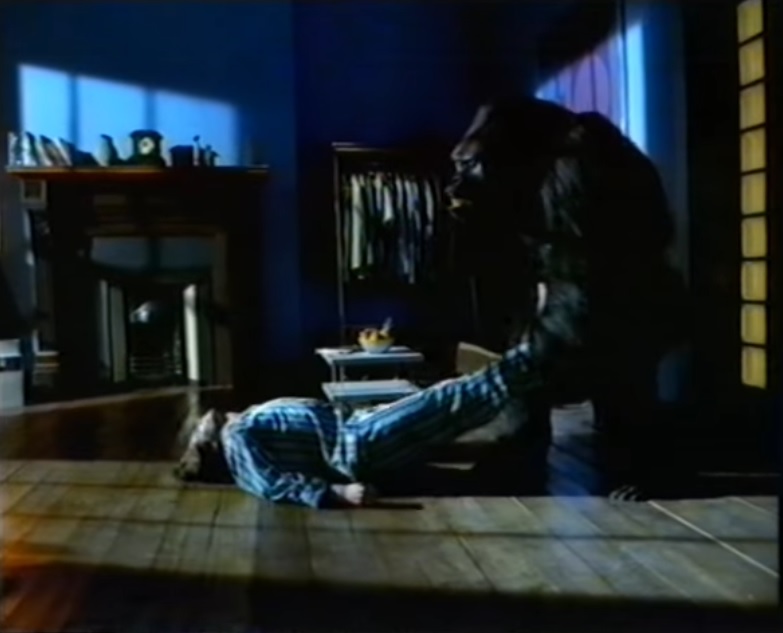
The World's Most Horrifying Advertising Animals #47: Wella Shockwaves Gorilla

You might recall how, some years ago, the public's imagination was momentarily captured by a television campaign in which a drumstick-wielding gorilla was seen to bash out the percussion fill to a certain Phil Collins tune. It didn't have a lot that was conceivably to do with the product being shilled (a bar of chocolate), but it certainly garnered attention. The gorilla in question was alright enough, although if you ask me a little too cute and clean-cut. My TV ad-suffused nightmares are haunted by a very different gorilla - a nocturnal, city-dwelling ape who terrorised the appearance-conscious for a brief spell back in the late 1990s. A gorilla who was weird, wild and had an undisputedly sinister side. This was the gorilla who really deserved to go down in the advertising hall of the fame; the one who came to you when your defences were down and for whom Wella brand gel was required to literally keep out of your hair.

This campaign opened by purporting to answer that most immortal of questions - why does your hair look so bad in the morning? The real answer is that you probably shouldn't be showering right before you go to bed, but that is obviously significantly less fun that what the ad comes up with - specifically, a gorilla who scrambles through your bedroom window every sundown and takes you on one positively mind-bending long night's journey into day. How mind-bending might have depended on which version of the ad you were watching; the basic formula has the gorilla taking hold of the sleeping protagonist, tossing him around his apartment like a rag doll and taking him out for a crazy joyride (for all we know, not even in the protagonist's own car), but the full, uncut version from Germany went a lot more hardcore with the gorilla's hedonistic outbursts. In this version, he goes so far as to extend his middle finger to a couple of innocent bystanders...which sounds, on paper, as though it should make him the funnier depiction, yet the ad counterpoises by centring in on the more menacing implications of having a gorilla invade your personal space while you're at your most unresponsive. This ape is a looming, snorting beast who takes you from your comfy resting place and out into a harsh nocturnal soundscape of blaring horns and sirens. He crawls along your bedsheets like something from a low-rent slasher. All of which gives him the air of a most unsavoury prowler, in the hair-raising business, one assumes, because he's a thug who just gets off on the chaos. Not so with the gorilla from the chopped down version, who starts by resting his face adoringly on the sleeper's shoulder. As he tosses the man around, he lets out a hearty chuckle. This gorilla is doing it because he loves. He loves...yes, he loves messing up your hair, that much is evident. But what he really loves is spending his twilight hours with you, and this bizarre ritual is just his offbeat way of showing it. From his perspective, the two of you had a beautiful thing going, and then you went and allowed that tub of greasy cosmetics to come between you.

The diverging ads are a fine example of just how drastically you can alter the tone of a campaign with a bit of editing and a change of soundtrack - both make witty use of the fever dream absurdity of the scenario, but at notably different pitches. In the shorter version that I was always accustomed to seeing at the time, the gleefully buoyant choice of music not only has the gorilla coming off as more of a mischievous scamp, but pretty much everything in how the ad is put together imbues him with a greater sense of affection for the man whom he ruthlessly pummels every evening. That moment where he fondles his hair one last time before calling it a night is a particularly lovely touch. There's a whole lot of tenderness in this edit. Compare that to his uncut counterpart, who curtly shoves his companion aside during the driving sequence, when the motion of the vehicle momentarily causes his head to rest against his fuzzy gorilla hide. The two apes likewise get their own individual reactions to the appearance of the fatal Wella hair gel, as befits their respective characterisations - the uncut gorilla beats his chest in indignation, presumably intending to get even with his human quarry on another night, while the cut gorilla howls in desperation, horrified that his token of affection has been so thoughtlessly nullified.

The creepiest aspect of the scenario (incorporated into both versions of the ad) is the epilogue implying that the gorilla is constantly monitoring his unwitting plaything, even during the daylight hours. If Wella is proposing that this is why we ALL tend to have bad hair in the morning, then is the implication that we ALL have our own personal gorillas popping in every nightfall to play? It surely can't just be one urban gorilla doing it to everybody with a head of hair all over the glove, or how on earth would he find the time? Or is he supposed to be like Santa Claus or the Tooth Fairy, and can apparently handle calling in on innumerable households in a single night? (Now that I think about it, The Bad Hair Day Gorilla does have a nice ring to it.) The simpler explanation would be that this gorilla is actually a cunning metaphor, for the bestial qualities that lurk within us all. He is the wilder part of yourself that you might not always want to let hang out, the part of you that entices you to do, if not bad, then socially unacceptable things (like strutting around with unkempt hair), here envisioned as a dark shape that creeps into being and manipulates your body while your higher reasoning turns a blind eye (if you're wondering how this guy manages to sleep through the experience of being tossed around by a hulking gorilla, then there's your answer - it's entirely willful on his part). The practicalities of Wella Shockwaves, the ad proposes, are in avoiding making such qualities evident in your diurnal, or public self. Although if the implication is that there was no gorilla and that the damages to our protagonist's hair were all entirely self-inflicted, then I'm not sure it bodes so well for him at the end of the uncut ad, given that I think I hear a police helicopter in hot pursuit. The shorter version is just sweeter all-round, even if that precious playful gorilla does end up getting spurned.

Sunday, 26 March 2023

Right Here, Right Now (This Is Your Life, Lenny!)

"Right Here, Right Now" by Fatboy Slim (otherwise known as Norman Cook) is a curious artefact of the big beat era. The track, which pivots on a string sample from "Ashes, the Rain & I" by James Gang and a micro-snippet of dialogue spoken by Angela Bassett (she was on everyone's social media radar earlier this month for some reason, but life moves on fast) in the 1995 film Strange Days, is arguably Fatboy Slim's most iconic. It captures the urgency and euphoria of merely being alive in the present, with a combative energy that accounts for its enduring popularity as a sports anthem. Mixmag, who proclaimed it the 10th best dance track of all-time in a 2013 article, described it as "a universal anthem of strident empowerment". Here's the thing, though...it is kind of a haunted track, is it not? It's about the omnipresent threat of the apocalypse and our persistent failure to take corrective action. Really, it is.

"Right Here, Right Now" was released as a single in 1999, and I'd like to think it's not such a coincidence that Strange Days itself takes place in a hypothetical version of 1999, specifically in the last two days before the new millennium. Directed by Kathryn Bigelow and taken from a script by James Cameron, the cyberpunk thriller presented a more technologically alluring vision of the then-near future than the 1999 we shortly wound up with, but one that nevertheless sought to cater to contemporary anxieties as we approached the Y2K - the sense that, whether it stemmed from concerns about the Millennium Bug, religious prophecies or anything else, it signified the end of a particular era in human history, and the dawning of a new age of uncertainty. In Strange Days, our dependence on technology is depicted not as facilitating our salvation, but as symptomatic of our civilisation being in decline. Lenny, the characteristically shady noir protagonist played by Ralph Fiennes, deals in a form escapism that is designed to disconnect participants from the present moment at every conceivable sensory angle; he is a peddler of SQUID (otherwise known as the Superconducting Quantum Interference Device), an illegal contraption that records human memories and all of their associated physical sensations onto Minidiscs and enables third parties to experience them first-hand, via "playback", as if they were their own. Lenny affirms that these vicarious thrills are not to be mistaken for "TV-only-better...it's a piece of somebody's life. Pure and uncut, straight from the cerebral cortex" - although it does encompass much the same function as television, in enabling viewers to get tantalisingly close to the kinds of salacious shit they presumably wouldn't touch in real life. As with television, there's the question as to whether the viewer's spectatorship makes them complicit. Friction between reality and fantasy is at the heart of the picture, and becomes particularly explicit during a scene in which Bassett's character, Mason, stresses to Lenny that: "This is your life! Right here, right now! It's real time, you hear me? Real time! Time to get real, not playback!" For context, Mason is telling Lenny to get over his ex, Faith (Juliette Lewis), hence her subsequent insistence that, "Memories were meant to fade. They're designed that way for a reason." Faith gets to weigh in with her own wry observations on the matter when she tells Lenny why the cinematic experience will forever have the edge on playback: "The music comes up, there’s credits, and you always know when it’s over." With or without the aid of playback, Lenny's attachment to Faith keeps him stranded in an inferior non-reality, but there is a more dangerous element to this desire to disconnect from the present, if it means indifference to its social ills. Mason's statement "Right here, right now!" is itself an echo of the rallying cries of another character, Jeriko One (Glenn Plummer), a rapper whose outspoken criticisms of the LAPD inevitably make him a victim of police corruption. Before his untimely demise, Jeriko proclaims that the day of reckoning is coming, bringing the people the opportunity to tear down the corrupted present and reclaim it as their own. "History begins and ends again right here, right now!" All of this is set against the backdrop of one heck of a gargantuan party taking place upon the streets of Los Angeles, as flocks of people gather in an attempt to seize that specific moment in which The End and The Beginning seem to intertwine. (Was December 31st 1999 really anything like that epic for anybody who lived through it? It certainly wasn't for me. I watched the movie Tron on TV and then went out with my parents to a nearby party, of which I have precisely one surviving memory - an older guest questioning if Wilson Pickett's "In The Midnight Hour" was appropriate background music to have on when there were kids around. That's all!)

The counterpoint to the high emotions surrounding the Y2K, and everything it threatens or promises, is the suggestion forwarded by private investigator Max (Tom Sizemore) that The End of Things, when it comes, will arise not from some apocalyptic bang, but from the whimper of stagnation: "Everything's been done, every kind of music's been tried, every government's been tried, you know? Every fucking hairstyle, fucking bubble gum flavours, you know, breakfast cereal, every type of fucking. What are we gonna do? How we gonna make it another thousand years, for Christ's sake?" In Max's words, civilisation is doomed because it's already expended all of its avenues and has no further space in which to adapt and move forward.

This ability to keep moving forward was imperative to the accompanying music video for "Right Here, Right Now", which was created by Hammer & Tongs (the pseudonym of director/producer duo of Garth Jennings and Nick Goldsmith) and depicts the world in a constant state of upheaval, its occupants always having to stay mobile in order to get to what's next down the line. Like Strange Days, it's concerned with a countdown, but one spanning 350 billion years, a concept that seems to slyly echo the title of the track's album of origin, You've Come A Long Way Baby (itself taken from an advertising slogan for Virginia Slims cigarettes, which speaks ironically to humankind's appetite for self-destruction over self-preservation). Taking its cue from the opening sequence to the 1978 French animated series, Il était une fois... l'homme, it follows the course of human evolution in less than four minutes, its rapid visual momentum giving the illusion of a single entity continuously morphing and adapting over time, pressing ever onward as if driven by the urge that there's always somewhere else it has to be.

The critical moment of the sequence occurs at 1:03, when our protagonist, in fish form, exits the ocean and becomes stationary for just a moment, as if the viability of its selected evolutionary trajectory is in doubt. At first, the fish can only squirm helplessly on its new terrain. To its left, off in the distance, stands the silhouette of a mighty Tyrannosaurus Rex. To its right, just out of reach, is a small mantis, which gives the fish the incentive it needs to keep going. The camera pans to the back-end of the fish as its fins morph into legs, while just above the outline of that T-Rex looms marginally closer; it's here that our attentions are momentarily split between two parallel narratives, although one of them is already at a dead-end. The sun is setting on the time of the dinosaurs - we all know how things ultimately went down for them - and it is our intrepid piscine who shoulders the future. This all coincides, incidentally, with the first occurrence of Angela Bassett's sample, which kicks in just as the fish leaves the water, throwing itself into a situation where its only options are either to adapt or perish. Now perfectly suited to terrestrial life, it keeps moving in the same direction, devouring the mantis and leaving behind the immobile T-Rex in the midst of volcanic eruption. The fish then becomes a crocodilian, scales ever further up the evolutionary ladder and emerges in the form of a mammal, specifically a primate. From here it's on the fast track to learning to walk upright, shedding the bulk of its body hair and gaining sapience - the appearance of an "End School Zone" sign acts as our segue into this bold new world of knowledge and civilisation, but conversely suggests that things are only going to get more precarious from this point on. Something well-covered by Il était une fois... l'homme (and also the Simpsons couch gag that paid homage to it) that the "Right Here, Right Now" video seems almost humorously indifferent toward is the course of human history, with our homo sapien strolling pretty much directly into a contemporary city. The process of evolution becomes a shaggy dog story, to which human civilisation acts as an almost gleefully frivolous punchline - the video ends by poking fun at Fatboy Slim's own iconography, as the homo sapien dons a shirt that reads, "I'm #1 So Why Try Harder", the very slogan brandished by the (still unidentified) figure on the You've Come A Long Way Baby album cover, who then shows up to finish off the video. This positing of Cook (or a shorthand thereof) as the pinnacle of human evolution is a gloriously tongue-in-cheek gag, but one that feels cut from the same sardonic cloth as Max's warning in Strange Days that humankind has already reached its zenith. If our moment as #1 has been and gone, how confident can we feel about where we're going from here?

What makes "Right Here, Right Now" such a haunting track is that, while the titular sample might be rooted in the apocalyptic anxieties of a bygone age, speaking to a moment that has long since passed (Strange Days was, after all, a picture that superficially dated itself almost instantly by choosing such an imminent date for its setting), the apocalyptic anxieties themselves haven't gone away. If anything, Strange Days was to prove distressingly prescient in terms of the challenges society would face going forth into the 21st century. The technology itself wasn't so far off - it might not might not have reached the lurid heights of SQUID, yet the availability of camera technology and rise of YouTube has made the kinds of point-of-view films depicted therein accessible at the touch of a button, while the growth of social media offers its own immersion in a technological world as an alternative to flesh-and-blood interaction. Meanwhile, the murder of Jeriko One and the central theme of police brutality were themselves timely explorations of tensions surrounding the beating of Rodney King, the aquittal of the four police officers charged with using excessive force, which was captured on video tape, and the 1992 Los Angeles riots, but that's a tension that has merely persisted and remains as relevant as ever with the murder of George Floyd and the resulting fall-out in 2020. The contemporary problems of climate change, pandemic, political extremism and the ever-persistent nuclear threat are indicative of an impending boiling point - the sense that, more than ever, our society is on the escalating collision course for disaster. Ostensibly an ode to the present moment, there's a level on which Bassett's resounding battle cries speak specifically to a lost moment, a time for action that was already squandered, an apocalyptic warning that we did not heed. They serve as chilling reminders that we are basically fish who made our way up onto dry land and then didn't budge an inch. The time for action (both collective and individual) is still upon us, just as it was almost a quarter-century ago when we entered the new millennium, just as it was 28 years ago when Strange Days debuted. The "Right Here, Right Now" is a celebration of a specific moment, but it is a prospective moment that humankind has yet to seize and capitalise on. Mason was imploring Lenny to wake up to what was happening in the present and, thanks to the enduring popularity of Fatboy Slim's sound collage, she's had the opportunity to keep belting it out at all of us for 24 years. By now that mantis will have certainly scarpered, but if we get our fish fins into gear there's a chance we can still avoid going down with that dinosaur.

Wednesday, 15 March 2023

Brother From Another Series (aka We Don't Talk About Pruno)

Today is the Ides of March, and what better way to honor the occasion than by paying tribute to the two most endearing backstabbers that I know?

On the DVD commentary for "The Simpsons Spin-Off Showcase", Ken Keeler introduces the core concept of a spin-off as being to "take a successful show and make an unsuccessful one out of it". That gets a hearty laugh out of Yeardley Smith and provides the basis of the episode's entire irony-drenched philosophy. There are, however, two very obvious counterpoints to Keeler's definition. Firstly, The Simpsons itself is a spin-off, of the crudely drawn filler material on The Tracy Ullman Show. Secondly, the series had, that very season, already paid tribute to one of the most acclaimed spin-offs in television history (the tribute in question was, ironically, penned by Keeler himself), the one that has, ever since, served as a model example of how to do a sitcom spin-off correctly. And for good reason - Frasier kicked Cheers' butt. I recognise that Cheers itself is still an iconic and fondly-remembered show, but then my assertion is not an at all uncommon one - shit got interesting when Frasier ditched his Boston barstool and took his place alongside his fastidious younger brother in their Seattle opera box. "Brother From Another Series" (episode 4F14), which first aired on February 23rd 1997, is another shining example of why I hold Season 8 in such high regard - it's the kind of experimental episode I could only really see them pulling off at this point in the series' lifespan, one that, in lesser hands, might have smacked of hollow gimmickry. The previous season's "Sideshow Bob's Last Gleaming" had already explored (very successfully, I might add) how far you could take a Bob encounter in terms of pure, gut-wrenching peril, and while "Brother From Another Series" features a similarly action-orientated climax with Springfield once again at risk of complete annihilation, it's less interested in topping its predecessor in that regard than in examining Bob's predicament from a predominantly fresh perspective. It brings in a sparkling new addition to Bob's line-up of thorny relationships, one that cuts closer to home than usual for the clown-cum-criminal and sheds compelling light on the man he is, and the man he could potentially be if his circumstances were slightly altered. The result is a very different kind of Sideshow Bob episode, in which Bob finally gets to pay homage to the role for which his voice actor Kelsey Grammer is best renowned, whilst building on his in-universe characterisation in a way that is functional, meaningful and exceedingly gratifying. You can keep your Cape Feares, seriously. For me, THIS is the Bob narrative to rule them all.

True Simpsons geeks might have noted that "Brother From Another Series" was only the second episode named in honor of John Sayles' criminally underrated 1984 science fiction indie The Brother From Another Planet - and, unlike Season 4's slackly-titled "Brother From The Same Planet", the reference actually works, alluding to the imported nature of pivotal kinship, and to the fact that anybody hip to the television sitcom landscape of the 1990s would have certainly seen it play out before somewhere, in some parallel reality. In this episode, Bob gets an unexpected new beginning when his kid brother Cecil (voice of David Hyde Pierce) re-enters his life after a decade of estrangement, and manages to secure his release from prison, on the condition that Bob stays with him and joins his hydrodynamical workforce. Naturally, this isn't doing wonders for Bart's sleeping habits - Bob insists that he's over his vindictiveness and wants only to lead a normal life, but the shamus in short pants isn't nearly so willing to let their relationship go, and makes a point of stalking Bob in the hopes of proving that the leopard's spots remain unchanged. The obvious precursor to this scenario is "Black Widower" of Season 3, with Bart once again being the only character inclined to entertain the possibility that an ostensibly rehabilitated Bob might be harbouring dangerous intentions. But on this occasion the culpability is inverted, so that (oh delicious twist) Bart has the wrong perspective and Bob is effectively the good guy, a novel arrangement that gives Bob the privilege of, not unreasonably, getting to declare Bart psychotic.

"Brother From Another Series" is an episode that I've held off talking about for a while. I've held off talking about it because I want to do it all the justice that I possibly can, since it is quite a bit special to me. By that, I mean that it is my all-time favourite Simpsons episode - it has been ever since its UK debut late in the spring of 97. At the time, I was still a virgin to all things Frasier, so the central conceit was lost on me, although I did pick up that there was something a little...peculiar about Cecil as a character. There was, very blatantly, an in-joke that I wasn't getting; the title alone was a dead giveaway in that regard. I still had so much more of a journey to undertake regarding "Brother From Another Series" and that other series it was so lovingly homaging, but that didn't prevent me from immediately falling in love with the dynamic between Bob and Cecil - after years of Bob being such an odd man out in his highbrow graces, it was heartening and refreshing having him contend with a character who could operate on the same wavelength. I also give "Brother" credit for being the first Bob episode to really attempt to explore any of the specifics of Bob's backstory - eight seasons in, and we still knew next to nothing about his personal history. The only window we'd previously gotten was in "Sideshow Bob Roberts", where it was revealed that Bob attended Yale University, and as such feels automatic antipathy for the alumni of Princeton (a gag that actually receives additional payoff here - guess what university Cecil attended?). The question of Bob's family was something I had long wondered about (disregarding Neil, his nephew from one issue of the Simpsons Comics, who can get his non-canonical ass out of here) - it didn't look like any of them attended his wedding in "Black Widower", but I figured that he had to have one. Finally, "Brother" stands out for being the Bob episode that I can most get behind philosophically speaking, as a card-carrying Sideshow Bob sympathiser - it is an unusually favourable episode toward Bob, which has less to do with him getting to be the hero on this occasion than it does "Brother" appearing particularly mindful of the plight Bob faces as an ex-con. Rather than upholding his criminal history as evidence that he can never be a functional member of society and should be fundamentally regarded as an object of fear, this episode flips the process on its head, in having Bob really, really wanting to go straight, but finding that his past will ultimately always be wielded against him. You might say that it is the anti-"Black Widower", an antecedent of which Keeler's intelligent script does seem to be looking to make us specifically conscious - the events of "Widower" are evoked, outside of Bob's usual rap sheet recital, during his dinner with Edna K, when he notes that their evening together constitutes his first date in six years (I assume he's talking about Selma, although his math is a little off, given that that episode aired in 1992). As far as I'm concerned, setting out to be the anti-"Black Widower" is an extraordinarily auspicious place for any Sideshow Bob episode to start.

I've professed to being less fond of "Widower" than I am the other Bob episodes of the "classic" era, in part because Bob's motives for wanting to kill Selma are so disappointingly arbitrary (compared to "Krusty Gets Busted", in which he was given a very clear and compelling reason for his backstabbing). Truth is, I find it such a bleak and depressing installment in general; it's the episode that affirms Bob's commitment to the path of sociopathy (making his flimsy motivation all the more frustrating), but it comes at it from a position of unrelenting sardonicism. "Widower" is obviously attuned to the crippling flaws of the criminal justice system; it's aware that, rather than enabling Bob to become an upstanding citizen, his experiences within this system have pushed him even further along that slippery slope. The ludicrousness of Bob being expected to rebuild his life is highlighted in the disclosure that he left prison with only ten dollars to his name and no visible means of supporting himself besides leeching off of his new fiancée. The episode does, superficially, purport to transmit sympathy in Bob's corner, only to throw it back by the end with the twist that he was Evil All Along, and there's just no helping him, other than to put him back under lock and key. And, let's face it - Bart's distrust of Bob was rooted overwhelmingly in the fact that Bob had specifically wronged Krusty, a character to whom he feels a disproportionate sense of loyalty. The revelation that Selma's beau was an ex-con did not, in itself, perturb him ("Cool, he can teach us how to kill a guy with a lunch tray!"). I appreciate that it must have been intensely awkward for Bart to have this man hanging around his family's kitchen after the part he'd played in implicating him, but he had no real evidence on which to base his initial suspicions that Bob was up to no good, outside of the fact that he just didn't like him. Marge's observation that Bart never lost his mistrust might serve as a "cute" callback to the ending of "Krusty Gets Busted", but it does highlight the central problem that Bart has been rewarded for what were fundamentally always prejudices on his part - at least by "Brother From Another Series", Bob has proven himself to be a repeat offender, and Bart arguably does have some justification for his paranoia. Naturally, he is a bit shaken by their previous encounters, but he's also genre savvy; he's been playing this game with Bob for long enough to know what to expect. "Brother" goes entirely the opposite route to "Widower", in demonstrating that Bart's expectations actually have him blinkered - his gaze is so fixed on Bob that it never occurs to him to watch out for Cecil. As Keeler notes on the commentary: "You don't like Bart, by the end of the episode. He hasn't been right in his suspicions. Everyone in this episode is wrong EXCEPT Sideshow Bob."

Even so, the conclusion "Brother" reaches is actually no less bleak than that of "Widower". It doesn't exactly work out any better for Bob, in spite of his being 100% in the clear this time. And yeah, that ending always was something of a bitter pill for me to swallow, being as grotesquely unfair as it is to our hero. To a point, this outcome was dictated by that evil little thing called the status quo, and the imperative to get everything back to square one once our twenty-two minutes are up. But I can accept it as carrying a deeper significance than a simple reset, and it's a significance I greatly appreciate. The ending is as intensely cynical as that of "Widower", the key difference being that this cynicism is not directed at Bob himself, and at the idea per se that he could have outgrown his allotted role as town homicidal maniac and turned things around, but rather at the idea that the town - and by extension, the series dynamics - would ever have allowed that to happen. In this instance, Bob did not fail society so much as society failed him. Besides, there is an upside to the arrangement, in that Bob and Cecil get to stay together. And that's a happy ending, right? Don't those two bruvs just have the most delectable chemistry?

Let's talk now about Cecil and his inspiration. First, a fun fact - his character design was conceived as a synthesis of Sideshow Bob and his voice actor David Hyde Pierce. We've already explored what you'll get if you combine Sideshow Bob and Mick Jagger. Sideshow Bob and David Hyde Pierce, on the other hand, will get you...well, none other than Simply Red frontman, Mick Hucknall. When I heard Josh Weinstein point that out on the DVD commentary, I could have kicked myself for not having made that observation independently. For Cecil does indeed bear more than a passing resemblance to Hucknall as he looked during the Picture Book era. I've never been able to watch the music videos to "Money's Too Tight To Mention" and "Holding Back The Years" in quite the same way again.

I spent an inordinate part of the summer of 97 rewatching my home recording of "Brother From Another Series" back-to-back; it struck me as an almost miraculously wonderful episode of The Simpsons. Mainly, I craved the repartee between Bob and Cecil, and could have taken an entire series' worth of it. I did a little background reading on the episode and discovered that, lucky me, I could have exactly that, Bob and Cecil's brotherly rapport being a somewhat darker variation on that shared by Grammer and Pierce's characters in contemporary sitcom Frasier. I tuned into Channel 4, where Frasier was playing, more out of curiosity than anything else, at the thought of seeing those familiar voices come out of actual human beings. I freaking loved it, and all of a sudden I had a whole new series to devour. My appreciation for "Brother From Another Series" only deepened from there; I could attest that the chemistry between Frasier and Niles Crane had been beautifully replicated in Bob and Cecil, two brothers who compliment each other's refined tastes and who intermittently feel the need to go at one another like a couple of rutting stags. And while I grew to love Frasier and Niles as their own independent characters, to me they will always be the live action counterparts to Bob and Cecil first and foremost. It's how I was introduced to them.

If you've never seen an episode of Frasier, there are a couple of gags in "Brother From Another Series" that might confuse you - the appearance of that "Frasier is a Hit Show On NBC" title card before the second act (a nod to the characteristically Frasier convention of giving each individual episode act its own title), and Cecil's reference to a mysterious "Maris", this being the name of Niles' wife, the focus of a long-running gag in which she is frequently discussed but always stays firmly off of screen. Otherwise, you don't need to be particularly well-versed in Frasier to enjoy the "Brother" on its own terms, although there is still a lot you'll miss out on - not least, the irony of Frasier and Niles both being psychiatrists and Bob and Cecil both being characters who could clearly use psychiatrists in their lives. Nevertheless, you might appreciate that one of the smartest and subtlest underlying gags of the first act is in the set-up seeming particularly suggestive of the beginnings of a TV sitcom, which perhaps comes off as even more salient with "The Simpsons Spin-off Showcase" being so close around the corner. The whole plot point of Cecil arranging for Bob to move into his apartment is reminiscent of the premise of Frasier, in which Frasier played reluctant host to his father Martin (John Mahoney, who would later guest star as the Terwilliger patriarch in "Funeral For A Fiend"), whose mobility issues were making it increasingly difficult for him to live alone. Their relationship wasn't exactly estranged, but Frasier was blatantly never as close to Martin as he was to his late mother Hester, and there had been a notable drift in their contact during his time living in Boston, so a lot of the tension in earlier seasons came from them re-establishing their bond and learning how to put up with one another. Bob and Cecil come together from a similar point of disconnection, with the prospect of catching up after years of not speaking - and all the time in the world in which to get reacquainted is exactly what they end up with, but alas, not in the confines of Cecil's chic apartment.

More than a love letter to Frasier, I see "Brother From Another Series" as playing into that broader sense of "what if?" that characterises a number of episodes from Oakley and Weinstein's tenure, most notably "Spin-off Showcase" and its own predecessor, "22 Short Films About Springfield". Like those episodes, the premise (and the title) feels evocative of the kind of parallel sitcom narratives that might be unfolding constantly all over Springfield, and which we could potentially even be watching if the Simpson family didn't insist upon hogging the limelight. But the question of "what if?" carries its own harsher significance for the Terwilliger brothers, as we delve deeper into the nature of their fraternal bond and uncover the reason why they stopped talking. The Crane brothers' dynamic is so skilfully intersected with the specifics of Bob's narrative, intermittently creating something of a culture clash - for example, there's a great moment where Cecil, an ardent wine enthusiast much like Niles, offers his new charge a glass of Bordeaux using typically ornate Crane bro-esque jargon, to which a pruno-surfeited Bob retorts that he'll happily accept anything that doesn't taste like orange juice fermented under a radiator (at least he was tasteful enough to keep it to the radiator). The greatest stroke of genius, though, is in the reveal that Cecil, like Niles, harbours a deep resentment of his brother's celebrity - even if, in Cecil's case, all that celebrity really amounts to is the sad trajectory from a TV clown's sidekick to a pitifully unsuccessful criminal. Hey, Bob got notoriety from the deal, which is more than being a humble civil servant will get you. This echoes Niles' envy of Frasier's status as a local radio psychiatrist, a frequent source of tension between the Crane brothers and something he was particularly explicit on in the Season 1 episode "Author Author", where Niles specifies that becoming a psychiatrist, like Hester, was something he had aspired to since childhood, only for Frasier to nab his thunder by way of seniority. "Brother" offers up its own direct equivalent, through the disclosure that, a decade prior, Cecil had tried out for the much-coveted role of Krusty's sidekick, only for Bob to inadvertently upstage him and take the spoils.

There is, naturally, a thread of unspoken humor in the inexplicability that becoming a clown's sidekick should have been a matter of such imperative for someone as highly educated as Cecil (according to Bob, Cecil wanted to be Krusty's sidekick since he was five years old...which does make me question how old Krusty has to be, since I'm not pegging Cecil as any younger than his mid-late 30s - Bob's in his 40s, right, and I doubt the age gap between the two of them is all that great). What's also not verbalised by either brother but hangs heavily over their contention is the blatancy that accepting the position as Krusty's sidekick was the decision that caused Bob's life to crash and burn, costing him not only his relationship with Cecil, but his dignity, integrity and eventually his liberty. Which is where the whole matter of "what if?" comes in. What if things had gone differently on the day in question, and Bob had never caught Krusty's eye? What if he had been able to resist Krusty's offer, out of solidarity with Cecil? He might have avoided ten wasted years of needless division with his brother for a start. Moreover, he might actually have been able to channel his personal energies into something positive and constructive, instead of getting hung up on futile, self-destructive things like obsession and revenge. Bob's an intelligent, courageous and resourceful person, and he has clearly always had the capacity to do tremendous good in him, something that "Brother From Another Series" enables him to finally act upon. The climax of the episode provides us with a heartening and honestly quite harrowing glimpse into the benevolent Bob he could still have been, and with which Springfield would have been lucky to have been blessed, but which it turned down because it just wasn't ready to accommodate.

Innocent Bob may be in "Brother", but angel he ain't. For all of his good intentions this time around, there is still one area in which he gets things spectacularly wrong - as much as I love him, Bob is kind of a dick to Cecil, and this maybe doesn't reflect so well on him, given how deeply he owes it to Cecil for getting him out of jail. It is telling how much more barbed their interactions become in Cecil's apartment, away from the watchful surveillance of the prison visiting room, giving us insight into the ritualised sparring that has presumably characterised their relationship for some time. Cecil might kick off their dinner table pissing contest with his loftiness in being appointed Chief Hydrological and Hydrodynamical Engineer, but all of the fabulously rude rejoinders are coming out of Bob's mouth; Cecil is completely outmatched in that regard. And true, Cecil is planning to betray Bob, but Bob has no idea at this stage, and he's probably not doing a whole lot to convince Cecil to reconsider his impending perfidy. The specific exchange where Bob dismisses Cecil's suggestion that any civilisation in history has ever considered Chief Hydrological and Hydrodynamical Engineer a "calling", only for Cecil to cough pointedly and Bob to concede that, "Yes, the Cappadocians, fine" - well, it may be my favourite exchange in the entire history of the series. It's hilarious and brilliantly esoteric, and that's exactly what I dig in a Simpsons gag. But you know, it does look an awful lot to me like Cecil was attempting to defuse the tension, and Bob couldn't resist the temptation to keep on being disparaging. I suspect this is intended to feed into the narrative misdirection - our suspicions are meant to be zeroed in on Bob throughout, so his astringent treatment of Cecil might have us questioning if his prior amiability was all part of some act to get through that prison door (I remain wholly unconvinced that his supposed religious awakening was anything but). But no, it turns out that Bob's happiness at being reconciled with his brother is entirely sincere - he just moves past it very quickly, and back into his implied old habit of locking antlers with him. This, ultimately, is the mistake he makes - he underestimates his brother and all that he's capable of, because he's so used to always having the upper hand with him.

What is obviously wrong-headed about Cecil's scheme to destroy the Springfield dam and have Bob take the fall is that he's already gotten to watch from a distance just how badly becoming Krusty's sidekick worked out for Bob, and the healthiest possible takeaway would've been that Bob had suffered for his actions while he had dodged a bullet. But then healthy life perspectives clearly don't flow in the Terwilliger genes (something we might connect back to Bart's observation on how "inside every hardened criminal beats the heart of a 10-year-old boy", foreshadowing as it does the intrinsic immaturity of Bob and Cecil's respective grudges). It's possible that Cecil wouldn't have fared any better than Bob if he'd gotten the gig, but this is of no odds to the younger Terwilliger; even if he'd wound up with Bob's pitiful life trajectory, it was still his trajectory, and Bob took it from him. What Cecil really wants to do is to prove that he can do better than the brother who's always bested him, if not as Krusty's sidekick then as a master criminal; like Bob, he aspires to subvert the status quo by hitting back at the individuals who've most held him down. Hence, Cecil punishes Bob by making him a victim of the crimes he's thus far only ever been used to dispensing - he sets out to frame Bob, as Bob did to Krusty, and to destroy him, as Bob has previously attempted with multiple characters. (Note: it's not clear if Cecil always set out to blow Bob up along with the dam or if he was just taking advantage of the opportunity - he couldn't have predicted that Bart and Lisa would get involved, and had no premeditated plans for Bart specifically, but it's entirely feasible that he always intended to ambush Bob at the dam and hold him at gunpoint.) To demonstrate that he is a Terwilliger to the core, Cecil admits to Bob upfront that he cares significantly less about the $15 million he's embezzling from the deal so much as getting even with his brother - the money is, as Niles Crane once said of marrying into Maris's family fortune, a delightful bonus. Delightful enough for him to shriek in frustration when Bart causes him to accidentally throw all of the ill-gotten bank notes over the side of the dam (according to a deleted scene, it ended up with Hans Moleman, but I think it's more fitting for the cash to just disappear into oblivion - almost like the briefcase in Fargo - illustrating how unimportant it really is to the situation at hand), but he latches onto an immediate consolation prize via the opportunity to do the single thing that was perpetually beyond Bob, and dispose of one particularly pesky 10-year-old child. To give Cecil his due, he isn't taken in by Bart's flattery as Bob would have been. He could just make a first-rate homicidal maniac yet.

The most ironic thing about the climax of "Brother" is that Bob does still technically get to make an attempt on Bart's life, just under circumstances that make it more admissible than usual. When Cecil hurls Bart off the top of the dam, Bob pulls off the death-defying stunt of swinging and catching him by hanging onto the detonating cord - he saves Bart, but it does leave them both directly at the mercy of Cecil, who has the detonator at the opposite end. Bob proposes that they cut the cord, preventing Cecil from blowing up the dam and saving the town, even if it means that the two of them would inevitably plummet to their deaths. Bart seems reluctant, but Bob's the one with the pliers and he makes the call. I'm put in mind of the climax of "Sideshow Bob's Last Gleaming", where Bob dragged Bart into his last-ditch suicidal gambit to crash the Wright brothers' plane on top of Krusty; in both cases, Bob approaches the prospect of his own destruction with a thoroughgoing fearlessness that is either highly admirable or pant-wettingly terrifying, depending on its context. It just goes to show how easily his talents could have been used in service of good instead of ruination. Bob and Bart both survive, thanks to a conveniently placed water pipe that breaks their fall but leaves Bob temporarily immobilised; Bart does the honorable thing and repays Bob's earlier act of heroism by pulling him to safety when he could have let him quietly slip. Does this hint at a potential understanding between the two long-running enemies? As with everything else, "Brother" illustrates that there is always the possibility of a better way, only have it go tragically down in flames. Despite their two-way show of magnanimity, I suspect it would be extremely difficult, under any circumstances, for Bob and Bart to ever truly to be friends - a problem that may be rooted more in Bart's small-minded grievances than Bob's, as the episode ending bears out.

In the aftermath, Bob still insists on being a dick to Cecil (jeez Bob, you've been in Cecil's shoes, you could cut him just a little slack); Cecil, by contrast, seems to convey a grudging respect for Bob, conceding that they are now levelled in their mutual inability to pull off their criminal ambitions: "All this time I thought you were a bungler, but destroying a city is far tougher than I thought." Sadly, Cecil's concession is all the graciousness Bob is going to get from this resolution; Chief Wiggum shows up and insists on arresting Bob along with Cecil, despite a gaping lack of evidence for his involvement. Wiggum has clear preconceived expectations about how this scenario must have played out and is as blinkered as Bart was earlier. This turn of events was, for a time, enough to make me thoroughly loathe Wiggum, but I've moved past that, having figured that Bob is a victim of so much more than Wiggum's incompetence. You know what I consider to be the really unsettling thing about this outcome? The total silence from our shamus in short pants. Lisa, to her credit, makes a perfunctory effort to stand up for Bob; Bart keeps his mouth shut and lets it happen. According to the current Wikipedia summary, "Wiggum arrests Bob, despite Bart and Lisa's protests that he is reformed", but it simply isn't true that Bart offers any kind of protest at all. Clearly, he was quite happy to see his old nemesis go back behind bars. Bart might have had the decency to save Bob's life when it fell to him to do so, and he might even have climbed down from his opening assessment that Bob is "pure evil"...but that doesn't necessarily mean he could forgive Bob for all the years of bad blood they will unfortunately always have behind them. Bob may yearn for a change of direction, but Bart is less inclined to let it go. Could we say that Bart is the real villain of "Brother", then? "Irredeemable" as Grammer observes on the episode commentary? It wouldn't be inaccurate, but I'm disposed to go a step further and see his shameful silence as being indicative of Springfield's ultimate indifference toward Bob's plight as a whole. The cruelty of the ending is actually two-fold - not only does Bob get dragged back to jail after his display of incredible heroism, it turns out to have all been for naught. The ill-constructed dam disintegrates by itself and unleashes a deluge upon the town, but it doesn't look like anybody is seriously hurt (I do like the joke that it's apparently only just occurred to Homer to look for Bart and Lisa now, goodness knows how many hours after they snuck out). The harsh reality is that Springfield just wasn't worth Bob's efforts to defend it; he pays the price for sticking up for a town that he knew in his heart of hearts to be cursed. The single victory Bob is afforded in the final scene is in getting to reassert his status as the dominant Terwilliger, by beating Cecil to the top bunk in their cell. Business carries on as usual for our two rutting stags, in whichever neck of the woods they might find themselves.

Here's the thing about Frasier and Niles, though - in spite of their intense sibling rivalry, they were the best of friends really, and very dependent on one another's companionship as their mutual emotional safety net. It's your classic love-hate relationship, and deep down I could see the exact same being true for Bob and Cecil; for as much as they annoy one another, they are also the only individuals who truly "get" one another, and there is a certain degree of reassurance to be had from that. Bob could do a whole lot worse than being locked up with Cecil at the end. Although I am going to admit that the punchline of the episode confuses me a little. "When do they bring us the menus?" sounds like the kind of typically naive thing that Niles would say, but Cecil says it with a knowing smirk, suggesting that he is in on the joke, whatever it might be.

And that's "Brother From Another Series", the episode that both lifted my heart and broke it in one fell swoop and left an indelible impression on my pre-adolescent psyche. I got the sympathetic Sideshow Bob episode I always wanted - which is just as well, because Bob would be taking a hiatus for the next four years, so I had to look on this episode as his going away present of sorts. By the time he eventually returned, in Season 12, the world had become a very different place and so had The Simpsons, and "Day of The Jackanapes" was a crushing disappointment to me (come back "Black Widower", all is forgiven). But you can't take "Brother From Another Series" away from me, and that's what really counts. And while it is a shame that Cecil wasn't able to become a fixture of Bob's installments going forward, because he is such a great character in his own right, I still got to enjoy the Terwilliger brothers' ongoing rivalry second-hand, by way of their parallel universe incarnations in Frasier. We'll always have Maris.