Showing posts with label yoram gross. Show all posts
Friday, 7 December 2018
Blinky Bill's White Christmas (2005)
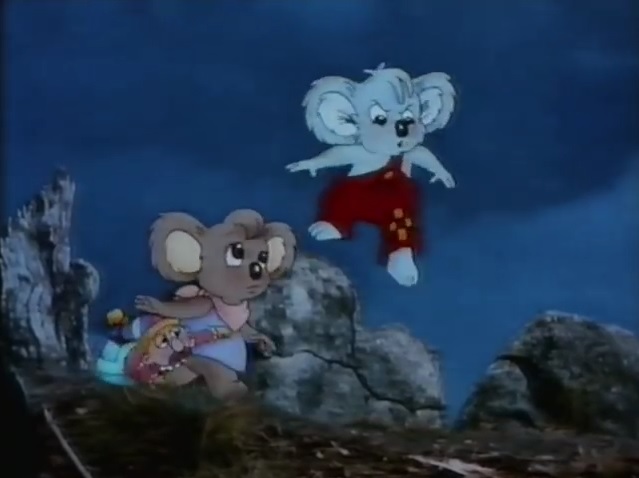
Flashback to 1992, and there were major changes in the air for the Australian animation squad at Yoram Gross Film Studio. To date, their legacy had been largely founded on a series of films chronicling the adventures of Dot, a heroic young girl with the ability to converse with animals, but the studio were thinking about retiring Dot (who received her final feature outing in 1994) and were eagerly in search of a new signature character to lead them toward the modern age of the approaching millennium. They found it in a fresh interpretation of Blinky Bill, a much-loved literary character created by New Zealand children's author Dorothy Wall, and a lucrative new animated franchise was swiftly born. A feature film, Blinky Bill: The Mischievous Koala, debuted in 1992 and was followed by a spin-off-TV series in 1993, which proved a smash hit not only on its native Australian soil but also in several European territories. The Adventures of Blinky Bill initially ran for two seasons between 1993 and 1995 but was given a new lease of life in 2004, when Yoram Gross, through a recently-formed partnership with German media company EM.TV (the same media company who also had The Muppets at one point in time), brought the series back for an additional season (somewhere in between, there were also unsuccessful efforts to give Flap, Blinky's platypus sidekick, his own spin-off series, but we're not talking about those today). The culmination of this revival was a Christmas special in 2005, Blinky Bill's White Christmas, which was directed by Guy Gross (son of the studio's eponymous founder) and would prove the last hurrah for the 2D incarnation of Blinky, before Yoram Gross Film Studio put him back into cold storage for a further decade and eventually rebooted him as a CG animation franchise in 2015.
Clocking in at just under 80 minutes, Blinky Bill's White Christmas was technically our second Blinky feature film, albeit made specially for television. How does it compare to The Mischievous Koala? When I reviewed that film earlier this year, I rated it as being fairly chaotic on the narrative front, what with its reliance on extensive and digressive flashback sequences, its insanely dragged out climax and its curiously abrupt ending, although I gave it strong enough marks for atmosphere and emotion. Blinky Bill's White Christmas beats its predecessor hands-down in terms of narrative consistency (White Christmas doesn't have an amazingly fleshed out story, but there's at least coherent progression from Point A to Point B), but in all other areas the 1992 feature has it licked. For one, White Christmas is nothing to write home about visually speaking. The Mischievous Koala utilised Gross's signature aerial imaging technique of superimposing animated characters onto live action backdrops, resulting in an ostensibly primitive look that's surprisingly effective at emphasising the innocence and fragility of its protagonists when stacked up against the big and tumultuous world. This was not exported into the 1993 TV series, which went with a more traditional painted background approach. By the time of the 2004 revival, the animation industry had changed significantly and a digital ink makeover was in order; as a result, the third season has a significantly altered, more vibrant and less detailed look that's difficult for me to comment on without betraying my personal preference for hand-painted cel animation. I need only glance at a frame from Season 3 and I feel over-stimulated by the immense amount of colour saturation going on. Compared to the garish simplicity of Season 3, White Christmas boasts some fairly detailed background imagery that's easier on the eye, but the mood and character of Blinky's earlier adventures is very much missed. On the plus side, original voice actors Robyn Moore and Keith Scott are still on board (with the additional voice talents of Sarah Aubrey and Shane Withington) and do as fine a job as ever.
Blinky Bill's White Christmas functions as the grand finale to The Adventures of Blinky Bill, although long-term fans of Gross's Blinky should note that two major characters from the TV series, Marcia the marsupial mouse and Shifty the dingo, are conspicuously absent here, but for a handful of very brief blink-and-you'll-miss-them cameos during the opening montage. This would be less galling if the special didn't also waste so much time with random incidental characters we've never met before and (this being the final bow for this incarnation of Blinky) won't ever see again. The main narrative arc sees Blinky and Flap travel to the fabled Wollemi forest in search of a rare pine tree, but there's also a superfluous subplot involving Miss Magpie's efforts to assemble a school choir from the talentless tykes she teaches, meaning we get lots of useless filler sequences with nobodies like Angela the possum, Johnny the weak-bladdered rabbit and Tim and Tom, bandicoot twins who trade identities on a daily basis. The purpose of this narrative thread, other than to pad White Christmas out to the full 80 minutes, feels as if it's to further impress the special's big musical centrepiece, "Christmas in Australia" by pop singer Christine Anu, onto the viewer. I can't find any evidence that the song received a proper commercial release, but the special's tendency to keep periodically emphasising its existence does have the air of an odious marketing ploy about it.
As Miss Magpie's shrill assembly of pint-sized choir animals are eager to inform us over and over, it's Christmas in Australia, and if you know nothing else about the Australian climate then know this - Australia is in the Southern Hemisphere, so over there Christmas occurs in peak summertime. The traditions and iconography of the Australian Christmas are still very heavily rooted in those of its European counterpart, however, so it is not at all uncommon for Aussies to exchange cards depicting wintry scenes and Santa Claus heavily clad in his Coca Cola-endorsed reds, right before they hit the beach for a glorious day of surfing and sunburn. Keeping in mind that Blinky had by now established a strong fanbase in Europe as well as Australia, I don't find it too far-fetched that the plot of the special was purposely designed with an eye toward bridging the gap between the sweltering Australian Christmas and the traditional European white one. Blinky picks up on the curiously discordant nature of the former when he asks Wombo, his elderly wombat mentor, why Santa would wear such a ridiculously bulky suit in the middle of summer. Wombo explains to Blinky that many of the holiday traditions with which they are familiar originate in the Northern Hemisphere, where Christmas is associated with cold and snow. Blinky finds the entire notion of a frosty Christmas to be very far-fetched at first, so Wombo shows him a home movie of a trip he made to Europe as a younger wombat, where he was able to experience one of their legendary white Christmases first-hand. During his visit, Wombo acquired a snowglobe, which he has cherished ever since, for looking upon it always reminds him of his glorious Christmas in the frozen North. The instant Wombo produced the snowglobe and explained very clearly what it meant to him, I had a sneaking suspicion that it was very unlikely to survive the special intact - the snowglobe looks extremely fragile, it's just received a wad of exposition and, let's face it, Blinky is a ticking time-bomb - and sure enough, it isn't long before Wombo's much-loved artifact is reduced to a shattered heap. Remorseful at having broken Wombo's snowglobe, Blinky decides that the only way he can possibly compensate is to recreate Wombo's white Christmas experience right there in Greenpatch. Blinky delegates the task of creating snowfall to Splodge the kangaroo and Nutsy the girl koala while he and Flap venture out into the wilderness in the hopes of bringing back another staple of the European Christmas, a decorated pine tree. Rumor has it that some rare specimens can be located in the distant Wollemi Forest, although said forest is also reputed to be home to a variety of fearsome prehistoric creatures, so most Greenpatch residents are smart enough give it a wide berth.
The antagonists of the special are a couple of professional "plant poachers" named Chopper and Sly, who also have their sights set on plundering the mysterious goodies of the Wollemi Forest. They might as well be Harry and Joe from the original film, and in fact they come across as versions of Harry and Joe that have been purposely watered down in order to appear less intimidating to younger viewers (not that Harry and Joe themselves made for particularly formidable foes during their climactic showdown with Blinky and his gang, but they were at least capable of dishing out destruction of truly cataclysmic proportions toward the start of the film). Chopper and Sly are easily my least favourite aspect of White Christmas, for their sequences are frankly even more of a chore to sit through than the aforementioned filler with Miss Magpie and her choir. If you read my review of The Mischievous Koala, you might recall me noting that Yoram Gross's take on Blinky Bill attracted some controversy for its negative portrayal of the woodchipping industry. The original feature was careful to cover itself with a disclaimer emphasising that its villains were into illegal woodchipping practices only, but I've found at least one source claiming that the Australian forest industry took offense when the lyrics "Save us from that woodchip mill!" were incorporated into the TV series' theme song. White Christmas plays things as safe as humanly possible, by giving Chopper and Sly an extensive amount of dialogue in which they plainly discuss the criminality of their own plant-harvesting actions, just so there's no confusion as to which subcategory of woodchipper Yoram Gross are condemning. Needless to say, Chopper and Sly's villainy is painted in very broad strokes, and they make for fairly unengaging antagonists, too on the nose in their misdeeds to have any kind of authenticity but also too dense and ineffectual to seem capable of causing any real harm. It doesn't help that they're a variation on the same stupid-little-skinny-guy-and-slighty-less-stupid-but-still-pretty-stupid-fat-guy schtick we've seen replicated hundreds of times in the wake of Laurel and Hardy.
Despite the 80 minute run time, there's not a whole lot actually happens in White Christmas. Blinky and Flap have various run-ins with Chopper and Sly and are eventually cornered in a cave, where they befriend a large wombat-like creature they name "Wol" (on the basis that that's the only thing he can seemingly say). Wol's species is never formally given, but he's a Diprotodon, a type of extinct giant burrowing marsupial related to the wombat (I know this, not because I'm amazing proficient in marsupial paleontology, but because Lobe once referenced the species in an episode of Freakazoid!). Wol, of course, is one of the prehistoric residents of the Wollemi Forest, but Blinky and Flap don't twig this right away. The most curious thing about Wol is that he wears a diaper, presumably as an easy shorthand to clue us in that he's only a baby, although later on when we actually get to the Wollemi Forest and meet the rest of its oddball menagerie they turn out to be largely non-anthropomorphic and are quite content to strut around in the nude, so...who among them forces Wol to wear a diaper for his modesty/convenience? Then again, we don't really get to spend a lot of time in the Wollemi itself. The obvious dilemma Blinky faces, as he finally reaches the forest, is whether or not it's ethical for him to cut down and make off with an endangered tree, even for something as ostensibly unselfish as a friend's Christmas celebrations. This is where the bulk of the special's drama lies, for we never sense that Chopper and Sly pose much of a threat to the forest (and indeed, Wol's father is quite capable of seeing unwanted encroachers off himself, without the aid of Blinky or Flap). It's here that White Christmas would really have benefited from a sprinkling of the trademark melancholia that ran rife throughout the Dot features and The Mischievous Koala, in order to convey a sense of the Wollemi Forest being something very special and vulnerable. As it is, the Wollemi is really just a bland forest populated by slightly odd-looking creatures who don't talk or wear clothes (Wol's mysterious diaper notwithstanding). Evidently, it's meant to be a place that time forgot, but not enough is done to instill it with its own unique atmosphere or mystique. In the end, Blinky decides that he cannot cut down one of the wollemi pines and risk destroying the homes of any of the forest's residents, but regrets not having anything to show for his troubles to Wombo...whereupon Wol gets him out of his spot by gifting him with a small potted wollemi seedling. A sweet gesture, although it does raise further questions, such as where did Wol even manage to get hold of that pot in the first place? Like his diaper, it somewhat undermines the implicit idea that that these creatures are meant to be untouched by civilisation, be it that of humans or anthropmorphic bush critters.
Overall, most of what I've had to say about White Christmas has probably sounded overwhelmingly negative, so I should emphasise that I don't dislike the special, I just don't think that it benefited in any shape or form from being dragged out to feature length. There's probably just enough plot here to fill out a standard 22 minute episode of the regular TV series. Trim off the subplot fat involving the choir animals and Splodge and Nutsy (whom we keep checking in on intermittently), along with any conversation between Sly and Chopper that goes on for more than five seconds, and you'd be left with a much slicker (although still unremarkable) product. At 80 minutes, White Christmas is a pleasant but soporific experience, one that will likely struggle to retain the interests of older viewers.
The juiciest aspect of Blinky Bill's White Christmas occurs in the last few seconds of the special, when it decides, quite out of the blue, to throw a genuine curiosity at us. Blinky and Flap return to Greenpatch with an additional souvenir in the form of Sly and Chopper's woodchipper (possibly a deliberate callback to Blinky and his gang hijacking Harry and Joe's vehicle at the end of the original film), to discover that Splodge and Nutsy's efforts to create genuine snowfall have all ended in failure. That's when Blinky hits upon the idea of creating a kind of faux snowfall by feeding the woodchipper old newspapers and sprinkling the cut up shreds of paper over Greenpatch like confetti (I was somewhat surprised that a special with such an explicitly eco-friendly story would go with a solution that's basically tantamount to littering, but so long as the residents of Greenpatch are prepared to chip in to clean it up afterward...). The outcome seems to satisfy Wombo, and the special ends with all of the animals gathered together beneath Blinky's paper storm, singing one last rendition of that infernal "Christmas in Australia" song. That's when we pan away to reveal that the entire scene is actually just something Blinky is observing inside a snowglobe, just before he turns to wish the viewer a merry Christmas. And that's how the 2D version of Yoram Gross's Blinky permanently signs off. I...have no idea what to make of that ending, but I instantly get flashbacks to another TV show that infamously opted to end with the inexplicable implication that the entire series was nothing more than an idle daydream going on inside the head of a child with a snowglobe fixation. Are we supposed to draw similar conclusions about Blinky Bill's entire canon? I don't know, but I'm happy to step back and let the fan theories commence.
Thursday, 17 May 2018
VHS Verve: Blinky Bill The Mischievous Koala (aka Save Us From That Woodchip Mill!)
Here at The Spirochaete Trail I've specialised in harvesting and devouring some of the most feel-bad animations ever to have graced this Earth, everything from casualty-riddled eco-serial The Animals of Farthing Wood to anti-nuke feature film When The Wind Blows to the mind-numbingly morbid adventures of Scruffy The Tuesday Dog. With that in mind, it was always only a matter of time before I brought up Yoram Gross, Australia's master of melancholy. Born in Poland in 1926 and being of Jewish heritage, Gross's formative years were spent locked in a daily battle to stay alive under the Nazi regime. Following the war Gross found employment in Israel as a cameraman, and in 1968 he immigrated to Sydney, Australia, where he and his wife Sandra Gross founded Yoram Gross Film Studio. The studio would become famous for the Dot films, a series of animated features produced between 1977 and 1994 about the adventures of a young girl who gets involved in the plights of various creatures in the Australian wilderness, notably a mother kangaroo on an impossible quest to be reunited with her abducted joey. In this article, published in 2011, Gross emphasises that he is fundamentally an optimist and that his positive spirit is reflected in his films, which impart messages about love, loyalty and pacifism being stronger forces than hate and war, although truth be told the Dot films are not exactly what you'd call mirthful viewing and I would not recommend them if you're not prepared to withstand a considerable amount of heartache. The first time I saw Dot and The Kangaroo I remember howling in anguish at the ending and wondering why on earth the bloody film had insisted on being so cruel to me. If you want to see a grown adult cry, then Dot and The Kangaroo is definitely one of the top titles you should consider showing them. It is, of course, entirely possible to convey a positive message while still having your audience bawl their eyes out at the end (that's what Watership Down manages to achieve, is it not?), but the Dot films certainly don't make bones about the sadness of life, championing its resilience while underlining its fragility, how filled it is with abrupt comings and goings and how often you don't have the chance to say your proper goodbyes. It was in Dot and The Kangaroo that Gross honed what would become his signature visual style, in pasting animated characters atop live action imagery.
In 1992 Dot's career was nearly at a close, and Gross was branching out with a new animated franchise featuring a very different breed of Australian hero - Blinky Bill, an anthropomorphic koala created by New Zealand-born children's author Dorothy Wall in 1933, whose adventures have been a staple for generations of Aussie children ever since. The Blinky Bill stories had previously formed the basis of a puppet-based series, The New Adventures of Blinky Bill, which ran from 1984 to 1987, but Blinky Bill: The Mischievous Koala was the merry marsupial's first ever feature film. In 1993 it was followed by an animated TV series, The Adventures of Blinky Bill, which served as a direct sequel to the events of the film. This ran for three seasons and was a big international success, raising the character's profile in several European markets. In 2005, Gross would revisit the character with a one-off seasonal special, Blinky Bill's White Christmas (written and directed by Gross's son, Guy Gross), and in 2015 Yoram Gross Film Studio (now rechristened Flying Bark Productions) retooled Blinky for the computer age, complete with a 3D animated reboot, Blinky Bill: The Movie, and spin-off TV series, The Wild Adventures of Blinky Bill. We'll get to the modern, all-new CG Blinky eventually, but for now I want to focus on the one that figured in my own childhood, and which has continued to haunt me ever since. In the UK, this film was released by BBC Video under the title Blinky Bill: The Movie, although for the purposes of this review I'll be sticking with the original Australian title.
The original Blinky Bill story by Dorothy Wall (Blinky Bill: The Quaint Little Australian) has its share of similarities with Beatrix Potter's The Tale of Peter Rabbit, in that each revolves around a feisty young creature who is cautioned to be wary of humans after his father falls victim to their murderous machinations. Like Peter, Blinky has a distaste for following rules and is soon lured by the temptations of a potentially hazardous human habitat - in his case a roadside food store owned by Miss Pym who, like Mr McGregor, has zero tolerance for any wildlife audacious enough to be stealing her wares. As with Peter, Blinky evades capture by his human nemesis, only to have to face the wrath of his frantic family once he's legged it safely home. A series of sequels followed, including one published in 1940 where Blinky became the mascot for the Australian Army (top that, Peter Rabbit), which was apparently toned down from its original form when Wall's publishers found the premise of Blinky straight-up joining the army to be a bit out there. Actually, reading through this biography of Wall, it seems that the world was tragically denied the full extent of her eccentricities, with most of her really weird and intriguing ideas ending up in the reject bin and the manuscripts being destroyed. That story about six skeletons going on a cruise and swapping houses - what sort of Faustian bargain to I have to make to go back in time and save it from the clutches of oblivion? Wouldn't you love it if there was an animated adaptation based on that set-up for me to be reviewing?
In Gross's film, Blinky Bill remains a free-spirited young koala who lives with his mother in the Australian bush community of Greenpatch (here, his ill-fated father is never brought up) and whose rebellious, Bart Simpson-esque demeanor makes him a natural adversary to disciplinarians in all their forms. When not undermining the pretensions of avian authority figures like the pompous Mayor Pelican and straight-laced schoolteacher Miss Magpie, Blinky enjoys clowning around with his friends, who include Splodge, a slow-witted but big-hearted kangaroo, Marcia, a pugnacious marsupial mouse, Flap, a lisping platypus, and Jacko, a loud-mouthed kookaburra. Blinky's world is turned upside down by the arrival of a reckless pair of tree-pillaging humans, Joe and Harry, whose insatiable appetite for timber devastates Greenpatch and forces the animal community into exile. Blinky is injured in the demolition and emerges from the wreckage an amnesiac, but is reminded of his identity with the help of a lonely young female koala, Nutsy, and resident sage Mr Wombat. After reconvening with the other animals, Blinky learns that his mother remains unaccounted for and, along with Nutsy, sets out on a perilous search and rescue mission, which takes them all the way to the human headquarters, the much-feared Woodchip Mill.
Blinky Bill: The Mischievous Koala reuses many of the themes from the Dot films (parents separated from their children, human encroachment of the natural world). It also incorporates Gross's characteristic style of juxtaposing animated characters with live action backgrounds; it goes without saying that the film's visual aesthetic is nowhere near as sophisticated as what Hollywood had recently pulled off with Who Framed Roger Rabbit, but then it isn't trying to be. Gross's technique isn't so much about wowing the viewer with its technical wizardry as creating a curious kind of visual poetry, with characters whose hand-drawn simplicity makes them seem all the more ingenuous and delicate against their real-world environs. You might recall that When The Wind Blows did something very similar, in having the two-dimensional Jim and Hilda move around a very plain and three-dimensional domestic setting, shortly before it was all flattened by a nuclear blast. In both cases, the effect is to create a sense of unreality and to paradoxically cause the characters' ill-fated worlds to appear all the more immediate and fragile. The sequences early on in the film with Blinky and his neighbours crawling out from beneath the rubble and staggering through the smoking remains of their erstwhile home, as masses of dark red clouds sweep overhead, have an undeniably haunting, almost apocalyptic quality, as if we've just witnessed the fall of an entire civilisation. Later on, when Blinky and Nutsy set out for the Woodchip Mill and have to cross a raging river, those cute little cartoon koalas do look awfully small and vulnerable out there in the big, dark, unforgiving world.
Gross's Blinky Bill adaptation was released in 1992, the same year as Kroyer Films' Ferngully: The Last Rainforest, another animated feature to base its pivotal conflict around the destruction of the Australian wilderness. The early 1990s was the time of the ecologically sensitive kids' cartoon, with a whole array of feature films (Ferngully, Once Upon A Forest) and TV shows (Captain Planet, Widget, Twinkle the Dream Being) dedicated to extolling the virtues of caring for the planet, and Blinky Bill was only too happy to climb aboard the bandwagon. Nowadays, of course, the environment has become such a heavily politicised issue that even more muted forms of environmental didacticism (eg: Pixar's Wall-E) tend to provoke instant knee-jerk reactions in some, and it goes without saying that if you prefer your cartoons to be entirely free of overtly green messages, then Blinky Bill is not the movie for you (my take: although valid criticisms could probably be made about the simplicity and heavy-handedness with which some of the aforementioned media present such messages, environmental consciousness is certainly not a quality that I would ever want to discourage in children). In Blinky Bill's case, the message is entirely in keeping with Wall's stories, which frequently express concern for the plight of koalas and other bush animals. Gross's film does notably go to lengths to emphasise that the environmental destruction depicted therein is the result specifically of illegal logging procedures - the dialogue between the human characters makes this clear, and if you stick around to the very end of the closing credits this is even reiterated through a handy disclaimer (nevertheless, it's my understanding that the spin-off TV series generated some controversy among the Australian timber industry when the lyrics "Save us from that Woodchip Mill!" were incorporated into the show's opening theme song - possibly because the context about it referring to illegal logging was removed).
With Ferngully and Disney's 1990 film The Rescuers Down Under, the early 90s was also a time when Hollywood animation underwent a short-lived infatuation with all things antipodean (which isn't terribly baffling when you consider how ravenously US audiences had eaten up the Crocodile Dundee films), although in reality neither film displays a whole lot of passion for Aussie culture, with the Australian wilderness serving merely as a backdrop to stories populated by characters with predominantly American accents (this is more conspicuous in Disney's film than in it is in Kroyer's). The authentically Australian Blinky Bill is an altogether humbler beast than its big-budget counterparts, lacking both the high energy spectacle of Disney's film and the cheesemongering glory of Kroyer's (say what you will about Ferngully, but it is fantastically entertaining), but reveling in the kind of adrift, haunting ambience that most Hollywood animation would never dream of. I'll also give praise to the vocal cast, which is as minuscule as such a cast can be, yet the range of voices they throw up is so diverse that the film never gets bogged down by the limitations of this. Virtually all of the voices are performed by only two actors, Robyn Moore (who voices Blinky and all of the female characters) and Keith Scott (who voices every male character sans Blinky), with a third cast member, Ross Higgins, chipping in as an unusual frog chorus for just one scene (see below).
Blinky Bill: The Mischievous Koala is not an amazingly narrative-driven film, which isn't unusual for Gross - the Dot films didn't have the tightest of stories either, in most cases consisting of Dot wandering around from Point A to Point Z and wagging chins with various Australian fauna - but for Blinky Bill the episodic plotting and lack of narrative focus does ultimately work against it, giving us a barebones story that's pulled around in all directions (incidentally, The Rescuers Down Under had a very similar problem - it's one of Disney's most adrenaline-fueled films, but good grief is the story all over the shop). As the film opens we're pretty much plonked directly into the action, with the humans advancing on Greenpatch and slicing the unfortunate forest to ribbons, before which we're afforded only a very fleeting opportunity to acquaint ourselves with any of its individual residents. This is followed by an extended flashback sequence as Wombat and Nutsy attempt to restore the amnesic Blinky's memory, which opens with an analogue to the characters' origins in The Quaint Little Australian, as Mrs Koala introduces her newborn baby to the rest of the community and toys with naming him Walter or Blue Gum before finally settling on Bill. This is a useful enough sequence for taking time out to establish who each of the main characters are, although the flashback as a whole goes on for well over twenty minutes and very quickly loses all sense of structure. Basically, it's a a series of short skits dedicated to proving over and over that Blinky is a handful and that his long-suffering mother is a saint for putting up with him. Blinky is seen ruffling various feathers around Greenpatch, before finally ending up in the roadside store where he has his infamous encounter with Miss Pym (side-note, but I kind of seriously detest Miss Pym's character design in the Yoram Gross adaptation, which is so ridiculously gangling that she doesn't resemble a human so much as a demonically-possessed spagbowl - I suppose this could have been a deliberate stylistic choice in order to play up the strange, alien quality of humankind to the bush creatures, but none of the other human characters in the film are anywhere near so unpleasant to look at). Really, I'm not sure whey they bothered to incorporate the Miss Pym arc into the movie at all, other than to pay homage to Wall's original story, for it has no bearing on anything that happens later on in the main Woodchip Mill arc. In fact, if you're unfamiliar with Wall's book then I suspect that you'll be confused as to who the heck this woman is and why we waste so much time hearing about her intense hatred for fluffy marsupials (in song form!). Then again, the first half of the film is full of these weird little interludes that have nothing much to do with anything. For example, there's a barbershop quartet number performed by frogs. For some reason. Another involves Bobbin, a pommie rabbit who sings about the joys of football and procreation in a short musical sequence that serves no purpose other than to make a point about the non-indigenous rabbit's tendency to reproduce at a faster rate than the Australian outback can handle. Actually, I do like Bobbin's sardonic personality and I'm glad that the sequence is there.
Once Blinky and Nutsy have made it to the Woodchip Mill and the central conflict with the loggers kicks into gear, the film sets up a whole new arc involving a very different kind of human - Claire, Harry's young daughter, who spends her days at the Woodchip Mill and is blatantly starved for companionship. When Nusty is pursued by the mill's guard dogs, Bruno and Hilda, and forced to take refuge in Claire's bedroom, Claire seizes the opportunity to adopt the frightened koala as her pet. The whole deal with Claire is frankly a bit odd, as it's not overly clear how we're supposed to respond to her character. On the one hand, she's the only human in the entire film who doesn't exhibit a contemptuous attitude toward animal life and, in that light, she plainly represents the next generation, whom the film hopes will do a better job at caring for the planet than their parents. On the other hand, and despite her benign intentions, Claire isn't exactly the good guy in this equation either, given that she's set on removing a wild animal from its natural habitat and holding it in captivity; there's a scene where Claire introduces Nutsy to her less-than-tickled family, who take an uncharacteristically responsible attitude in suggesting that the breakfast table perhaps isn't the most appropriate environment for a bush animal like a koala. Then again, the film never takes the time to establish how Nutsy actually feels about her human captor. I notice that she isn't kicking and screaming with terror whenever Claire holds her near, but she likewise doesn't think twice about ditching her later on when Blinky shows up to return her to the bush. There's definitely room for pathos with Claire's character (her family don't seem to understand her much and there are no other children in sight, so it's obvious that her desire to latch onto Nutsy is born of extreme loneliness) but the film never develops her, nor attempts to build up any kind of bond between her and Nutsy. In the end, Claire is just another obstacle for Blinky and his mates to overcome. They figure that Nutsy falling in with humans is bad news as they suspect it will end with the humans stuffing Nutsy with cotton wool and selling her to tourists (by that, I'm not sure if they're talking about actual taxidermy or of they've conflated taxidermy with plush toy manufacture). Once Nutsy is captured, the focus shifts onto rescuing her and the whereabouts of Blinky's mother are brushed aside until the very end. Blinky rallies reinforcements in the form of Splodge, Marcia, Flap and Jacko and returns to the mill, where he faces off against the dogs and humans in an extended climax that's very chaotic and could have done with some considerable trimming. A tighter climax and more time devoted to building Claire's character probably would have gone some way toward fixing the narrative problems in the latter half of the film. As it is, the climax really is just a drawn-out parade of the adult humans screwing up at every opportunity. Despite the devastation they unleashed at the beginning of the film, when they're not behind the wheels of their logging trucks Harry and his crew are far too bumbling and uncoordinated to pose that much of a threat. They have shotguns which they brandish a lot, but they can't seem to shoot straight, or even keep themselves upright for that matter. They're such a blunderous bunch that even Blinky can't harbour too great a grudge against them, in fact. There's a moment during the confrontation where Harry takes a tumble into a vat of water and Blinky temporarily drops the animosity to implore the klutzy human to swim to safety.
Blinky Bill ends rather abruptly; once Blinky and Nutsy are reunited the film suddenly seems to recall that, oh yeah, the entire point of going to the mill in the first place was to look for Blinky's mother, so they have her show up suddenly out of the blue, and it's all good. I suppose the abruptness of the ending could be attributed to the fact that that they were setting up for a TV series and so an airtight conclusion wasn't a priority (a number of loose threads that are left dangling at the end of the film, like how the residents of Greenpatch are to rebuild their community and the whereabouts of Nutsy's family, were subsequently addressed in the series). The film attempts to wrap things up on a melancholic note with regard to Claire, one which I suspect was deliberately looking to evoke the same poignancy of the aforementioned ending to Dot and The Kangaroo. They both have similar subtexts about wild animals needing to remain free and how any attempts on our part to box them in and contain them for our own purposes, however benevolent, will inevitably destroy the untamed qualities that make them so alluring in the first place. It doesn't have quite the same impact here, possibly because the animals in Blinky Bill are a lot more anthropomorphised than the ones in Dot and The Kangaroo - they wear clothes and go to school and such, so there isn't as big a gulf between their world and the humans' - but mainly because we're never able to get to be all that invested in Claire as a character. Blinky Bill doesn't "earn" its tearjerker ending as Dot and The Kangaroo does, although it gets it anyway thanks to that infernal song they play during the closing credits ("You and Me" by Robyn Dunne, Geoff Robertson and Kevin Bennett). It's not the kind of endnote that'll crawl under your skin and nibble away at you for days on end, as Dot and The Kangaroo will, but I'd be lying if I said that the final sequence of Blinky and his friends making their ultimate bid for freedom doesn't give me the chills.
The Verdict:
Despite its messy, undisciplined narrative (which never manages to find a balance between tipping the hat to Wall's original books and laying the ground for the upcoming TV series), Blinky Bill: The Mischievous Koala still succeeds in pulling hard upon the heartstrings, thanks to just how beautifully it conveys the vulnerability of its central characters, and that sense of vulnerability proves indispensable in keeping the viewer invested for the full 90 minutes. I have compared it unfavourably to Dot and The Kangaroo a few times, and that's definitely the film to track down if you're seeking an absolute classic in Australian animation, but Blinky Bill is still worth a gander. Besides, you kind of have to start here if you intend to delve into the aforementioned TV series - which is what you can expect to see on these pages in due course.
PS: There is an odd moment in the film when Blinky boasts to a family of frogs that he's "taught elephants to croak". Obviously Blinky's a liar, but this line stuck in my craw nevertheless because logically speaking Blinky shouldn't know what elephants are. There are no elephants in the Australian bush. However, thinking back, Wall's original story does contain a line about Blinky observing that Miss Pym's footsteps sounded like those of an elephant, so maybe they were just paying homage to her rather questionable choice of simile. Elephants in the outback? Whatever next?
Subscribe to:
Posts (Atom)