Showing posts with label national film board of canada. Show all posts

Thursday, 13 March 2025

Bob's Birthday (aka In Ourselves Are Triumph and Defeat)

Even at a relatively brief 12 minutes, Bob's Birthday, the 1993 animation from British-Canadian husband and wife team Alison Snowden and David Fine, is a slow burn. The short, a co-production from Channel 4 and the National Film Board of Canada, centres on Bob Fish (Andy Hamilton), a neurotic dentist turning 40, and the efforts of his forbearing wife Margaret (Snowden) to throw him a surprise party, under the pretence that they'll be dining out at an Indian restaurant come the evening. Bob, though, isn't feeling the occasion and is in the midst of a mid-life crisis. The narrative highlight is when, having arrived at the house with no inkling of Margaret's actual intentions, he proceeds to strut into the living room with his genitalia on full display, and to fire off a string of damning remarks about the friends and associates who, unbeknownst to him, are hiding behind the furniture. But that doesn't occur until seven minutes in. Before then, we get an extensive build-up in which Margaret's innocent party preparations are contrasted, uneasily, with Bob's drab day at the dental surgery, and his wandering eye for his young and oblivious secretary, Penny. Bob is not a particularly sympathetic character. Much of his malaise about the onset of middle age seems to revolve around his cold dissatisfaction with his life with Margaret, all while we're seeing the evidence of Margaret's sweetness and devotion to Bob in plain sight. There is, though, something achingly human about his prosaic predicament. Snowden and Fine's short was to resonate with audiences, winning the Academy Award for Best Animated Short in 1995, and later inspiring a spin-off series, Bob and Margaret,  which rain from 1998 to 2001.

Bob's Birthday is a poignant, particularly sour-toned trouble in paradise tale with a sprinkling of strange and grotesque touches - right from the very first scene, in which a severed foot visible upon the kitchen floor is quickly revealed to be a squeaky dog toy. Bob, who has dedicated his career to the preservation of oral hygiene, lives in a world that is markedly unhygienic, with all kinds of uncomfortable realities simmering below its proverbial gum-line. The aphid infestation that is slowly devouring the plants in the dental surgery is a visual indicator of the emotional ugliness of which Bob, until his climactic blow-up, prefers not to talk, as is the ornamental doll gifted to him by a patient, revealed to be a kitschy toilet roll holder, and the criminal activity happening both on the street outside Bob and Margaret's abode (Margaret doesn't seem to notice the thief who casually breaks a car window and makes off with its radio) and within their living room (one of their guests pockets the spare change she fishes out from behind the sofa cushion). The surgery's aphid problem also juxtaposes comically with the script's various allusions to gardens as symbols of vitality. Bob listens to a radio announcer (voiced by Harry Enfield, and sounding distinctly like a more sedate Dave Nice), who introduces a discussion on middle age with a clunky metaphor about seasons in the gardening calendar. The greenery with which Bob has surrounded himself (the reflections of his own metaphorical garden), is ailing, potted and confined to a coldly clinical environment in which they have little hope of thriving. In his longing for Penny, Bob recites Thomas Campion's Renaissance love song, "There is a Garden In Her Face", while Penny is shown tending to one of the infested plants; the plant's continued degradation in her care (by the final shot in the dental surgery, we see that it only has one leaf remaining) a sure sign that his yearning is unlikely to heal his inner turmoil. His work offers him no solace. One patient merely feeds his existential fears, by citing an American study claiming that dentists have a particularly high rate of suicide. Another, despite her tasteless choice of birthday present, seems more benevolent in her musings. Her suggestion that 40 should be seen as a new beginning, with one having had ample opportunity to learn from the foolishness of their youth, is swiftly undermined by Bob's immediate instinct, on arriving home, to engage in a whole new bout of foolishness, behind what he naively believes to be closed doors.

Bob's Birthday offers a humorous look at the existential despairs associated with ageing (Snowden and Fine were themselves closer to 30 when they made the film, and apparently already feeling the pinch of their impending middle age), but its sharpest insights are in the moments which create a broader portrait of loneliness, accentuating the mutual solitude of both Bob and Margaret, and the obvious disconnect that has crept into their marriage. The futility of Margaret's party preparations is echoed in the adjacent tussle between the couple's two dogs (whom, it later appears to occur to Bob, were taken in as substitutes for having children) for a football, which leaves both parties locked in a stalemate for the duration of the short. Bob's professed desire to have children with Margaret seems at odds with his interest in an extra-marital affair, reading less like an attempt to reaffirm their union than a further, desperate expression of his fear of ending up alone. Bob is so overwhelmed by the prospect of oblivion in his future that he's unable to recognise the care he is evidently receiving from Margaret in the present, and his own failure to return it. His disparagement of his wife, and his unwitting sabotage of the party she'd planned, amount to a cruel rejection of that care, pushing Margaret into a more subdued existential crisis, in which she contemplates her own ageing, vulnerable form and the lack of love in her life (can she count on Bob to take care of her?). Her predisposition to always nurture the pathetic Bob nevertheless seems to transcend the emotional bruising she endures; she eventually returns downstairs and tenderly hands him a pair of trousers, which Bob obligingly receives.

Bob's journey can be seen as following the familiar trajectory of the five stages of grief. The earlier scenes in the dental surgery are all about denial. His silent desiring of Penny, who's never hinted to reciprocate his interests, amounts to a hollow attempt at escapism from his middle-aged discontent, while his sterile interactions with his patients offer him little recourse for an emotional outlet. When Bob gets home, his anger suddenly becomes manifest in the gruesome outburst in which, in an act of overcompensation for his own roving fancies, he coldly advises Margaret to find herself a new partner. He denounces all of their friends as boring, before sinking into a mournful rumination about how the only people they ever cared for, Ted and Elaine, have since deserted them for Australia (his evident attraction to Elaine indicates that Penny wasn't the first occasion in which he's contemplated infidelity to Margaret). He reaches his bargaining stage when he searches for an answer to his problem. Should he and Margaret have children? Would he be more attractive if he exercised more or went on a diet? Finally, he embraces Margaret and appears to have achieved acceptance. Suddenly he seems very upbeat and optimistic about the restaurant dinner he believes is awaiting them, insisting that he's been looking forward to it all day, despite his earlier reservations that curry was too spicy for his palate.


This takes us into the short's ambivalent ending, in which Bob goes out to start the car, and Margaret takes the birthday cake she'd prepared earlier and follows him, abandoning the thwarted party and leaving her friends in the darkness. Meanwhile, Bob proclaims his newfound acceptance of middle age by reciting the final lines of Henry Wadsworth Longfellow's "The Poets" ("Not in the clamor of the crowded street, Not in the shouts and plaudits of the throng, But in ourselves are triumph and defeat"), and is seen to unlock the car door for Margaret, freeing the way for her to join him in wherever life will take him next. We might question why Margaret chooses to ignore the party guests at the end. Is she too embarrassed to face them? Is this some futile attempt to sweep those pervasive uncomfortable realities back under the rug, by pretending they were never there? Or does it represent her own rejection of the social connections that, as per Bob's accusations, Margaret despises as much as he does? (The rather emphatic slamming of the door might imply the latter). Either way, it is obviously a bit fanciful to suppose that they won't have to face the music sooner or later. They're going to have to come back home eventually (for one thing, their dogs are there) and, whether or not the guests will be waiting or will have found their own way out, this is the world they'll still have to live in. Perhaps we feel a mite bad for the guests, with whom we don't really spend enough time to assess if they are as bad as Bob claims. For the most part their transgressions seem to be quite low-key. We've got the penny-pincher who pockets coins from behind the sofa, and another who spills a drink on the carpet despite Margaret's request that they leave it unstained. Bob repeats some rumor he's heard about one guest, Barbara, who is a "wild card" behind the back of her husband Brian. Otherwise, their biggest sin, according to Bob, is simply being dull. He could be right - as we first enter the party, some of the guests are having a rather vapid conversation about basil and mozzarella. All the same, we're not given enough information to see their friends as the real problem. Bob is plainly his own worst enemy (something his citation of Wadsworth Longfellow appears to acknowledge), but by embracing Margaret (physically and emotionally) he seems to find his way toward redemption. Margaret, meanwhile, throws her lot in with Bob, concession that, in the end, all they fundamentally have is one another.

There is, though, another problem. Bob remarks how prudent it was that they booked their restaurant table in advance, as being a Friday night, they can expect it to be busy. But of course Margaret hasn't. She never intended to go to the restaurant, which was just a decoy to disguise her actual intentions. They're going to have to take their chances. Maybe they'll get lucky and get a table anyway, maybe they'll have to drive around all night looking for a place that can take them (in which case Margaret is going to have to admit to Bob that she lied about making the booking). What lies behind them is a lot of awkwardness and angst that's bound to rear its head again somewhere down the line. What lies ahead of them, tonight and on every night to follow, is uncertain. By the end, Bob and Margaret have each resigned themselves to that particular fate.

Thursday, 6 July 2023

The Garden of Écos (aka After The Gold Rush)

The hardest thing about entering into Co Hoedeman's 1997 film The Garden of Écos is the intuitive understanding, straight off the bat, that the titular paradise is not fated to last. The title, recalling the Garden of Eden, already seems telling enough, but there is something so intricate, so beautifully-realised and, above all, so guileless about Hoedeman's paper-crafted world that makes it instantly ripe for destruction. The Dutch-Canadian animator, who is best known for his Academy Award-winning 1977 short The Sand Castle, has here created something that seems at once vibrant and deeply nostalgic. The colours, the lighting and the movements of the characters are beyond resplendent; the garden feels alive and meticulously constructed as a functional ecosystem, while also being evocative of some bygone childhood dreamland, one that was always destined to fade into the stuff of faint memory the second the outside world crept in. The Garden of Écos is on one level an ecological parable, dealing with the mismanagement of natural resources and illustrating how the breakdown of one thread of the web of life can have catastrophic consequences all over. On another level it is an anti-warfare narrative, showing what happens when co-operation is displaced by conflict as an overriding value. The common teaching is that, without recognition of the interconnectivity of all things, and our dependency on a shared environment, none of us can hope to survive.

The opening two minutes depict how a typical diurnal cycle plays out in the titular garden, focussing on the various animal lifeforms that populate it and the niches they've carved out within. Many are visibly based on real-world animals, the most prominent being a family of sheep-like quadropeds, including a parent and child who function as the emotional nexus of the narrative. Other lifeforms have a surreal or fantastical twist that reinforces the intersection between familiar ecology and playful fantasy. One critter looks like a mishmash between a flightless owl and an animate cloak; another is spherical, resembling a kind of terrestrial sea urchin with a brood of sprightly golf balls constantly in tow. Hoedeman takes time to carefully establish the distinctive ways in which each of these species interacts with their environs and with one another, imbuing them with a character and vitality that is immediately endearing. Even the ones that lack obvious facial features, such as the spherical beings, are able to convey such life and personality as to engender the viewer's empathy, eg: when we see two of the smaller spheres hesitating before travelling down a ledge.

Even at its most pristine, Écos is not exactly symmetrical with Eden. Death is never entirely absent from the garden, it being a daily reality that some of its inhabitants prey on others. The buzzing yellow insects that emerge from their hive every dusk form a vital food source for a species of winged nocturnal beings that behave like bats but make distinctive bird-like calls. Meanwhile, the baby spheres are picked off by green snakes that camouflage themselves in the grasses, yet even the presence of animals who survive by devouring another's young do little to negate the overwhelming sense of peaceful equilibrium that characterises those earlier moments. There is, above all, an overarching cooperative spirit that seems to permeate the garden at all corners, even among those predatory beings - one of the snakes, upon catching a young sphere, is seen to feed it to its companion. From the start, we are primed to feel an intuitive respect for each creature's role within the scheme of things.

The inevitable upset to this balance arrives in the form of a swarm of creatures resembling something between a caterpillar and a crustacean (for simplicity's sake I'll just refer to them as "shrimps"), who raid the garden while most of its residents are sleeping and ravage the flowers on which the sheep depend. What immediately marks the shrimps out as outsiders to the garden's ethos is that they do not share in its community spirit; their tendency toward coaction does not extend beyond their own kind, and they exhibit no awareness of the bigger picture. In contrast to the sheep, who take only as much from the flowers as they need, the shrimps pick massive quantities and hoard the buds away inside a cave - the same cave in which the nocturnal avians roost during the daylight hours - for purely their own usage. Their wastefulness wreaks grisly consequences when the stockpile of picked buds begins to decompose en masse, unleashing lethal gases into the cave and poisoning the nocturnal birds. Obviously, these shrimps are a swarming disaster zone. Yet Hoedeman makes the curious but effective choice of choosing to portray the intruders, who on paper should represent the absolute worst of an unchecked culture of excess and consumption at its most rapaciously catastrophic, seem less malevolent than they do incompetent and out of their depth in a world that's clearly much bigger than their comprehension. For the purposes of this story, it is important that they come across as as fundamentally little and vulnerable as everything else in Hoedeman's world and that, much like the garden residents, all that they basically want to do is to survive (honestly, they're probably the cutest lifeforms in the picture). When the locals finally resolve to get violent with the raiders, the results are harrowing and in no way cathartic. The most disturbing aspect of the narrative trajectory is that the cooperative spirit that defines Écos, while in some respects fortified by the shrimps' invasion, does not, ultimately, prove redemptive. As a team, they remain united to the finish, yet it is their willingness to cast the shrimps as enemies and make the us and them division that proves most lethal to their garden's vitality. Écos is a tale of poisoning and how it pervades and corrupts a formerly pristine paradise, and that poisoning takes multiple different forms.


The native critters attempt to weather the hardship as a community, by gathering together the ravaged flowers, while one of the owls tries (unsuccessfully) to carry some of the poisoned birds to safety. And yet even they are not immune to the same kind of short-sightedness that facilitates the shrimps' ravenous consumption, by not considering the wider-ranging impacts of some of their own actions. Without the nocturnal birds to control their population, the buzzing insects multiply and become a nuisance to the other creatures. One of the owls discovers that squeezing a type of flower will disperse toxins into the atmosphere that kill the bugs, a seemingly resourceful innovation it shares with its neighbours, which merely furthers the proliferation of poisons around the garden. The toxins that now scatter the ground prove just as lethal to the spherical creatures, in turn rendering them inedible to the snakes. Obviously, this is analogous to the use of pesticides and their potentially catastrophic impact on the wider environment, while also symbolising the seed of animosity as it spreads its corruptive influence, finally prompting the once-peaceful garden inhabitants to declare full-blown war upon the shrimps (they do not seem naturally hardwired toward violence, their first instinct being to flee rather than fight, although they rise to the challenge when prompted), rather than attempt to reach a more amicable solution. As a survival tactic, it proves as bogus as their measure taken against the insect population, culminating in a tragedy so terrible that it stops both sides in their tracks.

The hardest thing about exiting Hoedeman's film is the deliberate lack of resolution. The dispute between the garden inhabitants and the invasive shrimps, not to mention the broader ecological problems caused by the introduction of the various toxins into the garden, remains unsolved by the fade-out. For a fleeting moment, we are teased with the possibility of peace, with all parties united in their recognition of the devastation their joint hostility has brought about. The shrimps seem as concerned by the young sheep's death as the garden's denizens; while two of them were responsible for pushing down the boulder that killed the young sheep, it looked to me like they were attempting to help the friend a snake had cornered on a lower ledge, and it is evident that the young sheep was not their intended target. That final wide shot, showing all of the survivors coming together to gaze upon the body of the crushed sheep, provides the one moment in which the sense of community that previously enabled Écos to thrive seems to extend across all barriers; neither side wanted it to end with this. The possibility of understanding is there, but alas, Hoedeman insists that it is not realised. The garden inhabitants, upon noticing the shrimps attempting to participate in the mourning process, angrily turn on them and force them to retreat, definitively denying them a place within their order. Whether the garden has seen the last of these interlopers remains up in the air, but there is no feeling of victory in their closing expulsion. The point of no return has already been crossed, with the death of the young sheep indicating the termination of any last hope of recovery, both for the garden and its inhabitants. The fallen youngster, a symbol both of innocence and of the incoming generation stifled by the shaky decisions of its elders, has been extinguished by a toxin of a different nature, one that both sides are fully culpable in proliferating through their mutual inability to share resources and see eye-to-eye. The residents of Écos have compromised themselves, and even if life within their garden is able to continue on in some form, the gentle guilelessness that once pervaded the land seems irrecoverable. Death had always existed in Écos, but by the end it has truly come to signify the snuffing out of life, and not the process by which life perpetuates itself.

Saturday, 27 August 2016

The Big Snit (1985)


When it comes to animation depicting the horrors of nuclear war from the perspective of a married couple who are seemingly unaware of the depth and the direness of their situation, Richard Condie's tragi-comic short The Big Snit is probably the second most famous of its kind, surpassed only by Jimmy T. Murakami's 1986 feature adaptation of Raymond Briggs' graphic novel When The Wind Blows.  Both films are intensely heart-breaking, although Condie's short approaches the subject with a decidedly playful, off-the-wall lunacy which contrasts with the sombre realism of Murakami's haunting masterpiece. 

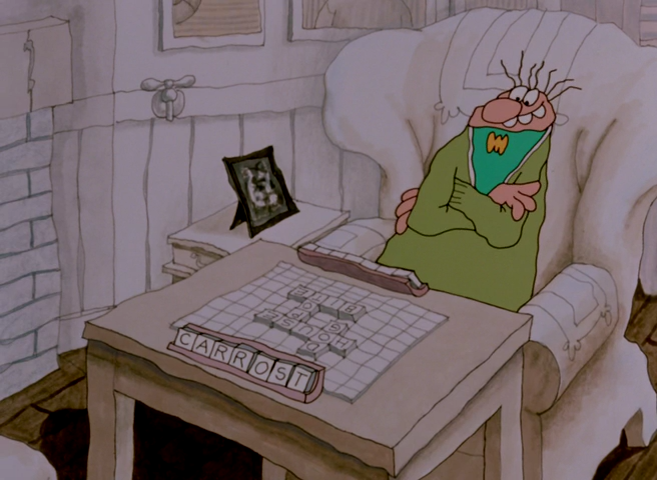
Produced by the National Film Board of Canada in 1985, The Big Snit is also a strong contender for the most celebrated animated short of all-time upon the subject of nuclear devastation, rivaled only the 1956 film A Short Vision by husband and wife team Peter and Joan Foldes.  Acclaimed upon release, it went on to win a multitude of awards, including the Hiroshima Prize at the Hiroshima International Film Festival in 1985, and was nominated for Best Animated Short Film at the 58th Academy Awards in 1986 but lost out to Børge Ring's Anna and Bella.  In addition, Matt Groening has cited the film as the inspiration for the opening scene to The Simpsons episode "Bart The Genius"; in both cases, various character quirks and relationship dynamics are established through a particularly agonising game of scrabble.

The Big Snit sees the impending threat of nuclear war played against the petty squabbles of an anonymous suburban couple who have had their momentary fill of one another's company (cleverly, the title does not make it clear to which "snit" it is referring, although as the short progresses there can be no question as to which of the two conflicts best commands our attention and emotional investment).  The wife's habit of detaching her eyeballs from her body and shaking them in order to align her pupils is irritating the snot out of her husband, who in turn has a tendency to saw compulsively at household furniture.  He's also not above a bit of foul play in his tactics on the scrabble board.  The initial tension between the couple is established entirely through understated means - awkward silences, rattling eyeballs, the futile rearranging of scrabble tiles - to the extent that we're over a minute and a half into the short before any actual dialogue is heard.  Having reached an impasse with their game of scrabble, the two decide to take a breather - the wife in order to hoover around the bathroom, and the husband to indulge in a guilty pleasure by watching his favourite show, Sawing For Teens.  By the time they return to their game, tensions have merely escalated (not helped by the husband's attempt to take a stealthy peak at his wife's scrabble tiles), with the husband finally reducing his wife to tears by making one angry accusation about her eyeball rattling habit too many.

Due to their absorption in their personal woes, and to their mishap-prone cat gnawing through the television power cord, they miss an emergency broadcast warning that a nuclear missile is headed in their direction and remain largely oblivious to the intense state of panic that has gripped the world outside (the husband becomes aware of it at one point, but can only conclude that a parade is taking place).  The manner in which the film balances the (mostly) quiet, understated world inside the house with momentary glimpses of the apocalyptic insanity unfolding beyond it is perfect, underscoring the self-contained nature of the couple's conflict and creating a sense in which the fears and concerns of the outside seem ridiculous and insignificant compared to this latest strain on their relationship.  Condie's eye for quirky details is also a delight (among the figures attempting to flee nuclear apocalypse are Santa Claus, a chicken driving a "Palace of Poultry" van and Noah with an ark full of animals).  The banality of the couple's spat is flavoured with a wonderful dash of absurdity which perfectly encapsulates the capriciousness from which everyday conflicts originate and escalate.  And yet this conflict is also treated with a degree of tension and humanity which is totally lacking in the mindless panic outside.  Our assumptions that the couple might be able to put their problems into perspective if they understood the bigger picture are completely subverted - in the build-up to the nuclear blast, the outside world is treated as little more than an intrusive distraction which the couple are fortunately able to keep at bay.  The panic from the impending catastrophe is played almost entirely for laughs - even the initial announcement has a distinctly humourous edge, what with the newscaster taking the form of a decaying skeleton, the ludicrous advice (eg: to take cover beneath a refrigerator) and the language of the warning finally merging with that of an airline announcement; gags which nevertheless underscore the overwhelming futility of the situation.

The Big Snit takes an immensely touching turn in its climax, with the husband looking to make amends with his tearful wife by playing to her on an accordion, a symbol from the early days of their relationship which serves as a wordless reaffirmation of their enduring bond.  During the accordion performance and the couple's subsequent reconciliation the commotion outside is completely tuned out, as if anything beyond it ceases to matter.  Only when the cat, apparently having had enough of being on the receiving end of so many accidents, motions to be let outside and the husband dutifully reaches for the door knob, does the chaos of the outside world finally permeate the internal world of the household, a few rumbles and an ominous white glow seen through the keyhole indicating that the nuclear missile has landed.

The ending of the short, in which the couple find a newfound enthusiasm for life (ironically after dying) and decide to return to their game of scrabble, apparently oblivious to the fact that the world has just ended, is a real tearjerker, on a par with Jim and Hilda's final fate in When The Wind Blows, although once again there couldn't be more of a contrast in terms of how the two films handle what are essentially very similar conclusions.  By the end of When The Wind Blows, Jim and Hilda are no longer blind to the reality of their situation, although neither wants to admit this to the other (particularly Jim, who struggles to maintain his façade of optimism to the finish), and as both of them retreat feebly into their paper sacks, they now seem quite resigned to the inevitable.  The nameless couple of The Big Snit, meanwhile, are ultimately impervious to any significant changes in the outside world, to the extent that they can step out into an ethereal Heaven and care only about getting back to their shared experience over a game of scrabble.  Much as the impending global catastrophe has provided little more than the backdrop to the much more pressing issue as to whether or not this couple are able to overcome a frivolous butting of heads, so too their renewed bond and devotion to one another proves so overpowering that it transcends the horror of the situation.  In that sense, it is a triumphant story about basic humanity rising above the forces of chaos and indifference that threaten to destroy it.

Like When The Wind Blows, The Big Snit focuses extensively upon a single couple in order to emphasise the individual lives affected by global affairs, and in the process reflects much upon what it is to be human, from the individual quirks and habits which can sporadically cause us to lose patience with those closest to us, to the various smaller, everyday pleasures which ultimately make life endurable when so much else lies beyond our control.  It is over an entirely frivolous game of scrabble that the occurrences causing the disagreement between the couple are set into motion, and in the same entirely frivolous game of scrabble that the couple find the promise of a new day (albeit no longer in this world), having decided that whatever minor disputes or grievances they might have are simply not worth it in the end.


Availability: Watch The Big Snit on the National Film Board of Canada's website: http://www.nfb.ca/film/big_snit/